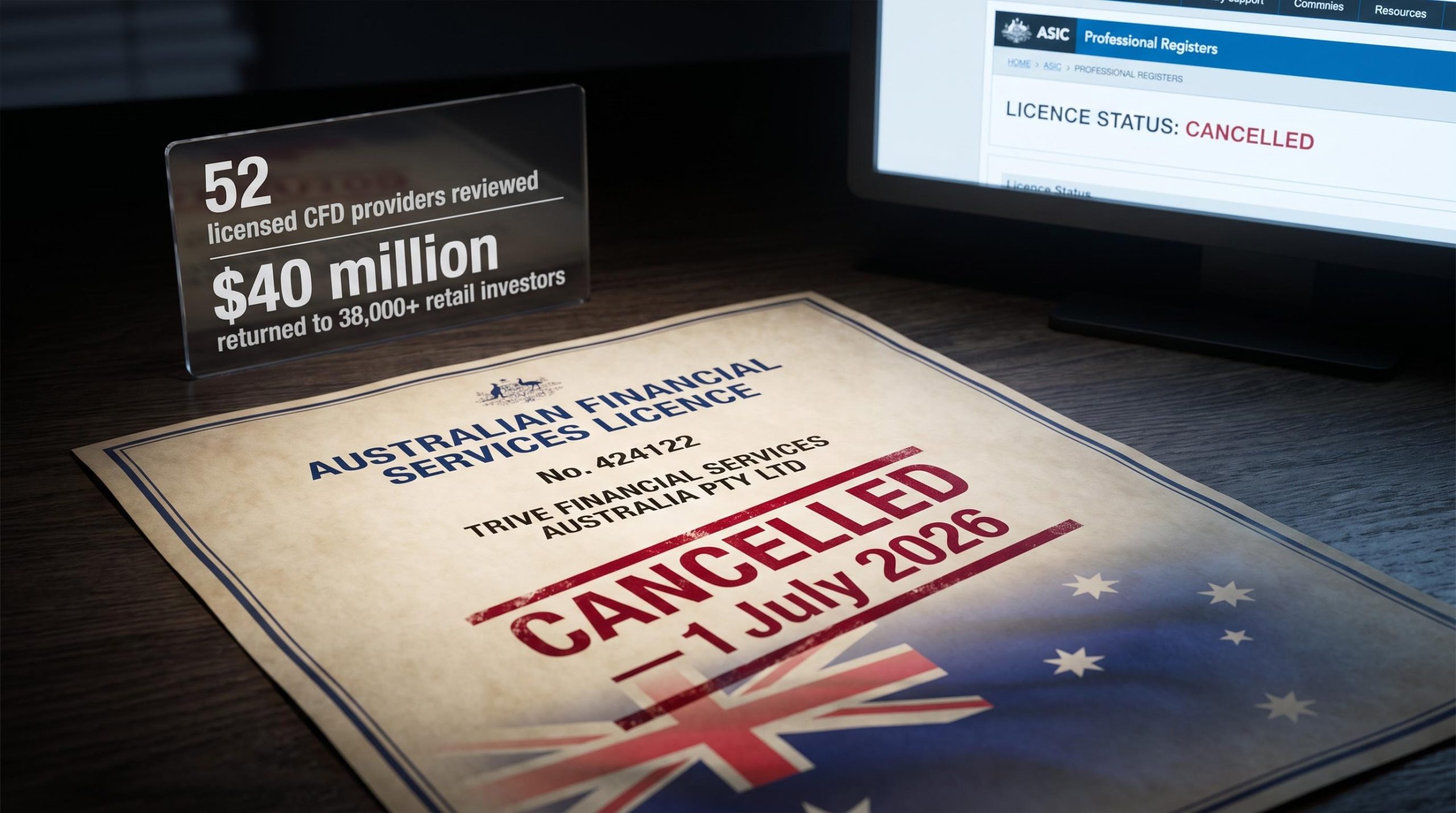
ASIC has revoked the Australian Financial Services (AFS) licence of Trive Financial Services Australia Pty Ltd, with the cancellation taking effect on 1 July 2026, ending the CFD provider’s presence in the licensed market after a wind-down that had been underway for more than a year. Clients who held accounts with the firm now need to confirm the status of their funds and understand their options.
The events leading to this outcome trace back to a broad regulatory examination involving 52 licensed CFD providers. Within that review, operational shortcomings at Trive were identified, and the firm voluntarily ceased accepting new clients from April 2025. The business effectively ceased providing financial services in Australia after that point.
Here is what the cancellation means for existing clients who need to act, and what the Trive case tells you about how ASIC is reshaping regulatory expectations across the CFD market.
How Trive’s AFS licence came to be cancelled
The timeline matters here, because the 1 July 2026 cancellation date does not tell the full story. The practical exit happened more than a year earlier.
As part of its broader examination of CFD providers, ASIC found material shortcomings in aspects of Trive’s operating practices. Trive’s response was to agree voluntarily to cease taking on new clients from April 2025, after which the firm wound down its Australian financial services activity. After that halt, the firm effectively stopped carrying on a financial services business in Australia.
The grounds for cancellation were found in section 915B(3)(a) of the Corporations Act 2001, which gives ASIC the power to remove a licence where a holder is no longer actively conducting a financial services business. No separate fine, ban, or misconduct finding was imposed. The cancellation formalised a business that had already stopped operating, rather than punishing one that was still active.
Section 915B(3)(a) operates as a mandatory cancellation ground rather than a discretionary power, meaning that once ASIC is satisfied a licensee has ceased operating, it must remove the licence regardless of whether any misconduct occurred.
Legal basis: Under s915B(3)(a) of the Corporations Act 2001, ASIC holds the power to remove a licence where the holder is no longer actively conducting a financial services business in Australia.
The key dates in sequence:
- 25 June 2012: Company incorporated as ILQ Australia Pty Ltd
- 24 July 2012: AFS licence No. 424122 granted
- April 2025: New client onboarding voluntarily halted
- 1 July 2026: AFS licence cancellation takes effect
The April 2025 halt was the moment this firm exited the Australian market in practice. The July 2026 cancellation was the administrative formalisation of a wind-down that had already happened.
When big ASX news breaks, our subscribers know first
Trive’s history under three names and what the register shows
One complication for clients and counterparties: this entity has operated under three different names since incorporation. If you dealt with it under an earlier name, you may not immediately recognise it in ASIC’s cancellation records.
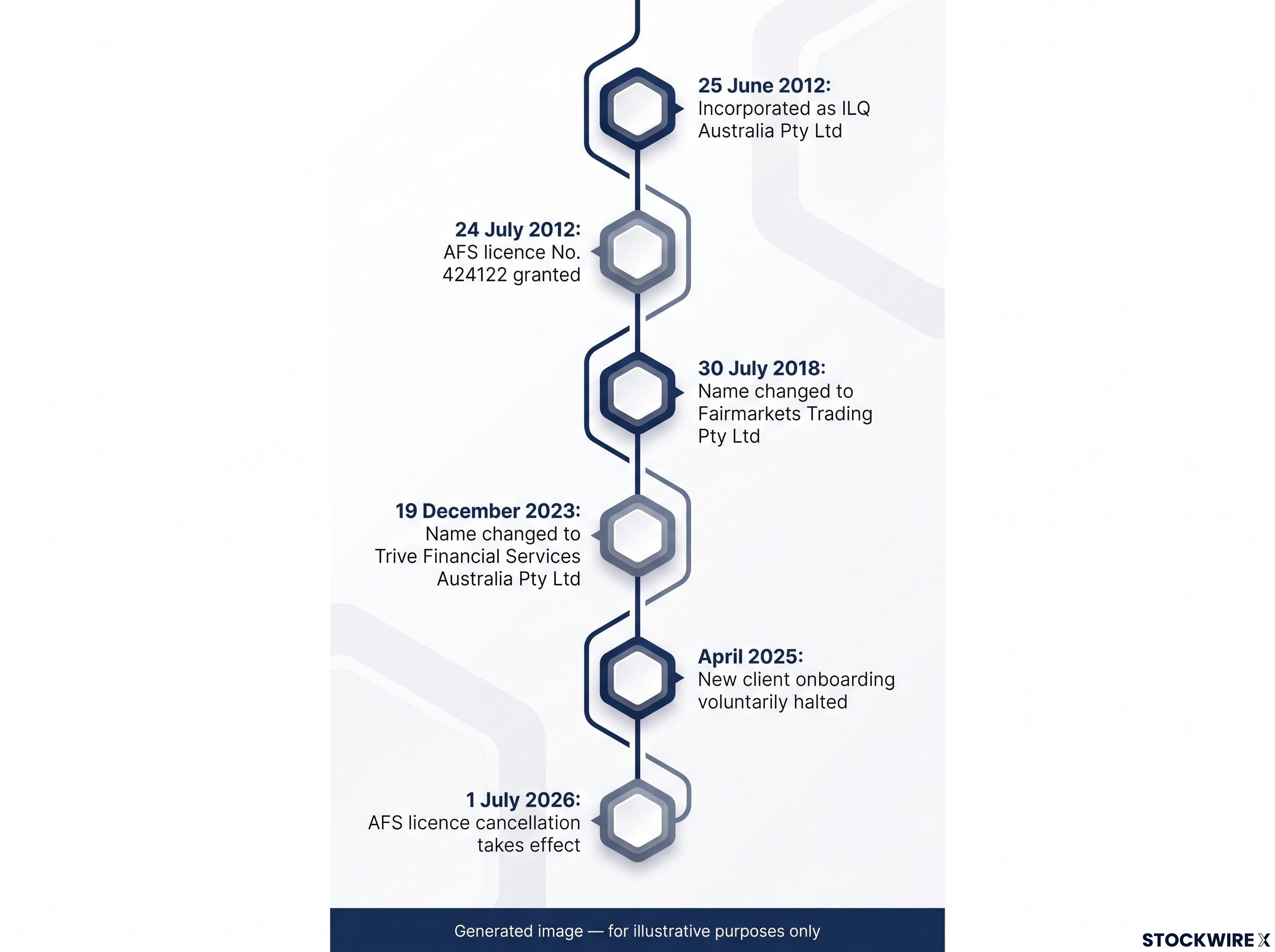
| Date | Event |
|---|---|
| 25 June 2012 | Incorporated as ILQ Australia Pty Ltd |
| 24 July 2012 | AFS licence No. 424122 granted |
| 30 July 2018 | Name changed to Fairmarkets Trading Pty Ltd |
| 19 December 2023 | Name changed to Trive Financial Services Australia Pty Ltd |
| 1 July 2026 | AFS licence cancellation takes effect |
The AFS licence number, 424122, remained constant across all three names. The updated cancellation status is now reflected in ASIC’s Professional Registers. You can verify this yourself by searching the registers using the company name or licence number.
What ASIC’s CFD industry sweep tells you about where the regulator is focused
The Trive cancellation is not a standalone event. It sits within a sustained ASIC campaign targeting the CFD market, and the scale of that campaign tells you something about the problems the regulator has found.
In its whole-of-industry review of 52 licensed CFD providers, ASIC secured the return of close to $40 million to more than 38,000 retail investors.
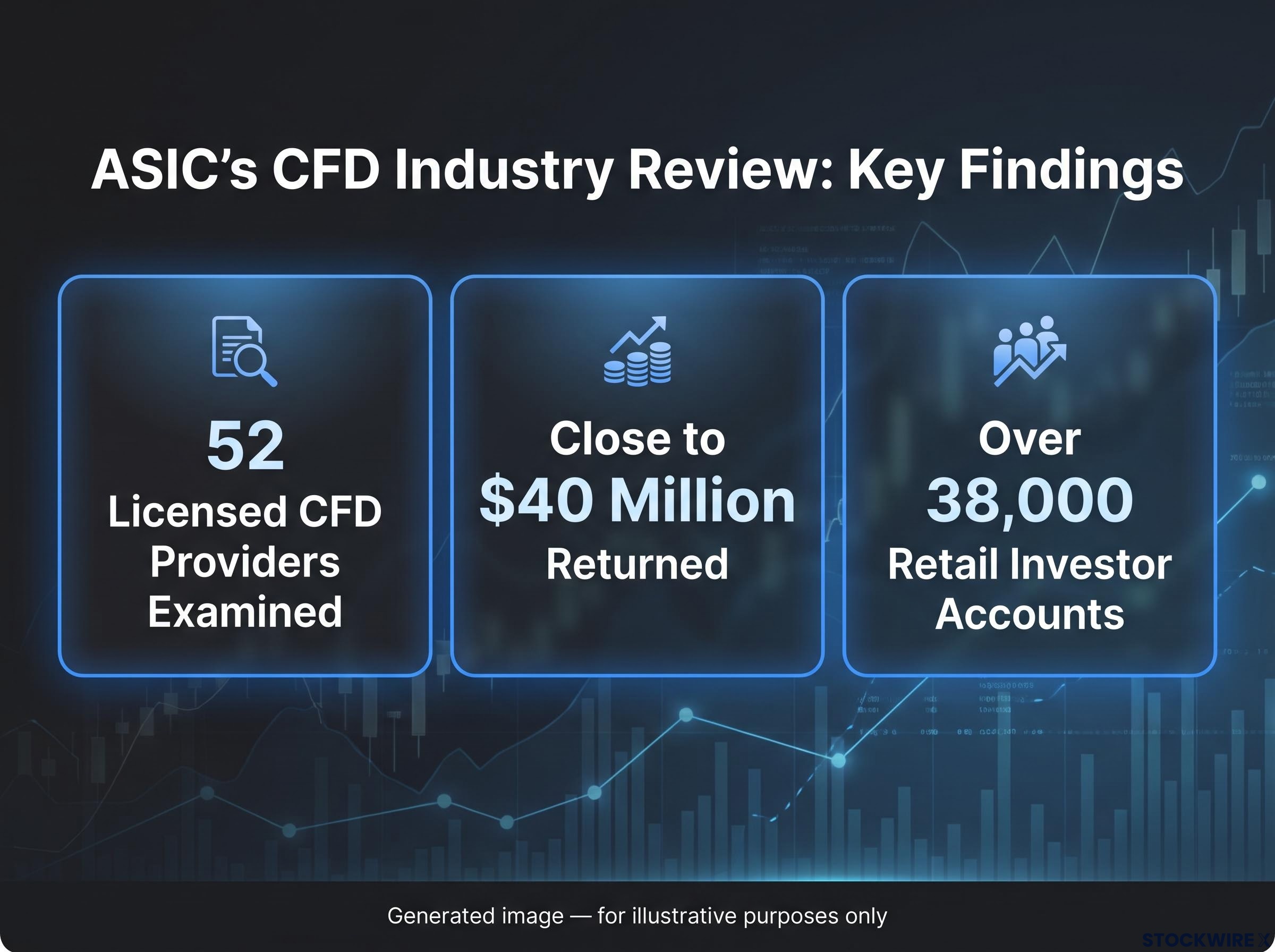
That figure is the headline outcome of the broader review, and it tells retail CFD users that provider quality genuinely varies across the licensed market. ASIC’s surveillance is finding material failures, not just tidying up administrative loose ends.
ASIC’s CFD sector review, which covered all 52 licensed issuers over 14 months and recovered close to $40 million for more than 38,000 retail clients, found that margin discount practices alone accounted for over $36 million in refunds across 28 issuers.
Three dimensions of the review matter:
- Scope: The whole-of-industry review covered all 52 licensed CFD providers operating in the Australian market
- Investor outcomes: Retail clients received close to $40 million in refunds, distributed across more than 38,000 accounts
- Enforcement posture: Delivering better outcomes for consumers of high-risk financial products, including CFDs, sits explicitly within ASIC’s stated supervisory priorities for market intermediaries
The Trive case illustrates ASIC’s willingness to act where operational standards fall short, whether that results in licence cancellation, client remediation, or both.
What this cancellation means in practice for existing Trive clients
If you held an account with Trive, the cancellation does not eliminate the firm’s obligations to you. Trive is expected to address client money, complaints, and outstanding balances as part of its wind-down process.
However, the onus is now on you to initiate contact and verify your position. A cancelled licence does not trigger an automatic process to return client funds. ASIC’s release does not state that funds are impaired, but the absence of a specific assurance means direct confirmation from the firm is necessary.
The AFS licence cancellation process does not automatically trigger a client fund return mechanism; the obligation to manage outstanding balances and wind down client accounts remains with the cancelled entity, not with ASIC.
Steps for affected traders
- Contact Trive directly to confirm the status of your account and any remaining funds. Establish how withdrawals or account closures are being managed during the wind-down.
- Verify the licence status on ASIC’s Professional Registers. Search by company name or AFS licence number 424122 to confirm the cancellation is recorded.
- Lodge a complaint with the Australian Financial Complaints Authority (AFCA) if you believe you have suffered a loss linked to Trive’s conduct or the wind-down. AFCA is the external dispute resolution scheme for financial services complaints in Australia. Note that AFCA has complaint time limits and eligibility rules, so act promptly rather than waiting.
- Seek independent financial or legal advice if your situation involves large positions, margin calls, or disputed transactions. Before opening any replacement CFD account, verify the new provider’s AFS licence status independently on ASIC’s Professional Registers.
Under the relevant legislation, Trive has the option of seeking a review of ASIC’s cancellation decision through the Administrative Review Tribunal (ART). As of 24 July 2026, there is no public indication that such a review has been lodged.
Where the Trive cancellation leaves the CFD market
The Trive case confirms three things about where ASIC stands on CFD oversight. The regulator is actively reviewing the market, operational deficiencies carry consequences even before formal enforcement action, and the administrative cancellation route shows ASIC is prepared to remove licences where the business case has collapsed.
What it leaves unresolved is narrower. Trive’s right to seek ART review of the decision remains open, and the surveillance of 52 providers is ongoing. The $40 million recovery figure signals the review has found genuine problems across the licensed market, not just at a single operator.
For retail CFD investors, provider stability is not guaranteed by the existence of a licence. The Trive timeline shows a firm can hold one for over a decade and then exit the market within 14 months. ASIC’s current surveillance posture makes further actions in this space a realistic expectation, not a tail risk. The burden of due diligence sits with you.
The CFD product intervention order, which introduced leverage caps, margin close-out rules, and negative balance protection, is set to expire on 23 May 2027, making ASIC’s current industry consultation directly relevant to every retail CFD user assessing provider stability.
This article is for informational purposes only and should not be considered financial advice. Investors should conduct their own research and consult with financial professionals before making investment decisions.