
Brent Falls Below $80 as Hormuz Peace Deal Strips Risk Premium
53 mins ago

SpaceX began trading on Nasdaq under ticker SPCX on 12 June 2026, and Canadian investors now have a TSX-listed route in on the company’s very first Monday of public life. The Ninepoint SpaceX HighShares ETF (SXHI) starts trading on the Toronto Stock Exchange today, 16 June 2026, giving Canadian investors CAD-denominated access to SpaceX Class A shares through a single-stock ETF with a covered call income overlay and modest leverage. At a launch price of $10 per unit versus SpaceX’s IPO price of $135 per share, the fund offers a structurally different entry point. Ninepoint Partners describes SXHI as what is believed to be the first fund ever launched in anticipation of, rather than after, an underlying company’s IPO.
What follows covers exactly what SXHI is, how its three-part mechanics work, what it will cost, how to buy it today, what risks to weigh, and how it compares to competing SpaceX ETFs now available in Canada.
The speed of this launch tells the story. Ninepoint Partners, a Canadian alternative investment manager with over $8 billion in assets under management, filed the preliminary prospectus for SXHI on 29 May 2026, more than two weeks before SpaceX had even priced its IPO. A follow-up confirmation came on 11 June, one day before SpaceX listed on Nasdaq.
By the time SPCX opened for trading on 12 June, the ETF wrapper was ready.
The SpaceX IPO pricing process was unusual in a structural sense: the company bypassed the traditional institutional roadshow, meaning the $135 per share figure was set without an order book to validate demand, and the first real price discovery happened on exchange at debut on June 12.
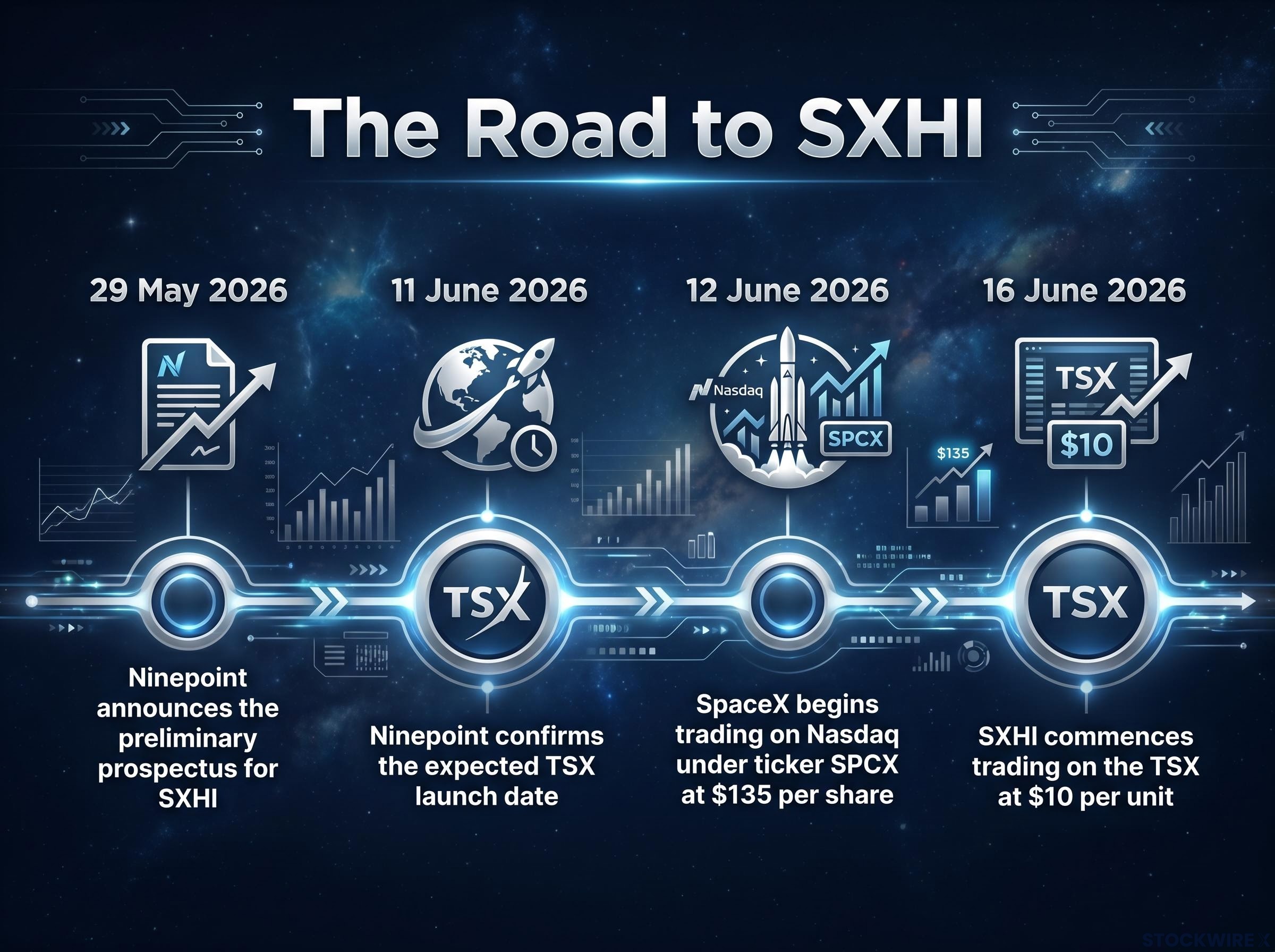
The key milestones ran in tight sequence:
John Wilson, Co-CEO, Managing Partner, and Chief Investment Officer at Ninepoint, and Karla Chen, Executive Vice President and Head of ETFs, have led the product’s development. The fact that a fund was structured and filed before the underlying company even went public signals how extraordinary investor demand for SpaceX had become well before listing day.
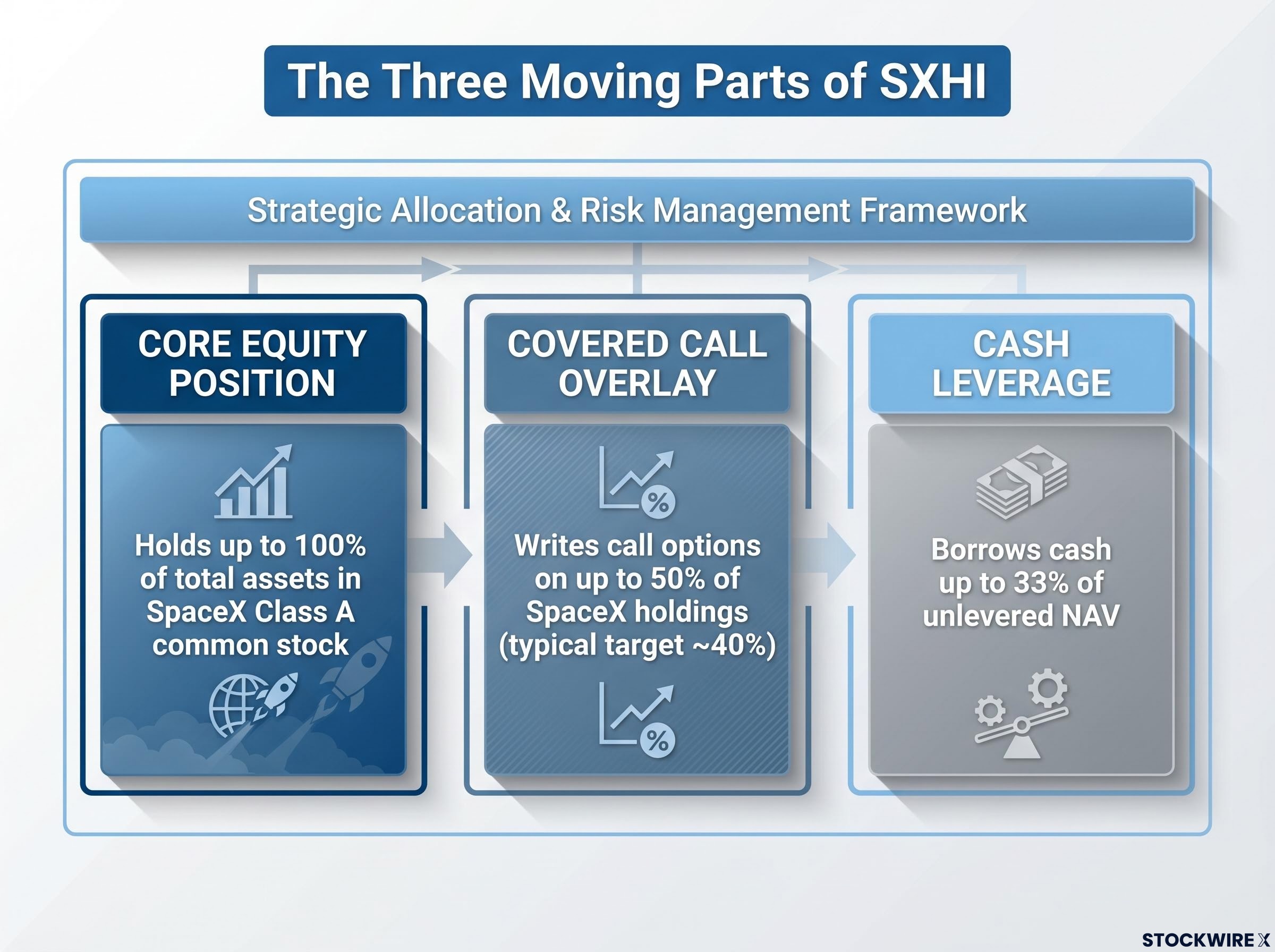
SXHI is not simply a wrapper around SpaceX shares. It combines three distinct mechanical layers into a single product, and understanding each one is the difference between knowing what the ticker represents and knowing what the fund actually does to an investor’s capital.
Ninepoint has stated that distribution amounts will only be announced once the SpaceX options market becomes sufficiently established following the IPO. Monthly income is the stated objective, and the fund is expected to be eligible for a distribution reinvestment plan (DRIP). However, payout levels are not guaranteed or confirmed at this stage, and distributions may fluctuate depending on option premiums collected.
Evaluating covered call ETF distributions on yield alone misses the metrics that predict whether income is sustainable: distribution streak length, lifetime payout growth rate, and total return context together determine whether a fund is genuinely compounding investor wealth or gradually eroding NAV to fund payouts.
Early investors face a genuinely unusual cost structure. Ninepoint has waived the management fee entirely from launch through 30 September 2026, meaning the first three and a half months of holding SXHI carry zero management cost.
Fee structure: Management fee of 0% from launch through 30 September 2026. Standard management fee of 0.29% per annum (29 basis points) effective 1 October 2026.
The 0.29% post-promotional fee applies across Ninepoint’s entire HighShares lineup and is described as among the lowest available for covered call ETFs in Canada.
Investors should note that trading commissions and operating expenses still apply even during the promotional window. The 0% period covers the management fee specifically, not every cost associated with holding the fund.
The purchase path is straightforward, but a few details matter on day one of a new listing:
This route provides indirect, income-oriented SpaceX exposure denominated in Canadian dollars, rather than requiring a direct purchase of SPCX on Nasdaq in U.S. dollars.
Ninepoint classifies SXHI as a High-risk product. That rating is not a generic label; it flows directly from the fund’s structural design choices.
The National Instrument 81-102 investment fund rules set out the Canadian regulatory framework governing prospectus requirements, permitted derivatives use, and leverage restrictions for ETFs, establishing the compliance boundaries within which a product like SXHI must operate.
Risk classification: Ninepoint rates SXHI as High risk in its official prospectus disclosure.
Each layer of the product introduces a specific, identifiable risk:
SXHI is not the only route to SpaceX exposure on Canadian exchanges. Several products launched in the same window, each targeting a different investor profile.
Purpose Investments received approval for the Purpose SpaceX Yield Shares ETF (SPXY), listed on Cboe Canada. SPXY targets long-term capital appreciation from SpaceX stock with monthly distributions generated through covered calls and cash-covered puts. It employs approximately 25% leverage and covers approximately 50% of the portfolio with its options strategy.
Tradr ETFs launched two leveraged instruments: SPCM, which targets 200% of SpaceX’s daily performance (2x long), and SPCG, which targets -200% (2x short). Both are designed for short-term trading by sophisticated investors and carry very high risk on large adverse moves. Neither is structured as a buy-and-hold product.
The Tradr products carry daily reset period mechanics, meaning their leverage target is recalibrated every 24 hours and volatility drag compounds continuously, making them structurally incompatible with buy-and-hold strategies regardless of conviction in the underlying share price.
| Feature | SXHI | SPXY | SPCM / SPCG |
|---|---|---|---|
| Exchange | TSX | Cboe Canada | Cboe |
| Currency | CAD | CAD | USD |
| Leverage | Up to 33% of NAV | Approximately 25% | 2x daily |
| Strategy | Covered calls (~40-50%) | Covered calls + cash-covered puts (~50%) | Pure leveraged long / short |
| Target investor | Long-term, income-oriented | Long-term, income-oriented | Short-term, sophisticated traders |
For Canadian investors seeking TSX-listed, CAD-denominated SpaceX exposure with an income overlay, SXHI is the most direct route currently available through a standard brokerage account.
Today, 16 June 2026, marks day one. SXHI offers TSX-listed, CAD-denominated, income-generating SpaceX exposure with a 0% management fee window open until 30 September 2026, a combination that did not exist four days ago.
The product’s High risk classification warrants careful review. Investors considering SXHI should read Ninepoint’s prospectus in full and assess how a concentrated, leveraged, options-based ETF fits their individual risk tolerance and portfolio objectives. As the SpaceX options market matures in the weeks following the IPO, distribution levels will become clearer, giving unitholders a concrete near-term development to monitor.
For investors deciding whether SXHI fits their income strategy, our dedicated guide to covered call ETF selection covers how reinvestment capacity changes the metrics that matter most, including the distinction between out-of-the-money call strategies that preserve equity upside and at-the-money strategies that maximise premium income at the cost of participation.
This article is for informational purposes only and should not be considered financial advice. Investors should conduct their own research and consult with financial professionals before making investment decisions. Past performance does not guarantee future results, and financial projections are subject to market conditions and various risk factors.
SXHI is the Ninepoint SpaceX HighShares ETF, a TSX-listed single-stock ETF that holds SpaceX Class A shares, writes covered call options on up to 50% of its holdings to generate monthly income, and borrows up to 33% of its unlevered NAV to amplify exposure.
Canadian investors can buy SXHI through any standard brokerage account with TSX access by searching the ticker SXHI; the fund trades in CAD at a launch price of $10 per unit, and placing a limit order on the first trading day is recommended to manage spread risk.
Ninepoint has waived the management fee entirely from launch through 30 September 2026, after which a standard management fee of 0.29% per annum applies; trading commissions and operating expenses still apply during the promotional window.
SXHI trades on the TSX with up to 33% leverage and a covered call overlay targeting around 40-50% of holdings, while Purpose's SPXY on Cboe Canada uses approximately 25% leverage and combines covered calls with cash-covered puts; both target long-term, income-oriented investors, unlike the Tradr 2x daily leveraged products SPCM and SPCG.
Ninepoint has stated that distribution amounts will only be announced once the SpaceX options market becomes sufficiently established after the IPO, so early investors should expect uncertainty around initial payout levels, though monthly income is the stated objective.