SXHI Lists on the TSX Just Four Days After SpaceX’s Nasdaq IPO
1 hr ago

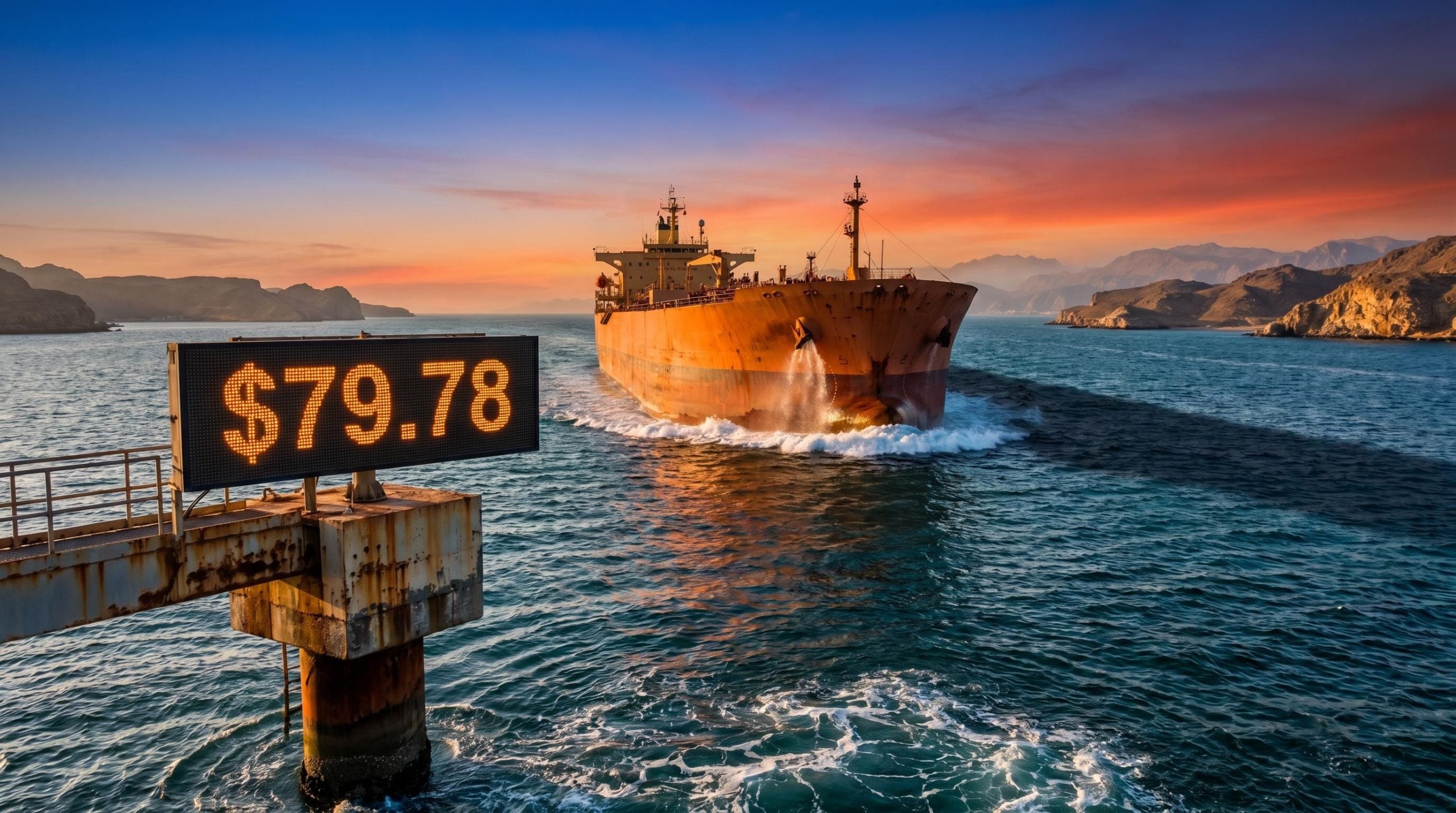
Brent crude dropped below $80 per barrel on Tuesday for the first time in three months, erasing a geopolitical risk premium that had been building since U.S. naval forces effectively sealed one of the world’s most critical oil arteries in late February 2026.
A preliminary U.S.-Iran peace framework announced over the weekend of 14-15 June 2026 has set in motion the reopening of the Strait of Hormuz, the chokepoint through which roughly one-fifth of globally traded oil normally flows. The market response was unambiguous: Brent futures fell 4.1% and WTI dropped 4.26%, with Goldman Sachs moving quickly to cut its oil price forecasts for both 2026 and 2027. What follows breaks down what the deal actually says about the reopening timeline, why a gap exists between the futures selloff and physical market recovery, and what energy investors and commodity traders should be watching as the 60-day ceasefire framework plays out.
Brent crude futures fell approximately 4.1% to $79.78 per barrel on Tuesday 16 June 2026, while WTI crude futures dropped roughly 4.26% to $77.31 per barrel. The move extended Monday’s slide to three-month lows, making this a two-session selloff rather than a single-day spike.
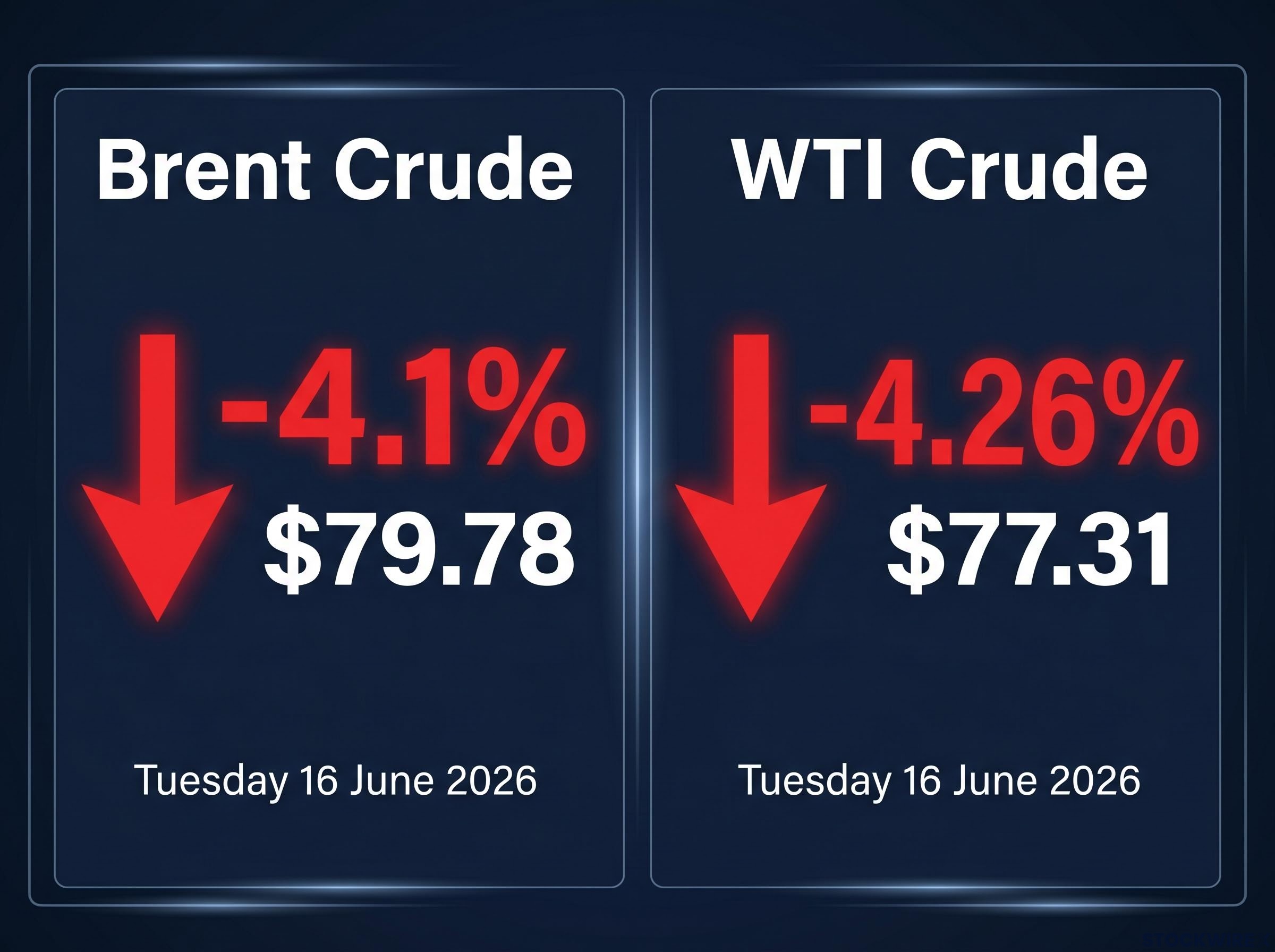
Two forces drove the decline simultaneously:
Brent traded in an approximate range of $80-$83 per barrel during the week of 16 June, with WTI holding between $77 and $80. The break below $80 Brent is both a psychologically and technically significant threshold, one that influences producer hedging strategies, refiner margins, and equity valuations across the energy sector.
Goldman Sachs revised both its 2026 and 2027 crude oil price forecasts downward following the framework announcement, an institutional signal that the directional shift is expected to persist rather than reverse within days.
The revision represents more than a reaction to a single session. It reflects a reassessment of the supply outlook for the remainder of the year, with restored Hormuz flows changing the baseline assumptions that underpinned the bank’s previous projections.
The Goldman Sachs crude forecast revision set a fourth-quarter 2026 Brent target of $80, down from $90, and trimmed the 2027 average estimate to $75 from $80, giving traders a concrete institutional baseline for how far the supply-shock premium has now been stripped from forward curves.
The Strait of Hormuz is the sole maritime outlet for Persian Gulf oil exporters. Under normal conditions, approximately one-fifth of all globally traded oil passes through this narrow waterway, making it one of the most consequential chokepoints in global energy infrastructure.
When the U.S. naval blockade commenced in late February 2026, it physically constrained Gulf exports by restricting passage through the strait. The disruption operated on two levels: it created real supply tightness as barrels were removed from the market, and it built a geopolitical risk premium on top of spot prices as traders priced in the possibility of prolonged or escalating conflict. The result was one of the most significant energy supply disruptions in recent memory.
The disruption the current reopening is now unwinding was not a simple blockade; it operated through a triple-lock closure mechanism combining US naval operations, Iranian toll enforcement on non-US vessels, and the near-total withdrawal of commercial war-risk insurance, each of which must be reversed through different processes before normal tanker traffic resumes.
Market sensitivity to Hormuz is asymmetric. Closures produce outsized price spikes; credible reopenings produce equivalently sharp reversals. That asymmetry explains why a diplomatic framework announced in Geneva moved crude prices in New York and Houston before a single additional barrel had been delivered. The practical constraints on any reopening are real:
President Trump, speaking at the G7 gathering in France, projected full operational status for the Strait of Hormuz by Friday 20 June 2026, linking the reopening to the formal signing ceremony scheduled for 19-20 June in Geneva.
Senior U.S. officials told The Wall Street Journal that normal shipping activity could take up to two weeks to fully resume. The gap between these two positions is not merely semantic. It reflects the difference between a political announcement and an operational reality shaped by insurance underwriters, tanker operators, and refinery scheduling desks.
| Source | Timeline stated | Basis |
|---|---|---|
| Trump at G7 (France) | Full reopening by Friday 20 June 2026 | Linked to formal signing ceremony |
| Senior U.S. officials (WSJ) | Up to two weeks | Insurance, tanker repositioning, schedule coordination |
| Kpler analysis | ~50% of pre-war traffic within 30 days | Shipping data modelling assuming smooth implementation |
According to Kpler analysis, Hormuz traffic could reach nearly 50% of pre-war levels within 30 days if implementation proceeds smoothly, the most specific quantitative anchor currently available for physical market recovery.
The gap between Friday and two weeks is precisely the kind of uncertainty that can generate short-term price bounces after the initial selloff. Traders who understand the distinction between political timelines and physical market realities are better positioned to navigate near-term volatility.
A ceasefire collapse tail scenario modelled by Goldman Sachs in May 2026 projected Brent above $130, forced shelving of rate cuts at both the Federal Reserve and the ECB, and sharp repricing across growth equities, a constellation of outcomes that remains the relevant stress case even as the base case has now shifted firmly toward normalisation.
Futures markets priced in the Hormuz reopening within hours of the framework announcement on 14-15 June 2026. Physical market normalisation, by contrast, is expected to take days to two weeks according to senior U.S. official estimates.
This is not market irrationality. It is how commodity markets absorb geopolitical shocks. Futures contracts reflect expectations; physical delivery reflects logistics. The two operate on different clocks, and the lag between them creates a specific and predictable volatility pattern.
Before Iranian and Gulf barrels physically reach end markets, three things must happen in sequence:
Temporary price bounces are most likely in the window between the formal signing (19-20 June) and physical traffic approaching 50% of pre-war levels. Any security incident in the strait itself, or a delay in the formal signing, would be the highest-impact catalyst for a reversal.
The Kpler 30-day recovery estimate provides a physical market anchor against which futures pricing can be measured. Until actual cargo data confirms the ramp-up, the gap between paper and physical markets remains the primary source of short-term noise.
| Sector | Direction of impact | Key mechanism |
|---|---|---|
| Upstream producers | Negative | Margin compression at sub-$80 Brent, particularly for high-cost U.S. shale operators and frontier project developers |
| Refiners | Positive | Cheaper crude inputs support refining margins where product demand holds; benefits both integrated majors and pure-play refiners |
| Airlines and logistics | Positive | Lower jet fuel and bunker costs improve profitability to the extent pricing power on fares and freight rates is maintained |
| Consumers | Positive | Lower and less volatile oil eases headline inflation, giving central banks slightly more room than during the blockade-driven price spike |
If sub-$80 Brent begins to look like a sustained trading range rather than a short-lived dip, equity markets may mark down earnings expectations for upstream oil producers. The distinction between integrated majors (which benefit on the refining side) and pure-play exploration and production companies (which do not) becomes particularly relevant in that scenario.
The formal signing ceremony, expected 19-20 June 2026 in Geneva, is more likely to be a validation event than a fresh price catalyst. Markets move on expectations, and the selloff that followed the weekend announcement already priced in the broad terms of the framework.
Three variables will determine where crude benchmarks settle over the coming months:
The 60-day ceasefire framework establishes the defined near-term window within which all three variables will play out. Extension or breakdown of that framework will be the next binary event for oil markets.
The geopolitical risk premium is unwinding, and the centre of gravity in oil markets has shifted from supply-shock fears to managing potential oversupply. That is a meaningful directional change. It does not, however, mean the path from here is a straight line lower.
The timeline dispute between President Trump and senior administration officials remains unresolved. The logistics lag before physical volumes normalise will generate noise that could be mistaken for a deterioration in the deal itself. And the 60-day ceasefire framework requires either extension or a more durable resolution before markets can treat Hormuz as fully restored.
War-risk insurance premiums, set by P&I clubs on actuarial rather than diplomatic timescales, represent one of the more durable constraints on a full price reversal; they form part of the structural floor for crude prices that analysts at ING currently place in the $75-85 per barrel range even as Hormuz flows gradually normalise.
The near-term checkpoints are specific: the formal signing on 19-20 June, the first shipping data confirming tanker traffic through the strait, and any OPEC+ signalling on output adjustments. Each will either validate the current selloff or complicate it.
This article is for informational purposes only and should not be considered financial advice. Investors should conduct their own research and consult with financial professionals before making investment decisions. Forward-looking statements regarding oil prices, reopening timelines, and supply flows are subject to change based on diplomatic, operational, and market developments.
The Strait of Hormuz is the sole maritime outlet for Persian Gulf oil exporters, with roughly one-fifth of all globally traded oil passing through it under normal conditions. Its closure or restriction creates immediate supply tightness and adds a geopolitical risk premium to crude benchmarks worldwide.
The announcement of a preliminary U.S.-Iran peace framework on 14-15 June 2026 triggered a rapid unwinding of the geopolitical risk premium built into crude prices since the U.S. naval blockade began in late February 2026. Brent fell 4.1% to $79.78 per barrel and WTI dropped 4.26% to $77.31 per barrel as markets priced in the expected restoration of Hormuz supply flows.
President Trump projected full operational status by Friday 20 June 2026, but senior U.S. officials told the Wall Street Journal that normal shipping activity could take up to two weeks to fully resume. Kpler analysis estimates Hormuz traffic could reach approximately 50% of pre-war levels within 30 days if implementation proceeds smoothly.
Goldman Sachs revised its crude oil price forecasts downward for both 2026 and 2027, setting a fourth-quarter 2026 Brent target of $80 (down from $90) and trimming its 2027 average estimate to $75 from $80. The bank framed the revision as a reassessment of the full-year supply outlook rather than a reaction to a single trading session.
Refiners, airlines, logistics companies, and consumers broadly benefit from sub-$80 Brent through lower input costs, improved margins, and reduced inflationary pressure. Upstream oil producers, particularly high-cost U.S. shale operators and frontier project developers, face margin compression at these price levels.