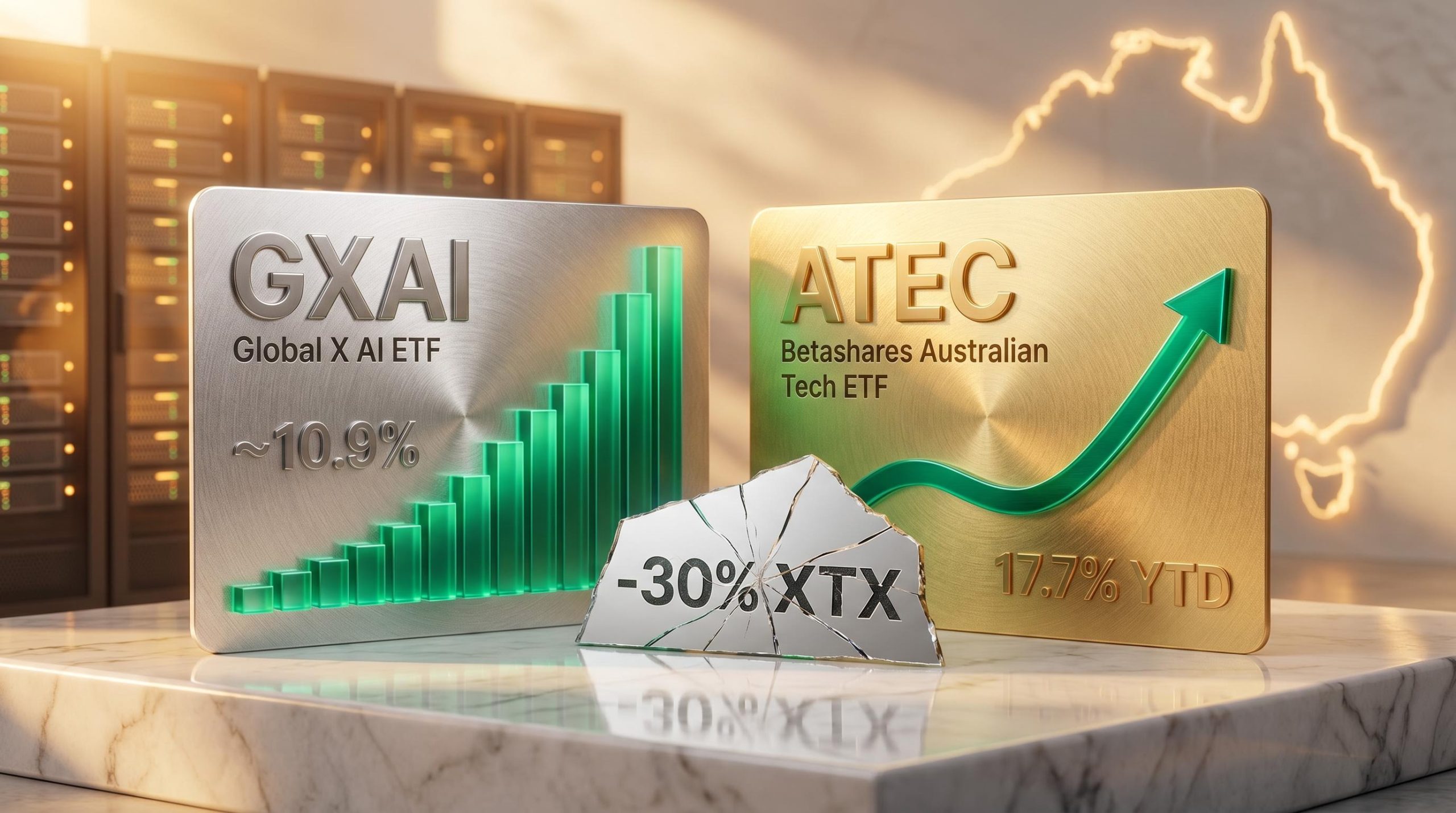
The S&P/ASX All Technology Index fell nearly 30% between January and March 2026. For a certain kind of investor, that is not a warning sign. It is an entry signal.
Two ASX-listed thematic ETFs sit at the intersection of two distinct but converging investment arguments. AI infrastructure spending among the world’s largest technology companies is accelerating rather than plateauing, while Australian tech stocks may have been sold off so aggressively that current prices no longer reflect underlying business fundamentals. Global X’s GXAI and Betashares’ ATEC offer concentrated exposure to each thesis respectively, and both are generating returns that demand closer examination.
What follows is an analysis of the earnings and capex data driving the GXAI case, the structural recovery argument for ATEC, how each fund is currently positioned, and what risks investors should weigh before adding either to a portfolio.
The AI infrastructure boom is not slowing down
The most recent US earnings season delivered results that beat investor expectations. According to a Global X research report referenced 16 May 2026, earnings growth among major US technology companies accelerated versus the prior quarter, a trajectory that contradicts the plateau narrative some market commentators had been building.
Earnings growth across major US technology companies accelerated quarter on quarter, reinforcing the structural demand case for AI infrastructure investment.
Four companies are driving the capex story: Microsoft, Alphabet, Amazon, and Meta. All four have revised AI-related capital expenditure forecasts upward, directing capital across four categories of infrastructure spend:
Hyperscaler capex commitments from Amazon, Microsoft, Alphabet, and Meta reached $130 billion in Q1 2026 alone, with full-year 2026 combined guidance tracking toward $725 billion and a $1 trillion annual run rate projected for 2027, figures that represent the demand floor beneath GXAI’s hardware and semiconductor holdings.
- Data centres and hyperscale compute facilities
- Cloud computing capacity expansion
- Semiconductor procurement and custom chip development
- Energy infrastructure to power AI workloads
Cloud revenue growth is gaining momentum alongside those commitments, which matters because it provides the revenue feedback loop that justifies continued spending. If cloud adoption were stalling while capex climbed, the thesis would weaken. The data points in the opposite direction. Sustained capex commitment from the largest technology buyers in the world establishes a structural floor beneath AI-thematic ETFs.
When big ASX news breaks, our subscribers know first
What GXAI holds and how it works
Understanding GXAI’s construction before encountering its performance data grounds the numbers in a real portfolio rather than an abstraction. The fund targets companies positioned to benefit from AI development and adoption, and its mandate captures two distinct layers of the AI value chain.
What the fund targets
GXAI’s portfolio is built around dual-layer exposure:
- AI application and services companies: Businesses developing and deploying AI-powered software, platforms, and commercial applications.
- Hardware and semiconductor enablers: Companies building the physical infrastructure, including chips, servers, and networking equipment, that makes AI workloads possible.
This structure gives the portfolio two pathways to gain from AI investment cycles. If enterprise AI software adoption accelerates, the application layer benefits. If the capex boom continues regardless of near-term software monetisation, the hardware layer captures that spending. An investor who already holds a broad global technology ETF should assess whether GXAI’s hardware weighting adds genuine differentiation or duplicates existing positions.
Current fund metrics (as at May 2026)
| Metric | GXAI |
|---|---|
| Unit Price (18 May 2026) | ~$16.40 |
| AUM (mid-May 2026) | ~$239-243M |
| YTD Total Return (to 15 May 2026) | ~10.9-11.5% |
Source: Global X Australia fund page, data as of 15 May 2026.
The Australian tech selloff created a potential re-entry window
The numbers were severe. The S&P/ASX All Technology Index (XTX) declined by nearly 30% between January and March 2026, one of the sharpest drawdowns in the index’s history.
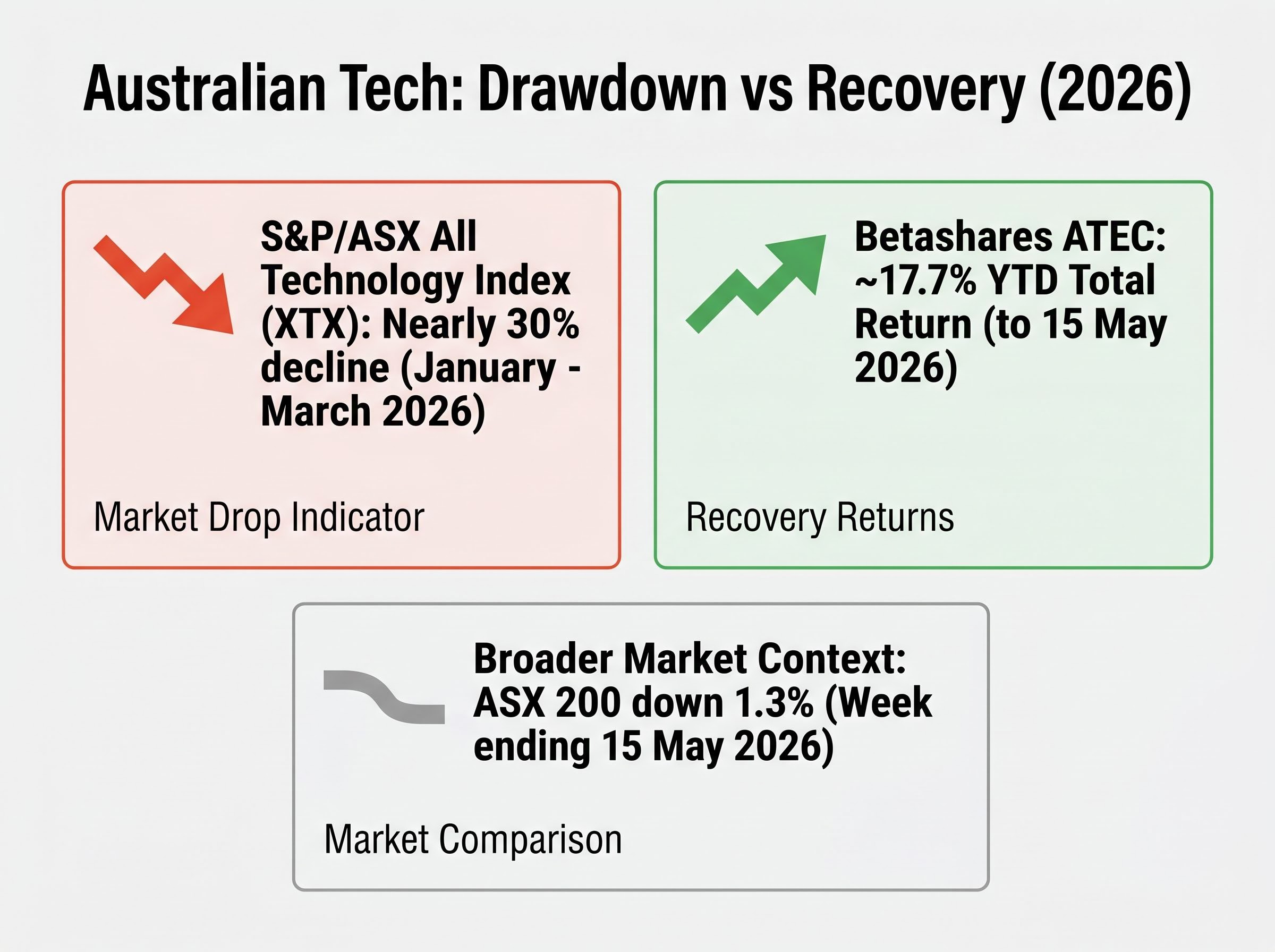
A nearly 30% decline in the S&P/ASX All Technology Index over three months was driven by narrative fear around AI disruption of SaaS business models, not a broad collapse in underlying earnings.
The selling was fuelled by a specific concern: that SaaS-based business models faced existential risk from cheaper, more capable AI systems. The logic ran that if AI could automate workflows previously handled by subscription software, the recurring revenue streams underpinning Australian tech valuations would erode.
The counter-thesis is building. Ben Clark of TMS Private Wealth, speaking in a Livewire Markets interview published in late February 2026, pointed to insider buying activity across beaten-down growth and tech names as evidence that the selling may have overshot fundamentals. Clark’s view, broadly, was that company directors were putting personal capital to work at prices they considered attractive, a signal that the market’s narrative-driven fear had created a disconnect from business reality.
A 30% index drawdown driven by sentiment rather than a broad deterioration in earnings is the kind of dislocation that creates asymmetric re-entry opportunities for investors with a 12-month horizon and tolerance for continued volatility.
ATEC’s structure, performance, and what the recovery argument rests on
What ATEC holds
Betashares’ ATEC replicates the S&P/ASX All Technology Index, covering ASX-listed companies across information technology, consumer electronics, online retail, and medical technology. The breadth of the index extends beyond pure-play IT exposure, capturing companies whose technology-driven business models sit across multiple sub-sectors of the Australian economy.
ATEC’s index composition is more cross-sectoral than its technology branding implies, with only 56% of constituents formally classified as technology companies under GICS and the largest single holding being Computershare, an industrials-classified business, at over 10% of fund assets.
The recovery evidence so far
ATEC’s year-to-date total return of approximately 17.7% as at 15 May 2026 suggests the recovery from the January-March lows is already well underway. For context, the ASX 200 was down 1.3% for the week ending 15 May 2026, underscoring how sharply ATEC’s trajectory has diverged from the broader market.
The recovery thesis rests on two pillars: valuations that fell to potentially attractive levels after the drawdown, and continued earnings growth from fundamentally sound companies within the index. The 17.7% YTD figure is early evidence that sentiment is shifting, but past recovery does not confirm the thesis is complete. Further gains depend on whether Australian tech companies deliver earnings that justify the rebound.
The question for investors is whether that outperformance has further to run or has already been largely captured.
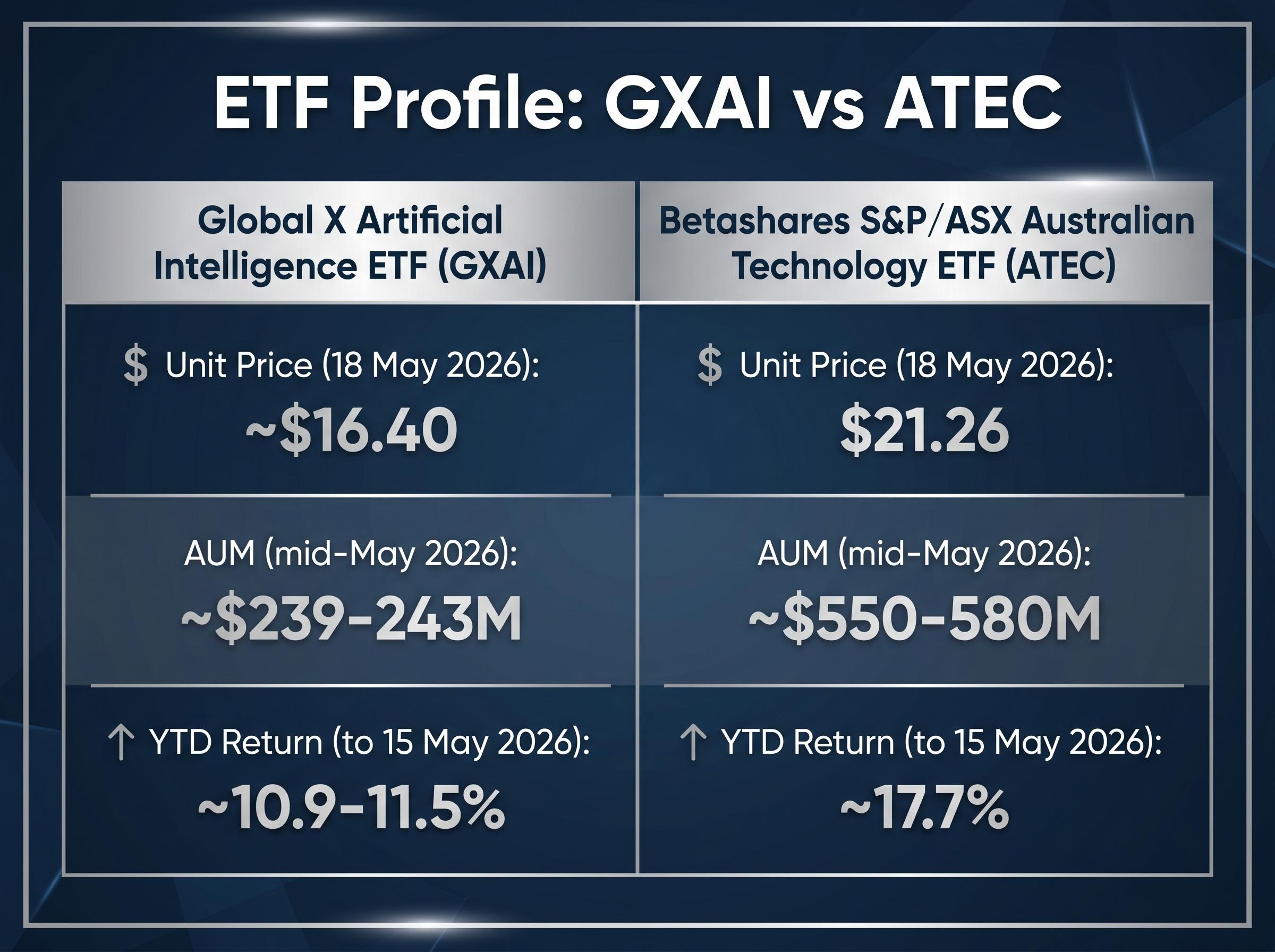
| Fund | ASX Code | Unit Price / NAV (18 May 2026) | AUM (mid-May 2026) | YTD Return (to 15 May 2026) |
|---|---|---|---|---|
| Global X Artificial Intelligence ETF | GXAI | ~$16.40 | ~$239-243M | ~10.9-11.5% |
| Betashares S&P/ASX Australian Technology ETF | ATEC | $21.26 | ~$550-580M | ~17.7% |
Sources: Global X Australia fund page (data as of 15 May 2026); Betashares fund page (data as at 18 May 2026).
The risks that could undermine both theses
Neither thesis is without identifiable failure conditions. Three categories of risk deserve specific consideration:
- AI capex deceleration (GXAI): If corporate clients fail to demonstrate sufficient return on investment from AI deployments, the major technology companies could scale back spending. GXAI’s earnings growth thesis depends on that capex continuing to accelerate.
- SaaS model disruption proves correct (ATEC): The narrative that drove the January-March selloff could prove at least partially accurate. If AI genuinely erodes recurring revenue streams for Australian SaaS businesses, the drawdown was not indiscriminate selling; it was early pricing of structural headwinds.
- Thematic concentration risk (both funds): Concentrated sector exposure means higher volatility than broad-market ETFs. A shift in investor sentiment away from technology themes could amplify drawdowns, and steeper losses are possible if either underlying investment thesis loses market favour.
The ASX 200 was down 1.3% for the week ending 15 May 2026, a reminder that the broader market is not uniformly supportive. Both ETFs carry meaningful concentration risk, and investors considering either fund should assess position sizing carefully, treating them as satellite allocations within a diversified portfolio rather than core holdings.
Thematic ETF timing risk can invert the relationship between a fund’s reported return and the return actually experienced by investors, as illustrated by ARK Innovation’s +233% time-weighted gain translating into an approximately -35% money-weighted loss for the typical investor who entered near peak valuations, a pattern directly relevant to funds recovering sharply from drawdown lows.
The case is compelling, but the thesis demands active monitoring
GXAI and ATEC represent two distinct but complementary ways to express a bullish near-term view on technology and AI. GXAI offers offshore AI infrastructure exposure, backed by accelerating US earnings and rising capex commitments. ATEC offers a domestic recovery play, supported by a 17.7% YTD rebound from a potentially indiscriminate selloff.
The monitoring discipline is straightforward. Investors should track:
- US tech earnings trajectory: Continued beats and upward guidance revisions sustain the GXAI thesis. Misses or flat guidance would undermine it.
- AI capex guidance updates: Watch for any downward revisions from Microsoft, Alphabet, Amazon, or Meta in upcoming quarterly reports.
- XTX index earnings delivery: Australian tech companies need to post earnings that justify the recovery in ATEC’s unit price. Revenue growth and margin stability are the metrics that matter.
- Broader ASX sentiment and risk appetite: A sustained risk-off environment in Australian equities would create headwinds for both funds regardless of their individual merits.
The structural tailwinds are real, but both theses have identifiable failure conditions. Investors who monitor these signals will be better positioned to add, hold, or exit as conditions develop over the next 12 months.
For investors weighing whether GXAI is the right vehicle for AI exposure or whether individual AI stock selection might deliver better risk-adjusted returns, our full explainer on AI stock selection versus ETF exposure traces the dot-com parallel in detail, examining why being correct about a transformative technology did not translate into correctly identifying winning companies in 2000 and why that lesson applies directly to AI in 2026.
This article is for informational purposes only and should not be considered financial advice. Investors should conduct their own research and consult with financial professionals before making investment decisions. Past performance does not guarantee future results.