Markets dropped sharply in the first quarter of 2026, dragged lower by fears many analysts now consider overblown. The S&P 500 pulled back toward correction territory from its late-February highs, driven not by collapsing earnings or a deteriorating economy, but by anxiety over the Iran conflict and its potential oil supply disruptions. Yet that very pessimism may be precisely what sets up the next sustained leg higher. Two structural forces are converging as the second half of 2026 approaches: the well-documented tendency for US stocks to rally in the 12 months following midterm elections, and the “wall of worry” dynamic in which cautious investor positioning leaves sidelined capital ready to re-enter. What follows is a clear explanation of why legislative gridlock tends to help stocks, how sentiment resets create the conditions for further gains, and what the historical post-midterm record actually shows, so readers can evaluate whether the months ahead are as constructive as some institutional analysts suggest.
Why markets fell in early 2026, and why the cause matters more than the decline
Not all pullbacks are created equal. The distinction between why markets fall and how far they fall is the more useful lens for assessing what comes next.
Classifying a selloff correctly is the prerequisite step before any assessment of recovery timing: a decline rooted in sentiment fear resolves differently from one rooted in structural earnings deterioration or a permanently impaired competitive landscape.
The Q1 2026 equity selloff was primarily a sentiment event. Iran-related fears, centred on the Strait of Hormuz and potential oil supply disruptions, drove a wave of risk-off positioning that pushed the S&P 500 toward, but not into, formal correction territory from its late-February peak. The decline looked alarming on a chart. The underlying economy told a different story.
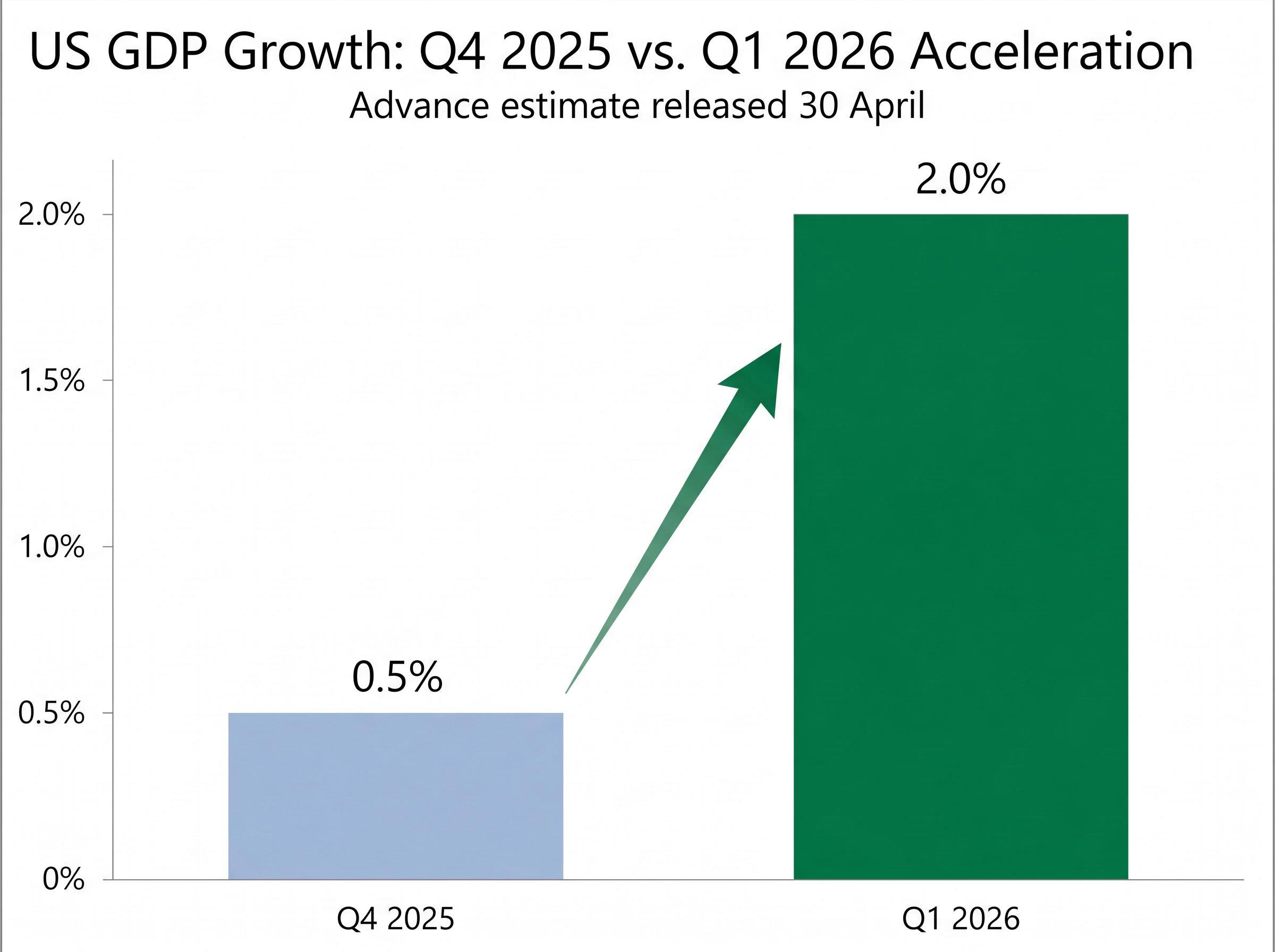
The Bureau of Economic Analysis released its advance GDP estimate for Q1 2026 on 30 April, showing the US economy grew at an annualised rate of 2.0%, a meaningful rebound from Q4 2025’s sluggish 0.5%. Growth was accelerating, not contracting.
The U.S. Treasury’s Q1 2026 economic statement confirmed real GDP growth accelerated to 2.0% at an annual rate in the first quarter, corroborating the Bureau of Economic Analysis advance estimate and reinforcing the case that underlying economic conditions remained sound through the Iran-driven market turbulence.
This matters because sentiment-driven pullbacks and fundamentals-driven bear markets follow different recovery paths:
- Sentiment-driven pullback: Markets decline on fear, uncertainty, or geopolitical anxiety while underlying economic conditions remain stable or improving. These tend to reverse once the fear catalyst fades or is repriced.
- Fundamentals-driven decline: Markets fall because corporate earnings, economic growth, or credit conditions are genuinely deteriorating. These require structural improvement before a sustained recovery begins.
Fisher Investments characterised the Q1 2026 downturn as sentiment-driven, noting that the overall bull market forecast remained intact as of May 2026.
The rest of this article builds on that distinction. If the decline was a sentiment shock imposed on a fundamentally sound economy, the question becomes: what happens when the sentiment resets?
When big ASX news breaks, our subscribers know first
The wall of worry explained: how pessimism can power a bull market
The idea that pessimism can be good for stocks sounds counterintuitive. It is, until the mechanism becomes clear.
Wall of worry: A market condition in which equity prices climb despite widespread investor anxiety, because cautious positioning leaves capital on the sidelines. As worries gradually ease, that sidelined capital re-enters the market, providing sustained buying pressure that supports further gains.
The concept is not about optimism. It is about positioning. When investors are fearful, they hold more cash, reduce equity exposure, and hedge aggressively. That creates a large pool of potential buying power. Each piece of better-than-expected news, each worry that fails to materialise, releases some of that capital back into equities. The market climbs not because everyone is confident, but because enough people are cautiously re-entering.
In Q1 2026, that mechanism reset. Investor confidence that had been gradually rebuilding following the 2025 market correction was effectively erased by Iran-conflict fears. Sentiment returned to a cautious baseline, recreating the conditions that historically precede sustained rallies.
The consumer confidence divergence from equity market performance in April and May 2026 reached historically unprecedented levels, with the University of Michigan’s final April reading hitting a record low of 49.8 while the S&P 500 traded near all-time highs, a pattern that prior cycles suggest tends to coincide with market troughs rather than the onset of sustained declines.
What the current sentiment data actually shows
The mid-May 2026 sentiment picture is notably mixed:
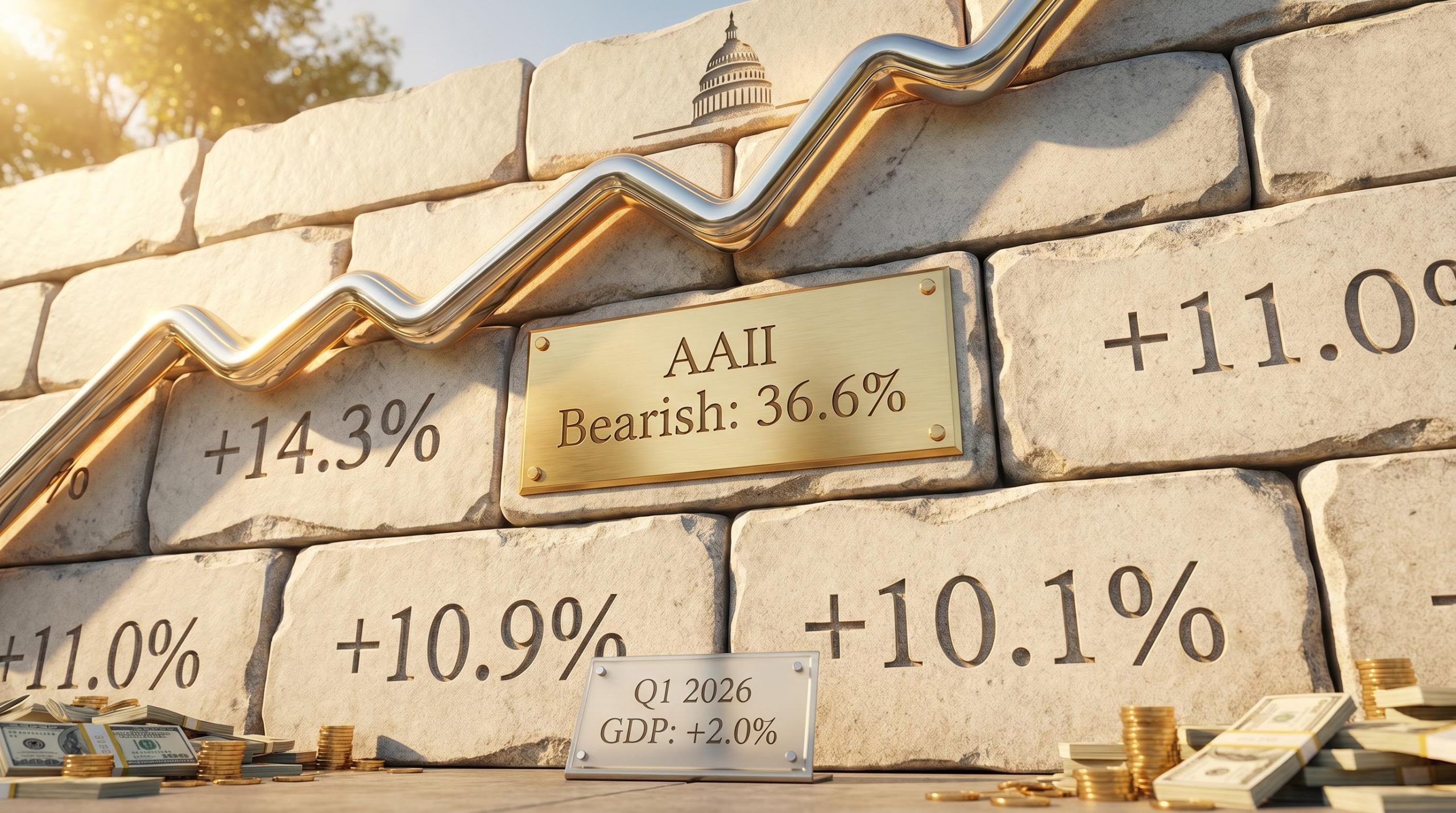
- AAII Sentiment Survey (week of 13-14 May 2026): 39.3% bullish, 24.1% neutral, 36.6% bearish
- CNN Fear and Greed Index (mid-May 2026): 63-66, registering “Greed”
These two readings appear to contradict each other. The AAII survey, which polls individual investors directly, shows bears nearly matching bulls, with 36.6% bearish sentiment remaining elevated relative to long-term averages. The CNN index, which aggregates multiple market-based indicators including momentum, options activity, and junk bond demand, registers a greed reading.
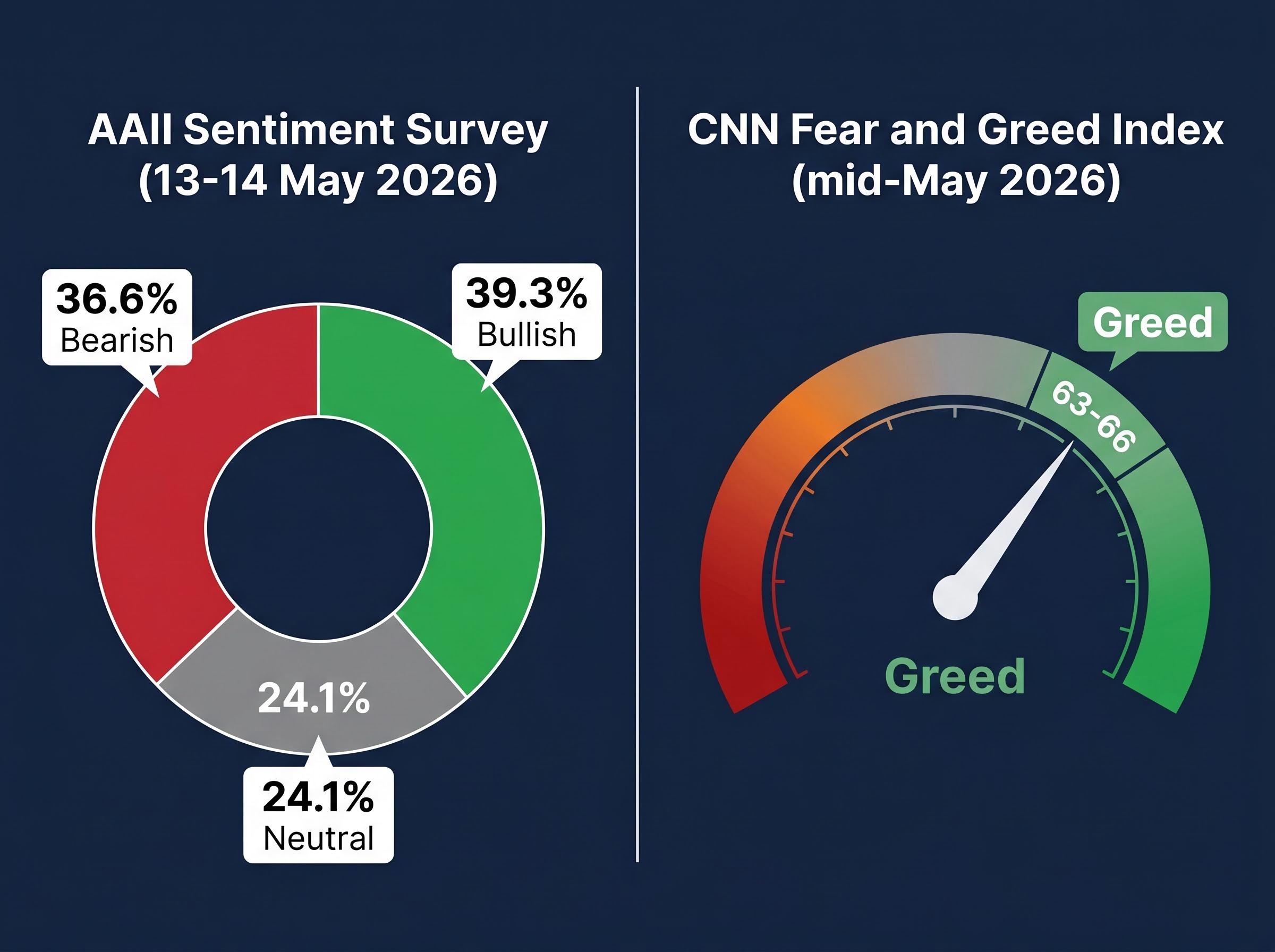
The divergence itself is informative. Individual investors remain cautious even as market-derived signals turn more positive. That gap, where the market’s behaviour is running ahead of investor confidence, is consistent with a wall of worry rather than the kind of universal complacency that typically precedes major selloffs. Even the CNN “Greed” reading sits well below euphoric extremes.
How post-midterm election returns have historically played out for US stocks
Consider the record before the interpretation.
US equity markets have historically delivered above-average returns in the 12 months following midterm elections. Analysts refer to this pattern as the “Midterm Miracle,” and it rests on a straightforward logic: midterm elections resolve a significant source of political uncertainty, giving corporations and investors greater clarity on the legislative environment for the following two years.
| Midterm Election Year | S&P 500: 12-Month Post-Midterm Return | Notes |
|---|---|---|
| 2022 | +10.1% | Recovery from 2022 bear market; divided Congress confirmed |
| 2018 | +10.9% | House flipped to Democrats; gridlock materialised |
| 2014 | +1.4% | Below-average; global growth concerns weighed |
| 2010 | +11.0% | Post-GFC recovery; strong earnings rebound |
| 2006 | +14.3% | Pre-financial crisis gains; House shifted to Democrats |
The pattern is visible but not mechanical. The 2014 cycle delivered below-average returns despite the historical tendency, a reminder that broader macro conditions still matter. The general direction, however, has been consistent: post-midterm 12-month periods have more often produced above-average than below-average equity returns.
Fisher Investments, in its Q1 2026 outlook and subsequent May commentary, explicitly applied this framework to the current cycle, characterising existing market volatility as establishing the kind of pessimistic baseline that has historically preceded strong post-midterm recoveries.
The 2026 midterms approach with that baseline already in place. Current volatility, driven by Iran-related fears rather than economic deterioration, mirrors the pattern of pre-midterm pessimism that the historical record suggests tends to resolve positively.
Investors wanting to stress-test the historical case more rigorously will find our deep-dive into the post-midterm rally record, which examines all 19 cycles since 1950, the role of uncertainty resolution versus party composition, and the specific complication posed by the S&P 500’s already-elevated starting point heading into November 2026.
Why legislative gridlock is a feature, not a bug, for equity markets
Most voters view a gridlocked Congress as a failure of governance. Equity markets have historically treated it as something closer to a stabilising force.
The logic is not ideological. It is structural. Three factors explain why reduced legislative activity tends to support equity prices:
- Policy certainty increases. When neither party controls both chambers and the presidency with comfortable margins, sweeping legislation becomes unlikely. Corporations can plan with greater confidence that the tax code, regulatory framework, and trade policy will remain largely unchanged.
- Regulatory stability improves. Gridlock reduces the probability of significant new regulations being enacted. Industries that are sensitive to regulatory change, including healthcare, financial services, and technology, tend to benefit from a static policy environment.
- The legislative risk premium shrinks. Markets price in the possibility of adverse policy changes. When gridlock makes such changes less probable, that risk premium compresses, lifting valuations independent of earnings growth.
Analysts at Fisher Investments have characterised the anticipated outcome of the 2026 midterms as likely to increase legislative gridlock, a development they view favourably for equity returns. Their analysis also notes a broader tailwind: the number of major global elections in 2026 is limited compared to recent prior years, and most international trade negotiations have been characterised as largely resolved. The aggregate political risk premium that markets have been pricing is therefore diminishing from multiple directions simultaneously.
How Iran conflict fears fit into the pattern, and why resolution matters for the second half
Geopolitical crises feel unique and unresolvable while they are unfolding. The historical record suggests they follow a more predictable arc than investors tend to assume in the moment.
Fisher Investments’ analysis of prior conflicts identifies a consistent pattern:
Equity markets have historically rebounded, and oil prices normalised, within approximately 6-12 months of conflict onset, well before hostilities formally ended.
This does not mean the Iran situation is trivial. It means markets are forward-looking instruments that begin pricing in resolution before resolution arrives. The key question is not whether the conflict ends, but whether its market impact follows the historical recovery arc.
Three distinct mechanisms support the case that it will:
- Historical market recovery pattern. Equity markets have consistently repriced geopolitical risk downward within months of initial shock, as the worst-case scenarios fail to materialise and supply chains adapt.
- Oil price normalisation. Energy markets tend to find equilibrium as alternative supply routes activate and strategic reserves are deployed, reducing the oil premium that initially accompanies conflict.
- Political incentive for resolution. The Trump administration faces strong electoral motivation to pursue rapid de-escalation with Iran ahead of the 2026 midterms, adding a cycle-specific catalyst beyond historical base rates.
Fisher Investments has characterised Iran-related oil supply fears as overstated relative to historical precedent, consistent with their broader view that the current pullback is sentiment-driven rather than reflective of a genuine structural shift in energy markets.
The second half of 2026 and what investors should actually be watching
Three forces covered in this article are converging: a sentiment reset that has recreated a constructive wall of worry, an approaching midterm election that historically resolves political uncertainty in favour of equities, and a geopolitical risk premium that historical patterns suggest will decline within the conflict’s first year.
The convergence of cautious sentiment positioning, anticipated political clarity from the 2026 midterms, and a geopolitical recovery arc consistent with historical precedent creates a structurally constructive backdrop for US equities in the second half of the year.
That backdrop is constructive. It is not a guarantee. The thesis is conditional, and the conditions can be monitored.
Three things to watch before year-end
- AAII bearish reading trajectory. The 36.6% bearish reading from mid-May 2026 is the baseline. A declining bearish share over the coming months would suggest the wall of worry is dissolving and sentiment is normalising, a historically positive signal for forward equity returns.
- Post-midterm legislative activity. Confirmation that gridlock is materialising as anticipated would validate the political tailwinds thesis. The specific composition of Congress matters less than whether the outcome reduces the probability of sweeping policy changes.
- Iran conflict arc. Tracking whether the geopolitical situation follows the historical 6-12 month recovery and de-escalation pattern. Oil prices, shipping insurance premiums, and diplomatic developments are the tangible indicators to monitor.
The Q1 2026 GDP rebound to 2.0% provides the current fundamentals anchor. Fisher Investments’ bull market forecast remains intact as of May 2026, representing one institutional perspective that the underlying conditions support continued equity appreciation. Other analysts may weigh the risks differently, and readers should consider multiple viewpoints when forming their own assessment.
Tactical inflection signals worth monitoring include the BofA Bull and Bear Indicator, which moved from 6.1 in mid-April to approximately 7.6 by mid-May 2026, approaching the formal 8.0 contrarian sell threshold, alongside the Philadelphia Semiconductor Index trading at levels of technical overextension comparable to the Nasdaq at the dot-com peak.
The pattern is real, but it is never automatic
Historical patterns, including the post-midterm rally tendency, are observations across multiple cycles. They are not mechanical laws that apply identically in every instance.
The convergence of a sentiment reset, approaching political clarity, and geopolitical de-escalation creates a structurally constructive backdrop for the second half of 2026. That said, readers should weigh this framework alongside their own financial situation, risk tolerance, and investment timeline. No historical pattern eliminates the possibility of outcomes that deviate from the average.
The more useful takeaway is not a prediction. It is a distinction: the ability to separate noise from signal. Short-term sentiment shocks generate headlines and anxiety. Underlying fundamentals and historical patterns tend to prevail over longer timeframes, though not without interruption. Understanding that distinction does not remove uncertainty. It does make the uncertainty more readable.
Revisit the sentiment indicators, the political calendar, and the geopolitical de-escalation arc periodically as 2026 unfolds. The framework outlined here provides specific, measurable signposts rather than abstract reassurance, and the signposts will either confirm or challenge the thesis in real time.
This article is for informational purposes only and should not be considered financial advice. Investors should conduct their own research and consult with financial professionals before making investment decisions. Past performance does not guarantee future results. Financial projections are subject to market conditions and various risk factors.