
A company can report a “record quarter” on an adjusted basis while simultaneously posting a GAAP loss, and most retail investors will never notice the contradiction. This is not an accident. Quarterly earnings releases are authored by investor relations teams that serve two functions at once: delivering a factual financial record and constructing a strategic narrative around it. Four times a year, these documents shape how the market prices thousands of public companies, and the framing choices buried inside them carry real consequences for anyone making decisions based on the headline figures. This guide walks through the specific techniques companies use to present results favourably, the red flags that reveal what is being obscured, and a practical six-step method for reading any earnings release critically in 20 minutes or less.
What an earnings release is actually designed to do
The earnings press release is not a neutral document. It is written by a company’s investor relations team, reviewed by management, and released without an auditor’s sign-off. Unlike the 10-Q (quarterly SEC filing) or the 10-K (annual filing), which follow standardised formats and face regulatory review, the press release is where narrative construction happens most aggressively. Management chooses which metrics lead, which comparisons frame the quarter, and which figures earn a bullet point at the top of the page.
The SEC recognises this asymmetry. Its guidance under Regulation G requires that any non-GAAP financial measure be reconciled to the nearest GAAP equivalent and prohibits companies from presenting the non-GAAP figure more prominently than the GAAP figure. The existence of that rule is itself a signal: regulators have already identified the framing problem.
Understanding this structural reality is the prerequisite to reading anything else critically. Consider the contrast:
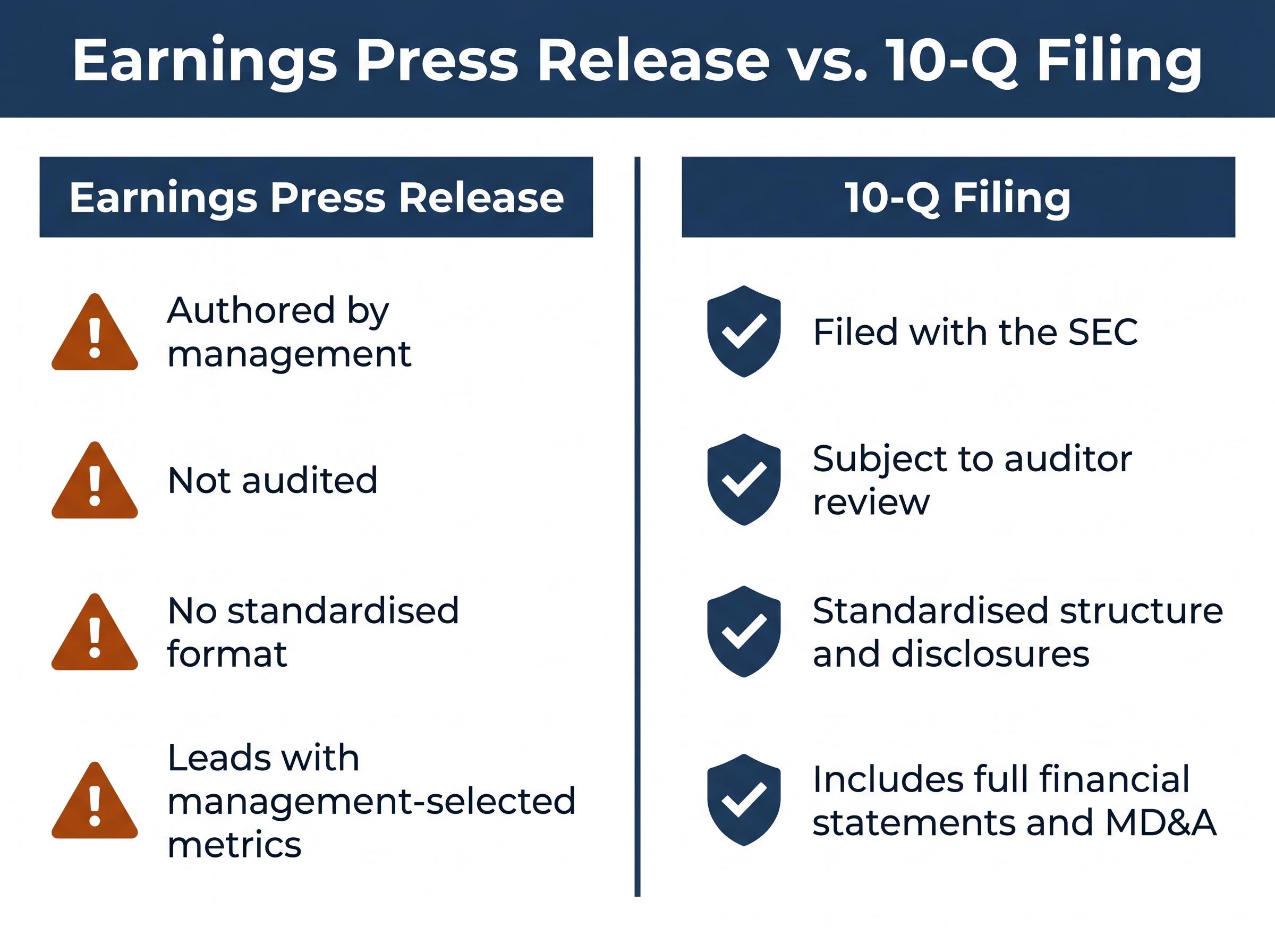
Earnings press release:
- Authored by management
- Not audited
- No standardised format
- Leads with management-selected metrics
10-Q filing:
- Filed with the SEC
- Subject to auditor review
- Standardised structure and disclosures
- Includes full financial statements and MD&A
An 8-K filing often contains or references the earnings press release, but the press release itself remains management-authored. Every section that follows in this guide builds on one principle: the document was designed to argue a case, not merely report facts. Read it that way.
The SEC’s proposed revision to quarterly reporting requirements, which would allow eligible domestic companies to replace Form 10-Q filings with a semiannual Form 10-S, directly affects how often investors receive the structured financial disclosures this framework relies on; critics of the proposal warn that extended reporting gaps widen the information asymmetry between corporate insiders and outside investors.
When big ASX news breaks, our subscribers know first
The anatomy of a GAAP vs. non-GAAP figure (and why it matters)
GAAP (Generally Accepted Accounting Principles) metrics are the standardised, audited financial figures the SEC requires in all public filings. They include revenue, net income, earnings per share (EPS), operating income, and cash flow from operations. Because every company must follow the same recognition rules, GAAP figures allow direct comparison across companies and across time.
Non-GAAP metrics are adjusted figures that management defines independently. A company’s “Adjusted EBITDA” might exclude stock-based compensation, restructuring charges, acquisition costs, and litigation expenses, but another company using the same label could exclude an entirely different set of items. As KPMG has acknowledged, management independently determines non-GAAP methodology with no universal standard. Non-GAAP figures are not audited.
| Attribute | GAAP Metrics | Non-GAAP Metrics |
|---|---|---|
| Audited | Yes (annually; reviewed quarterly) | No |
| Standardised | Yes, uniform rules across all filers | No, defined by each company individually |
| What is excluded | Nothing; all costs recognised | Stock-based comp, restructuring, litigation, acquisition costs (varies) |
| SEC presentation rules | Required in all filings | Must be reconciled to GAAP; cannot be more prominent |
The governing rules are Regulation G and Item 10(e) of Regulation S-K. Under these rules, companies must reconcile every non-GAAP figure to its nearest GAAP equivalent and cannot label a charge as “non-recurring” if a similar charge appeared within the prior two years or is reasonably expected within the next two years.
Regulation G and Item 10(e) of Regulation S-K, adopted by the SEC in 2003, established the core disclosure requirements that govern non-GAAP presentations today, including the prohibition on labelling a charge as non-recurring when a similar charge has appeared within the prior two years or is reasonably expected to recur.
The five most common non-GAAP exclusions to watch for:
- Stock-based compensation
- Restructuring and severance charges
- Acquisition-related costs and amortisation of intangibles
- Litigation settlements and regulatory penalties
- Impairment charges on goodwill or assets
The two-year recurrence rule: Under SEC guidance, a company cannot characterise a charge as non-recurring if a similar charge has occurred within the prior two years or is reasonably likely to recur within the next two years. When restructuring costs appear in four consecutive quarters but are still excluded from “Adjusted EPS,” that adjustment deserves immediate scrutiny.
Non-GAAP EPS is the figure most financial media headlines reference when reporting a “beat.” Knowing what has been excluded, and whether those exclusions genuinely qualify as non-recurring, is the single most important analytical skill for evaluating whether the beat carries any meaning.
Where companies hide what they do not want you to find
The opening paragraph and bulleted highlights of an earnings release are the highest-attention real estate in the document. Companies use this space exclusively for their strongest metrics. When the current quarter is weaker than the prior year, management may lead with full-year figures instead. When GAAP results disappoint, the opening bullets may feature only non-GAAP beats.
This is deliberate architecture, not neutral layout.
What goes at the top
The first two bullet points almost always feature management’s strongest numbers. Research consistently shows that companies position favourable metrics in the opening section and push weaker results further down. A related technique is the “sandwich”: placing a deteriorating metric between two strong ones so the decline reads as minor or isolated within a list of highlights.
What gets buried at the bottom
Guidance revisions carry more forward-looking weight than reported results, yet full-year guidance cuts are routinely buried in footnotes or delivered verbally near the end of an earnings call, after the stock has already reacted to the headline beat. Segment reporting offers another avenue: underperforming business lines may be consolidated with stronger divisions or removed from detailed reporting altogether.
Guidance signals across sectors routinely carry more price impact than the reported quarter itself, a dynamic visible each earnings season when companies with modest result beats are punished for cutting forward outlooks while others with modest misses rally on raised guidance.
Four placement red flags to watch for:
- The opening section leads exclusively with non-GAAP figures, with GAAP equivalents appearing only in the reconciliation table
- The current quarter’s weakness is obscured by full-year or trailing-twelve-month framing
- A guidance cut appears in a footnote, a supplemental table, or the final minutes of the earnings call
- A metric that featured prominently in the prior quarter’s release no longer appears at all
That last signal deserves emphasis. When a previously reported KPI disappears from an earnings release, treat the absence as information. Companies do not stop highlighting metrics that are improving.
How to read an earnings call transcript for signals management did not intend to send
A standard earnings call follows a predictable structure: a safe harbour statement (the legal disclaimer on forward-looking statements), CEO prepared remarks, CFO financial review, and then the analyst Q&A session. The prepared remarks are scripted and pre-approved. The Q&A is not.
That distinction makes the Q&A the most analytically useful portion of the call.
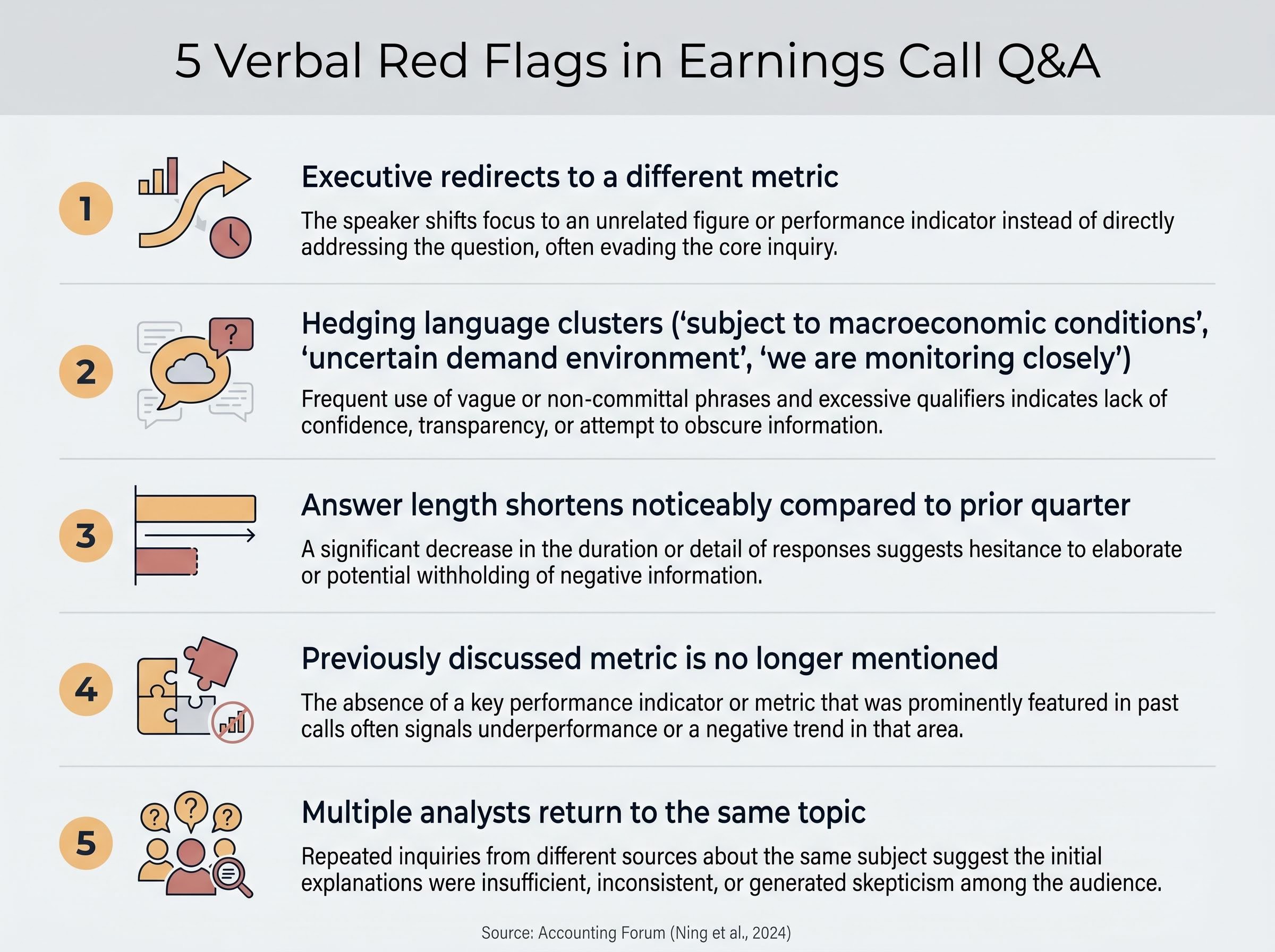
Five verbal red flags to listen for in Q&A:
- An executive redirects to a different metric than the one the analyst asked about
- Hedging language clusters in a single response (“subject to macroeconomic conditions,” “uncertain demand environment,” “we are monitoring closely”)
- Answer length shortens noticeably compared to the same question in the prior quarter
- A metric the company previously discussed in detail is no longer mentioned
- Multiple analysts return to the same topic across separate questions, signalling the analyst community has identified a material concern
Academic research supports the value of this qualitative analysis. According to research published in Accounting Forum (Ning et al., 2024), managers with stronger confidence tend to use more optimistic language, while those anticipating weaker results moderate their tone. These language patterns often appear before the numbers confirm the deterioration.
A note on AI-drafted language: There is growing awareness among financial analysts that AI-assisted drafting tools may be contributing to more uniformly neutral language in prepared remarks. Polished, consistently tempered tone is not necessarily a signal of genuine stability; it may simply reflect communications tools that smooth editorial variation. This makes Q&A analysis, where responses are unrehearsed, comparatively more important for detecting shifts in management confidence.
Metric switching is another pattern worth tracking across consecutive transcripts. A SaaS company that shifts emphasis from net revenue retention to gross revenue retention, for example, may be signalling that customer churn has increased. These changes should be tracked quarter over quarter, not evaluated in isolation.
A practical framework for reading any earnings release in 20 minutes
The analytical skills covered in the preceding sections convert into a repeatable six-step process, ordered from the fastest cross-checks to deeper verification.
- Find the GAAP reconciliation table first. Before reading any headline figure, locate the reconciliation and note what is being excluded from the non-GAAP number.
- Compare GAAP EPS to non-GAAP EPS. Calculate the gap between them. Then check whether that gap is widening quarter over quarter. An expanding gap signals that the adjustments are growing, not shrinking.
- Read the cash flow statement independently. Calculate free cash flow yourself: operating cash flow minus capital expenditures. Compare your figure to whatever the company labels as “Free Cash Flow” in its non-GAAP metrics.
Forward-looking checks
- Check accounts receivable growth against revenue growth. Accounts receivable (money owed to the company by customers) growing faster than revenue is a recognised revenue recognition red flag, as it may suggest the company is booking sales before cash is collected.
- Read guidance and compare to analyst consensus. Consensus estimates are available on Yahoo Finance or Seeking Alpha. Note whether the company raised, maintained, or cut its outlook, and whether guidance is provided only in non-GAAP terms.
- Pull the prior quarter’s earnings release. Compare it side by side with the current release for language changes, metric emphasis shifts, and any KPIs that have disappeared.
Earnings beat rates and analyst estimates interact in ways that can make aggregate results look more impressive than underlying business performance warrants; when analysts enter a season with unusually conservative forecasts, the resulting beat rate reflects the forecast gap as much as genuine outperformance.
| Step | Document Source | What to Look For | Red Flag |
|---|---|---|---|
| 1 | GAAP reconciliation table | Items excluded from non-GAAP | Recurring charges labelled “one-time” |
| 2 | Earnings release / 10-Q | GAAP vs. non-GAAP EPS gap | Gap widening each quarter |
| 3 | Cash flow statement | OCF minus CapEx vs. company FCF | Company FCF significantly higher than yours |
| 4 | Balance sheet | AR growth vs. revenue growth | AR outpacing revenue |
| 5 | Guidance section / consensus data | Raise, maintain, or cut vs. consensus | Guidance cut buried; non-GAAP-only outlook |
| 6 | Prior quarter’s earnings release | Language shifts, missing KPIs | Metric previously featured now absent |
All SEC filings are publicly available at no cost on SEC EDGAR. Analyst consensus figures are accessible on Yahoo Finance and Seeking Alpha. Multi-year trend data for historical comparisons is available on Macrotrends.
One behavioural note worth internalising: Post-Earnings Announcement Drift (PEAD) is a well-documented phenomenon in which stock prices continue to move in the direction of an earnings surprise for weeks after the announcement. Reacting immediately to the headline “beat” or “miss” framing, before completing the steps above, is one of the most common and costly errors retail investors make during earnings season.
This article is for informational purposes only and should not be considered financial advice. Investors should conduct their own research and consult with financial professionals before making investment decisions.
The sceptical investor’s edge is a habit, not a one-time read
Earnings releases are constructed arguments, not neutral records. The analytical skills in this guide are tools for reading them on the company’s own terms while drawing independent conclusions. Three takeaways matter most: always locate the GAAP reconciliation before engaging with headline figures; treat information placement and metric disappearance as data, not layout; and recognise that the Q&A transcript and the cash flow statement are the two hardest things for a company to fully control.
Earnings season recurs quarterly. Each cycle is an opportunity to practise these steps on real disclosures. The investor who reads four earnings releases critically each quarter, applying the six-step framework above, develops a material informational advantage over one who relies on headline framing alone.
For investors wanting to translate earnings release analysis into a quantified view of market expectations before a report lands, our dedicated guide to earnings season options pricing covers implied volatility mechanics, the volatility crush that occurs post-announcement, and a five-step framework for assessing event risk using front-month straddles.
SEC EDGAR and Investor.gov are free starting points for applying this framework immediately. The filings are public. The tools are accessible. The edge comes from the habit of using them.