A covered call ETF promising roughly double the yield of its index-proxy peers sounds like a straightforward upgrade for income investors. The reality, as verified performance data reveals, is considerably more complicated.
In the current yield-seeking environment, both concentrated covered call ETFs (holding 10-20 individual positions) and index-proxy alternatives (writing calls on the S&P 500 or Nasdaq-100) are attracting record retail inflows. The choice between them represents one of the most consequential structural decisions an income-focused investor can make in 2026. What follows is an analysis of what the data actually shows about the yield gap, total return differences, cost drag, and market-regime behaviour of each approach, giving income investors a framework for evaluating trade-offs rather than chasing headline numbers.
The yield gap is real, but smaller than the headlines suggest
The promotional pitch is familiar: concentrated covered call strategies deliver yields of approximately 21.6%, roughly double the 11.86% cited for index-proxy peers. The verified data tells a different story.
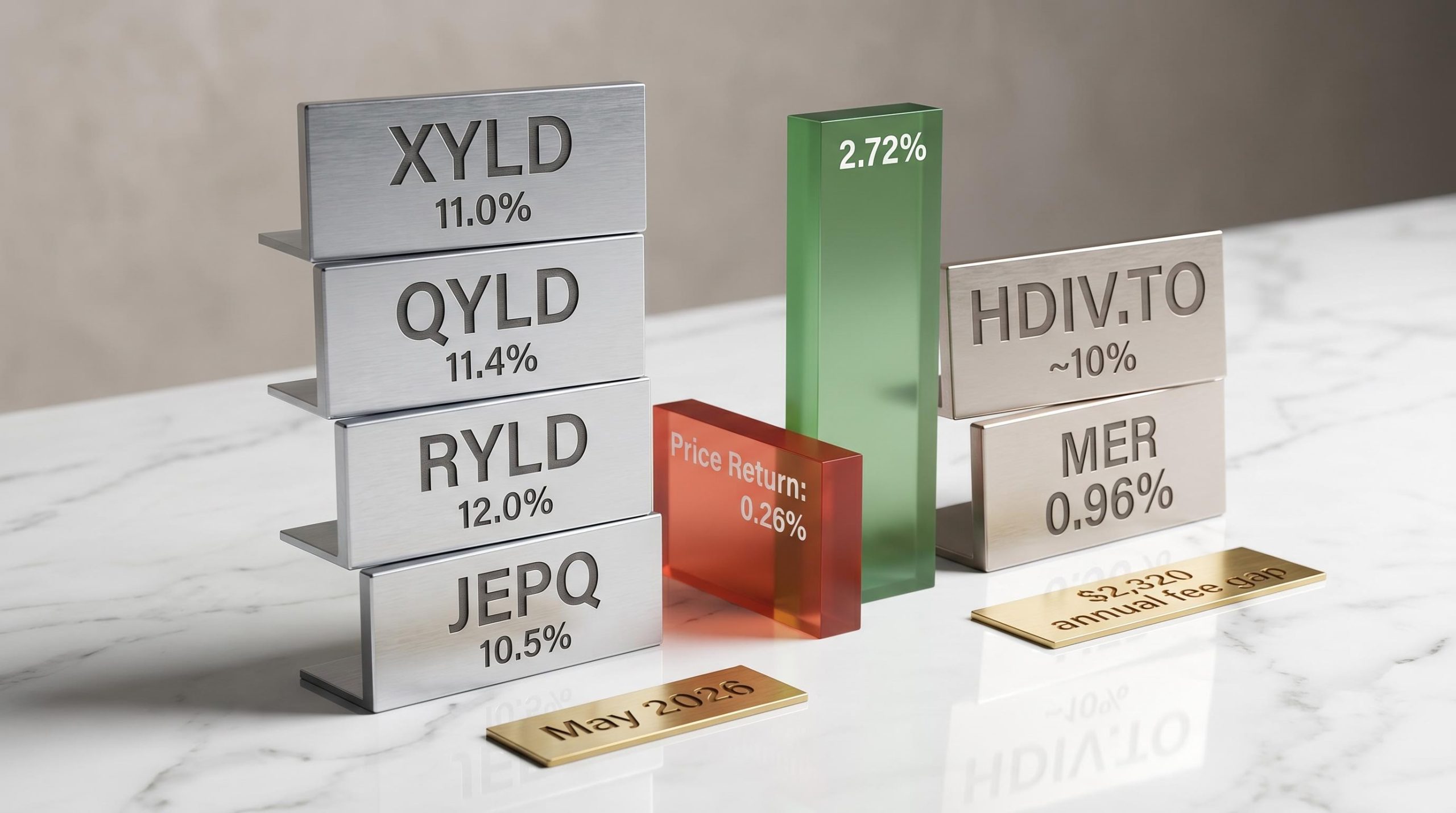
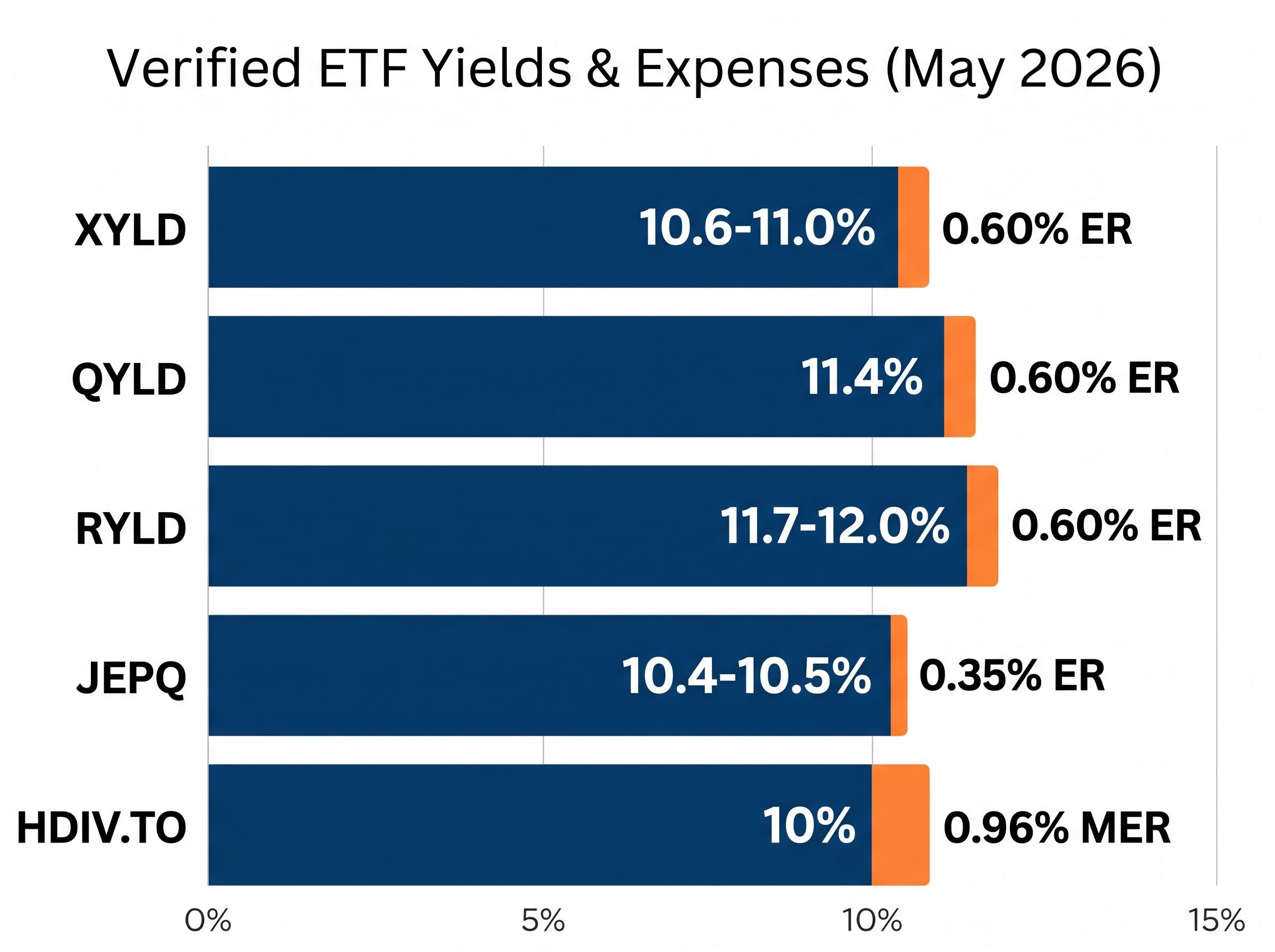
As of May 2026, the major index-proxy funds sit in a tight band. XYLD (S&P 500) yields approximately 10.6-11.0%. QYLD (Nasdaq-100) yields approximately 11.4%. RYLD (Russell 2000) yields approximately 11.7-12.0%. On the concentrated side, HDIV.TO, a Canadian multi-sector concentrated fund, yields approximately 10%.
| ETF | Category | Verified Yield | Expense Ratio | Exchange |
|---|---|---|---|---|
| XYLD | Index-proxy | 10.6-11.0% | 0.60% | NYSE |
| QYLD | Index-proxy | ~11.4% | 0.60% | NYSE |
| RYLD | Index-proxy | ~11.7-12.0% | 0.60% | NYSE |
| JEPQ | Index-proxy (active) | ~10.4-10.5% | 0.35% | NYSE |
| HDIV.TO | Concentrated | ~10% | 0.96% (MER) | TSX |
Both concentrated and index-proxy covered call ETFs deliver verified yields in the 10-12% range as of May 2026, despite marketing materials suggesting differentials of nearly double.
The yield premium in concentrated strategies is structurally real but far more modest than promotional figures suggest. It exists because writing calls on individual high-volatility stocks generates richer premiums than writing a single option on a broad, lower-volatility index. Higher implied volatility in individual names is the legitimate mechanical driver of any yield edge. The unverified 21.6% figure cited in some equally weighted concentrated portfolios should be stress-tested against fund provider disclosures before informing any allocation decision.
When big ASX news breaks, our subscribers know first
How covered call mechanics actually work, and why concentration changes the equation
A covered call strategy works by holding an equity position and simultaneously selling a call option against it. The fund collects the option premium as income, but in exchange, it caps its upside: if the stock or index rises above the option’s strike price, the fund does not participate in further gains.
For an index-proxy fund like XYLD, this means writing one option on the entire S&P 500, a broad benchmark with relatively lower implied volatility. For a concentrated fund holding 10-20 individual stocks, the manager writes separate options on each position, each carrying its own, often higher, implied volatility profile.
The structural distinctions between these two approaches come down to three features:
- Diversification level: Index-proxy funds hold 500+ or 2,000+ underlying names; concentrated funds hold 10-20.
- Option strike construction: Index-proxy strategies use systematic, rules-based strikes (XYLD writes approximately 1% out-of-the-money on a 30-day cycle); concentrated strategies may adjust strikes per position based on individual stock volatility.
- Implied volatility profile: A single index option captures the blended volatility of hundreds of names; individual stock options capture the full volatility of each holding, which is typically higher.
Concentration risk and premium richness are two sides of the same coin. The higher volatility that generates better premiums also means the underlying positions can move more violently against the fund.
Why systematic index-proxy strategies cap their own flexibility
XYLD and its peers write calls at fixed intervals regardless of whether current implied volatility is elevated or compressed. During a volatility spike, when option premiums are at their richest, these funds cannot opportunistically increase their premium capture; the rules are preset.
Actively managed alternatives like JEPQ, which uses an equity-linked note (ELN) structure rather than direct call writing, have more latitude to adjust strike levels and timing. This is a material structural distinction for income sustainability: an active manager can lean into periods of elevated volatility, while a systematic fund writes at the same cadence whether premiums are rich or thin.
Total return is where the concentrated advantage erodes fastest
The concentrated portfolio that appears to win on yield often loses on total return. The year-to-date numbers illustrate this directly.
Through May 2026, the concentrated portfolio delivered approximately 8.55% in total return but only 0.26% in price appreciation. The index-proxy portfolio delivered approximately 7.76% in total return with 2.72% in price appreciation.
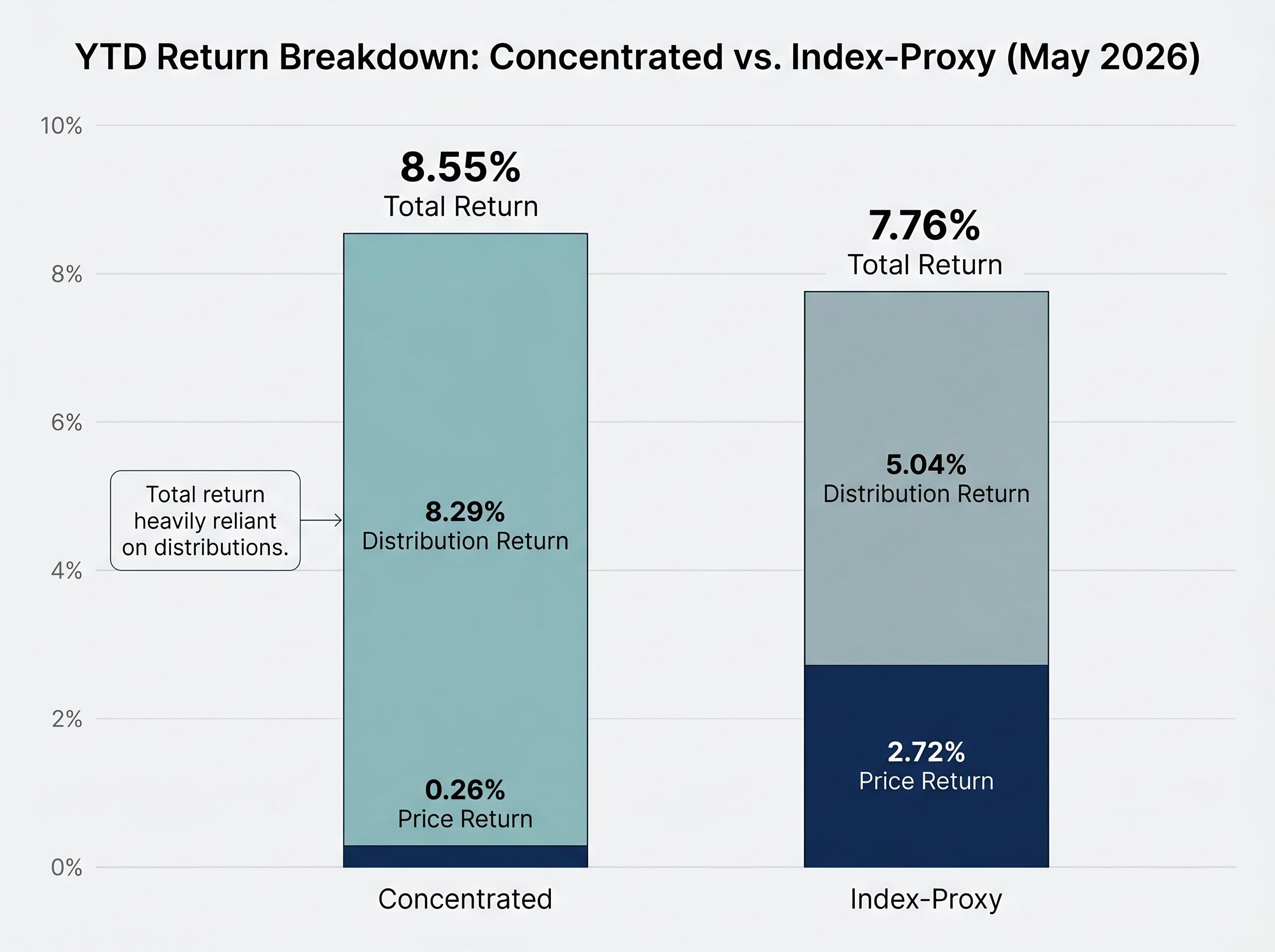
| Portfolio Category | YTD Price Return | YTD Total Return | 6-Month Subset Return |
|---|---|---|---|
| Concentrated | ~0.26% | ~8.55% | ~5.2% |
| Index-proxy | ~2.72% | ~7.76% | ~8.91% |
The distinction matters. Concentrated funds deliver nearly all of their return through distributions, which carry ordinary income tax treatment and compounding limitations. Index-proxy funds retain a larger share of total return in net asset value (NAV), meaning the fund’s price holds up better over time.
In 2023, XYLD delivered approximately 11.1% total return while SPY returned approximately 26.2%, a gap of 15 percentage points that illustrates how the call-writing cap creates structural underperformance during sustained bull markets.
XYLD’s 2026 year-to-date return of approximately 2.9% reflects the same dynamic in a more moderate environment. Income investors who focus only on distribution yield without accounting for NAV erosion may be drawing down capital rather than earning income, a distinction that materially affects long-term portfolio sustainability.
Market conditions determine which strategy wins, and timing matters enormously
Neither category dominates across all market environments. The evidence reveals three distinct regime behaviours:
- Bull markets: Both categories sacrifice upside due to the call-writing cap, but concentrated strategies with fewer, higher-volatility positions experience this cap more acutely. SPY returned approximately 26.2% in 2023 and approximately 24.9% in 2024; XYLD captured roughly half of the 2023 return.
- Flat or sideways markets: Covered call strategies of both types tend to outperform buy-and-hold because premium income becomes the primary return driver. This is the natural habitat for the entire category.
- Bear markets: Neither approach provides meaningful downside protection. Premium collected partially offsets losses, but the equity drawdown is experienced in full, modestly cushioned rather than hedged.
The investor holding exclusively one category through an extended bull market faces a quantifiable opportunity cost. The investor expecting downside protection from either category faces a structural misunderstanding.
The IV compression risk that both categories share
As retail capital flows into covered call ETFs grow, the supply of call options being sold increases. Greater supply of options may progressively compress premiums over time, reducing forward yields across both concentrated and index-proxy funds.
This is not a confirmed trend as of May 2026, but it is a structural risk worth monitoring through distribution history and fund disclosures. If premiums compress, the income advantage that makes covered call ETFs attractive relative to traditional dividend strategies narrows accordingly.
Financial Times reporting on options-selling ETF inflows and VIX compression documented that the rapid accumulation of assets in these strategies was beginning to dampen the CBOE Volatility Index, providing early empirical evidence that the structural risk of premium compression from growing retail participation is more than theoretical.
Cost structure and practical considerations for portfolio construction
The cost differential between categories is substantial at realistic portfolio sizes. The Global X suite (XYLD, QYLD, RYLD) charges 0.60% in expense ratios. JEPQ charges 0.35%. HDIV.TO, a concentrated Canadian fund, carries a 0.96% management expense ratio (MER), with total costs potentially reaching 2.67-2.84% once additional fees are included.
On a $100,000 position, the annual fee difference between JEPQ at 0.35% and HDIV.TO at 2.67% total costs equals approximately $2,320 paid before a single return dollar is earned.
Three practical considerations shape the portfolio construction decision:
- Cost comparison: A 2.32 percentage point annual cost differential compounds meaningfully over a multi-year holding period, directly eroding the income advantage concentrated funds may offer.
- Tax placement: Most covered call ETF distributions are classified as ordinary income rather than qualified dividends or capital gains. Placing these funds in tax-advantaged accounts (RRSP or TFSA in Canada, equivalent registered structures elsewhere) materially improves after-tax yield.
- Blended strategy: Combining index-proxy funds for broad U.S. or global equity income exposure with concentrated funds for sector-specific domestic yield, where the investor has conviction and cost transparency, can balance yield, distribution growth potential, and diversification.
The distinction between ELN-based funds like JEPQ and FLEX options funds affects far more than mechanics: covered call ETF structure determines whether distributions are classified as ordinary income taxed immediately or as return of capital deferred until sale, a difference that can outweigh a 1-2 percentage point yield gap for investors in higher tax brackets.
Return-of-capital risk adds another layer. High distribution yields can partially represent return of capital rather than earned premium, eroding NAV over time. Investors should review distribution tax slips and fund disclosures to assess how much of their income represents actual option premium.
A blended framework supported by the evidence
The evidence does not crown a winner. Concentrated funds offer modestly higher yield potential with meaningfully higher cost drag, NAV erosion risk, and distribution-dependent total returns. Index-proxy funds offer lower costs, better price appreciation retention, and more predictable systematic income, with capped bull-market participation as the trade-off.
The blended portfolio framework emerges as the evidence-supported conclusion: index-proxy funds for core U.S. or global equity income exposure, concentrated funds for targeted sector yield where the investor has conviction and full cost transparency.
Investors seeking to close the yield gap further without abandoning index diversification have increasingly turned to leveraged covered call ETFs, which combine 1.25x equity exposure with a call-writing overlay to deliver a portfolio delta of approximately 0.92 and yields above 13%, though leverage amplifies drawdowns in ways that the premium collected only partially offsets.
Four questions to ask before allocating to either category
The individual decision should be driven by four variables:
- Tax situation: Is the allocation in a registered or taxable account? Ordinary income characterisation makes tax-advantaged placement particularly valuable.
- Reinvestment capacity: Can distributions be reinvested to compound, or is the investor drawing cash flow? Distribution-heavy concentrated funds suit cash-flow needs; NAV-retaining index-proxy funds suit compounding strategies.
- NAV volatility tolerance: How much underlying price erosion is acceptable? Concentrated funds with 10-20 positions carry greater single-name drawdown risk than broad index alternatives.
- Market-regime conviction: What is the investor’s view on the equity market over their time horizon? Sustained bull markets penalise both categories, but concentrated funds bear that penalty less predictably.
An approximate annual distribution on $100,000 falls in the range of $10,600-12,000 from index-proxy funds. Concentrated funds may deliver more if their verified yields hold, but the unverified 21.6% figure should be independently confirmed through fund provider disclosures before informing any allocation.
This article is for informational purposes only and should not be considered financial advice. Investors should conduct their own research and consult with financial professionals before making investment decisions. Past performance does not guarantee future results. Financial projections are subject to market conditions and various risk factors.