


Arm Holdings delivered a beat-and-raise quarter on 6 May 2026 that, on the numbers alone, should have been a straightforward win. Revenue cleared consensus. Earnings per share came in above estimates. Forward guidance topped expectations. Then CEO Rene Haas disclosed that aggregate hyperscaler demand for Arm’s new AGI CPU product exceeds $2 billion across FY2027 and FY2028, but that supply has been confirmed for only roughly half of that figure. Within minutes, 13% of the stock’s after-hours gains evaporated. By pre-market trading on 7 May, shares sat approximately 8% below the previous close.
The reversal was not about what Arm earned. It was about what Arm may not be able to deliver. What follows is a framework for understanding how a clean financial quarter produced a sharp sell-off, how Arm’s supply gap compares to the constraints facing AMD and Intel, and what specific indicators will determine whether the situation resolves or compounds.
A clean quarter that almost no one is talking about
Q4 FY2026 revenue came in at $1.49 billion, up 20% year-over-year, beating the $1.47 billion consensus. Adjusted earnings per share landed at $0.60, clearing the $0.58 estimate. Both revenue streams contributed:
- Licensing and related revenue: $819 million, up 29% year-over-year
- Royalty revenue: $671 million, up 11% year-over-year
Q1 FY2027 guidance of approximately $1.18 billion at the midpoint (plus or minus $50 million) also cleared the $1.25 billion consensus, completing a quarter where every headline number exceeded expectations.
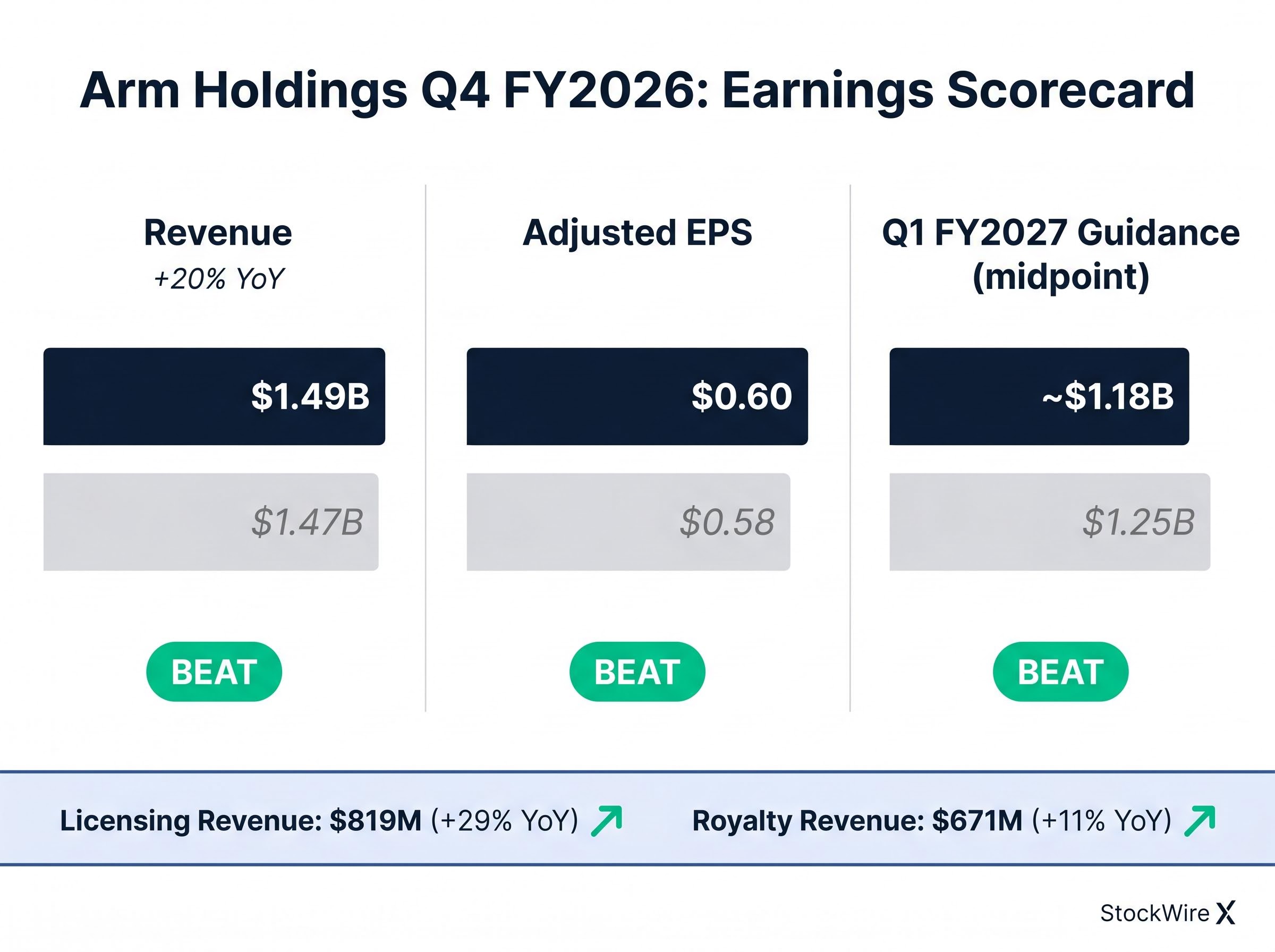
| Metric | Q4 FY2026 Actual | Consensus Estimate | Result |
|---|---|---|---|
| Revenue | $1.49 billion | $1.47 billion | Beat |
| Adjusted EPS | $0.60 | $0.58 | Beat |
| Q1 FY2027 Guidance (midpoint) | approximately $1.18 billion | $1.25 billion | Beat |
The stock did not decline because the quarter was weak. Investors who conflate the share price drop with a disappointing result are reading the wrong line of the earnings call.
When big ASX news breaks, our subscribers know first
How Arm’s AGI CPU became both the best and most complicated story on the call
In March 2026, Arm launched its AGI CPU product, a direct silicon play that marked a meaningful strategic departure from its traditional intellectual property licensing model. Rather than selling chip blueprints, Arm began selling finished data centre processors, a shift that placed the company in direct competition for hyperscaler server contracts.
On the earnings call, Haas framed the demand picture in terms that initially sent shares higher.
The scale of Arm’s disclosed demand becomes clearer when placed against the broader hyperscaler capex cycle: combined AI infrastructure spending across Meta, Microsoft, Alphabet, and Amazon is projected at $600 billion to $750 billion for 2026, a permanent reallocation that has shifted semiconductor supplier dynamics from demand uncertainty to supply constraint as the binding variable.
CEO Rene Haas described aggregate hyperscaler demand for AGI CPUs as exceeding $2 billion across FY2027 and FY2028, more than double the figure announced at launch, characterising the situation as “a good problem to have.”
The optimism lasted until CFO Jason Child spoke.
What “supply secured for half” actually means in practice
Child disclosed that supply has been confirmed for only the first $1 billion tranche, representing roughly 45-55% of total booked demand. Delivery in H2 FY2027 is expected to be “lumpy” due to foundry constraints.
The bottleneck sits at TSMC’s 3nm and 2nm capacity, where AI chip demand (including Arm Neoverse designs) is consuming approximately 60% of 3nm capacity through 2027. Arm’s allocations are capped not because of engineering issues but because of hyperscaler priority queuing at the foundry level. Samsung and GlobalFoundries have been cited in supply chain reporting as alternative ramp options, though TSMC retains approximately 70% share of these designs.
The pressure on Arm’s foundry allocations sits inside a broader TSMC capacity competition playing out across the entire advanced-node semiconductor industry, with Apple simultaneously exploring Samsung Foundry and Intel Foundry Services as potential US-based manufacturing alternatives in response to the same 3nm and 2nm scarcity that is capping Arm’s AGI CPU shipments.
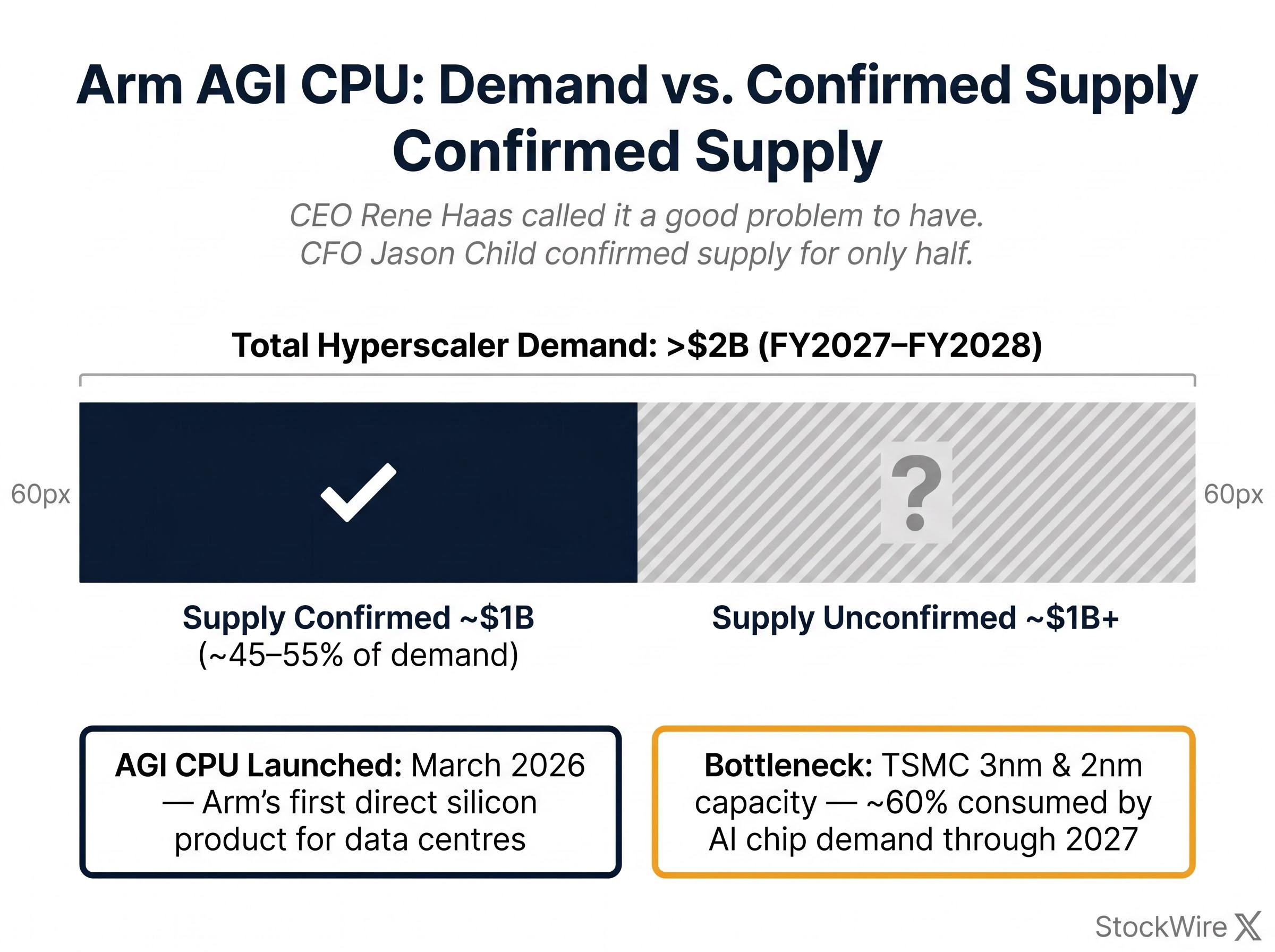
The gap is structural, not operational. Arm has a product hyperscalers want to buy. It cannot yet secure enough foundry capacity to fill the orders.
How markets price execution risk when valuation already assumes perfection
The intraday arc on 6 May traced the market processing two distinct pieces of information in sequence:
- Regular session close: shares rose 13.63% to $237.30 on the earnings beat
- After-hours high: shares briefly touched $239.50 as the call opened
- After-hours close: shares reversed to approximately $222.12, down roughly 6.4% from the regular close
- Pre-market 7 May: shares fell further to approximately $218.45, down approximately 8% from the prior close
The first move priced the beat. The second move repriced the execution risk embedded in the supply gap disclosure.
At approximately 121x forward P/E (based on the FY2027 non-GAAP EPS consensus of approximately $1.95), Arm’s valuation already embeds a strong execution assumption, leaving little margin for any new uncertainty about delivery timing.
At an EV/Revenue multiple of approximately 18x, the stock is priced for a company that converts its pipeline into recognised revenue on schedule. The supply gap disclosure introduced the first concrete evidence that conversion may be slower than the market assumed. In a valuation regime where execution is already priced as a given, even a partial disruption to the delivery timeline compresses the premium.
For investors holding Arm at 121x forward P/E, the supply gap is not the only risk to model: hardware spending sustainability across the hyperscaler cohort has attracted scrutiny from analysts who argue that $635 billion to $700 billion in FY2026 infrastructure commitments depend on generative AI application revenue catching up to deployment costs, a catch-up that has not yet materialised at scale.
Arm’s supply problem in context: how AMD and Intel are navigating the same pressure
Arm is not the only data centre chip supplier contending with demand that outstrips supply. Both AMD and Intel reported similar dynamics in their most recent quarters.
AMD reported Q1 2026 data centre revenue of $5.8 billion on 5 May, up 57% year-over-year, with server demand described as outpacing supply through CY2026 and a backlog exceeding $5 billion. Intel reported Q1 2026 data centre and AI revenue of $5.1 billion on 23 April, with CEO Lip-Bu Tan citing AI accelerator demand alongside x86 CPU shipment constraints related to 18A process delays and a backlog of approximately $4 billion.
AMD’s Q1 2026 beat was powered by the same structural shift: agentic AI workload demand is driving CPU procurement alongside GPU infrastructure, with AMD raising its server CPU total addressable market growth forecast from 18% to 35% annually and data centre revenue hitting $5.78 billion, a figure that contextualises exactly how large the hyperscaler appetite for non-GPU silicon has become.
| Company | Q1 2026 DC Revenue | Backlog | Supply Status |
|---|---|---|---|
| AMD | $5.8 billion | > $5 billion | Demand outpacing supply through CY2026 |
| Intel | $5.1 billion | ~$4 billion | 18A process delays constraining shipments |
| Arm | AGI CPU (new product) | > $2 billion demand | ~45-55% of demand supply-confirmed |
Piper Sandler’s 7 May note highlighted that Arm’s Neoverse architecture retains a structural edge for custom AI CPU workloads versus AMD and Intel’s general-purpose x86 designs. Barclays noted on 6 May that the hyperscaler AGI pull signals an architecture shift, but cautioned that the thesis depends on supply catching up. The difference is proportional exposure: Arm’s supply gap is larger relative to its disclosed demand, and its valuation premium leaves less room for slippage than AMD’s approximately 35x forward P/E or Intel’s lower multiple.
What the AGI CPU shift means for how Arm earns money going forward
Arm’s traditional business model operates on two revenue streams. The first is technology licensing: upfront fees collected when chip designers adopt Arm’s architecture. The second is per-unit royalties: smaller payments collected each time a device using an Arm design ships. Both streams grew in Q4 FY2026 (licensing up 29%, royalties up 11%), and neither depends on Arm physically manufacturing anything.
The March 2026 AGI CPU launch changed this structure. By entering direct silicon manufacturing for data centre chips, Arm moved from selling blueprints to selling finished processors. Revenue from this product line is contingent on physical supply, meaning foundry constraints now directly cap how much revenue Arm can recognise.
- Old model: Arm licenses designs and collects royalties regardless of which foundry manufactures the chip. Supply constraints at TSMC or elsewhere do not directly limit Arm’s revenue recognition.
- New model: Arm sells finished AGI CPUs to hyperscalers. If TSMC cannot allocate enough 3nm or 2nm capacity, Arm cannot ship the product, and the revenue remains unrecognised.
The data centre segment’s long-term projection of $15 billion (referenced at Arm’s Everywhere event) depends on this new model scaling. The supply gap matters more for Arm than it would for a pure-play IP licensor precisely because the business model shift has tied revenue to physical delivery.
How institutional investors are reading the disclosure
ARK Invest stated publicly on 6 May that the supply gap represents an execution risk rather than a demand risk, indicating an intention to add to its position on the dip. KeyBanc Capital Markets characterised the disclosure as a reality check on AGI hype, trimming FY2027 EPS estimates by 5% while maintaining its Overweight rating. Piper Sandler’s 7 May note acknowledged that the supply gap exposes higher execution risk than AMD’s fuller demand visibility, but concluded that the Neoverse architecture advantage remains intact.
What investors should actually be watching from here
Three forward-looking indicators will determine whether the supply gap resolves or widens:
- TSMC capacity allocation announcements: Any update on 3nm and 2nm allocation, particularly for Arm Neoverse tape-outs, is the most direct signal of whether the bottleneck is easing. TSMC management commentary at upcoming investor events will carry more weight than Arm’s own guidance on this front.
- Q1 FY2027 earnings (expected approximately August 2026): This will be the first financial read on whether H2 FY2027 delivery is tracking as guided or slipping further. Revenue recognition timing will matter more than the headline number.
- FY2027 consensus revenue trajectory: Wall Street currently sits at approximately $6.15 billion for full-year FY2027 (24 analysts, range $5.9 billion to $6.4 billion), up from $5.98 billion pre-earnings. Any downward revision tied to supply slippage could compress the 121x forward multiple further.
Analyst price targets reflect the range of outcomes the street is pricing:
- Low end: Goldman Sachs at approximately $125
- Recent upgrade: Susquehanna raised to $210 from $170 on 16 April 2026, maintaining Outperform
- High end: Mizuho at $255 (consensus high as of 6 May)
The spread between $125 and $255 is itself a measure of how uncertain the execution path remains.
Strong numbers, unresolved logistics: how to hold both at once
Q4 FY2026 was a genuine beat-and-raise quarter. The licensing business grew 29%. Royalties expanded 11%. Guidance cleared consensus. On the financials alone, there was nothing to sell.
The after-hours reversal was not irrational. At 121x forward P/E, Arm’s share price has always been a bet on execution, and the 6 May disclosure introduced the first concrete evidence that execution on the AGI CPU may be slower than the valuation assumed. ARK Invest sees an execution delay worth buying through. KeyBanc sees a reason to trim estimates while holding conviction. Both readings are internally consistent; the difference lies in how much tolerance each investor assigns to a supply gap of this scale at this multiple.
The quarter answered the demand question. The supply question remains open.
This article is for informational purposes only and should not be considered financial advice. Investors should conduct their own research and consult with financial professionals before making investment decisions. Past performance does not guarantee future results. Financial projections are subject to market conditions and various risk factors.






