
Morgans has issued sell ratings on all four of Australia’s major banks simultaneously, a sweeping call that implies meaningful downside across stocks held by millions of Australian investors through superannuation, direct equity, and income portfolios. The ratings, issued in late April 2026, land at a critical moment: ANZ, NAB, and Westpac are days away from reporting interim results, Westpac has already flagged weaker revenues and higher impairment charges in a pre-result trading update, and NAB has just completed a $1.8 billion equity raising. These are not abstract valuation exercises. They are forward-looking assessments tied to specific earnings drivers now unfolding in real time. What follows is a breakdown of the specific price targets, total return estimates, and earnings concerns behind each of Morgans’ four sell calls, along with a framework for how investors should interpret broker ratings and total return signals when evaluating major ASX bank shares in their portfolios.
Morgans’ verdict on Australia’s big four banks: a rare coordinated sell signal
Sell ratings on all four major banks at once is an unusual occurrence in Australian equity research. Brokers typically differentiate within the sector, favouring one or two names while flagging others for caution. Morgans’ decision to rate ANZ, CBA, NAB, and Westpac as sells reflects a sector-wide valuation concern rather than isolated stock-specific views.
Sector price momentum has diverged sharply from analyst consensus in 2026, with the ASX 200 Financials sector gaining approximately 8.87% year to date even as all 14 analysts covering CBA maintained sell ratings, a split that makes the gap between current prices and Morgans’ price targets appear less anomalous and more representative of a broad analyst community concern.
The trigger is quantitative. Morgans downgrades to a sell rating when expected total shareholder return, combining capital movement to the price target with forecast dividend yield, falls below approximately negative 10% over a 12-month horizon.
Morgans’ sell threshold: A stock receives a sell rating when the broker’s model estimates total shareholder return of approximately negative 10% or worse over the next 12 months.
Bank of Queensland was simultaneously downgraded from accumulate to hold, rounding out the sweep across Morgans’ entire covered banking universe.
Across Morgans’ full coverage:
- ANZ: Sell
- CBA: Sell
- NAB: Sell
- Westpac: Sell
- Bank of Queensland: Downgraded from accumulate to hold
For investors who hold bank stocks as dividend income plays or through diversified super funds, a coordinated sell signal across the entire sector warrants active consideration of whether current allocations are appropriately sized for the risk Morgans is flagging.
When big ASX news breaks, our subscribers know first
The numbers behind each sell call: price targets and implied downside
The implied downside across all four names is substantial. Even after accounting for dividend income, Morgans’ models suggest each stock is positioned to destroy capital on a 12-month view at current prices.
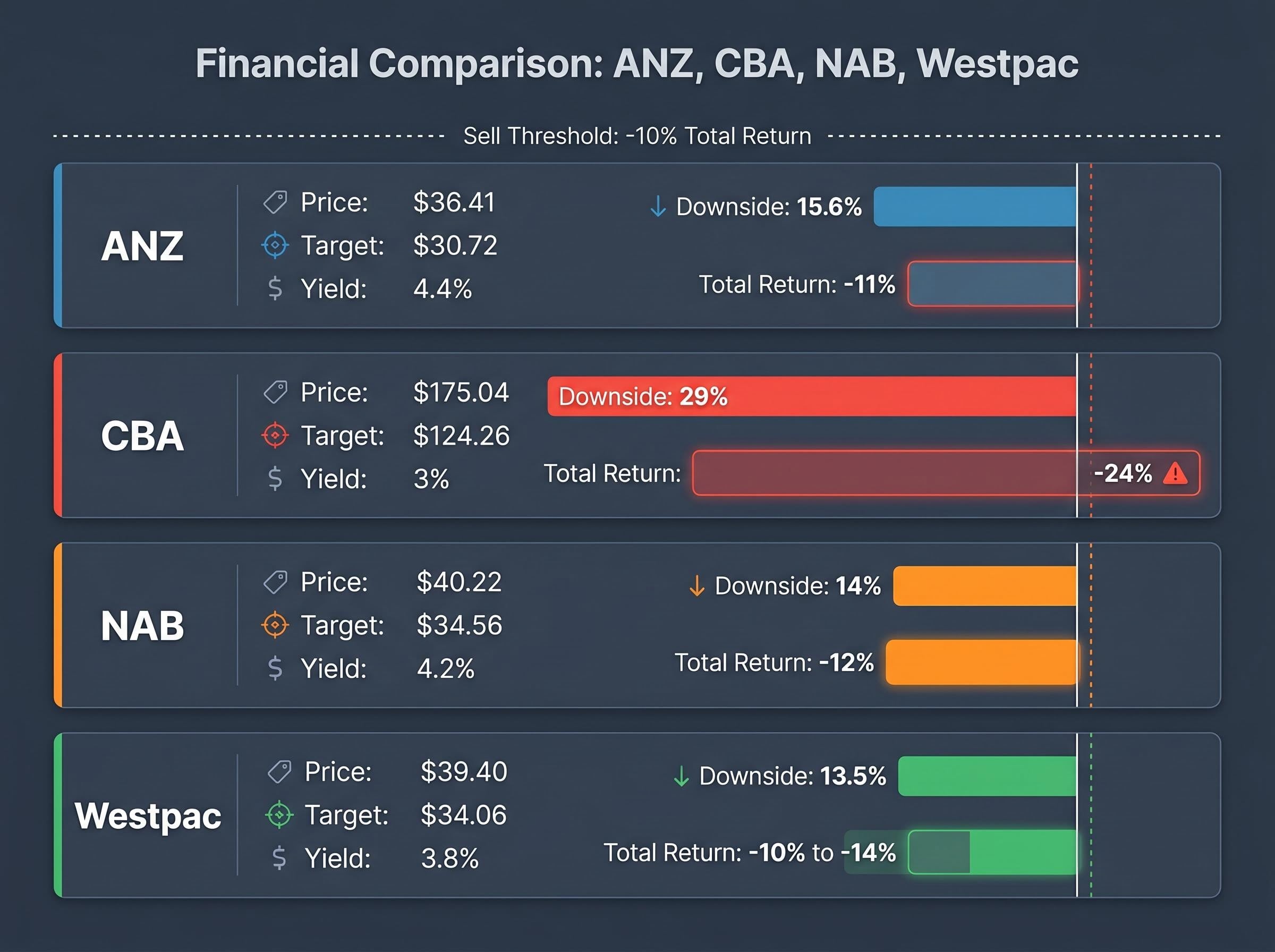
| Bank | Morgans Price Target | Share Price at Assessment | Implied Capital Downside | Estimated Total Return (12 months) |
|---|---|---|---|---|
| ANZ | $30.72 | $36.41 | Approx. 15.6% | Approx. -11% (incl. ~4.4% yield) |
| CBA | $124.26 | $175.04 | Approx. 29% | Approx. -24% (incl. ~3% yield) |
| NAB | $34.56 | $40.22 | Approx. 14% | Approx. -12% (incl. ~4.2% yield) |
| Westpac | $34.06 | $39.40 | Approx. 13.5% | Approx. -10% to -14% (incl. ~3.8% yield) |
The dividend yields partially offset capital losses but do not come close to neutralising them. CBA represents the most extreme gap, and it deserves closer examination.
Why CBA stands out even among the sell-rated banks
CBA’s sell rating persists despite Morgans actually upgrading its earnings-per-share forecasts and price target after a stronger-than-expected half-year result reported on 11 February 2026. The issue is not earnings quality. It is the trading multiple.
Morgans’ concern is that CBA’s share price has run so far ahead of fair value that even improved earnings cannot justify the current level. At approximately 29% implied capital downside, the gap between price and target is nearly double that of the other three banks.
CET1 capital ratio tightness adds a further constraint. It limits the scope for dividend-per-share growth, which means the income case for holding CBA at current prices is weaker than the headline yield of approximately 3% implies.
Investors wanting to understand why earnings upgrades have not narrowed the valuation gap will find our deep-dive into CBA’s price-to-earnings multiple instructive; it examines how CBA’s current trading multiple of roughly 27x compares to its historical average of approximately 18x and to global peer JPMorgan at approximately 12x, and explains why record profits have pushed valuations further above analyst targets rather than closing them.
What is driving each bank’s earnings downgrades: the specific pressures behind the calls
The sell ratings reflect actual deterioration in near-term earnings trajectories, not simply a valuation adjustment applied to unchanged fundamentals. Each bank faces a distinct combination of pressures.
NAB:
- $1.8 billion DRP equity raising announced 20 April 2026, adding approximately 40 basis points to capital but diluting earnings per share
- Elevated provisioning charges weighing on bottom-line forecasts
- Accelerated amortisation of capitalised software compressing reported earnings further
Westpac:
- Pre-result trading update on 14 April 2026 revealed revenues below both Morgans’ and broader consensus expectations
- Credit impairment charges exceeded forecasts, signalling faster-than-expected asset quality deterioration
- Operating costs were the sole positive surprise, coming in below expectations
ANZ:
- Forward EPS forecasts for FY2026 through FY2028 cut by 6-7%, with the price target reduced 6% to $30.72
- Downgrades informed partly by read-across from Westpac’s and NAB’s pre-result signals ahead of ANZ’s own May result
- The May interim result will be the first opportunity to test whether the cuts are conservative enough
Behind all three sits a sector-wide credit cycle story. Total Big Four provisions are forecast to rise sharply over the next two years.
APRA’s quarterly ADI statistics for December 2025 show aggregate CET1 ratios and provisioning levels across the authorised deposit-taking institution sector, providing the regulatory baseline against which each bank’s capital headroom and credit buffer adequacy can be measured.
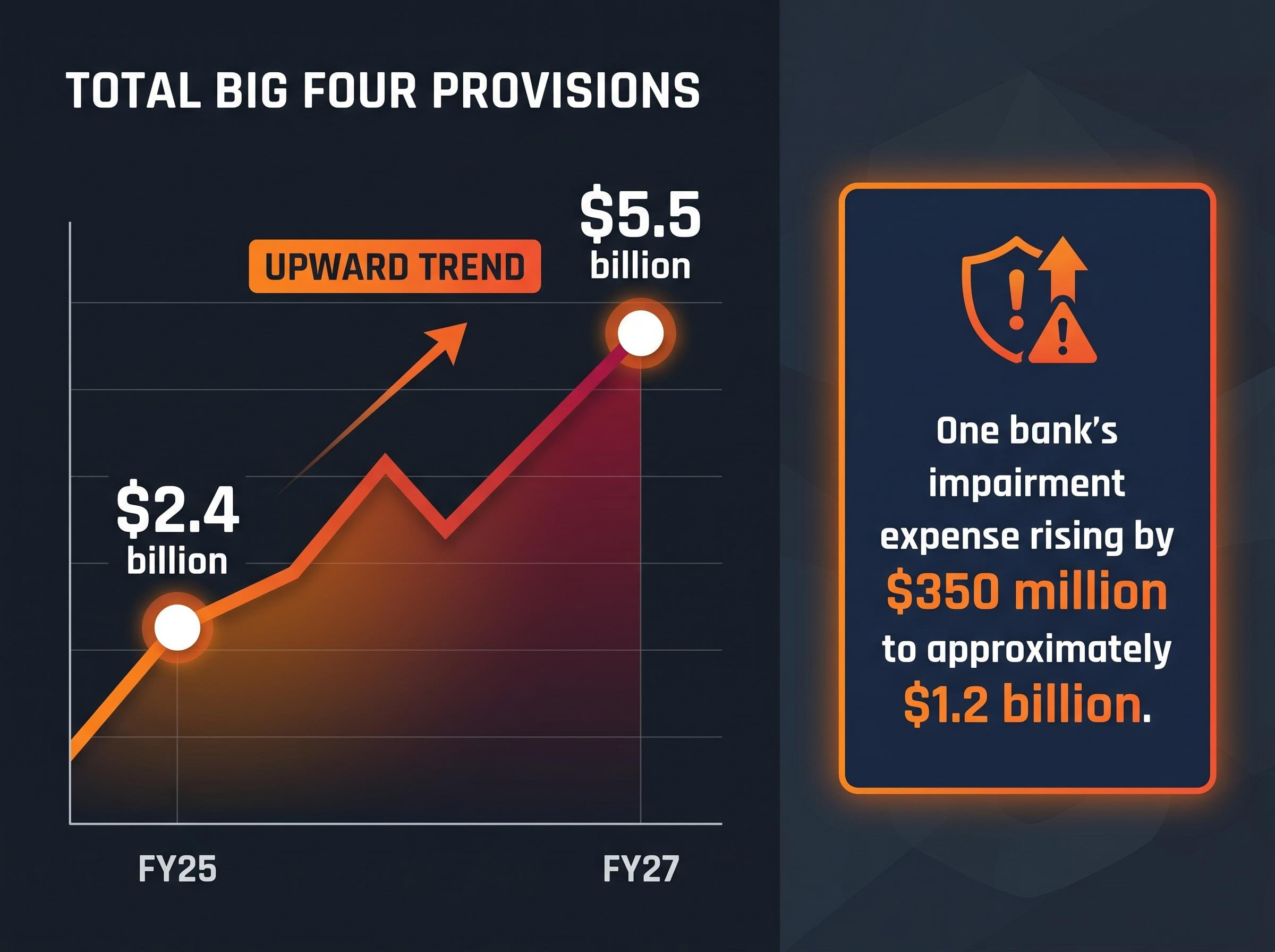
Industry provisioning trajectory: Total Big Four bank provisions are projected to rise from approximately $2.4 billion in FY25 to approximately $5.5 billion by FY27, with one bank’s impairment expense alone estimated to increase by $350 million to approximately $1.2 billion.
These are not valuation-driven downgrades. They reflect earnings models being marked down to account for credit deterioration that is already appearing in pre-result disclosures.
How broker ratings and price targets actually work: a framework for Australian investors
A broker sell rating is not an instruction to sell. It is a signal that one analytical model, built on specific assumptions, projects negative total returns from the current price. Understanding how these calls are constructed helps investors decide whether the assumptions match their own situation.
The standard spectrum of broker ratings in Australian equity research runs from strong buy through buy (or accumulate), hold (or neutral), reduce (or trim), and sell. Each rating corresponds to an expected total return band over a 12-month horizon, with thresholds varying by broker.
A price target represents the broker’s 12-month fair value estimate based on modelled earnings, margins, and multiples. It is not a prediction of where the stock will trade. Market consensus is the average of multiple brokers’ targets, and divergence between any single broker’s target and consensus is itself informative.
Total shareholder return, as brokers use the term, combines the expected capital gain or loss (the gap between current price and price target) with the forecast dividend yield over 12 months.
A four-step framework for evaluating any broker rating:
- Identify the rating and its return threshold (Morgans triggers a sell at approximately -10% total return)
- Compare the price target to consensus (Morgans’ ANZ target of $30.72 sits $5.94, or approximately 16%, below the consensus average of $36.66 from 14 analysts)
- Examine the earnings assumptions driving the forecast, particularly provisioning, margin, and growth inputs
- Assess the total return estimate against your own time horizon and income needs
When brokers disagree: what divergent views on the same stock mean for investors
The ANZ and Westpac situations illustrate how wide disagreement can run. Morgans rates both as sells. Morningstar, by contrast, considers both to be trading at a greater than 20% discount to fair value, a directly contradictory assessment.
This divergence typically reflects different modelling assumptions: normalised earnings levels, credit cycle timing, and discount rates rather than different access to facts. Morgan Stanley separately maintains a sell rating on NAB with a price target of $39.30 as of 21 April 2026, directionally aligned with Morgans but significantly less bearish on the magnitude of downside.
ANZ’s broker consensus profile is the most divided of the four banks: roughly six of sixteen covering analysts hold buy ratings supported by the post-Suncorp acquisition scale benefits and a CET1 ratio of 12.2%, while the bear case targets imply downside approaching 20%, a spread that reflects genuine two-way uncertainty rather than a one-sided call.
Wider broker disagreement on a stock is itself useful information. It signals higher uncertainty around the fundamental outlook, which investors should factor into position sizing regardless of which broker’s view they find more persuasive.
The macro backdrop feeding the bearish case: housing, credit risk, and the rate environment
The Morgans calls do not exist in isolation. They reflect a genuine inflection point in Australian credit conditions that investors can track independently.
National home prices fell 0.1% in April 2026, following a rise of 0.7% in March, with quarterly growth of 2.1% to March and a median home value of approximately $910,000.
Housing is the fundamental collateral base for the big four banks’ mortgage books. The April softening, modest as it appears in a single month, arrives after a period of prior RBA rate hikes that compressed net interest margins and pushed borrower stress higher. Stage 3 loan risks, the category that captures borrowers closest to default, are increasing.
The PropTrack Home Price Index for April 2026 recorded a 0.1% national price fall, bringing the median home value to approximately $910,000 and confirming that the brief recovery in dwelling values earlier in the quarter has stalled, a shift with direct implications for the collateral quality underpinning the big four banks’ mortgage books.
Three macro risk factors sit behind the provisioning forecasts embedded in Morgans’ price targets:
- Housing price trajectory: Early signs of softening after a brief recovery, with national prices now declining month on month
- Stage 3 loan growth: The combined effects of rate hikes and cost-of-living pressures are pushing more borrowers into distressed categories
- Provision adequacy: Analyst commentary suggests existing bad debt buffers may be insufficient to absorb deteriorating credit conditions
The May interim results from ANZ, NAB, and Westpac will be the first clear read on whether provisioning assumptions are conservative enough or whether the deterioration is accelerating faster than models anticipate. KPMG’s analysis of the Big Four half-year results is scheduled for 5 May 2026, providing an additional aggregate reference point.
What comes next for big four investors as May results approach
The May 2026 interim results season is the decisive near-term test. It will either validate Morgans’ bearish provisioning and earnings assumptions or provide grounds to reassess them.
Westpac reports first-half FY2026 results on 5 May 2026, the first scheduled read on actual credit quality numbers. ANZ and NAB are expected to follow later in May, though exact dates were unconfirmed as of the research date. CBA already reported its half-year results on 11 February 2026 and is not in the immediate reporting window.
Three metrics to watch in each bank’s May result:
- Credit impairment charges versus analyst forecasts: The single most important line item for validating or challenging the Morgans thesis
- Net interest margin direction: Whether margin compression is stabilising or accelerating under competitive and rate pressure
- CET1 capital ratio relative to regulatory minimums: Capital headroom determines dividend sustainability and appetite for further provisioning
Results calendar:
- Westpac: 5 May 2026
- ANZ: May 2026 (date to be confirmed)
- NAB: May 2026 (date to be confirmed)
- CBA: Already reported (11 February 2026)
For investors deciding whether to reduce, hold, or add to bank positions now, the next four to five weeks represent a high-information period. The results will provide the data to judge whether Morgans’ assumptions are too conservative, too generous, or about right.
The sell sweep in context: where this leaves investors in Australia’s most owned stocks
The big four banks are among the most widely held stocks in Australia through superannuation and direct equity portfolios. Morgans sees meaningful negative total returns across all four on a 12-month view: approximately -11% for ANZ, -24% for CBA, -12% for NAB, and -10% to -14% for Westpac.
Broker consensus is not unanimous. ANZ carries a mean hold rating from 14 analysts at an average target of $36.66, well above Morgans’ $30.72. Morningstar considers ANZ and Westpac to be trading at a greater than 20% discount to fair value. Informed analysts disagree, and that disagreement is genuine two-way uncertainty rather than noise.
Before acting on or dismissing the Morgans calls, investors holding bank positions should consider three self-assessment questions:
- Does a 12-month time horizon match the holding period for the bank stocks in the portfolio, or is the position held for longer-term income?
- How reliant is overall portfolio income on big four dividends, and would a reduction create a meaningful income gap?
- Do the provisioning and credit quality assumptions in Morgans’ models feel conservative, generous, or about right based on personal assessment of the Australian housing and employment outlook?
The Morgans sell sweep does not require automatic action. It does require engagement with the specific assumptions about credit quality, valuation multiples, and earnings trajectories that underpin it. The May results will provide the next opportunity to test those assumptions against actual bank disclosures.
For income investors weighing whether to hold or reduce bank positions, our dedicated guide to ASX bank dividends versus term deposits compares current term deposit rates of 5.00-5.10% against each bank’s franking-adjusted yield, models the payout ratio constraints limiting future dividend growth, and works through the specific scenarios where the income case for bank shares remains compelling despite the capital risk Morgans is flagging.
This article is for informational purposes only and should not be considered financial advice. Investors should conduct their own research and consult with financial professionals before making investment decisions. Past performance does not guarantee future results. Financial projections are subject to market conditions and various risk factors.