The founder of a prominent athletic apparel brand has officially launched an aggressive campaign to overthrow the board of directors leading the company he created. Chip Wilson escalated his grievances from private negotiations into a public Lululemon proxy fight in late April 2026 following a complete breakdown in standstill talks. The retail market is now watching a high-profile governance clash unfold in real time.
This development forces shareholders to evaluate the financial triggers behind the dispute, the proposed leadership overhaul, and what this governance battle means for everyday investors. By stepping away from closed-door discussions, the founder has thrust the brand’s internal conflicts into the public spotlight.
The Breakdown: How Standstill Negotiations Collapsed
The conflict became inevitable when private truce negotiations failed over strict contractual demands designed to limit the founder’s influence. The incumbent board proposed a long-term standstill agreement that included a non-disparagement provision to prevent public criticism of current management.
Negotiators required Wilson to establish an escrow account of at least $1 million to enforce these financial penalty clauses in the event of a breach. Wilson categorically refused to accept the restrictive terms, pulling out of talks and immediately triggering his public letters to the shareholder base.
The complete text of Chip Wilson’s letter to shareholders explicitly outlines how the proposed million-dollar escrow account would enforce a novel non-disparagement provision, a critical detail omitted from preliminary proxy filings.
“The board failed to publicly declare these specific penalty demands in their regulatory filings.”
Understanding why this truce failed shows investors just how fractured the relationship between the founder and the current board has become. The collapse of these private talks guarantees a protracted and expensive corporate battle ahead. The board’s attempt to enforce financial penalties only accelerated the public confrontation.
When big ASX news breaks, our subscribers know first
The 17 Billion Dollar Grievance: Inside the Financial Slump
The activist campaign stems directly from severe market underperformance and degrading corporate metrics over the past five years. Wilson argues that the loss of high-end brand prestige is the primary driver of these financial woes, demanding immediate structural changes to halt the downward trajectory.
This internal deterioration is being compounded by shifting US consumer spending patterns, as affluent shoppers increasingly deplete their savings and pull back on premium discretionary purchases.
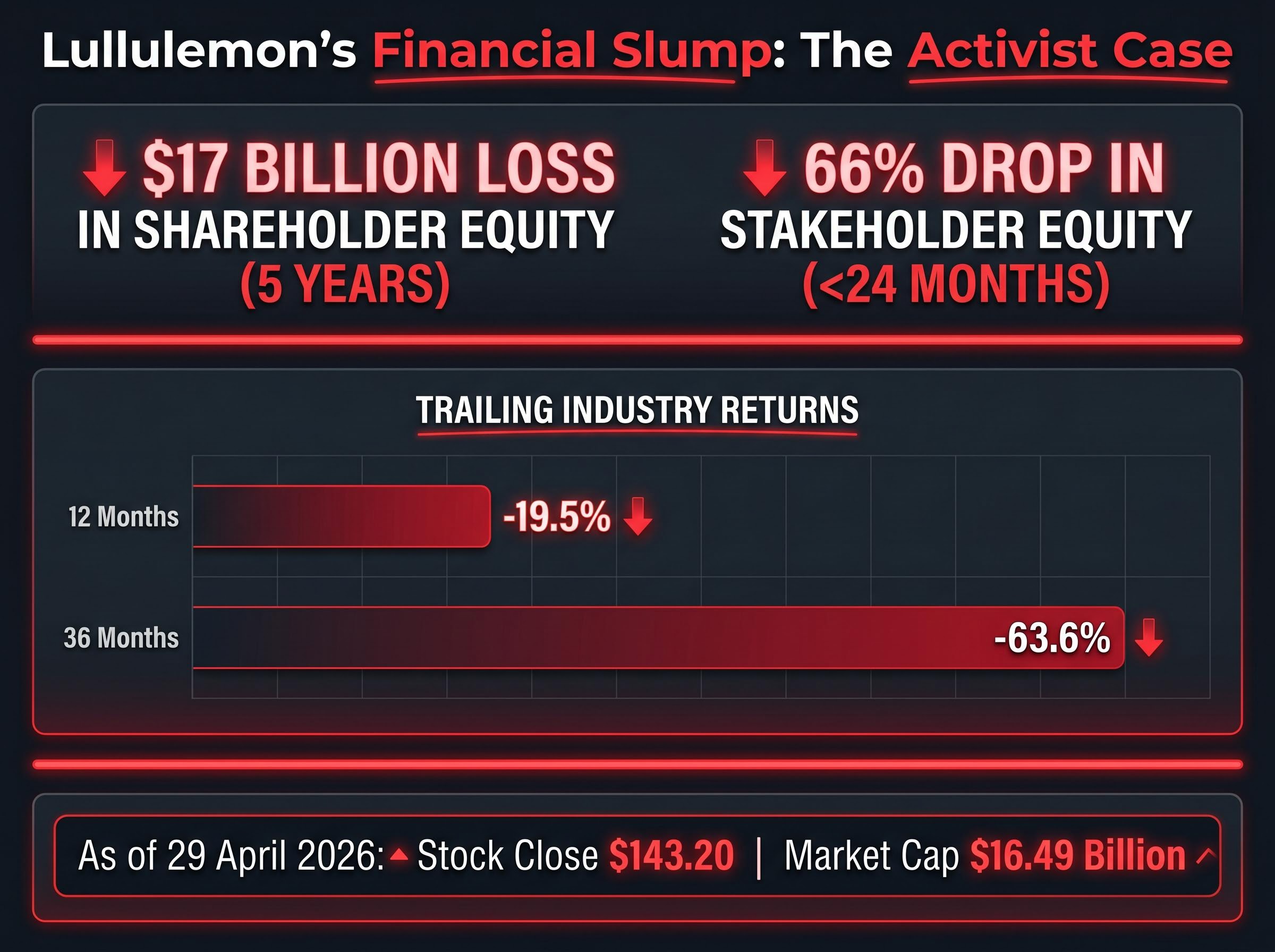
He has presented specific financial data to justify his intervention to the broader shareholder base and institutional investors:
An estimated $17 billion loss in shareholder equity over the past five years. According to campaign data, a 66% drop in stakeholder equity over a period of less than 24 months. Stock closing at $143.20 with a market capitalisation of approximately $16.49 billion as of 29 April 2026. According to campaign data, overall returns trailing industry competitors by 19.5% over 12 months and 63.6% over 36 months.
These metrics provide the fundamental justification for the corporate challenge. Investors can now see the quantitative damage underpinning the qualitative complaints about brand dilution and strategic missteps. The figures transform a narrative about creative differences into a concrete debate over shareholder value destruction.
Understanding the Mechanics of a Proxy Contest
A proxy contest occurs when insurgent shareholders attempt to persuade existing investors to use their voting rights to install new corporate directors. Retail investors often hear the term without understanding that it involves a formal campaign of mailing gold-coloured proxy materials to solicit these alternative votes. The process requires a comprehensive strategy to outmanoeuvre incumbent leadership through targeted shareholder communication.
The Push for Declassification
The current corporation operates with a staggered board, meaning directors are elected for multi-year terms rather than facing annual performance reviews. Declassification is a major goal for activist investors because it forces the entire board to face an election simultaneously, removing entrenched protections.
According to campaign claims, corporate governance data indicates that only one-tenth of S&P 500 corporations continue utilising the staggered election framework today. This structural reform empowers shareholders to read corporate filings with clear stakes, knowing their vote can enact immediate and sweeping leadership changes across the entire board.
Recent academic research on classified boards confirms this statistical shift, noting that the vast majority of large publicly traded corporations have moved toward annual director elections to improve overall shareholder accountability.
The Battle Lines: Wilson’s Nominees vs The Incumbent Board
Wilson is contrasting the insurgent energy of his handpicked turnaround experts against the entrenched private equity presence on the current board. He has formally nominated three alternative candidates with extensive retail experience to replace the current directors and execute his proposed operational overhaul.
The inclusion of leaders with proven track records in high-growth retail expansion strategies signals an intent to pivot away from financial engineering and back toward aggressive consumer market penetration.
A core component of the campaign involves specific conflict of interest allegations regarding Advent International L.P. According to Wilson, exactly four existing board members possess overlapping professional backgrounds with the private equity firm. Wilson aims to replace this financial engineering background with operators who possess direct brand-building experience.
| Nominee Name | Previous Corporate Experience | Key Financial Achievement |
|---|---|---|
| Marc Maurer | Former Co-CEO at On Running | Led significant global retail expansion and brand scaling |
| Laura Gentile | Former Executive at ESPN | Spearheaded major brand marketing and audience growth initiatives |
| Eric Hirshberg | Former CEO at Activision | According to campaign materials, delivered 500% equity share surges and doubled earnings over eight years |
Investors need to evaluate the actual people who might take control of the company. This comparison forces shareholders to choose between competing leadership visions for the apparel brand’s future. The vote will serve as a referendum on whether financial oversight or brand expertise should drive the next phase of corporate growth.
Leadership Under Fire: The CEO Transition and Brand Controversies
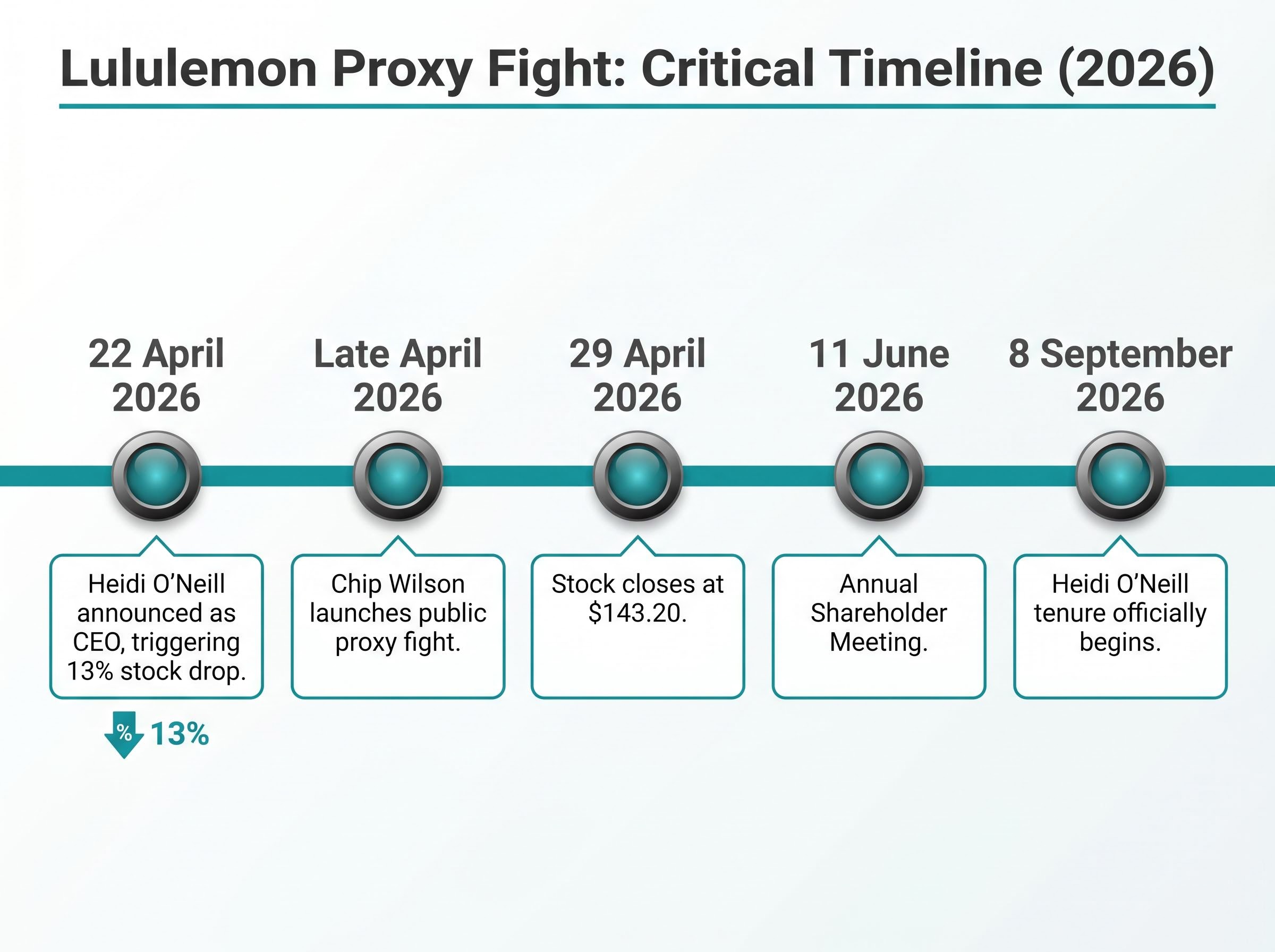
The boardroom battle coincides with a highly volatile executive transition that has amplified market skepticism. On 22 April 2026, the company announced the appointment of former Nike executive Heidi O’Neill as chief executive, effective 8 September 2026.
The market reaction was immediate and negative, resulting in a 13% stock drop following the announcement of her incoming tenure. Wilson claims recent brand collaborations have severely diluted the company’s premium status, a sentiment echoed by Wall Street professionals observing the sector. Discussions regarding a recent collaboration with the Walt Disney Company are limited to standard social media chatter, with no verifiable evidence of corporate backlash.
Similar executive shifts across the retail sector show that implementing strategic turnaround initiatives often requires a painful transition period, as incoming leaders must balance immediate operational triage with long-term brand rehabilitation.
The new chief executive will inherit three compounding crises on day one:
- Navigating a highly public and expensive proxy contest during her first quarter.
- Reversing a $17 billion erosion in shareholder equity amid profound market skepticism.
- Rebuilding the brand’s premium perception following heavily criticised corporate partnerships.
Executive transitions during governance disputes create massive volatility. This environment highlights the immediate headwinds the stock faces regardless of who wins the board seats. The ongoing instability leaves current shareholders highly exposed to near-term execution risks.
The June Showdown: What Shareholders Need to Watch
The corporate dispute will culminate at the Annual Shareholder Meeting officially scheduled for 11 June 2026. Major institutional players like Vanguard and BlackRock have yet to signal their voting intentions, leaving the final outcome highly uncertain as proxy advisors begin their reviews.
Analysts currently view the activist campaign’s likelihood of success as moderate, supported heavily by Wilson’s retained 9% ownership stake. This upcoming vote represents a highly consequential event that will determine the brand’s trajectory for the next decade.
For investors exploring how these structural shakeups unfold in practice, our full explainer on activist investing details the methods external entities use to force sweeping leadership changes, highlighting recent proxy successes in the broader consumer market.
This article is for informational purposes only and should not be considered financial advice. Investors should conduct their own research and consult with financial professionals before making investment decisions. Past performance does not guarantee future results.