AstraZeneca committed £300 million to British infrastructure on Wednesday, directly reversing a highly publicised retreat from the country just months prior. The April 29, 2026 announcement coincides with a massive first-quarter earnings beat and direct praise from Prime Minister Keir Starmer.
This dual development signals a repaired relationship between the pharmaceutical leader and the UK government following a fractured year of negotiations. This AstraZeneca UK investment allocation offers investors and sector analysts a clear breakdown of exactly where the capital is flowing.
The deployment highlights the immediate impact on regional life sciences hubs and domestic technological partnerships. Understanding this specific capital allocation reveals what the renewed commitment signals for the broader UK pharmaceutical regulatory environment.
The structural policy shift provides a clear template for how multinational healthcare corporations evaluate domestic operational viability. Capital markets are closely monitoring how the government secures these infrastructure commitments against competing international jurisdictions.
Mapping the Cambridge and Macclesfield Upgrades
The new infrastructure initiative allocates the entire £300 million capital injection across two primary regional sites in England. The funding directly targets the Rosalind Franklin structure at the Cambridge headquarters alongside new operational footprints in Macclesfield.
This geographic allocation represents a major victory for domestic employment in the life sciences sector. The upgrades mark a distinct shift away from traditional manufacturing capabilities and toward advanced digital infrastructure.
The capital expenditure encompasses the following specific facility upgrades:
Finalisation of the Rosalind Franklin research structure at the Cambridge headquarters Establishment of advanced data analytics centres in Macclesfield * Implementation of digital systems testing facilities to support global clinical trial networks
Investors evaluating regional supply chains can see this deployment strongly favours technology partners over traditional industrial contractors. The Macclesfield data facilities will process clinical outcomes directly from European trial cohorts, integrating the UK operations deeper into the company’s global analytics pipeline.
This transition toward data-driven trial management frequently relies on external clinical imaging analytics partners and diagnostic technology providers to accelerate assessment timelines.
The UK expansion parallels broader corporate growth, complementing the separate £300 million cell therapy manufacturing facility in Rockville, Maryland. That United States facility is currently creating over 150 jobs globally and focuses on T-cell therapies for cancer trials.
When big ASX news breaks, our subscribers know first
Decoding the Regulatory Shift Behind the Scenes
The renewed capital deployment reflects a rapid improvement in the domestic regulatory environment since the start of 2025. Understanding the friction between National Health Service funding constraints and pharmaceutical development costs explains the rapid policy reversal.
Drug pricing disputes occur when healthcare providers cap the prices they will pay for novel treatments, directly impacting the revenue projections of the companies developing them. When these pricing thresholds fall below the cost of long-term commercialisation, pharmaceutical giants often redirect infrastructure capital to more profitable jurisdictions.
The regulatory framework shifted markedly in the opening months of 2026. According to industry reports, four new medical therapies received regulatory clearance in the United Kingdom since January, demonstrating accelerated approval pathways.
Prime Minister Keir Starmer directly involved his government in the recent international pharmaceutical agreements that facilitated these approvals. Chief Executive Officer Pascal Soriot cited improved patient medicine availability as a primary driver for the renewed domestic focus.
Government Statement “This investment represents a major vote of confidence in the UK economy and our life sciences sector,” Prime Minister Keir Starmer stated following the announcement.
This alignment between state health policy and corporate strategy provides long-term sustainability for the United Kingdom market. Investors tracking geopolitical risk can view the recent clearances as evidence of structural policy improvement rather than isolated corporate concessions.
For readers wanting to understand how these domestic agreements compare to global infrastructure moves, our deep-dive into multinational capital allocation explores how pharmaceutical giants weigh UK regulatory reforms against massive parallel investments in Asian markets.
First Quarter Financials and Market Reaction
The regional infrastructure decision is backed by a massive cash-generating oncology and rare disease portfolio. The company released its first-quarter 2026 earnings concurrently with the infrastructure announcement, revealing significant global revenue expansion.
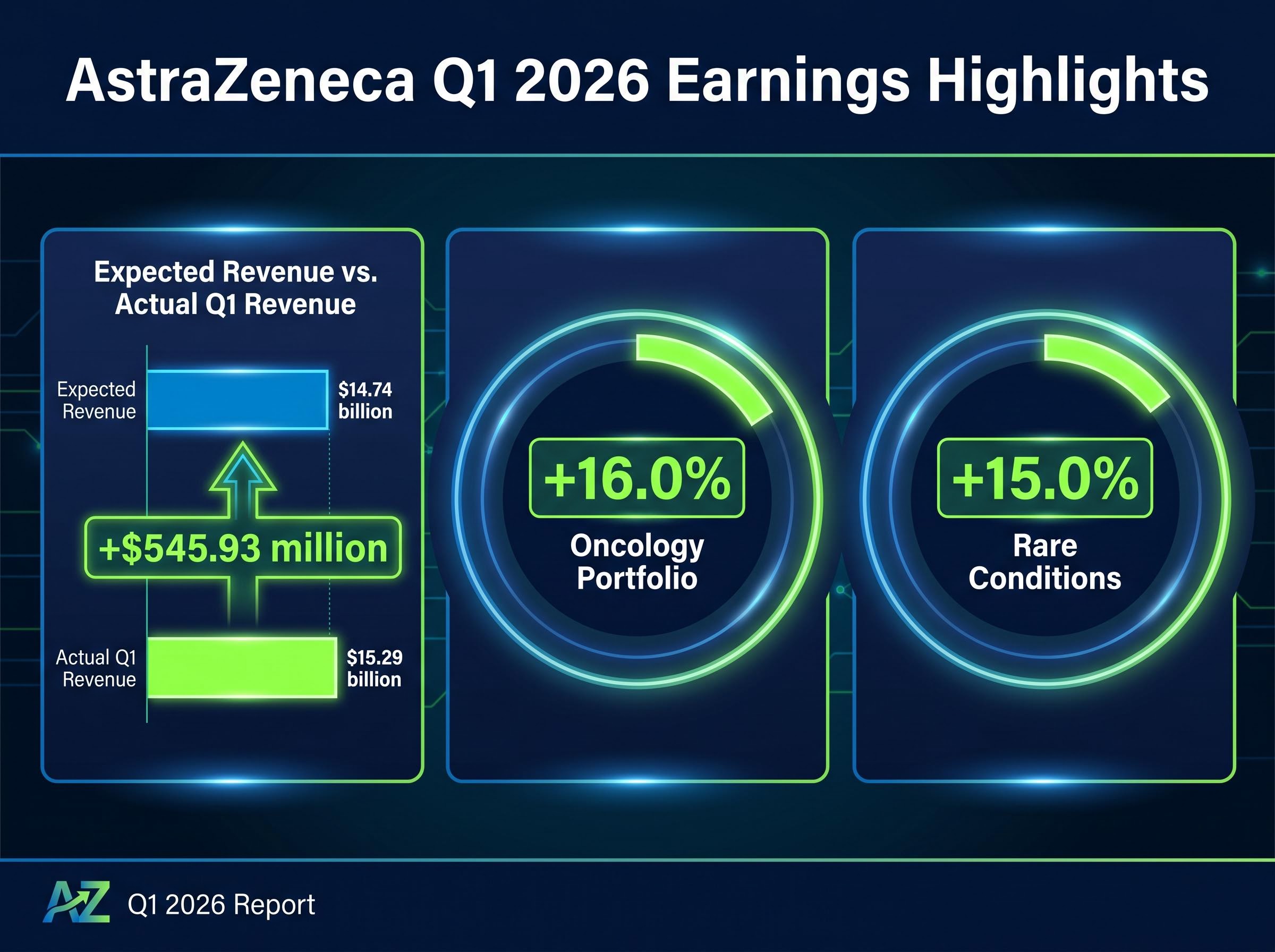
Total revenue reached $15.29 billion, surpassing analyst expectations driven largely by specialised therapeutic divisions. According to company data, the oncology portfolio expanded by 16 percent, while rare condition therapies increased by 15 percent.
According to market data, this momentum establishes a strong comparative position against sector competitor GSK, which reported overall sales of £7.6 billion with its own oncology division surging 28 percent.
Deepening these pharmaceutical earnings comparisons reveals that both companies are heavily relying on high-margin oncology and rare disease segments to drive their broader commercial trajectories.
| Financial Metric | Expected Result | Actual Result | Difference |
|---|---|---|---|
| Q1 2026 Total Revenue | $14.74 billion | $15.29 billion | +$545.93 million |
| Oncology Portfolio | Sector Consensus | Unspecified Base | +16.0% |
| Rare Conditions | Sector Consensus | Unspecified Base | +15.0% |
LSE Market Response and Shareholder Sentiment
The London Stock Exchange reacted immediately to the dual announcements of high revenue and resolved government friction. The AZN ticker opened at 14,026.00 GBp on April 29, 2026, representing a notable increase from the previous close of 13,972.00 GBp on April 27.
The market is directly rewarding the combination of exceptional cash flow generation and the elimination of domestic political overhang. Shareholders have responded positively to management deploying surplus capital into advanced analytics rather than traditional manufacturing infrastructure.
Past performance does not guarantee future results. Financial projections and market reactions are subject to ongoing volatility.
Reversing the 2025 Corporate Retreat
The current optimism stands in stark contrast to the specific abandoned projects that dominated the company’s domestic strategy last year. The United Kingdom came remarkably close to losing this capital entirely during a protracted standoff over state financial assistance.
Throughout 2025, the pharmaceutical leader initiated an industry-wide retreat from British infrastructure. According to industry reports, the company cancelled a £450 million manufacturing project intended for Speke in January 2025, explicitly citing a reduction in government funding support.
This was followed by a September 2025 decision to pause a £200 million research site expansion in Cambridge. According to regional estimates, that stalled project would have generated an estimated 1,000 jobs for the regional economy.
The previously paused Cambridge research site expansion served as a highly visible warning to policymakers regarding the commercial viability of domestic drug development under uncompetitive state funding models.
The April 2026 announcement operates as a direct revival and strategic replacement of these lost initiatives. By reviewing the cancelled projects, investors gain a realistic perspective on the fragility of corporate investments when competitive government subsidies are lacking.
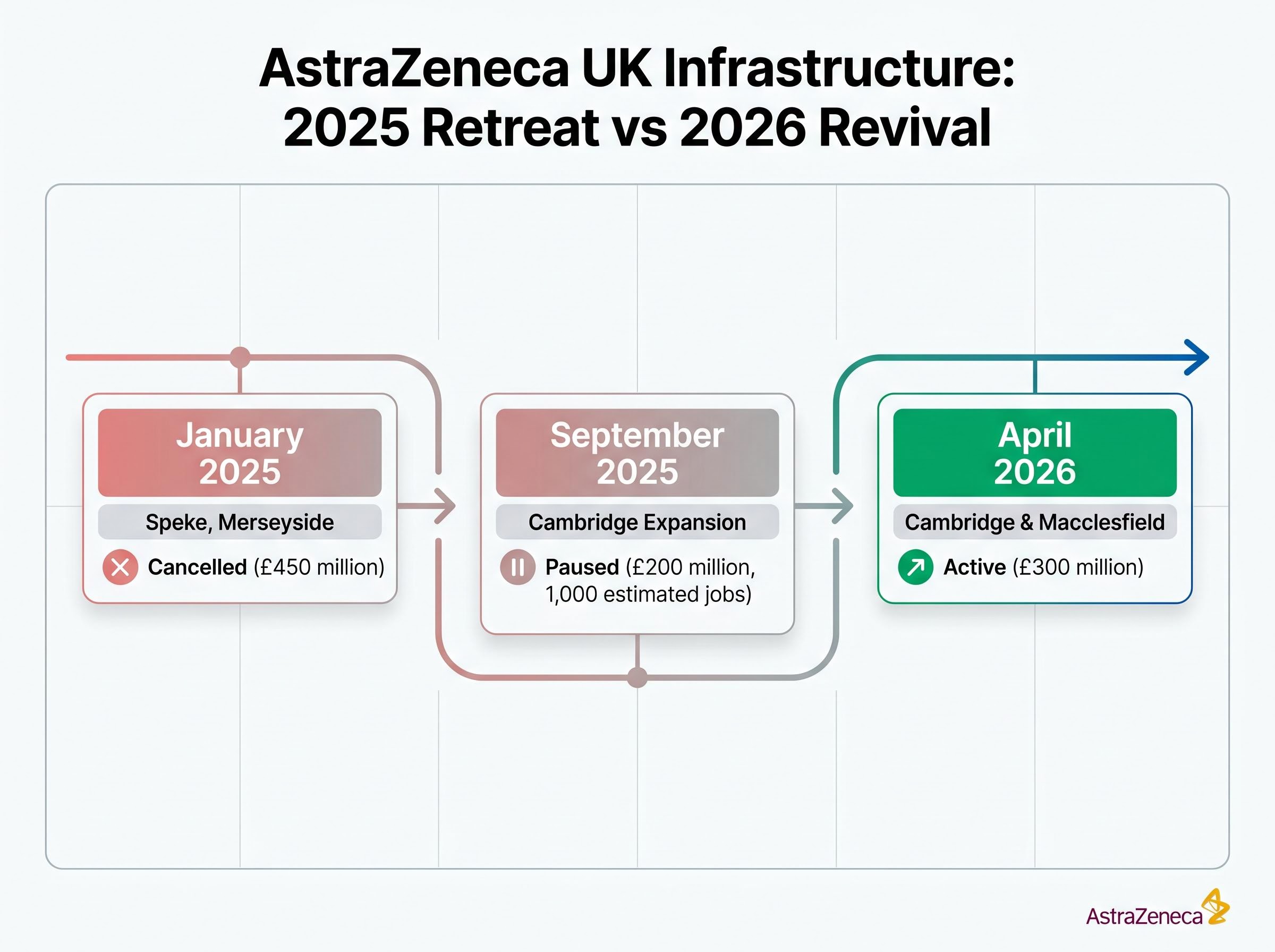
| Facility Location | Project Status | Estimated Value | Primary Reason Given |
|---|---|---|---|
| Speke, Merseyside | Cancelled (Jan 2025) | £450 million | Reduced UK government funding |
| Cambridge Expansion | Paused (Sept 2025) | £200 million | Regulatory and pricing friction |
| Cambridge & Macclesfield | Active (April 2026) | £300 million | Improved regulatory framework |
Cementing the Domestic Life Sciences Ecosystem
The £300 million capital allocation fundamentally changes the narrative surrounding Britain’s capability to retain global pharmaceutical leaders. The immediate deployment of funds into Cambridge and Macclesfield ensures these advanced digital facilities will integrate into the global analytics pipeline over the coming year.
Multinational drug sponsors are increasingly seeking out specialised clinical delivery infrastructure across global jurisdictions to accelerate their late-stage trials and expand their research capabilities.
Other multinational corporations will likely interpret AstraZeneca’s renewed confidence as a leading indicator for the United Kingdom regulatory framework. The successful resolution of the 2025 pricing standoff proves that targeted government negotiation can secure high-value technology infrastructure.
This article is for informational purposes only and should not be considered financial advice. Investors should conduct their own research and consult with financial professionals before making investment decisions.