Australia’s benchmark equity index closed at a six-week high on 28 July 2026, gaining 53.8 points, after RBA Governor Michele Bullock signalled that policy is already “on the restrictive side,” a phrase investors interpreted as the strongest hint yet that the tightening cycle may be approaching its end.
The gains were broad and sector-specific in a way that tells a precise story. The stocks that rose hardest are exactly the ones that benefit when bond yields fall and rate expectations ease. That pattern is not coincidence; it is the transmission mechanism from central bank communication to equity prices playing out in real time.
Here is which sectors moved, how much, and why, along with a distinction that matters more than the headline number: the gap between what Bullock actually said and what markets chose to hear, which shapes how you should interpret today’s rally.
The ASX 200’s best session in six weeks, by the numbers
The S&P/ASX 200 (XJO) closed at 8,947.8, up 53.8 points (+0.61%), its highest finish in six weeks. The breadth data confirms this was not a narrow lift driven by a handful of heavyweight names. Across the S&P/ASX 300, advancing stocks outnumbered decliners 172 to 113.
Key index moves on the session:
- S&P/ASX 200 (XJO): +0.61% to 8,947.8
- All Ordinaries: +0.53% to 9,112.0
- All Technology Index: +1.68% to 2,898.9
- Small Ordinaries: -0.11% to 3,322.8
- Australian dollar: -0.25% to 0.6972 against the USD
The index closed exactly on its intraday peak, having clawed back around 1.0% from the low point reached earlier in the session.
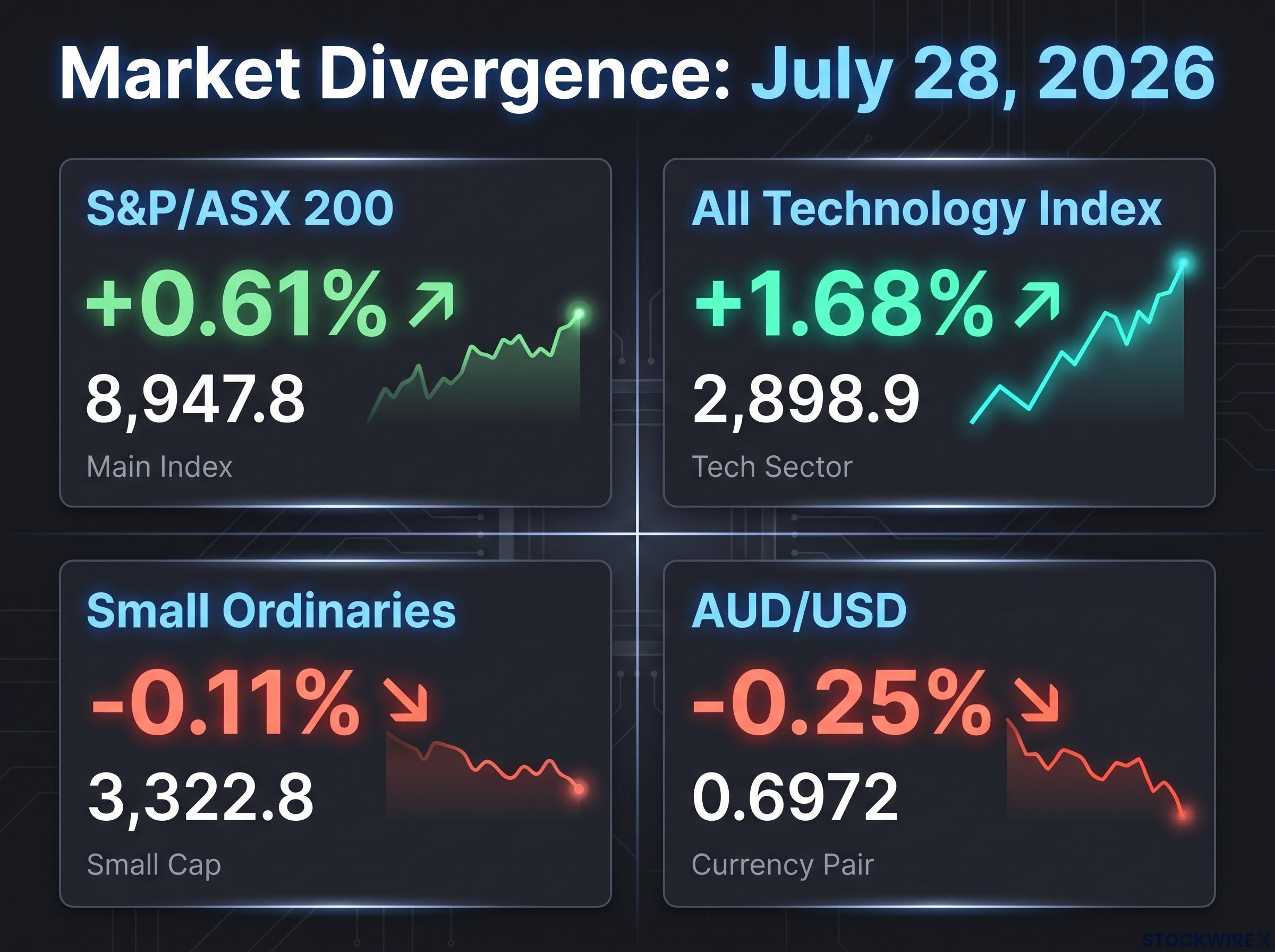
The Small Ordinaries decline is the detail that sharpens the picture. This was not a rising-tide session. The buying was deliberate, concentrated in large-cap, rate-sensitive names that reprice fastest when bond yields move. Small-cap stocks, less directly tied to discount-rate mechanics, were left behind.
When big ASX news breaks, our subscribers know first
What Bullock actually said, and what markets chose to hear
Bullock’s most quoted line from today’s Q&A session was concise and carefully worded:
“We are on the restrictive side a bit.”
That single phrase did more to move Australian equities than any data release this month. But the full context of her remarks tells a more complicated story than the rally suggests.
The RBA’s June hold decision marked the first pause after three consecutive 25 basis point hikes, and the Board’s silence on a steep decline in capacity utilisation and an unexpected rise in unemployment to 4.5% framed the conditions under which Bullock is now signalling a restrictive policy stance.
The dovish signals investors latched onto
- Bullock acknowledged that policy is already restrictive, meaning current interest rate settings are materially constraining demand.
- Housing market conditions had weakened more than the RBA previously forecast.
- Labour market conditions have eased, reinforcing the view that prior rate hikes are doing their work.
These three acknowledgments gave investors the raw material for a “peak rates” interpretation. If the economy is cooling in exactly the way the RBA hoped, the logic goes, there is less reason to hike again.
The hawkish qualifiers that complicate that read
- Bullock explicitly left an August rate hike on the agenda. According to a major Australian newspaper, she “made clear an interest rate rise will be discussed” at the next meeting.
- She warned the Board “would be ready to raise interest rates further if necessary,” a conditional that keeps further tightening alive if inflation does not moderate.
The gap between “policy is restrictive” and “no more hikes” is where today’s rally lives. Investors who conflate the two are pricing in more certainty than Bullock actually provided. Her stance is data-dependent and conditional, not a declared peak in the tightening cycle.
How a 5.2 basis point yield move reshapes equity valuations
Australia’s 10-year government bond yield fell 5.2 basis points following Bullock’s speech. That is a modest move in isolation. But when it confirms a shift in rate expectations rather than just daily noise, it triggers the kind of systematic sector rotation visible in today’s session.
The mechanism works differently depending on the sector. A basis point, for context, is one-hundredth of a percentage point; a 5.2 basis point decline means the yield dropped by 0.052 percentage points.
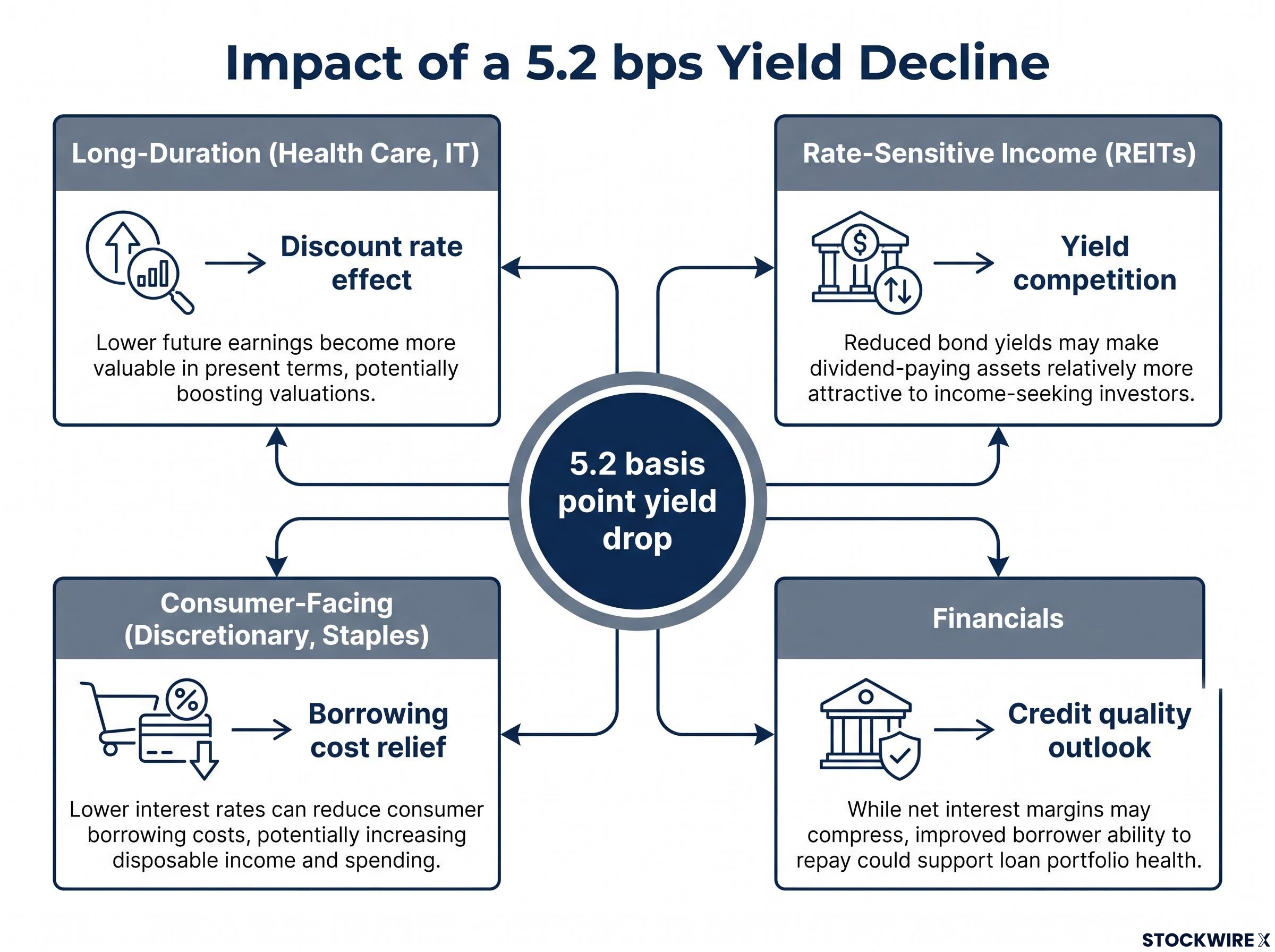
| Sector Type | Transmission Channel | Why It Benefits from Lower Yields |
|---|---|---|
| Long-Duration / High-PE (Health Care, IT) | Discount rate effect | Lower discount rates increase the present value of earnings concentrated in the distant future |
| Rate-Sensitive Income (REITs) | Yield competition | Lower risk-free returns make property income comparatively more attractive |
| Consumer-Facing (Discretionary, Staples) | Borrowing cost relief | Lower rates ease variable-rate mortgage stress and increase household spending capacity |
| Financials | Credit quality outlook | Reduced rate risk lowers the probability of stress across loan books |
Understanding which channel applies to which sector helps you anticipate which holdings will be most sensitive if August data shifts rate expectations in either direction.
Rate-sensitive ASX sectors, particularly REITs, infrastructure, and long-duration technology names, have historically begun repricing before confirmed rate cuts rather than after, which explains why institutional positioning in today’s session was concentrated in exactly those categories ahead of any formal policy shift.
Which sectors and stocks moved most, and by how much
Consumer Discretionary led the session at +2.68%, more than a full percentage point ahead of its nearest rival, Communication Services at +2.55%. Health Care rounded out the top three at +2.26%. At the bottom of the table, Utilities barely moved, slipping 0.06%, which reinforces the thesis: this was a rate-sensitivity trade, not a broad risk-on move.
“+2.68% for XDJ, the session’s standout move, more than double the index gain.”
| Sector | Return (%) | Closing Level |
|---|---|---|
| Consumer Discretionary (XDJ) | +2.68% | 4,002.2 |
| Communication Services (XTJ) | +2.55% | 1,636.3 |
| Health Care (XHJ) | +2.26% | 26,138.5 |
| Energy (XEJ) | +1.60% | 10,476.8 |
| Consumer Staples | +1.31% | 13,337.2 |
| Information Technology (XIJ) | +1.20% | 1,725.8 |
| Real Estate (XPJ) | +1.12% | 3,620.4 |
| Financials (XFJ) | +0.92% | 9,950.3 |
| Industrials | +0.43% | 8,378.2 |
| Utilities | -0.06% | 9,594.6 |
The All Technology Index gained 1.68% to 2,898.9, a corroborating signal that confirms the long-duration repricing thesis. Consumer Discretionary leading by a full percentage point is the market’s clearest statement that investors believe lower rates translate directly into stronger household spending. That is the bet being placed today.
What the commodity drag and the weak AUD tell you about the day’s split character
Not everything rallied. Commodity-linked segments were the principal detractors on the session, and the Small Ordinaries decline of 0.11% to 3,322.8 underscores that today was a rotation story, not a risk-on story. The distinction matters for how broadly and how long these tailwinds persist.
Institutional capital rotation of this kind, where headline index moves mask sharp divergence between advancing and declining sectors, has been a recurring pattern across 2026 sessions where rate expectations shifted on central bank communication rather than hard data.
The Australian dollar’s quiet signal
The Australian dollar slipped 0.25% to 0.6972 against the USD. A falling currency alongside a rate-sensitive equity rally is not a contradiction. It signals the market is pricing in a softer domestic growth path: lower expected rates reduce the yield differential that supports the currency. For investors, a weaker AUD has mixed implications; it is supportive for exporters but potentially inflationary for import costs, which could complicate the RBA’s inflation read.
Offshore futures and tomorrow’s open
US futures at the Australian close pointed to a potentially softer global backdrop heading into Wednesday:
- S&P 500 futures: -0.31% at 7,425.5
- Nasdaq futures: -0.99% at 27,912.0
- Dow Jones futures: +0.04% at 52,403.0
The Nasdaq decline is the most relevant number. If US tech sells off overnight, that headwind could test whether the domestic rate narrative is strong enough to sustain today’s gains without a supportive global backdrop.
What the August meeting means for investors still positioned for the rally
Today’s rally is a bet, not a certainty. Investors are pricing in a softer landing for rate expectations, and the August RBA meeting is where that bet gets settled or unwound.
Before Bullock’s speech, market pricing implied approximately a one-in-three chance of an August rate hike, according to one report (though this figure is not independently confirmed). Her remarks may have shifted that probability modestly lower, but her conditional framing remains firmly in place.
“Would be ready to raise interest rates further if necessary.”
Three variables between now and the August decision will determine whether today’s sector moves extend or reverse:
- Inflation data: Any upside surprise in the quarterly consumer price index would directly challenge the “peak rates” interpretation.
- Wages data: Persistent wage growth would give the RBA Board reason to act on the hike it has explicitly left on the agenda.
- Further RBA communication: Any shift in tone from Board members ahead of the meeting could reprice expectations again in either direction.
The sectors that led today, Consumer Discretionary at +2.68%, Communication Services at +2.55%, and Health Care at +2.26%, carry the most two-way risk into that decision. If August data softens, today’s gains may extend. If inflation or wages surprise to the upside, these same sectors could give back the most.
For investors wanting to build a framework that holds up across multiple August outcomes rather than betting on a single scenario, our full explainer on positioning through the rate peak covers quality upgrades, volatility-triggered rebalancing, and currency diversification strategies for the higher-for-longer environment.
This article is for informational purposes only and should not be considered financial advice. Investors should conduct their own research and consult with financial professionals before making investment decisions.