Three converging forces wiped hundreds of billions from global semiconductor valuations on 28 July 2026, triggering a circuit breaker on the South Korean Kospi, an 18% single-session collapse in Kioxia, and a fourth consecutive session of losses across U.S. chip names. This is not a single-headline event. It is a multi-front repricing.
The selloff did not arrive without warning. U.S. chip stocks had been sliding since 27 July, dragging Nasdaq futures lower and setting up Asian markets for a rout when Tokyo and Seoul opened. What gave the move its severity is the convergence of three simultaneous pressures: questions about whether AI infrastructure spending is economically sustainable, the breakthrough debut of a Chinese memory chip maker that rattled incumbents, and a mechanical valuation reset that was already overdue in some of the sector’s highest-multiple names.
Here is what happened, where, and which specific forces are driving the losses, so that if you hold any semiconductor or AI-linked exposure, you understand exactly what you are watching and what to monitor next.
How the selloff travelled from Wall Street to Seoul and Tokyo
This was a cascading event with a clear origin, not three markets selling independently. The sequence matters.
Monday session: the selloff that set up Asia
U.S. chip stocks set the table on 27 July. Nvidia fell approximately 5%. Western Digital dropped roughly 11%. Micron, AMD, Teradyne, ASML, and Seagate each lost between 4% and 7%. The Philadelphia Semiconductor Index extended a multi-day decline that had already been gathering pace.
The broader market barely flinched. The Dow rose 0.5% and the S&P 500 finished flat. That contrast made the semiconductor-specific weakness impossible to ignore; this was targeted selling, not a general risk-off session.
Premarket July 28: pressure building before Asia opened
By 04:46 ET on 28 July, premarket trading confirmed the selling had not exhausted itself. Micron and Western Digital had each shed around 4%. Intel was lower by approximately 3.2%, while Marvell Technology gave up roughly 2.8%. Both AMD and SK Hynix‘s U.S.-listed shares were trading down in excess of 3%. Super Micro Computer was off by close to 2.9%. A major semiconductor ETF was indicated to open more than 4% lower.
Nasdaq 100 futures were down 0.8-1% and S&P 500 futures had slipped approximately 0.3%, providing the direct transmission mechanism into Asian opening prices.
| Company | 27 July decline | 28 July premarket (04:46 ET) |
|---|---|---|
| Nvidia | ~5% | — |
| Western Digital | ~11% | ~4% |
| Micron | 4-7% | ~4% |
| AMD | 4-7% | >3% |
| Intel | — | ~3.2% |
| Marvell Technology | — | ~2.8% |
| SK Hynix (U.S. shares) | — | >3% |
| Super Micro Computer | — | ~2.9% |
| Major semiconductor ETF indicated more than 4% lower at open | ||
The timeline tells you something specific: this is a coordinated global repricing of AI chip risk, not regional noise. Asian markets were responding to U.S. signals, and the pressure building in premarket was likely to intensify once the New York session opened.
When big ASX news breaks, our subscribers know first
South Korea bore the worst of it, and the circuit breaker tells you why
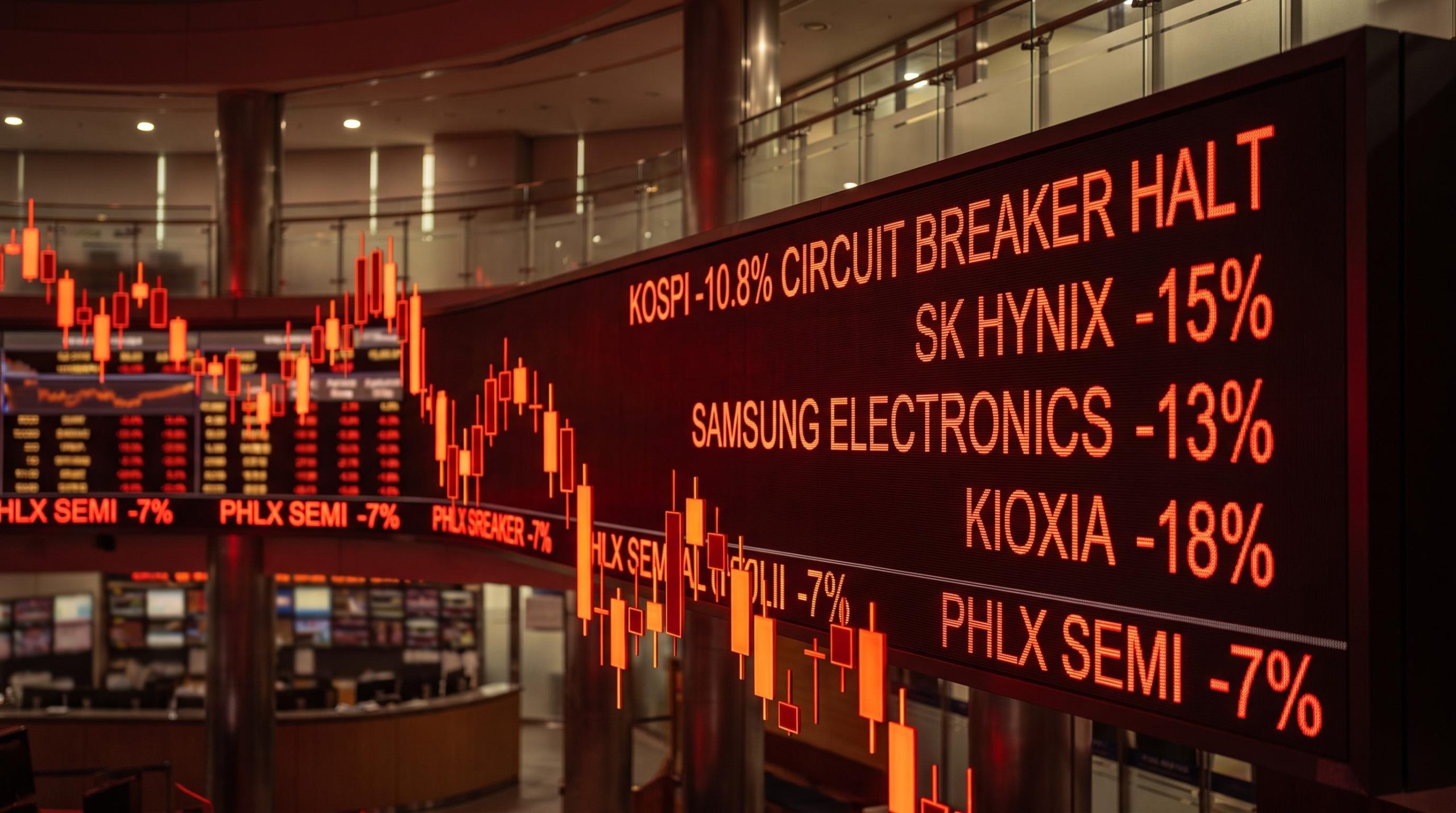
Kospi: halted after breaching the 8% decline threshold, then continued lower to finish the session down 10.8% on 28 July 2026, marking the eighth circuit breaker activation of the year.
The circuit breaker was not a technical footnote. It tells you that selling pressure was so concentrated and fast that Korea’s own safeguards, an automatic trading halt designed to prevent panic-driven freefall, could not contain the decline. The Kospi fell another 2.8 percentage points after trading resumed.
- Samsung Electronics finished the session ~13% in the red
- SK Hynix gave up approximately 15% by the close
- Together, Samsung and SK Hynix represent roughly half of the Kospi’s total market capitalisation, which is why the index-level damage was so severe
South Korea was always going to be the epicentre once AI chip sentiment turned. SK Hynix is Nvidia‘s primary supplier of high-bandwidth memory (HBM), a specialised type of DRAM designed for high-speed data transfer in AI accelerators. Earlier in July, reports of a potential HBM expansion slowdown had already demonstrated how sensitive the stock is to even small shifts in AI spending expectations. Today’s move extends that pattern: SK Hynix and Samsung are trading as proxies for global AI infrastructure sentiment.
Japan and the anatomy of an AI-premium unwind
The Nikkei 225 fell approximately 4% on 28 July, led by what local commentary described as a “massive wave of sell orders” in AI and semiconductor-related stocks at the opening bell.
- Nikkei 225: shed approximately 4% on the session
- Kioxia: collapsed approximately 18%, placing it among the worst-performing names across any of the three markets that day
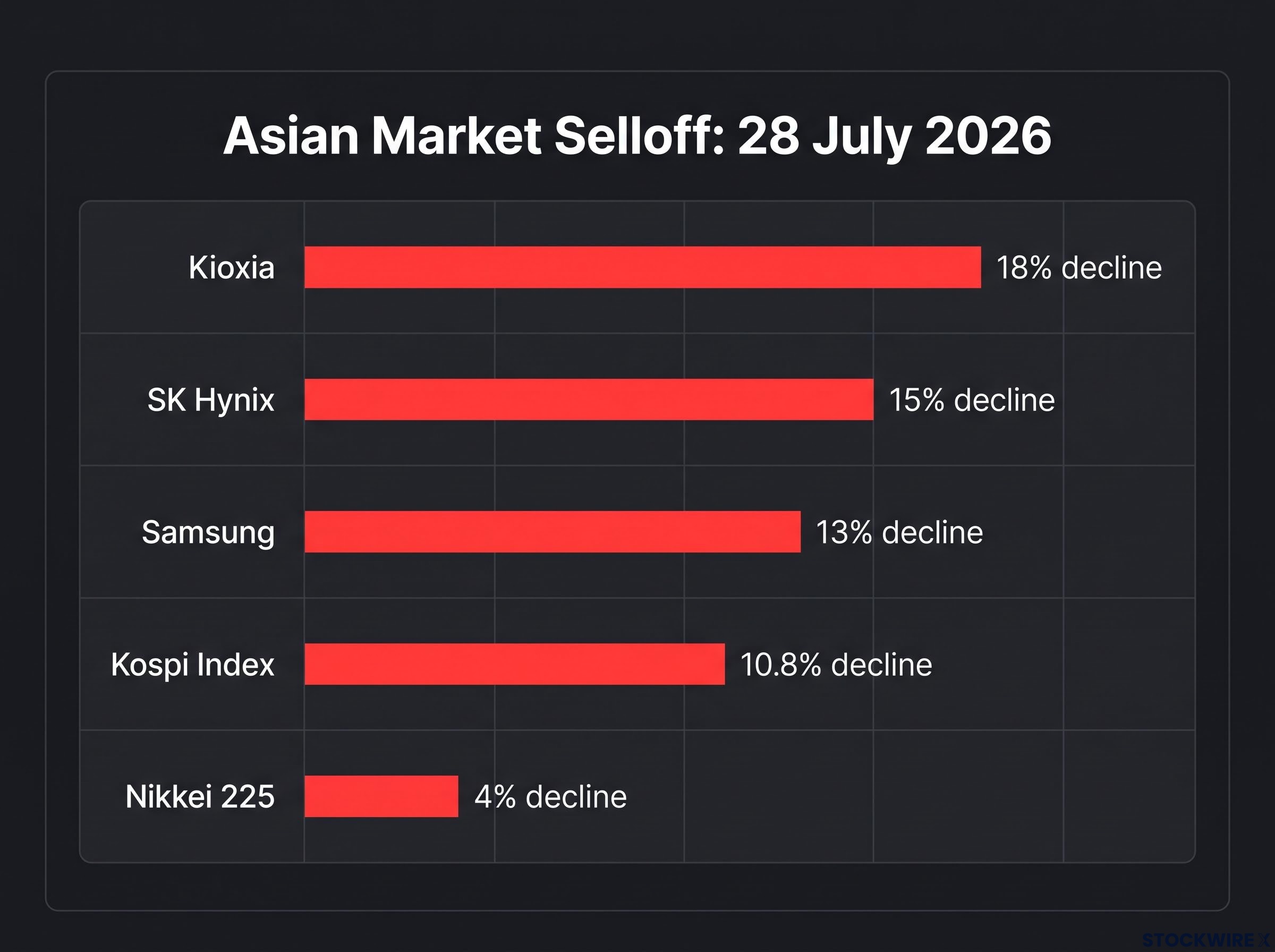
Kioxia‘s decline is the clearest single-stock illustration in this story of what happens when a premium built on AI infrastructure optimism meets a market that has started questioning whether that optimism was priced correctly. Kioxia had ranked among the strongest-performing stocks on Japanese exchanges through the first six months of 2026. An 18% single-session reversal signals that the de-rating is sector-wide, not country-specific.
Japan’s chip stocks had been among Asia’s strongest performers this year. Their sharp reversal suggests this repricing will not be contained by geography, and investors should treat any Japan-only bounce attempt with caution until the underlying AI capex concerns stabilise.
Three forces behind the selloff, and what they mean for chip valuations
Three distinct pressures converged simultaneously, each independently capable of generating significant sector losses:
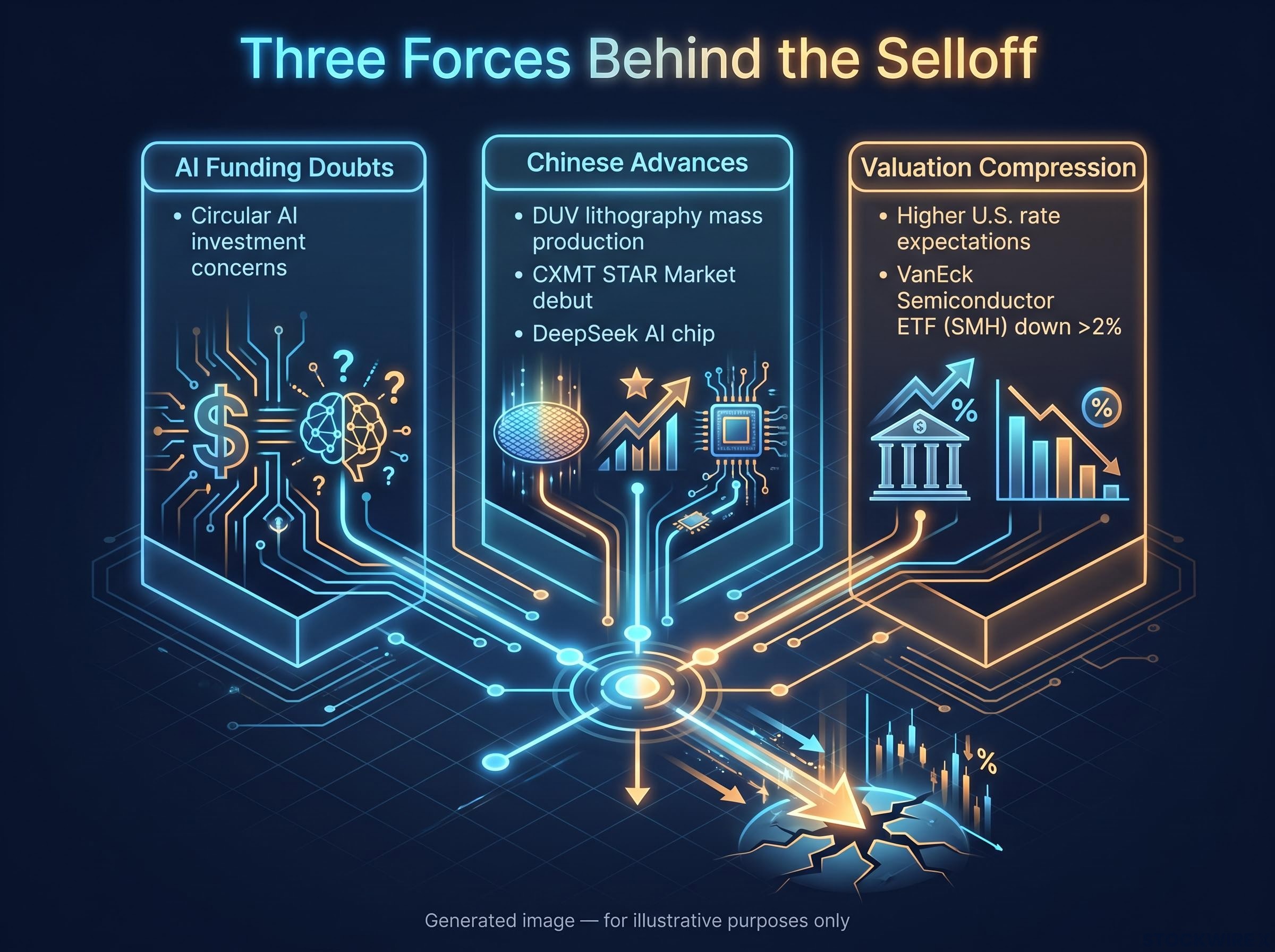
- AI infrastructure funding doubts: growing unease about whether the enormous sums flowing into AI buildout are backed by genuine end-user demand or simply by further rounds of capital deployment
- Chinese semiconductor advances: a rapid progression in Chinese chip capabilities that raises the prospect of lost market share and eroding margins for established players
- Valuation compression: a mechanical reset of multiples that were already stretched
Market commentary has characterised the concern as one of “circular AI investment”, questioning whether the capital being deployed into AI infrastructure is generating genuine economic returns or simply fuelling more capital deployment.
The circular AI investment concern had been building for weeks before the selloff: Vital Knowledge research showed AI capital spending approaching or exceeding 90% of operating cash flow at major hyperscalers, with Barclays models pointing to more than $200 billion in debt issuance required to close the structural funding gap between 2026 and 2028.
The AI funding question struck first. Investors are no longer treating hyperscale AI spending as a risk-free growth engine. They are questioning whether the returns will justify the capital being deployed, and whether debt loads accumulated to finance AI infrastructure are prudent. This directly affects the earnings outlook for GPU makers, memory suppliers, and equipment manufacturers.
China’s chip advances add a structural layer to a cyclical selloff
The second pressure is structural. Bloomberg reported that a Chinese state-backed company has begun mass-producing immersion deep ultraviolet (DUV) lithography machines, equipment used to pattern circuits on silicon wafers. This technology had previously been viewed as a bottleneck preventing China from moving up the fabrication technology curve.
Simultaneously, ChangXin Memory Technologies (CXMT), a Chinese DRAM maker (DRAM is dynamic random-access memory, the short-term data storage chips used across computing devices), debuted on Shanghai’s STAR Market. Reports indicate shares surged substantially, though exact figures remain unverified. The debut fuelled fears that Chinese DRAM could reach top-tier customers like Apple sooner than expected. DeepSeek‘s AI chip announcement added further pressure, reinforcing concerns that new Chinese entrants could erode incumbents’ margins in AI accelerators.
Valuation compression: why high-multiple stocks fall hardest
The third force is mechanical. AI chip names are long-duration growth stocks, meaning their valuations depend heavily on cash flows projected far into the future. When interest rates rise, those distant cash flows become less valuable in present-value terms, and the share price compresses even if revenue remains intact.
Higher U.S. rate expectations are amplifying this effect. The VanEck Semiconductor ETF (SMH) has posted a multi-day decline of more than 2%, and analyst commentary has drawn comparisons to dot-com era valuations. Revenue collapse is not required for large share price moves when multiples are this high; even a modest recalibration of spending assumptions produces outsized declines.
Semiconductor valuation multiples entering the selloff were not uniformly stretched: Micron traded below 9x forward earnings while Intel sat above 100x, a dispersion that means the mechanical correction the article describes will land very differently across individual names depending on how far each stock’s multiple had already diverged from its earnings base.
The three forces are not a list of separate problems. AI funding doubts challenge revenue certainty. Chinese competition challenges margin certainty. And the valuation reset makes both corrections larger than they would otherwise have been. All three are active at the same time.
What investors should watch for signals this rout is stabilising
There is no single all-clear signal. Stabilisation will likely require reassurance on at least the AI funding question, and the Chinese competition thread is a longer-duration concern that will not resolve in days or weeks. Here is what to monitor, in order of near-term importance:
- Hyperscaler earnings and capex guidance: forthcoming results from cloud AI platform companies are the single most decisive near-term catalyst. If they affirm infrastructure spending plans, the AI funding concern loses its sharpest edge.
- Kospi and Korean index behaviour: repeated circuit breaker activations or continued double-digit single-session moves signal that de-risking is not exhausted. The 8% threshold and the eighth activation of 2026 are the benchmarks.
- Federal Reserve signals: any indication of a more patient stance could ease valuation pressure on long-duration growth names. Conversely, faster rate hikes would keep pressure on richly valued chip stocks.
- Chinese semiconductor developments: further progress on DUV lithography, CXMT expansion, or new AI chip announcements from DeepSeek and others affect the competitive narrative independently of near-term sentiment.
The long-term structural case for semiconductors as digital infrastructure remains intact. This is a premium repricing event, not a demand collapse.
What the premium that just repriced was always made of
The semiconductor selloff of 28 July 2026 did not break the sector’s fundamentals. It repriced the assumptions those fundamentals were wrapped in.
For months, AI chip valuations had embedded a specific set of beliefs: that hyperscale AI spending would continue accelerating, that Chinese competitors remained years away from threatening incumbent pricing power, and that interest rates would not rise fast enough to compress the multiples investors were willing to pay. All three assumptions came under pressure simultaneously. The AI funding question challenged revenue certainty. Chinese competition challenged margin certainty. The valuation reset made both corrections larger.
The SMH’s multi-day slide and the Kospi’s eighth circuit breaker activation of the year are evidence of a sustained repricing, not a single-session panic. The distinction between a structural collapse and a premium repricing is the most important call any semiconductor investor has to make right now. Getting this wrong in either direction, whether through panic selling or dismissing the correction, carries real portfolio consequences.
Semiconductor stocks have not fundamentally broken. The price at which they change hands has just been anchored to a new, more sceptical set of assumptions about AI timelines, Chinese competition, and interest rates.
For investors wanting a structured framework for what to hold and what to reduce as this repricing continues, our comprehensive walkthrough of semiconductor cycle positioning covers the five-indicator system for timing exits across memory, foundry, and equipment names before the 2027-2029 supply wave arrives.
This article is for informational purposes only and should not be considered financial advice. Investors should conduct their own research and consult with financial professionals before making investment decisions. Past performance does not guarantee future results. Financial projections are subject to market conditions and various risk factors.