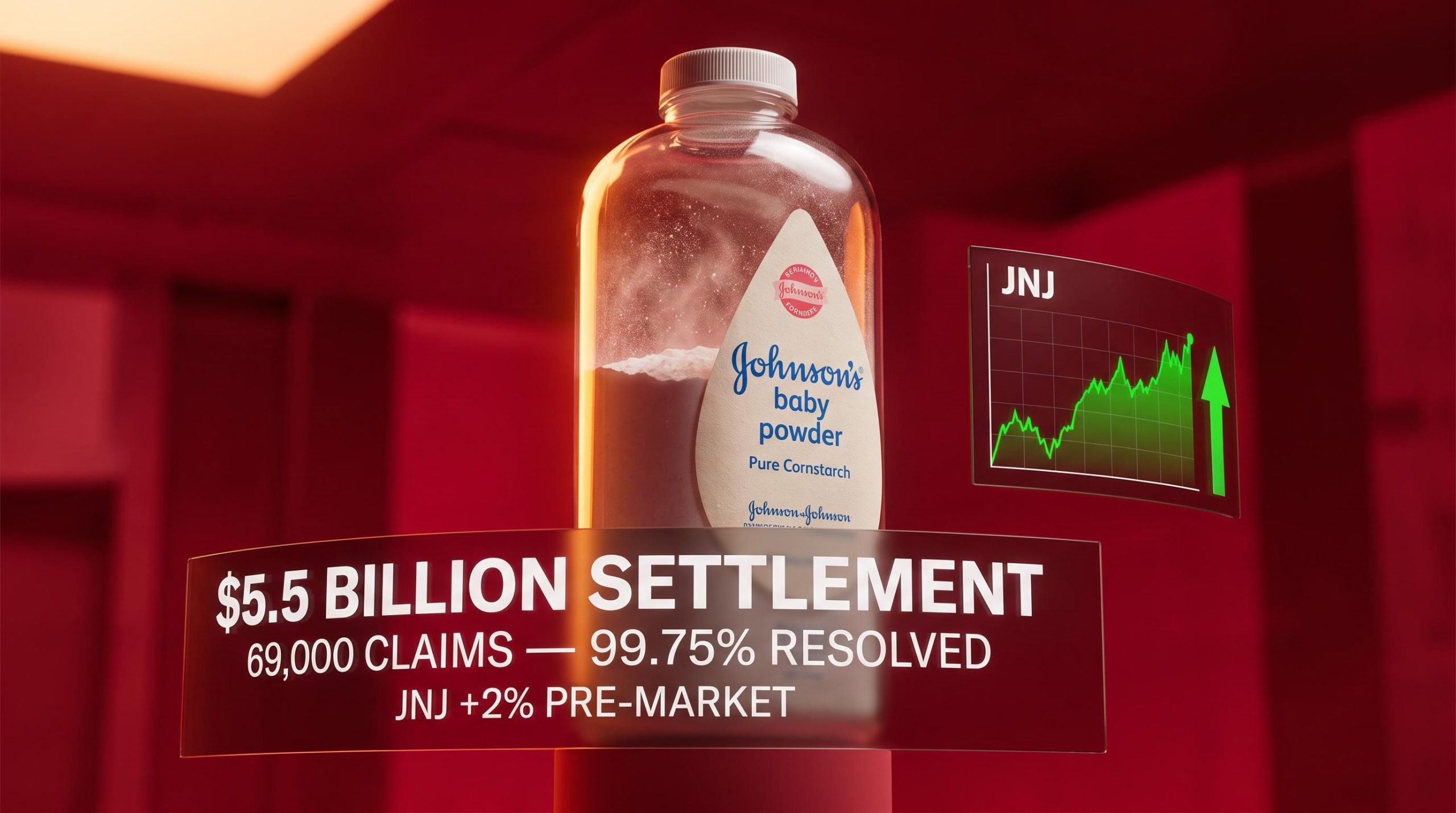
Johnson & Johnson has agreed to pay up to $5.5 billion to resolve approximately 69,000 U.S. ovarian cancer lawsuits linked to its talc baby powder, covering roughly 99.75% of remaining claims in the country. It is the largest proposed resolution in a legal fight that has run for more than a decade.
The deal marks a strategic pivot. A U.S. bankruptcy judge rejected J&J’s prior $8 billion Chapter 11 proposal in March 2025, forcing the company to negotiate directly with plaintiffs rather than channel liabilities through a subsidiary. Shares rose approximately 2% in pre-market trading yesterday, a signal that investors are actively re-pricing the risk, not simply noting the headline.
Here is what the settlement actually resolves, what it leaves open, and the specific conditions that still need to fall into place before the litigation discount on JNJ shares fully clears.
A decade of litigation, two bankruptcy failures, and a $5.5 billion reset
The lawsuits built steadily over the past decade. Tens of thousands of women alleged that J&J’s talc products, most prominently its baby powder, caused ovarian cancer. Individual jury verdicts occasionally exceeded $1 billion, and each headline reinforced a growing perception that the company’s liability was both enormous and impossible to model.
J&J twice attempted to contain the exposure through a legal manoeuvre known as the “Texas two-step”: spinning talc liabilities into a subsidiary called LTL Management and filing that entity for Chapter 11 bankruptcy protection. Both attempts failed. The second, which proposed roughly $8 billion to resolve claims, was rejected by a federal judge in March 2025.
That left direct negotiation as the only viable path. The result, announced yesterday, carries different terms and a different structure.
Core settlement terms:
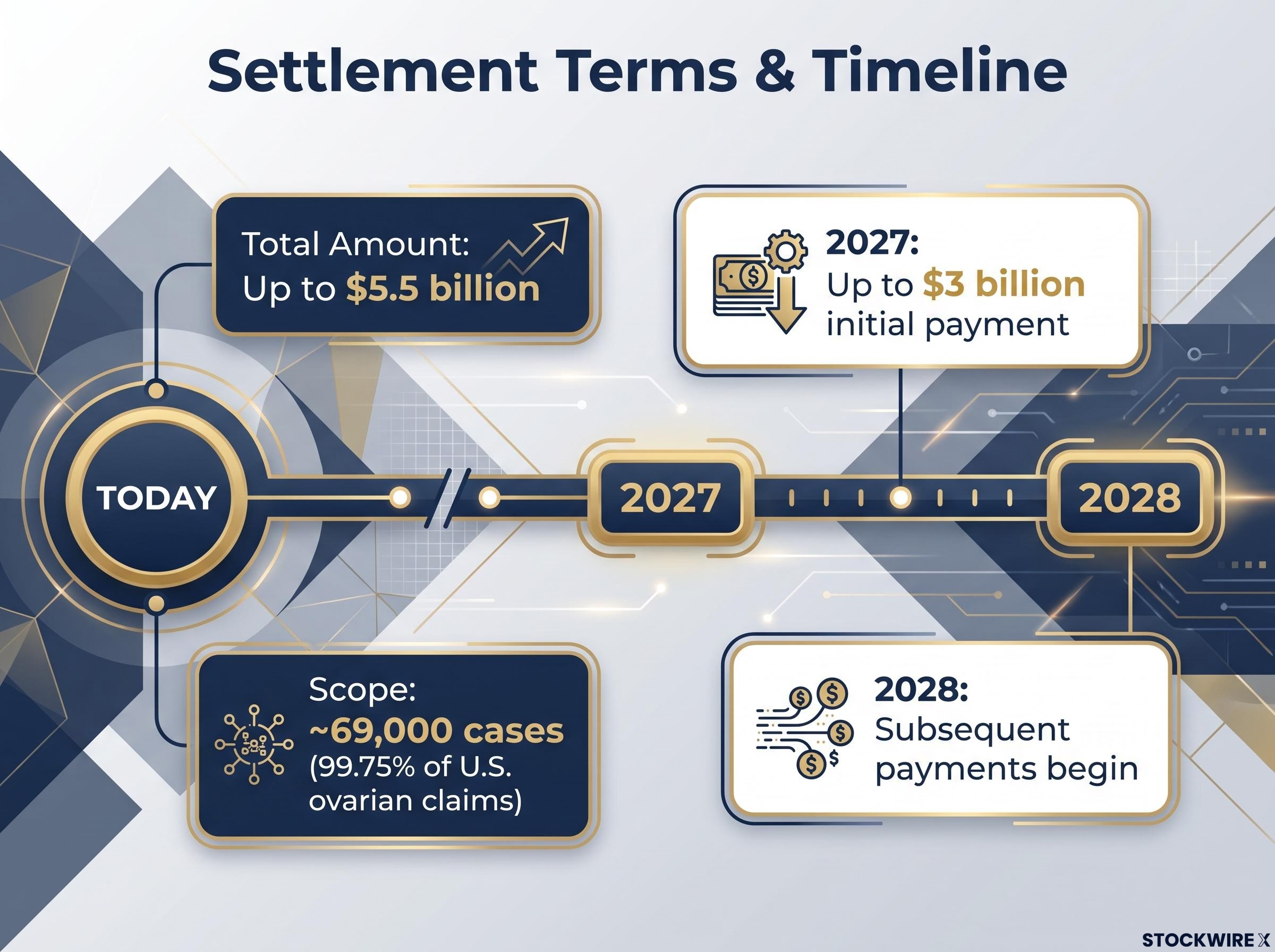
- Amount: Up to $5.5 billion
- Cases covered: Approximately 69,000 in federal multidistrict litigation (MDL) in New Jersey and related state courts
- Scope: Roughly 99.75% of remaining U.S. ovarian cancer talc claims
- Initial payment: Up to $3 billion scheduled for 2027
- Subsequent payments: No further payments due until 2028
The failure of the bankruptcy route matters for how you read this deal. J&J accepted a hard negotiated outcome rather than a structured one it could control, which means the financial terms here are more credibly final than anything the company proposed previously.
When big ASX news breaks, our subscribers know first
Is $5.5 billion a manageable cost for a company J&J’s size?
The headline number is large. Measured against J&J’s actual financials, it is absorbable.
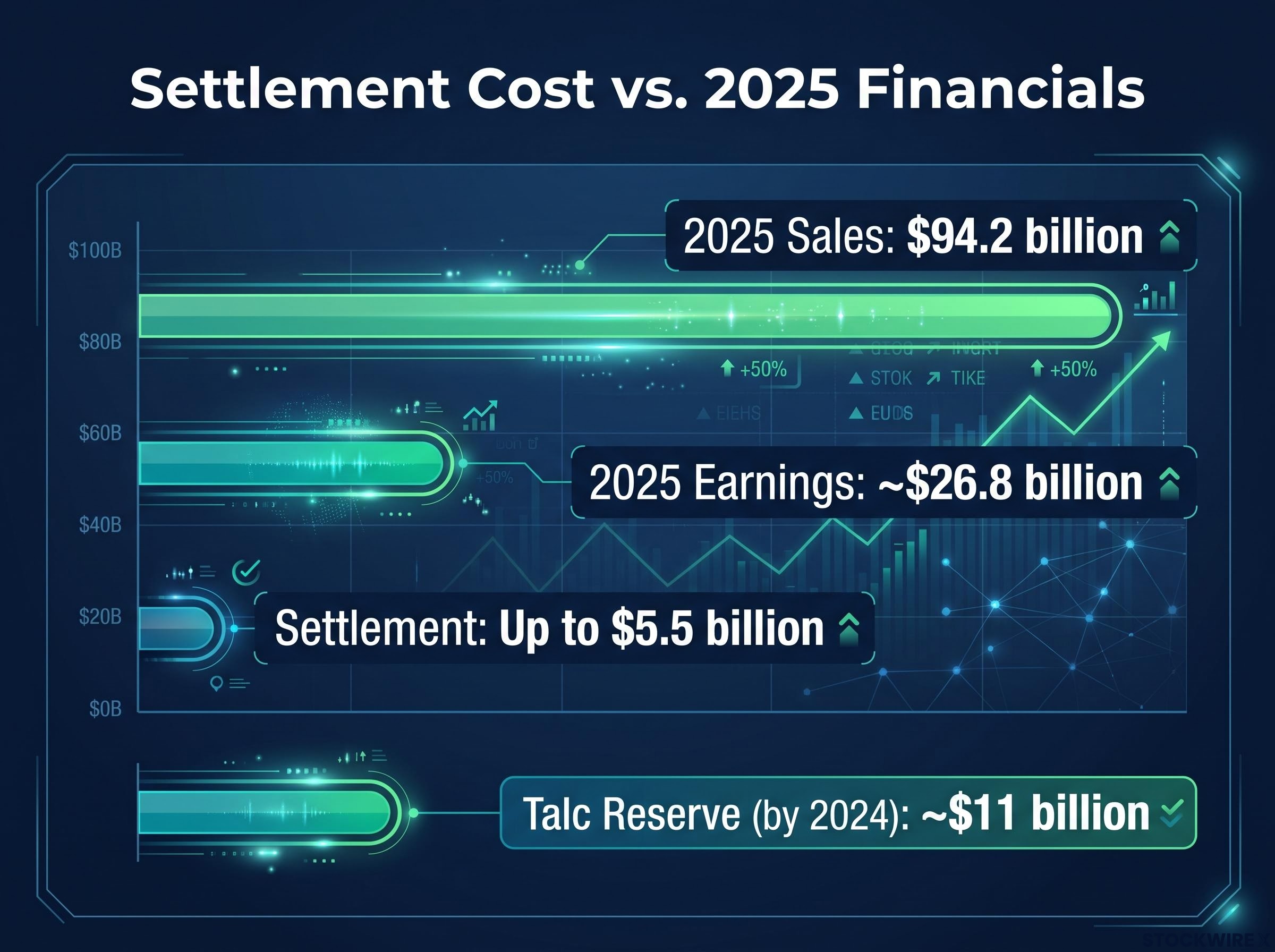
| Metric (2025) | Value | Settlement as % of metric |
|---|---|---|
| Full-year reported sales | $94.2 billion | ~6% |
| Adjusted net earnings | ~$26.8 billion | ~20% |
| Existing talc reserve (established by 2024) | ~$11 billion | Settlement partially funded from reserves |
J&J recorded a $2.7 billion charge in 2024 and built its talc reserve to roughly $11 billion. The incremental cash impact of this new deal depends on how much is already covered by those reserves versus what requires a new charge, a detail investors will need to track in upcoming earnings calls and SEC filings.
Companies that build pre-existing provisions against anticipated settlements reduce the earnings-shock risk when those deals are announced: Qantas’s $105 million Covid flight-credit settlement in early 2026 carried no earnings impact precisely because a matching provision was already in place, a structure that parallels the reserve mechanics J&J has been building toward the talc liability since 2024.
The multi-year payment structure matters here. Up to $3 billion leaves in 2027, with nothing further due until 2028. That cadence preserves near-term capital allocation flexibility.
J&J maintains a AAA credit rating at S&P, the clearest signal available that markets do not treat this settlement as a solvency event.
For income-oriented holders asking the key question, the payment structure and existing reserve base mean the deal is unlikely to threaten the dividend, the buyback programme, or the R&D budget.
How mass-tort settlements create and then compress a valuation discount
A litigation discount is the premium investors demand for bearing uncertain, open-ended liability. It shows up in more conservative price-to-earnings multiples, wider risk allowances in discounted cash flow (DCF) models (the standard method analysts use to estimate what future earnings are worth today), and hesitancy among risk-averse or ESG-sensitive institutional investors who face governance constraints on holding companies with large unresolved legal exposure.
What a litigation discount looks like in practice
J&J’s discount built over roughly a decade through a specific combination of factors:
- Jury verdict volatility: Individual cases occasionally produced awards exceeding $1 billion, making the tail risk almost impossible to model with confidence
- Bankruptcy strategy failures: Two rejected Chapter 11 attempts via LTL Management sustained management distraction and headline risk without resolving anything
- Reputational headline risk: Persistent coverage alleging asbestos contamination in consumer products eroded brand perception among both consumers and investors
- ESG-sensitive investor avoidance: Governance-focused funds faced structural barriers to holding a company with open-ended product liability of this scale
A bounded, modelable settlement compresses that discount by replacing uncertainty with a defined cost. Analysts can update their models. The most severe downside scenarios drop out of probability-weighted valuations.
The compression of mass-tort litigation discounts is not unique to J&J; social media platforms are currently accumulating a structurally similar valuation drag as courts begin producing landmark verdicts that force analysts to reprice open-ended liability across entire sectors.
The 2% pre-market move yesterday is not just a reaction to positive news. It is the market beginning to remove a risk discount that has been applied for years. How much of that discount has already been priced out versus how much remains contingent on the deal actually closing is the question that directly informs entry timing and position sizing.
Three conditions that must be met before this settlement is truly closed
A proposed settlement is not a closed settlement. Three specific conditions stand between this announcement and a clean resolution.
- The 95% participation threshold. The deal requires at least 95% of roughly 76,000 remaining claimants to elect to participate. Plaintiffs’ firms have publicly described the agreement as “a good resolution,” signalling strong support, but that endorsement is not yet binding. A 95% requirement is unusually high for a mass-tort deal. Even a small organised bloc of holdout attorneys could reintroduce the uncertainty this settlement is designed to eliminate, and any early signals of holdout formation should be treated as a material risk flag.
- Court approval and oversight. The MDL judge in New Jersey and relevant state-court judges must oversee implementation, assess fairness, and resolve eligibility disputes. For settlements of this complexity, court processes typically take months to more than a year.
- Financial disclosure confirmation. The settlement’s actual impact on reported earnings depends on details that are not yet public.
What to watch in upcoming SEC filings and earnings calls
- Size and timing of any new pre-tax charge related to the settlement
- Updated 2026-2028 guidance incorporating the liability
- Commentary on insurance offsets or other funding sources
- Whether talc-related legal costs are expected to decline materially once the settlement takes effect
Tracking these milestones lets you calibrate conviction as the deal either firms up or encounters resistance, rather than over-rotating on the announcement alone.
What the settlement leaves unresolved and why it still matters for JNJ’s risk profile
The $5.5 billion deal is comprehensive within its defined scope. Outside that scope, real exposures remain.
What is covered:
- U.S. ovarian cancer claims, approximately 99.75% of remaining U.S. talc lawsuits
- Cases in federal MDL (New Jersey) and related state courts
What is not covered:
- U.K. litigation: More than 7,000 potential claimants in what has been characterised as the largest product-liability case in British legal history, entirely outside the scope of this U.S. settlement
- Mesothelioma claims: Prior bankruptcy proposals expressly excluded mesothelioma; a large majority have reportedly been resolved separately, but sporadic activity may continue
- Other non-U.S. claims and broader regulatory matters: J&J’s litigation and regulatory risk profile extends beyond talc to other product categories
The U.K. case has been characterised as the largest product-liability case in British legal history, involving more than 7,000 potential claimants.
These are narrower exposures compared to the 69,000 U.S. ovarian cancer cases this settlement addresses, and their financial scale is likely to be materially smaller. But for anyone building a position today, the U.K. case represents the most concrete remaining tail risk: a large, organised claimant group in an active proceeding where any adverse interim ruling could generate headline volatility even as the U.S. settlement progresses.
What changes in the JNJ investment case if the settlement closes as announced
| What improves if settlement closes | What remains unchanged |
|---|---|
| Management attention shifts to pharma pipeline (Darzalex, Carvykti) and MedTech operations | Patent cliffs and biosimilar competition timelines |
| Valuation models can drop open-ended tail-risk scenarios | Pricing pressure across pharmaceutical markets |
| ESG-sensitive and risk-averse institutional investors face fewer barriers to position sizing | MedTech segment cyclicality |
| Legal expense and management distraction decline materially | U.K. and mesothelioma residual litigation exposure |
| Litigation discount compresses, supporting multiple expansion | Core R&D productivity and late-stage pipeline execution risk |
The settlement does not change what J&J’s drug pipeline can deliver. What it removes is the headline noise that has been diluting investor attention to that pipeline, which means a successful close could allow the pharma and MedTech fundamentals to receive the valuation weighting they would earn on a cleaner balance sheet.
Legal overhang removal has become a recurring investment catalyst across consumer-facing companies: a2 Milk’s $62 million class action settlement earlier in 2026, fully covered by insurance, demonstrated how court approval of a defined settlement can shift investor focus back to operating fundamentals almost immediately.
The milestones that move this from catalyst to closed chapter
The appropriate characterisation right now is a strongly positive but not yet fully de-risked catalyst. Conviction builds in stages: the 95% participation threshold first, then court approvals, then updated financial guidance confirming the reserve and charge mechanics.
If those milestones clear, the investment case sharpens around J&J’s core strengths: oncology and cell therapy growth via Darzalex and Carvykti, diversified MedTech cash flows, and capital allocation flexibility that a multi-decade dividend track record has already demonstrated.
If they do not, the same uncertainty that has weighed on the stock for a decade returns in a new form.
This article is for informational purposes only and should not be considered financial advice. Investors should conduct their own research and consult with financial professionals before making investment decisions. These statements are speculative and subject to change based on market developments and company performance.