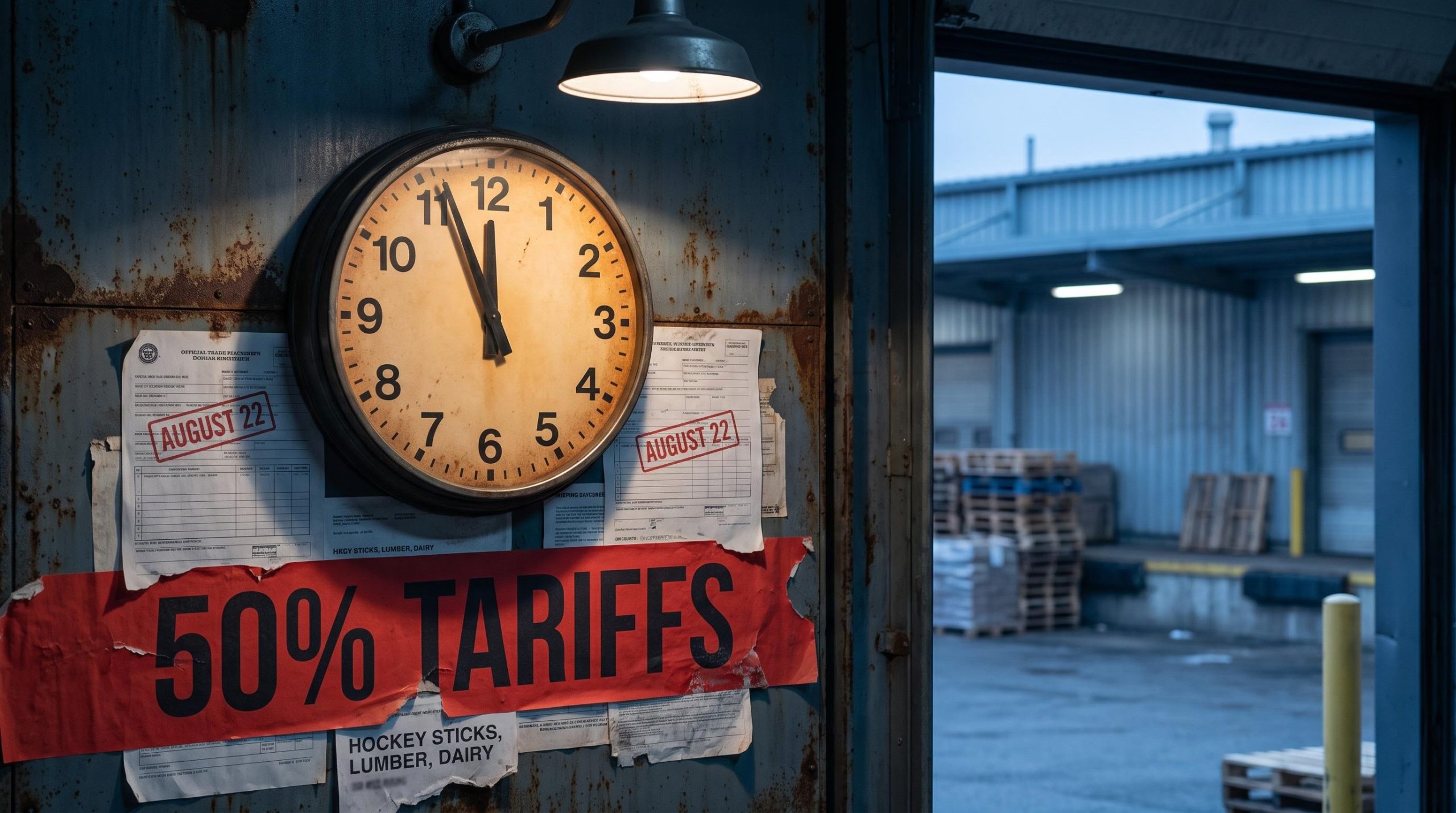
Hours before 50% tariffs were set to land on roughly $20 billion worth of Canadian exports, the US president posted on social media that the whole thing was on hold. His post claimed both countries had struck a deal, with only paperwork left to complete. For Canadian exporters who had spent weeks preparing for the worst tariff shock in a generation, the whiplash was immediate.
The suspension buys a three-day window, not a resolution. There is no signed agreement, no binding legal text, and no automatic extension if August 22 passes without one. The goods on the line, hockey sticks to furniture to dairy, represent categories that have never been targeted at this scale. Both governments are framing the pause as progress. Neither has confirmed what, precisely, was agreed.
Here is what the pause actually changes, what it leaves unresolved, and what investors and businesses need to watch over the next 72 hours and beyond. The surface-level relief is real. The underlying risk has not moved.
What Trump actually announced, and what it does not yet mean
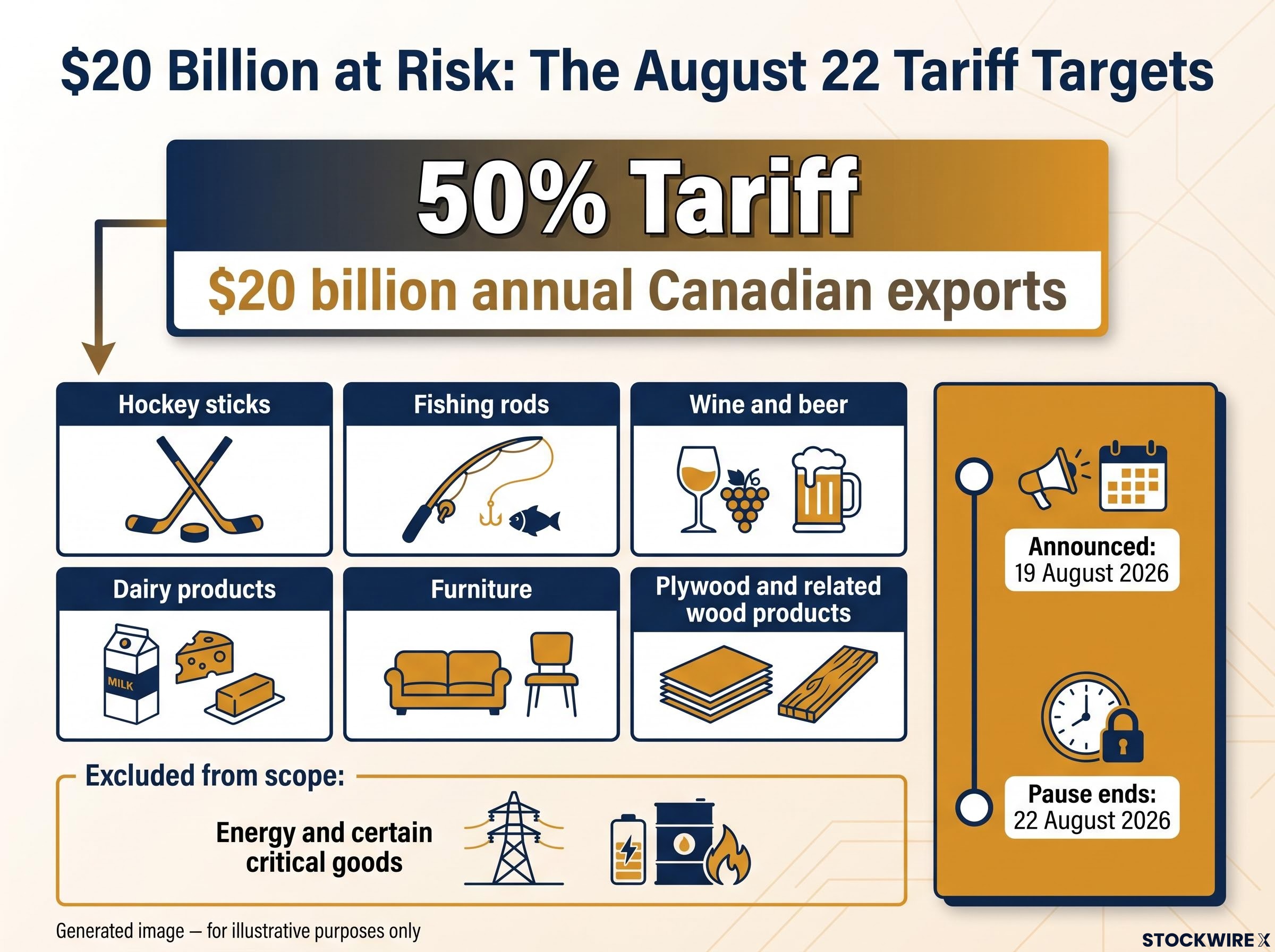
The announcement arrived via social media on 19 August 2026, hours before the tariffs were scheduled to activate. Trump’s stated justification was that both countries had reached a deal, though the paperwork had yet to be completed and signed off. The pause extends to approximately 22 August 2026. There is no automatic extension mechanism in place.
The goods covered under the paused tariffs span approximately $20 billion in annual Canadian exports, including:
- Hockey sticks
- Fishing rods
- Wine and beer
- Dairy products
- Furniture
- Plywood and related wood products
Energy and certain critical goods are excluded from the scope of these measures.
According to the USTR, the arrangement with Ottawa would open Canadian markets further to American goods and establish common ground on digital trade. No public text has been released detailing exact concessions from either side.
The gap between a deal announced on social media and enforceable legal text is where the actual risk sits. What looks like resolution is better understood as a 72-hour negotiation deadline with the tariff threat fully intact. For investors and businesses, the distinction between political framework and binding agreement determines whether any of this relief is durable.
When big ASX news breaks, our subscribers know first
The legal tool behind the threat: why Section 338 changes the risk calculus
The administration is using Section 338 of the Tariff Act of 1930, a statute dating to the Depression era that empowers the executive branch to impose punitive tariffs on nations judged to have treated US commerce unfairly. It is rarely invoked. Its deployment here signals that Washington has reached beyond the trade architecture both countries agreed to under the United States-Mexico-Canada Agreement (USMCA), the free trade framework governing North American commerce.
Section 338 mechanics require no formal investigation, no congressional oversight, and carry no sunset clause, which is precisely why the statute offered no advance warning mechanism and left Canadian exporters with no established legal framework to contest the action before it landed.
Section 338 sits alongside, not inside, USMCA. That distinction matters. Canada cannot rely solely on USMCA dispute mechanisms to challenge these tariffs because the legal authority comes from a different statute entirely.
These new measures were imposed on top of tariffs already in force:
- 25% on Canadian autos
- 50% on Canadian metals (steel and aluminium)
Both were applied despite USMCA’s duty-free commitments, establishing a pattern.
How this changes what USMCA protections actually guarantee
USMCA commitments are now effectively subject to unilateral US override via Section 338. For any investor or business whose exposure relies on USMCA protections holding, those protections are better understood as contingent rather than structural. Washington has demonstrated both the tools and the willingness to bypass them.
Trump’s refusal to extend USMCA for the standard six-year term, combined with the initiation of annual reviews from July 2026, introduces a source of persistent, repeating uncertainty that did not exist before.
Canada’s position and what Carney’s response signals
Prime Minister Mark Carney indicated that talks with Washington had moved in a positive direction while making clear that considerable work was still required before any deal could be concluded. Canadian officials confirmed only a temporary delay, not a completed agreement. No binding legal text has been confirmed by the Canadian side.
Carney’s broader strategic signal has been consistent: Canada needs to build an economy that is more self-sufficient and less dependent on US demand.
That dual messaging, short-term negotiation paired with long-term decoupling, tells you something important. Regardless of how August 22 resolves, Canadian policy is moving toward reduced US dependency. That shift has structural implications for cross-border trade volumes over a multi-year horizon, not just the next three days.
Structural trade realignment is already visible in capital flows: international ETFs absorbed $26.3 billion in net inflows between January and April 2026, with three major agreements ratified without US participation, a pattern that gives Carney’s long-term decoupling signal more strategic credibility than diplomatic posturing alone would warrant.
The tension between those two tracks is real. Pursuing a deal now while signalling economic separation later requires threading a needle that gets harder as deadlines compress. For investors, this means distinguishing between a negotiated truce (markets stabilise temporarily) and a genuine realignment (Canadian trade patterns and capital allocation shift structurally over time).
What markets face over the next 72 hours and why the stakes are asymmetric
The $20 billion in annual export exposure is the top-line figure, but the risk runs through specific asset classes in ways that are harder to hedge than a typical macro event. The binary nature of the deadline, tariffs either activate or they do not, compresses what would normally be weeks of positioning into days.
The muted market reaction to tariff announcements across 2025 and 2026 reflects a year of announce-delay-revise cycles that have trained investors to discount headline rates until implementation evidence arrives, a dynamic that shapes how the current pause is being priced relative to its stated scope.
The Canadian dollar is acutely sensitive. A confirmed durable deal would likely support it; a breakdown after August 22 could trigger renewed weakness. Canadian equities, particularly consumer goods, forestry, fisheries, and food and beverage names on the S&P/TSX, face direct exposure to whether these categories remain tariff-free.
| Asset class | Exposure channel | Bearish scenario (tariffs activate) | Bullish scenario (durable deal) |
|---|---|---|---|
| Canadian dollar | Export volume and investment flows | Renewed weakness on trade shock | Stabilisation and potential recovery |
| S&P/TSX consumer and materials | Direct tariff exposure on targeted goods | Valuation compression, capex delays | Relief rally, planning certainty restored |
| US furniture and wood products | Canadian input dependency | Sudden cost increases, margin compression | Supply chain continuity preserved |
| US specialty food and beverage | Canadian ingredient and product sourcing | Abrupt margin risk, limited rerouting time | Current sourcing arrangements maintained |
Supply chain exposure on the US side
US companies with Canadian input dependencies have had minimal time to reroute sourcing. Furniture components, wood products, and specialty food and beverage names face the sharpest margin risk if August 22 passes without resolution. Earnings revisions in these sectors could arrive abruptly rather than gradually, because the binary structure of the deadline leaves no room for gradual adjustment. Position sizing should reflect the reality that sharp moves in both directions are plausible within days rather than weeks.
Understanding USMCA and why the trade framework matters beyond this week
USMCA is the free trade framework covering the US, Canada, and Mexico. It was designed to provide duty-free market access across the three economies and a structured dispute-resolution mechanism when disagreements arise. For businesses and investors, it functioned as the baseline assumption underpinning cross-border trade planning.
That baseline has been progressively eroded. The escalation timeline tells the story:
- USMCA standard six-year extension declined by the US
- 25% tariffs imposed on Canadian autos and 50% on metals, both applied despite USMCA duty-free commitments
- USMCA joint review process initiated in July 2026, with annual reviews continuing thereafter
- Consumer and recreational goods threatened with 50% tariffs in August 2026, a new category of escalation
Section 338 operates outside the USMCA dispute-resolution architecture, meaning the agreement’s protections can be circumvented by a different legal authority entirely.
Presidential tariff authority now operates with a speed and unpredictability that statutory frameworks were not designed to accommodate: Section 338, Section 232, and successor legislative tools each offer different procedural pathways to the same outcome, meaning the ceiling on any bilateral trade dispute is structurally open-ended.
This week’s episode is one chapter in a longer deterioration, not a standalone crisis. For anyone who assumed USMCA was a stable long-term guarantee, the recalibration is straightforward: the agreement’s protections are now best understood as a floor that can be raised above by unilateral US action. Trade risk between the US and Canada is structural and recurring, and it should be priced accordingly in any portfolio with North American exposure.
What the August 22 deadline actually resolves, and what it does not
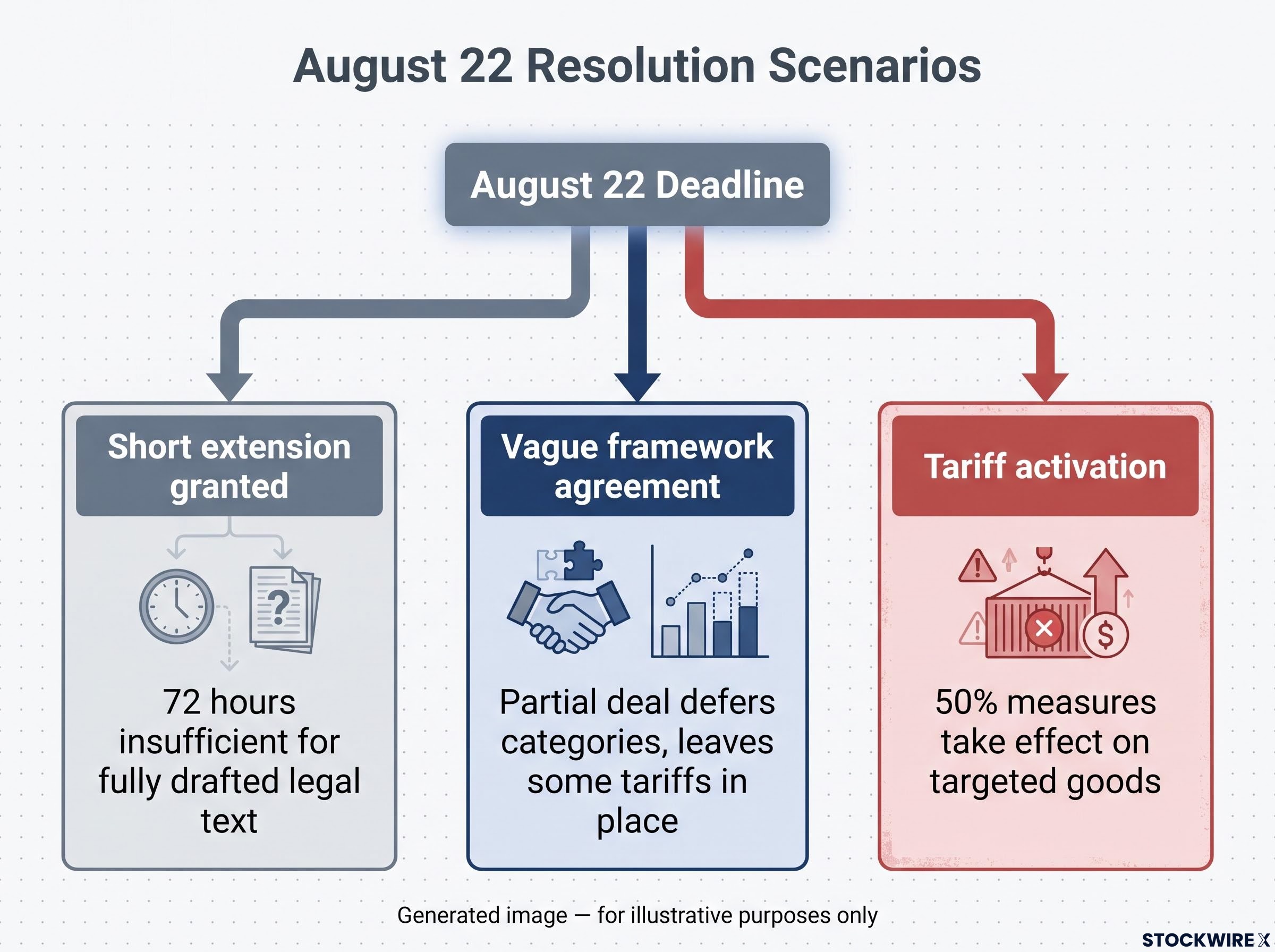
Three outcomes are most plausible once the deadline arrives:
- Short extension granted: The most likely near-term result. Trade deals of meaningful scope almost never move from agreement in principle to fully drafted legal text in 72 hours.
- Vague framework agreement: A partial deal that leaves some tariffs in place or defers specific categories to later negotiation rounds.
- Tariff activation: Some or all of the 50% measures take effect on targeted goods.
Watch for wording differences in USTR and Canadian government statements. “Framework” signals ongoing negotiation. “Binding agreement” with an implementation timeline signals genuine resolution. “Subject to review” signals continued uncertainty. Small language shifts are the most reliable near-term indicator.
The structural point is what matters most here. Even a fully positive resolution on August 22 does not return US-Canada trade risk to its pre-2025 baseline. The tools have been used. The precedent is set. 50% tariffs, Section 338 invocation, and 72-hour deadlines are now part of the operating environment. Any durable reprieve is best understood as a lower-risk period within a structurally higher-risk environment, not a return to normal.
Positioning through uncertainty: what this episode means for portfolios with North American exposure
The following are risk-management principles, not investment recommendations. Three actions apply directly to this episode’s unique structure:
- Stress-test existing holdings for scenarios in which the full 50% tariffs, or a scaled-down negotiated version, activate on consumer, materials, and industrials exposures with Canadian dependency.
- Review FX positioning for sensitivity to a tariff activation versus a confirmed durable deal. The Canadian dollar’s range of outcomes over the next week is unusually wide.
- Treat political “deal” announcements as provisional until binding text and implementation timelines are made public. The gap between a “framework” and an enforceable agreement is wide and consequential.
Monitoring official communications over the next week
The sources to watch are USTR official statements, the Canadian government (Carney’s office), and any joint communiques. Wording precision in these communications is a leading indicator. “Framework” signals ongoing negotiation. “Binding agreement” with an implementation timeline signals genuine resolution. “Subject to review” signals that tariffs remain deployable.
The most actionable insight from this episode is not the tariff level itself but the confirmation that 72-hour deadlines, social media announcements, and unsigned frameworks are now the operating environment for US-Canada trade. Any position that cannot survive a sudden tariff activation carries a tail risk that is no longer remote.
This article is for informational purposes only and should not be considered financial advice. Investors should conduct their own research and consult with financial professionals before making investment decisions. These statements regarding potential trade outcomes are speculative and subject to change based on political developments and negotiation progress.