Global equities are sitting at record highs, and Deutsche Bank macro strategist Henry Allen has just explained why that should make investors uncomfortable rather than confident. In a note published on 17 August 2026, Allen cautioned that current valuations embed an optimistic set of assumptions that are unlikely to hold simultaneously, with the balance of risks offering almost no cushion if any one of them cracks.
Two facts give this warning unusual weight. According to Deutsche Bank, Bloomberg’s index of U.S. financial conditions has recently reached its loosest reading in three decades, at a time when headline and core inflation are still running above target across most major economies. Meanwhile, the Strait of Hormuz has been effectively closed since 28 February 2026, disrupting roughly 20% of global seaborne oil and liquefied natural gas (LNG) flows, yet markets are pricing both realities as though they are benign.
Allen identifies three distinct risk paths that current valuations are essentially ignoring. Here is what each scenario looks like in practice, how it transmits into portfolio-level damage, and which signals to monitor in the weeks ahead.
Record highs on a foundation of very narrow assumptions
Equities are near all-time highs. Rate markets are pricing only a single additional Federal Reserve rate hike. Credit spreads are tight, volatility is subdued, and financial conditions are the loosest they have been in three decades.
Allen’s characterisation is blunt.
“Markets are pricing a near-immaculate scenario where basically everything goes right.”
That is not a throwaway line. It is a specific diagnosis: the assumptions embedded in current prices require growth to stay solid, inflation to keep falling, central banks to stop tightening after one more move, and the world’s most important oil chokepoint to reopen without lasting damage. Every one of those assumptions needs to hold simultaneously.
Risk-off directives from major institutions are converging around the same August window: Bank of America strategist Michael Hartnett issued a conditional instruction on 1 August 2026 to cut exposure until either a visible inflation re-acceleration or a bond-vigilante episode forces a policy U-turn, naming 28 August at Jackson Hole as the next critical inflection date.
What today’s financial conditions readings actually signal
Financial conditions sitting at their loosest point in roughly thirty years, against a backdrop of above-target inflation, is a combination that has historically been rare and short-lived. Deutsche Bank identifies a specific analytical error in treating this calm as evidence of safety. Extremely loose financial conditions have historically preceded, rather than predicted the absence of, episodes of market stress. The placid surface is a symptom of overconfidence, not proof that the risks have passed.
BIS market conditions research has established that identifiable conditions can point to a heightened risk of future market stress months before the event materialises, lending analytical weight to the argument that extremely loose financial conditions are a leading indicator of volatility rather than evidence of its absence.
For anyone holding risk assets at these valuations, the implication is asymmetric. Markets have essentially voted for the best-case outcome. If the assumptions hold, upside from here is modest because the good news is already priced in. If any one of them cracks, the repricing carries disproportionate downside.
When big ASX news breaks, our subscribers know first
Risk one: what happens if growth stays too strong
Strong economic data sounds like good news. In the current configuration, it is a potential trigger for pain.
The mechanism is straightforward. Should growth hold up and inflation prove persistent, policymakers would face pressure to deliver more rate hikes than the single move markets are currently prepared for. The expectation that central banks are nearly finished tightening, which Allen noted is unusual relative to historical cycles, would come apart.
Historical rate-hike cycles show that the S&P 500 has averaged roughly 9% in the 12 months following a first hike, but the 2022 outlier driven by emergency-pace tightening and supply-shock inflation illustrates precisely why the current configuration carries different risks than a standard tightening episode.
The asset classes most directly exposed to a hawkish repricing:
- Long-duration equities, particularly growth and technology names, face the sharpest pressure because higher discount rates reduce the present value of their future earnings
- Long-maturity bonds fall in price as yields rise to reflect a steeper rate path
- Short-duration fixed income and cash-like instruments are relatively better positioned, as their price sensitivity to rate changes is lower and their yields adjust more quickly
| Scenario Trigger | Most Exposed Assets | Relatively Sheltered Assets |
|---|---|---|
| Stronger growth forces additional rate hikes beyond single-move pricing | Long-duration equities, long-maturity bonds | Short-duration fixed income, cash-like instruments |
If the next inflation or payrolls print surprises to the upside, that is not just a data beat. It is a potential catalyst for markets to rapidly price in more tightening, directly hitting the parts of most retail portfolios with the longest duration. This is the scenario investors are least psychologically prepared for, because it begins with good economic news.
Risk two: a slowdown that never becomes a recession
Most investors wait for a recession to be declared before adjusting their positioning. Allen’s warning is that by the time that call arrives, the damage is already done.
Markets do not need a recession to reprice sharply. They only need a disappointment relative to what is already priced in.
History supports this directly. Deutsche Bank pointed to the 2015-2016 correction and the 2022 bear market as cases where growth decelerated without a formal recession ever being called, yet risk assets still suffered meaningful losses. The 2022 precedent is particularly pointed: that bear market began while the economy was still technically growing.
The question to ask is not “will there be a recession?” It is “is growth slowing relative to what current prices assume?”
The sector implications split cleanly:
- Most exposed (cyclical sectors): industrials, materials, consumer discretionary, where revenues and margins are most sensitive to a growth deceleration
- Typically more resilient (defensive sectors): utilities, healthcare, staples, though rich valuations can still drag these lower
Bonds could theoretically benefit as rate-cut expectations build, but above-target inflation constrains how far central banks can actually pivot. That creates an uncomfortable middle ground where the usual stock-bond hedge partially breaks down. If your portfolio was built for continued growth momentum, cyclical sector concentration becomes a specific vulnerability before a correction forces the issue.
Why the Strait of Hormuz changes the risk calculus entirely
This risk is categorically different from the first two. A supply shock does not just hurt one side of a portfolio. It attacks the diversification logic most investors rely on.
The scale of the disruption is difficult to overstate. The Strait of Hormuz has been effectively closed since 28 February 2026. Under normal conditions, the strait carries approximately 20% of global seaborne oil and LNG. Allen’s specific concern is that oil prices and the futures curve are not fully reflecting the possibility that this disruption persists or worsens.
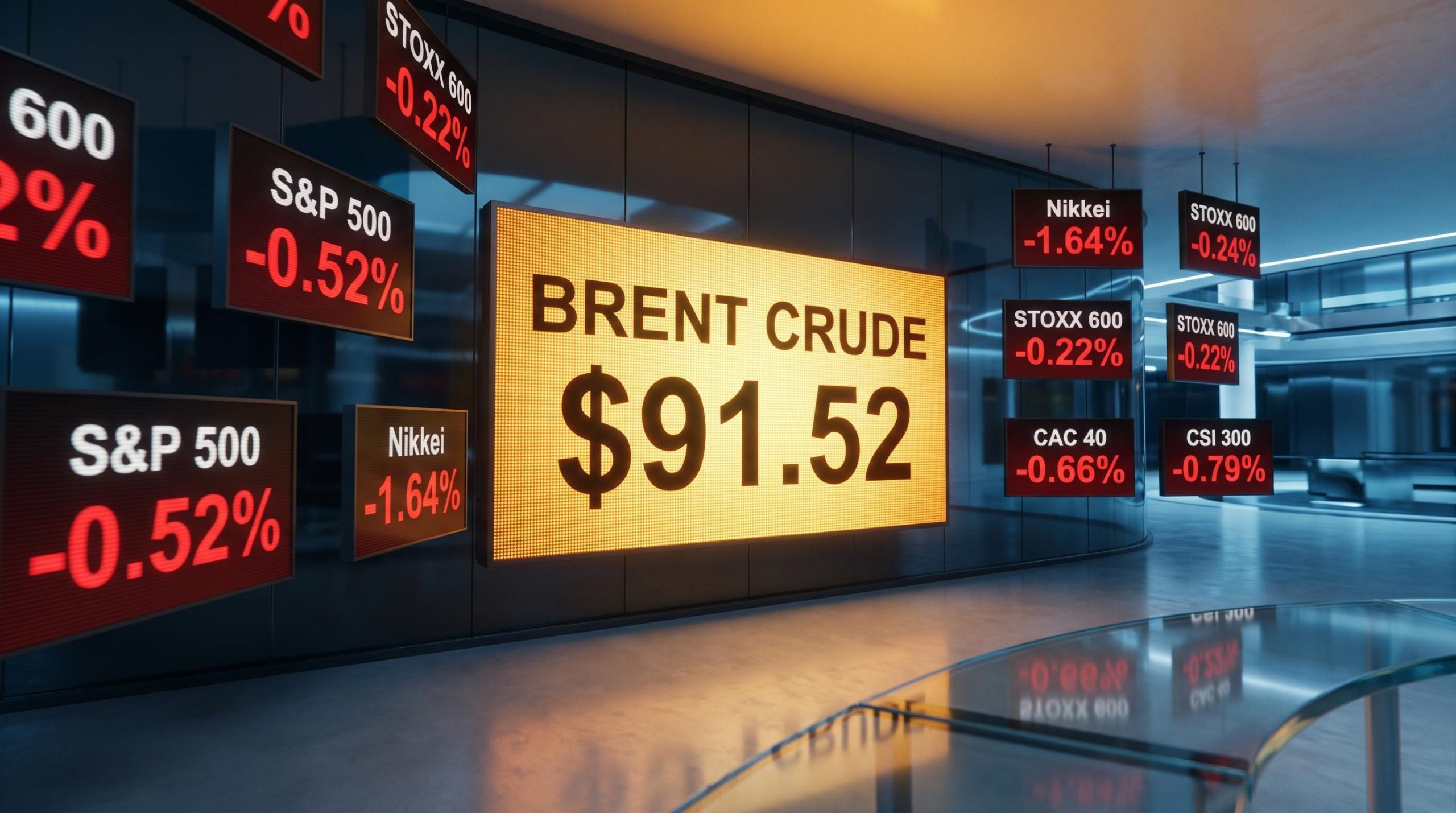
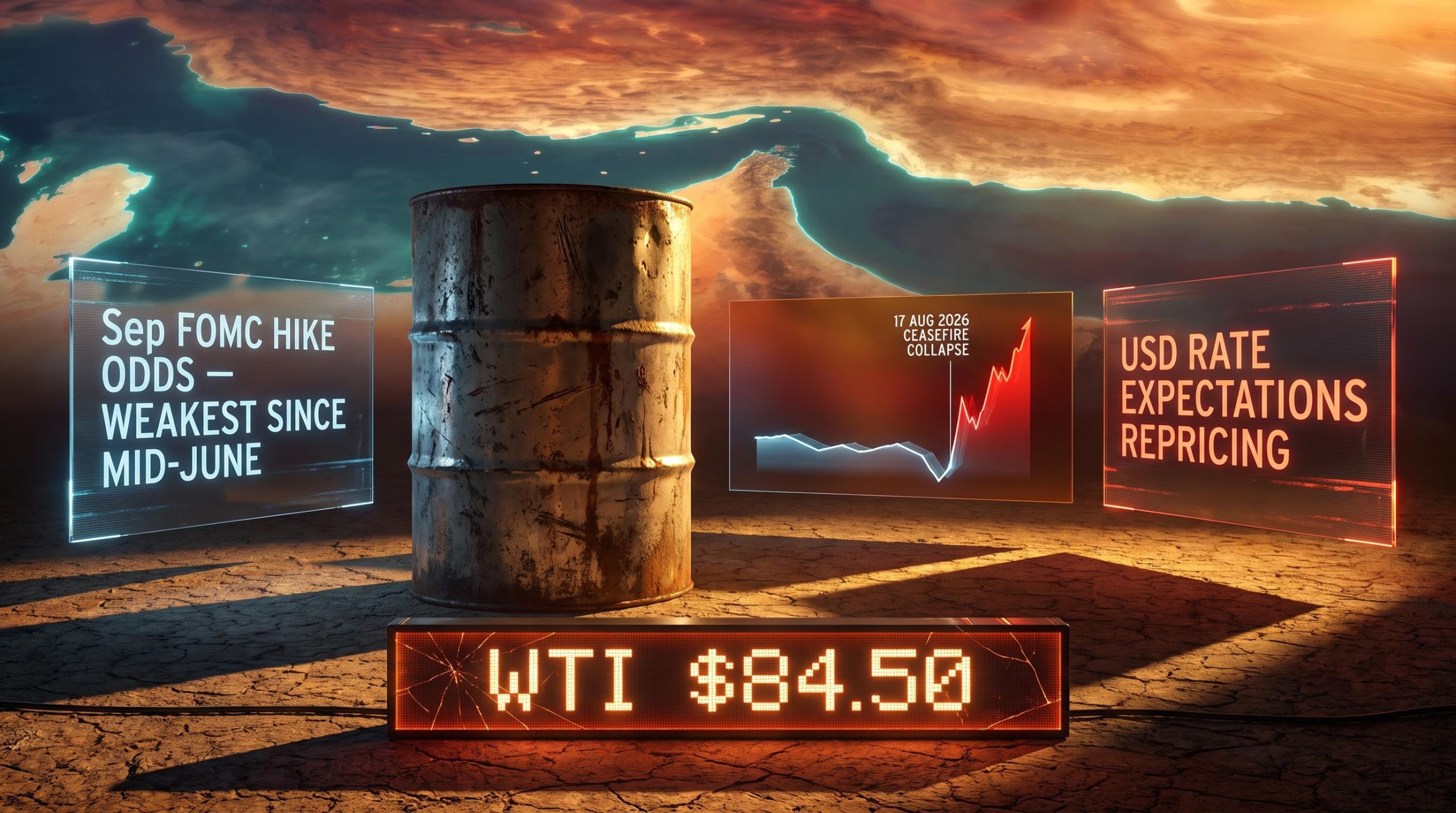
The Hormuz blockade transmission across oil prices, inflation, and central bank policy has already registered in Asian equity markets and ECB rate-hike signals, providing a concrete early map of how a sustained disruption propagates through asset classes before the futures curve has fully priced it in.
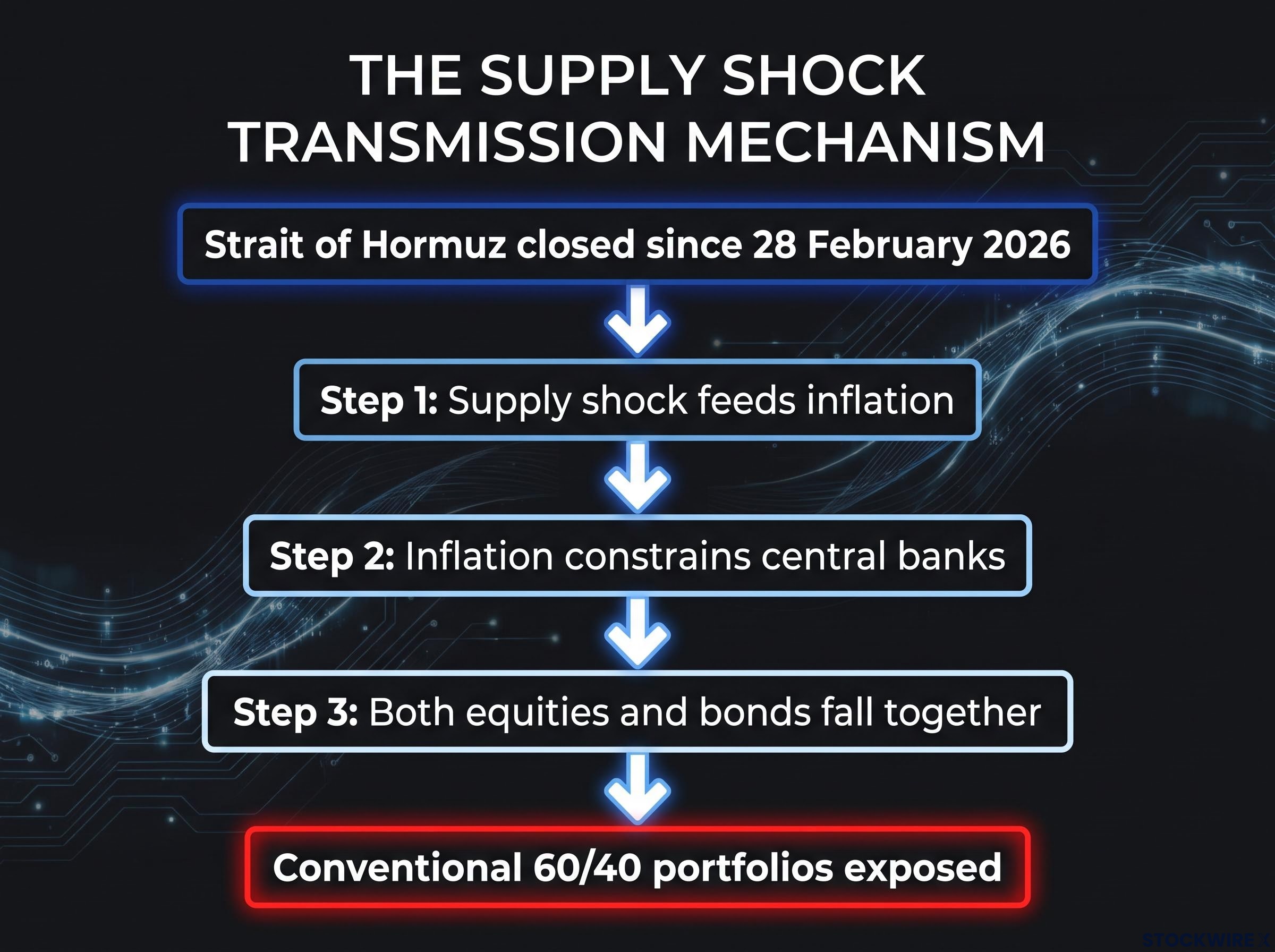
The transmission mechanism works in three steps:
- Supply shock feeds inflation. Higher energy prices flow directly into headline inflation and corporate input costs, squeezing margins and consumer purchasing power simultaneously.
- Inflation constrains central banks. Elevated energy-driven inflation limits policymakers’ ability to cut rates to support growth, and may force additional hikes even into a weakening economy.
- Both equities and bonds fall together. Weaker growth, higher inflation, and higher real rates create conditions that are hostile to most equities and traditional fixed income at the same time, dismantling the conventional stock-bond diversification benefit.
| Risk Scenario | Primary Trigger | Assets Most at Risk | Portfolio Implication |
|---|---|---|---|
| Growth too strong | Sticky inflation forces additional rate hikes | Long-duration equities, long-maturity bonds | Duration exposure reprices sharply |
| Slowdown without recession | Growth falls short of optimistic pricing | Cyclical sectors (industrials, materials, discretionary) | Earnings expectations cut; bond hedge partially impaired by above-target inflation |
| Hormuz supply shock persists | Energy prices spike on sustained disruption | Equities and bonds simultaneously | Stock-bond diversification breaks down; conventional 60/40 portfolios exposed |
For a reader holding a conventional 60/40 equity-bond portfolio, this is the most dangerous scenario. The hedge you are relying on, bonds as a buffer against equity losses, may not function in an inflationary supply shock the way it did in growth-driven downturns.
How to think about “priced for perfection” as an investor
“Priced for perfection” is not a market timing call. It is a description of the risk environment you are operating in right now.
In operational terms, it means the upside is largely already reflected in valuations. The asymmetry of risk is skewed to the downside: any deviation from the benign path is likely to cause a repricing that outstrips the magnitude of the deviation itself. Allen’s framing is that current pricing leaves almost no margin for error, which means being right on the scenario earns relatively little extra return, but being wrong costs significantly more than current volatility levels suggest.
The practical implications:
- Do not assume bonds will always hedge equity risk. In a supply-driven inflation shock, both asset classes can fall together.
- Treat today’s calm as a potential warning, not proof of safety. Loose financial conditions and tight spreads have historically preceded stress episodes, not ruled them out.
- Monitor rate-path data closely. Stronger growth or stickier inflation prints are the early signals of a scenario-one repricing.
- Think in terms of scenario risk rather than timing the top. Understanding how each holding behaves under each scenario matters more than guessing exactly when a correction might arrive.
What scenario-risk thinking looks like in practice
Consider a technology growth fund in your portfolio. Under scenario one (stronger growth, more hikes), its long-duration earnings get discounted at higher rates, making it one of the most exposed holdings. Under scenario two (growth slowdown), revenue momentum stalls and multiples compress. Under scenario three (supply shock), input costs rise while the central bank cannot provide relief, and bonds in the rest of your portfolio offer no offsetting gain.
That is not a recommendation to sell. It is a framework for understanding where your concentrated risk sits before the market tests it.
For investors wanting to convert the scenario-risk framework above into concrete portfolio actions, our dedicated guide to portfolio crisis preparation covers the four-question diagnostic, the liquidity buffer sizing approach, and the written drawdown stress-test process that builds resilience without requiring a market-timing call.
What to watch for as the August data cycle unfolds
Allen’s warning becomes actionable through three specific signals over the coming weeks:
- Inflation and labour market data relative to rate-path expectations. If incoming prints show growth or inflation running hotter than consensus, watch for rate futures to begin pricing additional hikes beyond the current single-move view. That repricing is the scenario-one trigger.
- Strait of Hormuz news flow. Any escalation or de-escalation in strait traffic relative to the near-total closure since 28 February 2026 carries outsized market impact because the futures curve is most visibly underpricing this risk.
- Rate futures pricing beyond the single-hike view. The moment markets begin discounting a second or third hike, the “priced for perfection” thesis starts breaking in real time.
The risk Allen identifies is not that any one scenario is guaranteed to unfold. It is that current pricing assigns near-zero probability to all three, simultaneously. The next few weeks of data are not routine economic releases. They are real-time tests of whether the benign assumptions underpinning record equity valuations can actually survive contact with incoming data.
This article is for informational purposes only and should not be considered financial advice. Investors should conduct their own research and consult with financial professionals before making investment decisions. Past performance does not guarantee future results. Financial projections are subject to market conditions and various risk factors.