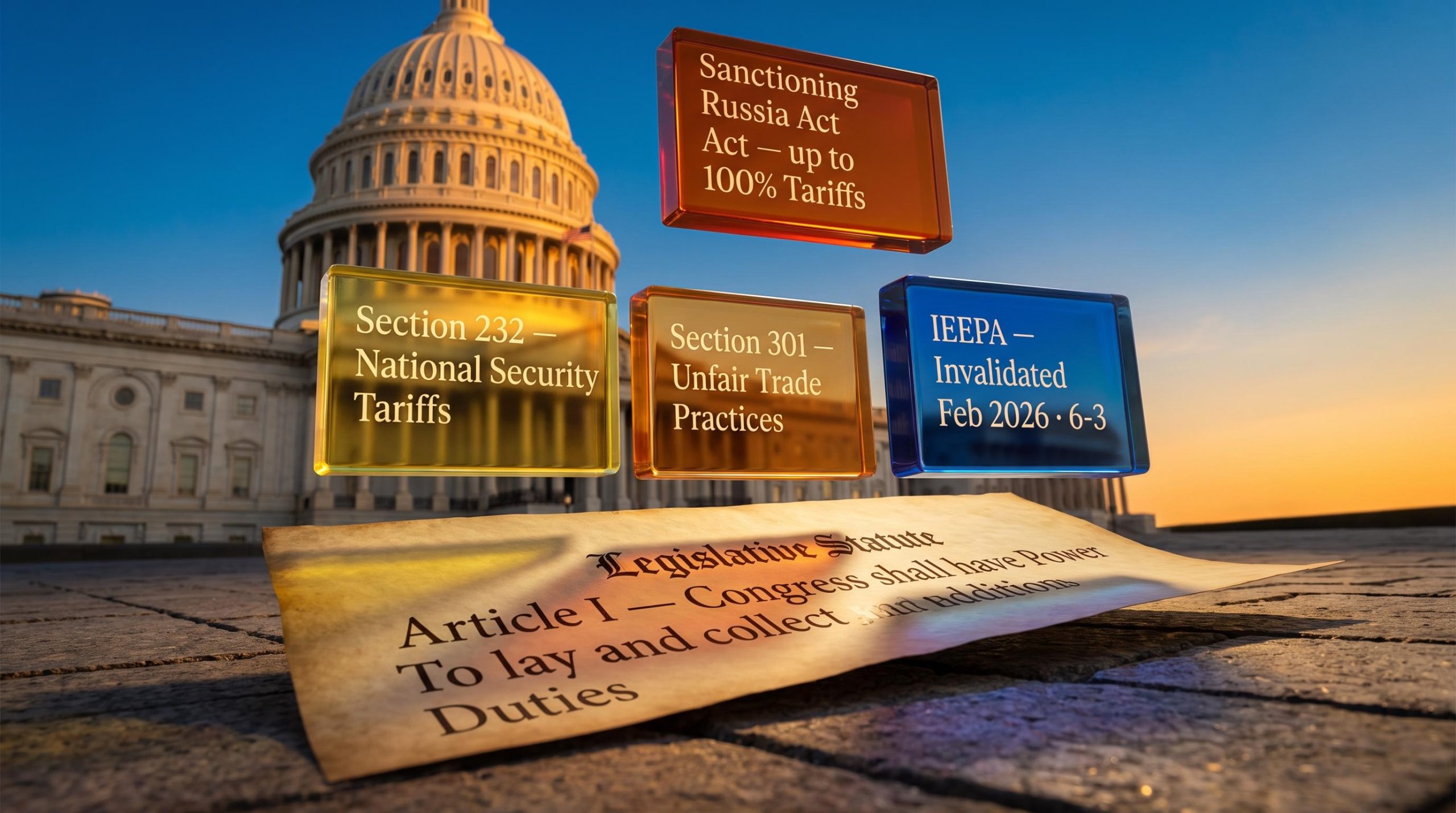
The U.S. Constitution assigns tariff authority to Congress. A business planning a ten-year capital project in July 2026 cannot assume any current tariff survives the next election. That gap between constitutional design and operational reality is the single most important structural risk in American trade policy right now.
The gap widened and then shifted shape in a matter of months. The Supreme Court narrowed one channel of presidential tariff power in February 2026, ruling that the International Emergency Economic Powers Act (IEEPA), a law designed to regulate transactions during emergencies, does not authorise the president to impose tariffs. But Congress is simultaneously considering the Sanctioning Russia Act, a bill that would hand the executive a fresh, explicit statutory channel for tariff authority, one specifically designed to survive the legal reasoning the Court just applied.
The mechanism by which tariffs are granted matters as much as the tariff rate itself. Here is the framework for understanding why that distinction shapes every investment decision in trade-sensitive sectors, and what it means for your exposure right now.
A constitutional power Congress slowly handed away
The baseline is clear. Article I of the Constitution grants Congress the power to “lay and collect…Duties” and to regulate foreign commerce. Tariff authority is, by design, a legislative function.
What happened over the following decades was not a single dramatic transfer. It was a sequence of individually defensible delegations that, taken together, produced a structurally different regime.
The statutory path from Congress to the Oval Office
Beginning in 1934, Congress passed a series of statutes that progressively shifted tariff authority toward the executive branch. Each one addressed a specific policy need. Together, they moved the system from rules to discretion.
The CRS analysis of delegated tariff powers traces how each major statute, from the Reciprocal Trade Agreements Act through IEEPA, shifted authority incrementally, with courts generally deferring to Congress’s judgment about how broadly it could delegate trade decisions to the executive branch.
| Statute | Year | Authority granted |
|---|---|---|
| Reciprocal Trade Agreements Act | 1934 | Allowed the president to negotiate trade agreements and adjust tariffs without new legislation |
| Trade Expansion Act (Section 232) | 1962 | Tariffs or restrictions justified by national security findings |
| Trade Act (Sections 301 and 122) | 1974 | Response to unfair trade practices (Section 301); temporary tariffs of up to 15% for 150 days (Section 122) |
| IEEPA (as later interpreted) | 1977 | Emergency transaction regulation reinterpreted by administrations as supporting tariff measures |
The result is that tariff policy in 2026 is less anchored in fixed legislative schedules and more contingent on presidential discretion. When tariffs can be imposed, modified, or removed by executive decision without a legislative vote, the stability that makes tariff policy plannable for your business or your portfolio disappears at the source, not at the margin.
When big ASX news breaks, our subscribers know first
What the Supreme Court settled in February 2026, and what it did not
The ruling looked, at first, like a real constraint. On 20 February 2026, the Supreme Court held 6-3 in Learning Resources Inc. v. Trump that IEEPA does not authorise the president to impose tariffs. Chief Justice John Roberts authored the opinion. The Court’s reasoning was precise: revenue-raising tariffs fall under Congress’s Taxing Clause authority, and IEEPA’s language about regulating importation does not implicitly transfer that power. IEEPA-based tariffs were invalidated. The administration was required to unwind them.
That was a real limit on one specific, fast, open-ended emergency channel. It confirmed that presidential tariff powers are not without boundaries.
The February 2026 ruling was not the first judicial intervention to narrow executive tariff authority; two federal courts had already dismantled IEEPA-based and Section 122-based duties within a three-month window earlier in 2026, and equity markets absorbed both with minimal volatility.
But the Court left the other statutory bases entirely intact. Section 232, Section 301, and Section 122 remain valid foundations for presidential tariffs. Within days of the ruling, the administration signalled plans to re-anchor its tariff strategy on those remaining statutes.
“The leverage derived from the credible threat of future tariff escalation remains intact.” — Brookings Institution analysis of post-IEEPA tariff strategy
What this tells you is that the February ruling closed one door while leaving the hallway open. If you treated the decision as a general constraint on executive tariff authority, you misread its scope. The structural capacity for rapid executive tariff action did not diminish; it shifted footing.
Why the Sanctioning Russia Act is a trade law story, not just a sanctions story
The Sanctioning Russia Act sounds like a Russia sanctions measure. It is that. But its structural significance extends well beyond any single country, and that is the part most coverage underweights.
The bill would do three things that matter for trade law architecture:
- Write explicit tariff authority into sanctions law, rather than relying on emergency interpretations of IEEPA or creative readings of older statutes
- Propose tariffs of up to 100% on top importers of Russian oil and gas (reduced from 500% in an earlier version)
- Extend potential tariff exposure beyond Russia to the EU and India
That third point is the one to underline. The bill’s geographic label obscures its institutional reach.
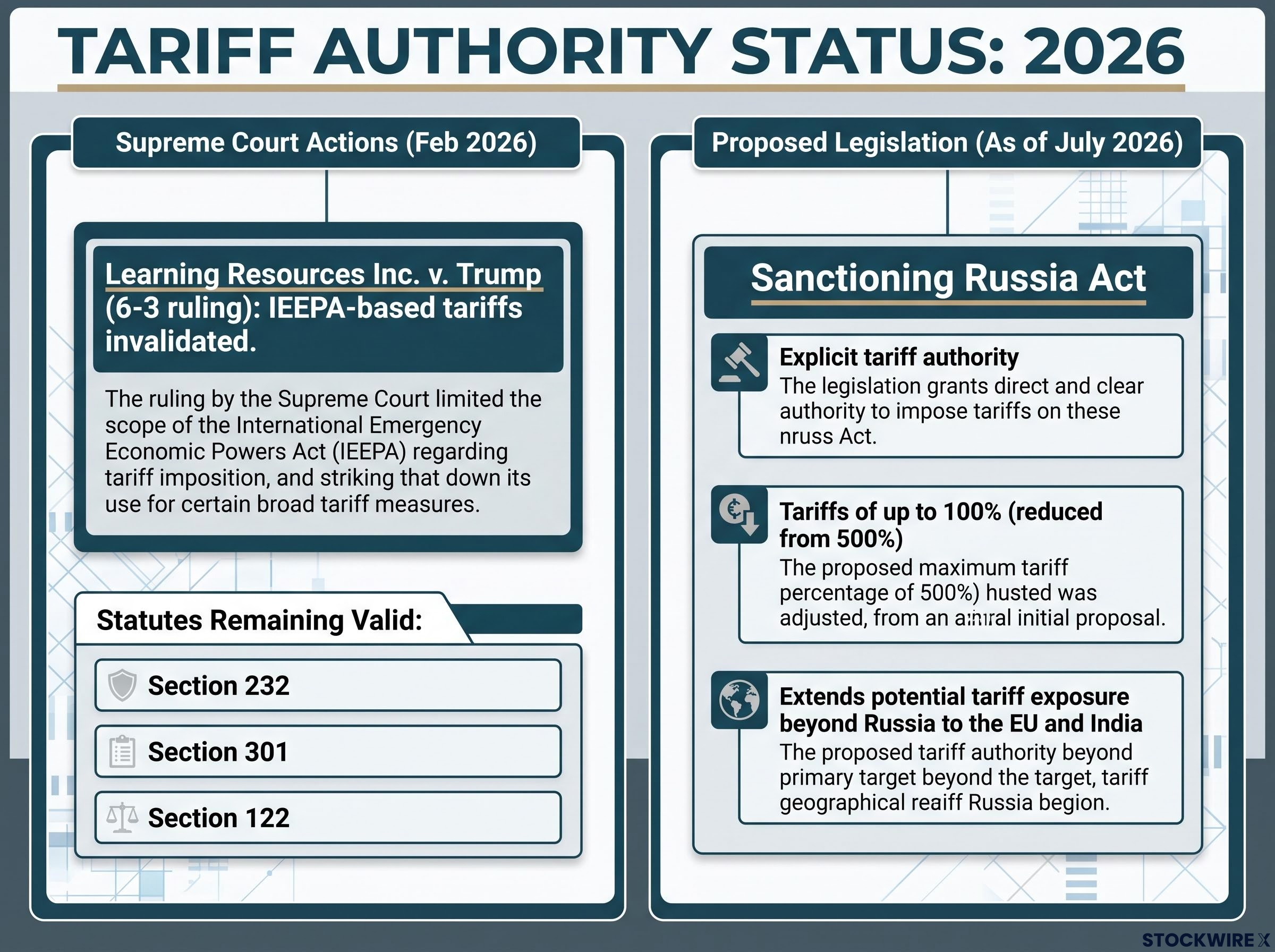
Explicit statutory delegation is harder to challenge in court than the kind of interpretive stretch the Supreme Court just rejected. When Congress clearly authorises a specific tool in the text of a statute, courts are far more likely to defer. The February ruling’s reasoning about IEEPA’s language does not apply to a bill that says, in plain terms, “the president may impose tariffs of up to 100%.”
Peter E. Harrell wrote in the Wall Street Journal on 19 July 2026 that the bill’s expanded presidential tariff authority is a more significant concern than questions about dollar reserve status, because it adds to already substantial executive trade powers and introduces additional economic uncertainty.
As of July 2026, the bill did not clear the House before members departed for the summer recess. The Senate has yet to take up the measure, and a number of Democratic senators are mounting procedural challenges directed at the tariff authority provisions in particular.
For any investor or business with exposure to EU or Indian trade relationships, this bill is a direct policy risk, not a Russia-specific development. The bill’s explicit language creates a statutory foothold that bypasses the very IEEPA limits the Supreme Court established months earlier, meaning it is specifically calibrated to be litigation-resistant in a post-Learning Resources legal environment.
Why unpredictable tariffs discourage the investment they are meant to protect
The argument for tariffs typically runs in one direction: protect domestic industry, encourage domestic investment, build capacity. The problem is that executive-decreed tariffs can deliver the first part while actively undermining the second.
The household cost impact of current tariff levels translates the structural arguments about discretionary executive authority into concrete personal finance terms: American households face an estimated $1,830 to $2,600 in additional annual costs, with vehicles, electronics, and pharmaceuticals absorbing the sharpest increases.
The mechanism operates through three channels:
- Policy volatility. Executive-driven tariffs can be imposed, modified, or removed rapidly in response to political or geopolitical shifts. Brookings characterises the current regime as “less anchored in fixed commitments and more contingent on presidential discretion.” For any firm planning a multi-year strategy, that conditionality changes the calculus.
- Long investment horizons. Capital-intensive industries, including steel, autos, semiconductors, energy, and heavy manufacturing, invest in assets with decade-long lives and large sunk costs. When profitability depends on a tariff-protected margin that can vanish with an election or a diplomatic shift, the rational response is to delay or scale down large capital projects.
- Modelling difficulty. Known, rule-based tariffs can be priced into capital budgets. Open-ended discretionary authority, especially when tariffs function as instruments of geopolitical bargaining, creates a distribution of possible future policies that is extremely difficult to quantify. Asset managers note that such uncertainty increases the hurdle rate for investment in globally exposed sectors.
The steel industry as a 50-year case study in tariff-driven underinvestment
The U.S. domestic steel industry since the 1970s is a concrete example of this pattern in action. Across multiple administrations, tariff protection was enacted, modified, and removed inconsistently. Without confidence that any given protective measure would remain in place across the full capital recovery cycle, steelmakers had little rational basis for committing to large-scale modernisation. Sustained underinvestment in new capacity and updated production methods followed as a direct consequence.
The protective effect of a tariff is real only if the tariff is credibly durable. A tariff that lasts one to two administrations is a subsidy to short-term operating margins, not a structural incentive to build new capacity. That distinction is the framework you need to evaluate any tariff-protected sector: the question is not whether a tariff exists today but whether it is durable enough to justify the capital cycle it is supposed to encourage.
How the ratchet works and why Congress has not reversed it
Each new delegation statute raises the baseline of executive discretion. Once industries and constituencies start relying on that discretion, reversing it becomes politically costly, even for legislators who object in principle.
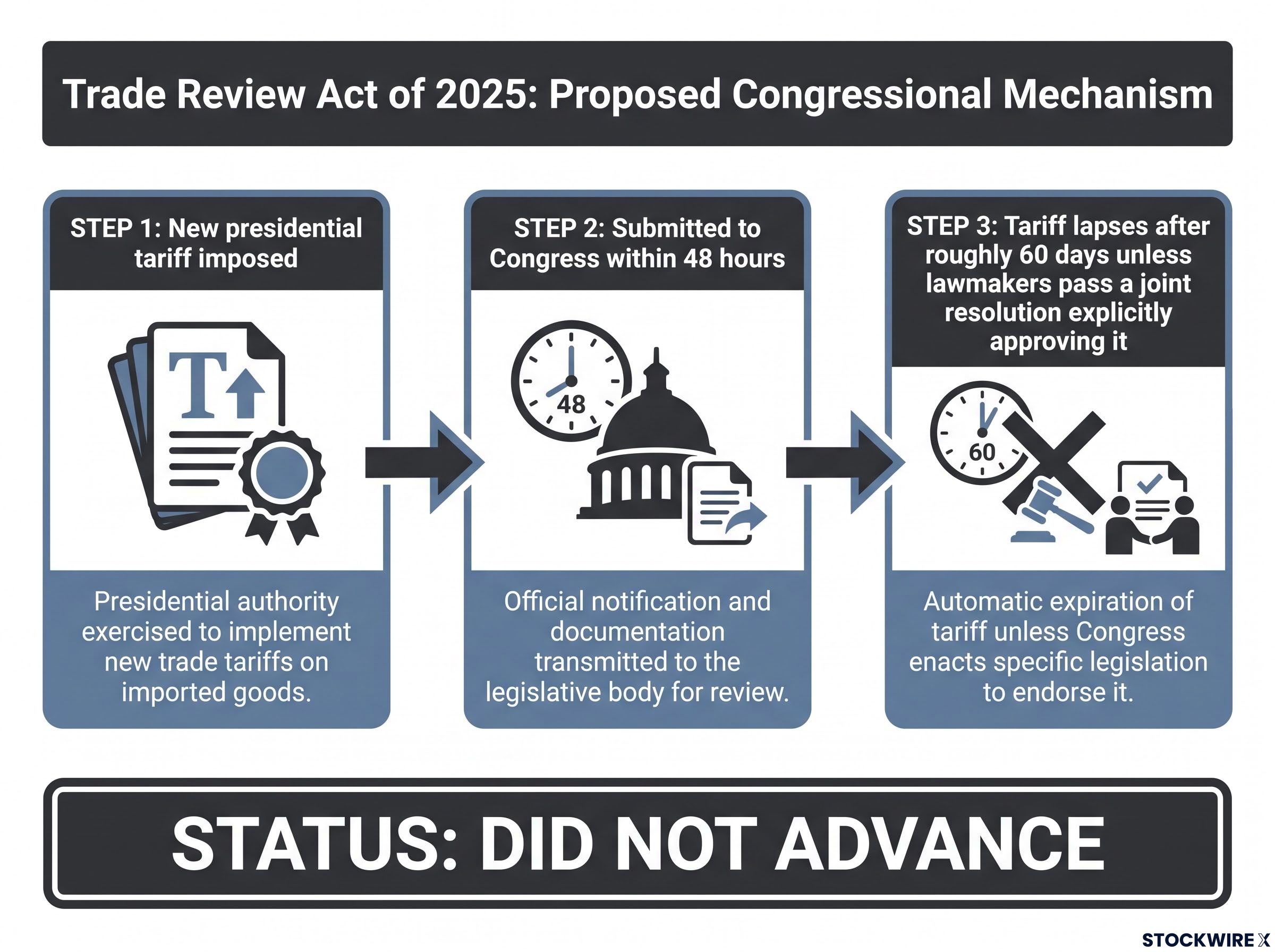
The Trade Review Act of 2025 illustrates the problem concretely. The bill would have required any new presidential tariff to be submitted to Congress within 48 hours of imposition, with the tariff lapsing after roughly 60 days unless lawmakers passed a joint resolution explicitly approving it. It did not advance.
The reason is not complicated. Legislators may prefer the executive to bear the political ownership of specific tariff decisions rather than forcing individual members to cast on-record votes for specific trade-offs. A vote to approve or reject a tariff on steel forces a senator to choose between steelworkers and steel buyers in their state. An executive order absorbs that political cost diffusely.
This dynamic produces what analysts describe as “institutional learned helplessness”: the baseline of executive control ratchets upward with each new delegation, and it becomes politically difficult to reverse that baseline once constituencies start relying on it.
Bipartisan rhetorical opposition to executive tariff authority has not translated into successful legislative reform across multiple Congresses. For your purposes as an investor, the institutional trend toward executive tariff discretion is unlikely to self-correct through normal legislative channels. That makes it a structural feature of the policy environment, not a temporary condition you can wait out.
Five variables to monitor as new tariff authority accumulates
The Sanctioning Russia Act is not an endpoint. If a sanctions statute with explicit tariff authority becomes replicable, the geographic and sectoral reach of discretionary tariffs would expand well beyond Russia across future legislative cycles. A single sanctions bill with tariff authority is material. A sequence of such bills targeting different countries would mark a structural reconfiguration of U.S. trade law.
Here are the five variables to track:
- Legal form of new tariff powers. Whether new legislation uses explicit tariff language or relies on existing statutes determines how courts can review and constrain presidential actions. Explicit language, as in the Sanctioning Russia Act, is harder to challenge and more durable.
- Interaction with existing statutes. How new powers sit alongside Section 232, Section 301, and Section 122 shapes both the speed and the durability of tariff measures.
- Emergence of a legislative pattern. A second sanctions bill with embedded tariff authority targeting a different country would signal that the template is replicating, requiring a fundamental reassessment of policy risk.
- Sector-specific capex trends. Monitoring capital expenditure patterns in heavily exposed industries provides an early-warning read on how policy risk is feeding through to real investment decisions.
- Congressional reform attempts. Whether legislative efforts to reassert congressional tariff oversight gain traction in future sessions is a meaningful signal about whether the ratchet is reversible.
The sectors most exposed are those with high fixed costs and complex supply chains: manufacturing, technology hardware, pharmaceuticals, and agriculture. All depend on stable cross-border flows and predictable input costs.
The global trade realignment triggered by U.S. protectionism has accelerated as trading partners conclude bilateral and regional agreements that explicitly exclude Washington, with three major trade agreements ratified since late 2025 and international ETFs absorbing $26.3 billion in net inflows between January and April 2026.
For any business with a capital project that spans the next presidential term, the question to answer is not what tariffs exist today but whether the legislative architecture being built in 2026 makes the next round of tariff changes faster, broader, and harder to reverse than any previous cycle.
A one-way ratchet in a world that still needs long-term capital commitment
The migration of tariff authority to the executive branch is not new. But the Sanctioning Russia Act represents a qualitative shift because it creates a litigation-resistant statutory model that can be replicated, arriving at precisely the moment when the February ruling closed the previous fast channel. The system adapted within months.
The distinction that matters for your planning is not between high tariffs and low tariffs. Both can be modelled. The distinction is between tariff levels and tariff unpredictability. Unpredictability raises the hurdle rate for long-term capital commitment regardless of the rate itself. The problem is structural, not arithmetic.
You do not need to predict specific future tariff rates. You need to price in the fact that the policy architecture of 2026 is designed for speed, discretion, and limited judicial review, and plan accordingly. That is the variable that separates businesses and investors who are positioned for the regime they are actually operating in from those still planning for the one they remember.
This article is for informational purposes only and should not be considered financial advice. Investors should conduct their own research and consult with financial professionals before making investment decisions.
Forward-looking statements regarding legislation, judicial outcomes, and policy developments are speculative and subject to change based on legislative activity, court decisions, and administration priorities.