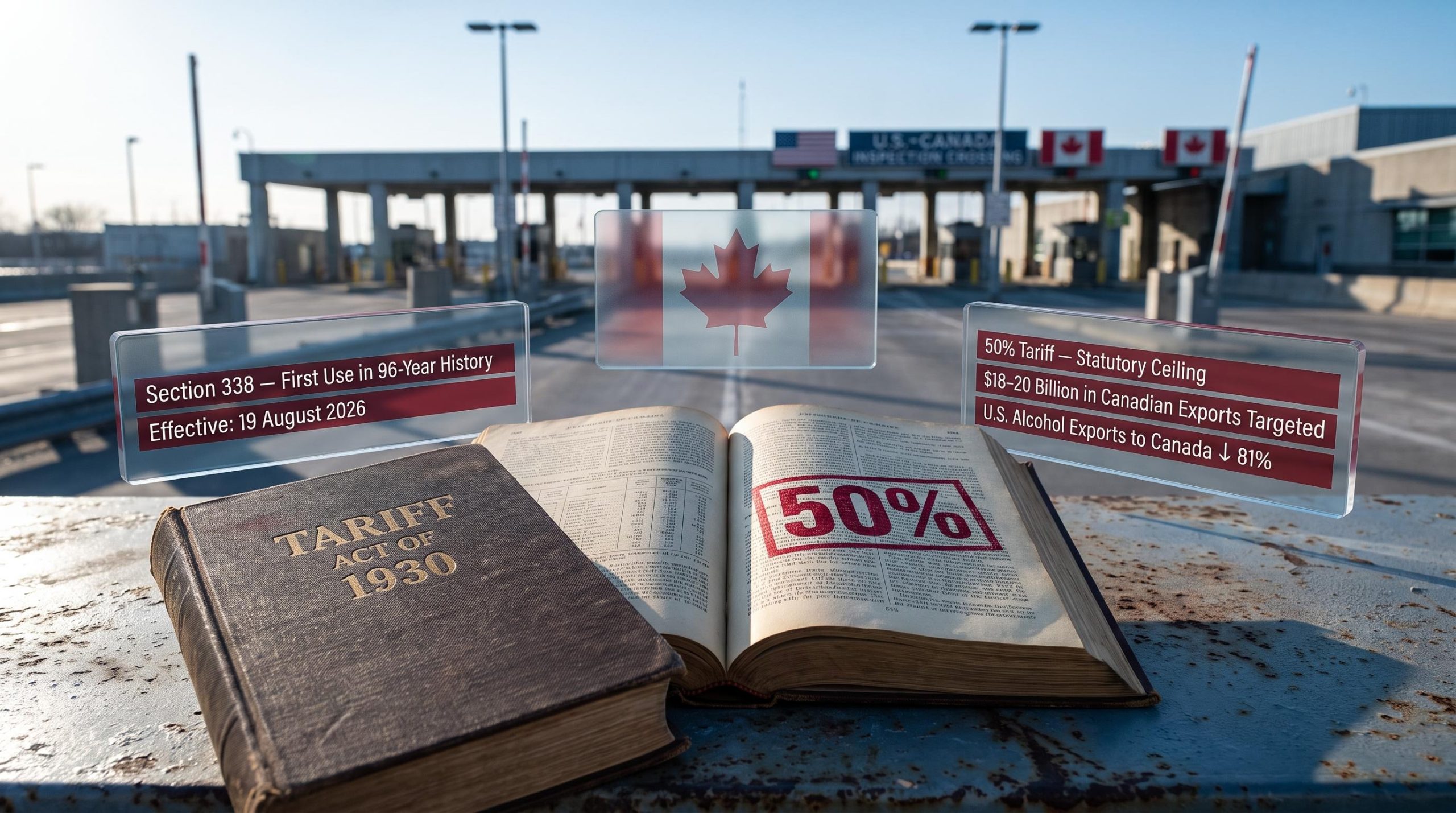
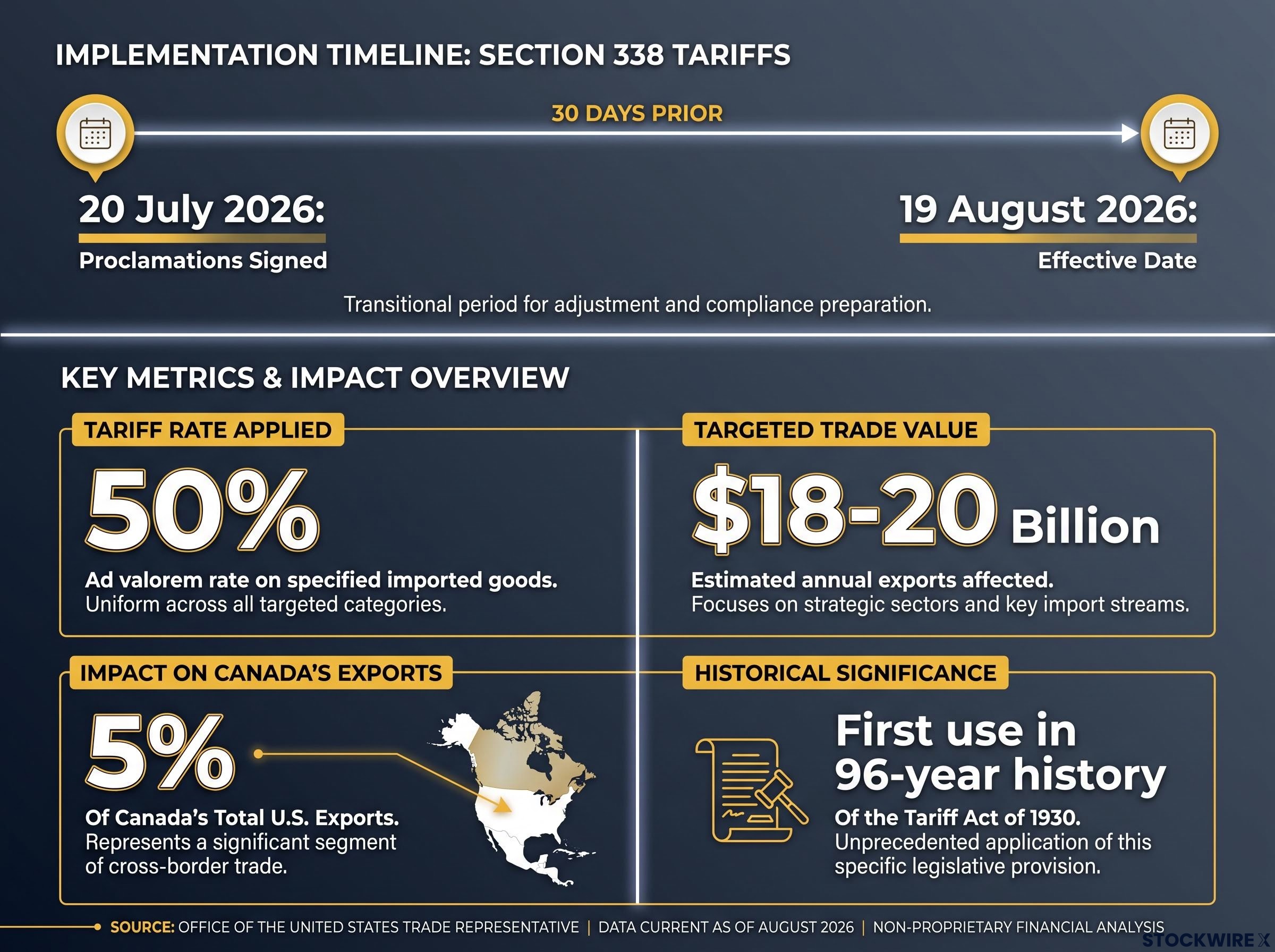
On 20 July 2026, President Trump signed three presidential proclamations imposing a 50% tariff on selected Canadian imports under Section 338 of the Tariff Act of 1930. It was the first time any president had used the statute in its 96-year history. The rate is not a negotiating position; it is the legal ceiling.
The proclamations target roughly $18-20 billion in annual Canadian exports across alcohol, dairy, wood products, textiles, and a basket of niche consumer goods. That figure represents approximately 5% of Canada’s total exports to the United States, but the damage is not evenly distributed. Prior to the proclamations, the USMCA trade agreement had delivered duty-free entry to the U.S. market for around 90% of Canadian exports, but those preferential terms are now overridden for every covered product category. The agreement includes no expiry provision, no prior investigation requirement, and no prescribed legal process that must run before the tariffs take effect. The effective date, 19 August 2026, is now less than four weeks away.
Here is a clear working model of what Section 338 actually does, why it was triggered across three specific sectors, what is covered and what was deliberately shielded, and what these factors mean for anyone with exposure to Canada-U.S. trade flows.
A 1930 statute no president had ever used, until now
Section 338 of the Tariff Act of 1930 (commonly known as Smoot-Hawley) authorises the president to impose additional duties when a foreign country either imposes unreasonable charges on U.S. products not equally applied to goods from other countries, or discriminates against U.S. commerce in a way that advantages third-country competitors. The discrimination must be relative: it is not enough that a measure hurts U.S. exporters; it must treat them worse than exporters from somewhere else.
The statute does not require:
- A formal investigation (unlike Section 301)
- A national security finding (unlike Section 232)
- Congressional consultation or reporting
- A public hearing or comment period
- A sunset clause or automatic expiry
The 50% ad valorem rate represents the maximum the statute permits, meaning this action exercises that ceiling in full. Section 338 further permits escalation all the way to a complete import ban if discrimination is found to continue, and no additional procedural steps are needed to reach that outcome.
No prior administration had ever invoked the provision. There is no case law governing its use, no judicial precedent interpreting its boundaries, and no established procedural norms for how broadly the president can define “discrimination” under its terms. For affected businesses and investors, that absence is a structural risk in itself: there was no formal warning mechanism, no pre-decisional comment period, and no established legal framework to anticipate or contest the action before it landed.
When big ASX news breaks, our subscribers know first
Sector by sector: how each proclamation satisfies the discrimination standard
The three proclamations are not three applications of the same argument. Each targets a distinct Canadian measure and constructs a separate legal theory that Canada treats another country’s goods more favourably than U.S. goods, meeting Section 338’s specific discrimination standard.
According to White House data, U.S. alcohol exports to Canada fell by 81% across 2024 and 2025, a period during which exporters from Europe and other markets expanded their volumes into the country.
For alcohol, the justification centres on provincial government corporations (such as the LCBO in Ontario) that removed U.S. products from shelves beginning in March 2025. Because alcohol from other exporting nations continued to gain share while U.S. exports collapsed, the administration characterised the bans as discriminatory rather than broadly protectionist. In June 2025, Alberta and Saskatchewan became the only provinces to remove their restrictions. A Nanos poll recorded 73% support among respondents for provincial governments maintaining the exclusion of U.S. liquor from shelves, which makes political resolution at the provincial level particularly difficult.
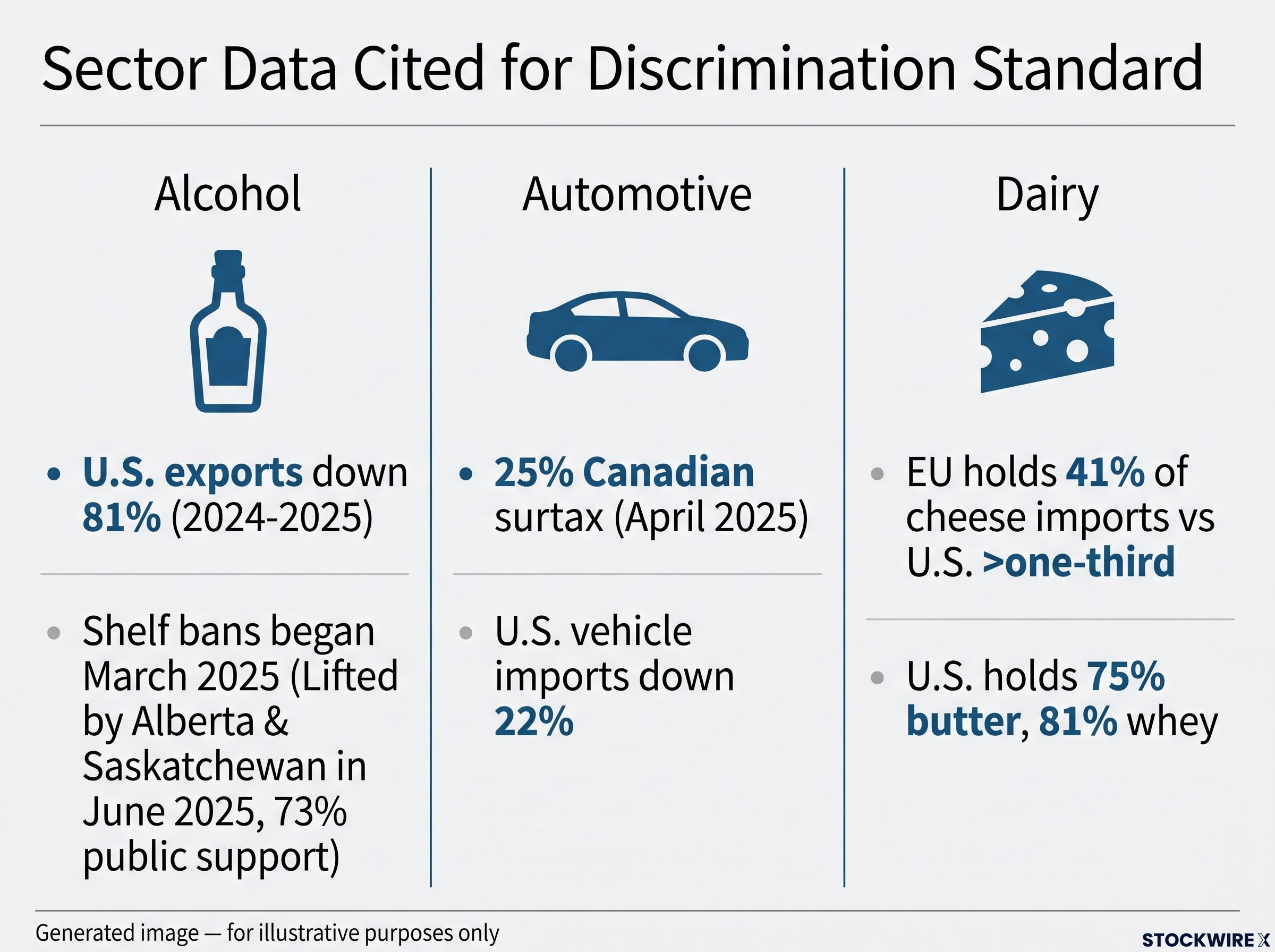
For automotive, the justification cites a 25% surtax that Canada applied to U.S.-origin vehicles from April 2025, a retaliatory response to U.S. Section 232 tariffs on autos. That measure contributed to a 22% drop in U.S. motor vehicle imports into Canada over the relevant period. However, because autos are already covered by Section 232 tariffs, they are explicitly excluded from the Section 338 tariff list. The annex labelled “motor vehicles” contains no actual passenger vehicles; it is a basket of related goods.
For dairy, the discrimination argument is narrower and more technical. Canada’s cheese tariff-rate quota (TRQ) system, which caps the volume of imports that enter below prohibitive tariff thresholds, operates differently depending on the trade partner. The USMCA grants TRQ access only to processors and distributors, whereas the Canada-EU trade agreement (CETA) also extends eligibility to retailers, giving European suppliers a broader route into the market. The EU has leveraged that wider access to account for roughly 41% of Canada’s cheese imports. Despite this, the U.S. retains its position as the leading single-country source of cheese, supplying over a third of total imports, and holds dominant positions across other dairy lines, including approximately 75% of butter imports, 81% of whey, and near-total coverage of milk. The cheese TRQ disparity gave the administration a legally specific discrimination argument that does not require broad market disadvantage to satisfy the statute.
| Sector | Core Canadian measure | Key U.S. trade statistic | Section 338 tariff status |
|---|---|---|---|
| Alcohol | Provincial shelf bans on U.S. products (March 2025) | U.S. exports down 81% (2024-2025) | 50% duty applied |
| Automotive | 25% surtax on U.S. vehicles (April 2025) | U.S. vehicle imports into Canada down 22% | Excluded (Section 232 covers) |
| Dairy | TRQ access disparity: USMCA vs CETA | EU holds 41% of cheese imports; U.S. holds >one-third | 50% duty on selected products |
Included, excluded, and exposed: mapping the actual tariff scope
The categories subject to the 50% additional duty span:
- Alcoholic beverages (wine, beer, spirits)
- Selected dairy products (certain cheeses, butter, processed dairy)
- Plywood and engineered wood products
- Textiles and apparel
- Certain industrial machinery and equipment
- Niche consumer goods (sporting equipment, furniture, toys)
The pattern of exclusions tells a different story from the 50% headline rate.
Why the exclusions matter as much as the inclusions
The proclamations carve out a substantial set of categories from the 50% duty: energy products (crude oil, natural gas, electricity), steel, aluminium, copper, timber and lumber, potash, critical minerals, fish and seafood, and certain civil aircraft components are all exempt. Each exclusion tracks a sector where immediate U.S. supply shortfall risk outweighs the tariff leverage benefit. The administration calibrated this action to maximise political pressure on Canada without triggering domestic supply disruptions in sectors the U.S. economy cannot quickly substitute.
That calibration is itself a signal about where the hard limits of escalation sit. But exclusion is not permanent: Section 338 gives the president authority to modify scope without procedural constraints, meaning today’s exclusions could become tomorrow’s additions.
For analysts and portfolio managers, the gap between the headline tariff scope and actual firm-level exposure matters. Damage is concentrated. Spirits distilleries that send more than half their sales volume across the border to U.S. buyers carry the sharpest revenue exposure. Wood product manufacturers, particularly plywood producers whose U.S. sales make up the majority of their output, face comparable pressure. Across most of the dairy sector and the broader alcohol category, the low share of domestic production that reaches U.S. consumers limits the total financial impact at an industry level. The $18-20 billion coverage figure describes the outer boundary, not the evenly distributed impact.
Section 338 in the legal framework: what USMCA cannot protect
Investors and analysts are more likely to have encountered Section 232 (national security tariffs on steel, aluminium, and autos) or Section 301 (unfair trade practices, used extensively against China). Section 338 sits alongside these but operates with fundamentally different constraints, or rather, a lack of them.
| Feature | Section 232 | Section 301 | Section 338 |
|---|---|---|---|
| Statutory basis | Trade Expansion Act of 1962 | Trade Act of 1974 | Tariff Act of 1930 |
| Trigger condition | National security threat | Unfair trade practices | Discrimination vs U.S. commerce |
| Investigation required | Yes (Commerce Dept.) | Yes (USTR) | No |
| Sunset clause | No (but review periods) | Four-year term | None |
| Congressional oversight | Limited | Reporting requirements | None specified |
The distinction that matters most is procedural. Sections 232 and 301 both require formal investigations that generate timelines, reports, and public hearings. Those processes give markets, lobbyists, and trade lawyers advance signals. Section 338 offers none of that runway.
The legal novelty of Section 338 sits within a broader context where executive tariff authority has itself come under judicial pressure, with two federal courts striking down IEEPA-based and Section 122-based duties within a three-month window earlier in 2026, leaving Section 232 as the most defensible remaining unilateral instrument.
The proclamations explicitly state that Section 338 duties apply even where USMCA preferential rates would otherwise shield Canadian goods. USMCA certificates of origin for covered products will not prevent the 50% surcharge at the U.S. border.
Canada is expected to file challenges through USMCA dispute panels and WTO channels. Dairy has already been the subject of two completed USMCA panel proceedings: the first found in favour of the U.S. and produced substantive changes, while the second came down largely on Canada’s side. But the legal uncertainty here is of a different kind. Because Section 338 has never been used, there is no established jurisprudence on how broadly the president can define “discrimination,” how far the U.S. can override treaty preferences using 1930-era law, or whether courts or panels will limit or uphold the proclamations. For every business or investor trying to model risk, the legal outcome of potential challenges is genuinely unknown, not merely uncertain in the way trade disputes usually are, but unknown in the foundational sense of having no prior case to reason from.
Where the exposure concentrates for exporters, importers, and investors
The policy architecture matters, but so does who pays and how fast.
Canadian exporters in affected categories face volume declines and margin compression. Spirits distilleries are most exposed given their heavy U.S. revenue dependence. Plywood producers with majority U.S. market share face similar pressure. For most dairy and alcohol producers, limited U.S. export volumes cap aggregate damage, but that is cold comfort for the specific firms whose revenue is concentrated there.
Retaliation and escalation: the tail risk that changes the range of outcomes
U.S. importers reliant on Canadian goods face a different problem: a landed cost shock requiring repricing, substitution, or margin absorption before 19 August. That 30-day window between proclamation and effective date is operationally short for companies with complex cross-border supply chains. Many firms will absorb the initial cost shock before any supply-chain adjustment is feasible, and that cost absorption will show up in near-term earnings and credit metrics before strategic repositioning can offset it.
Consumer cost pass-through from tariffs on alcohol, dairy, and wood products will vary significantly depending on how much of the landed cost shock U.S. importers can absorb versus push downstream, and the pattern observed across vehicles, electronics, and pharmaceuticals in 2026 suggests that higher-margin categories absorb less and pass through more rapidly.
Near-term actions U.S. importers must evaluate before 19 August:
- Pass through costs to downstream customers
- Seek alternative non-Canadian suppliers
- Renegotiate existing supply contracts
- Build inventory ahead of the effective date
- Review pricing strategies across affected product lines
For equity investors, the relative winners may be non-Canadian suppliers positioned to substitute into the U.S. market, and U.S. domestic producers that compete with now-tariffed Canadian goods and gain pricing power. Fixed-income investors should monitor credit metrics for issuers whose revenue mix is heavily tilted toward affected cross-border flows.
The muted market reaction to a headline 50% rate reflects more than a year of announce-delay-revise cycles that trained investors to discount announced rates until implementation evidence arrives, a pattern that makes the 30-day window before 19 August a monitoring period rather than an immediate repositioning trigger for most equity allocators.
Canada has previously responded to U.S. tariff actions with retaliatory duties, and similar steps are on the table now. Section 338’s escalation authority (to full import prohibition) and its unlimited duration make the ceiling on this dispute genuinely open-ended. If Section 338 survives legal challenge, its application to other bilateral relationships where discrimination is alleged becomes more plausible, extending the precedent risk well beyond Canada.
The Section 338 action is one data point in a broader global trade realignment that has seen three major trade agreements ratified without US participation since late 2025, redirecting capital flows toward India, Europe, and ASEAN markets in ways that compound the bilateral Canada-US disruption for investors holding cross-border positions.
Three variables that will determine where this dispute goes from here
The tariffs are signed. The effective date is set. What remains uncertain is whether they persist, escalate, or are withdrawn, and three variables will shape that outcome more than any others.
- Pre-effective-date negotiation outcomes: The 30-day window before 19 August is the most concentrated period for potential resolution. Any modification will likely come through presidential proclamation, using the same unilateral authority that imposed the tariffs.
- Canada’s USMCA and WTO challenge filings: Formal dispute proceedings could take months to years, and the tariffs remain in force throughout. No case law exists to reliably predict the outcome of a challenge to Section 338’s first-ever use.
- Provincial alcohol ban decisions: With 73% public support for keeping American liquor off shelves and only Alberta and Saskatchewan having lifted their bans, the political resolution path runs through provincial-level decisions, not just federal negotiation. That makes the timeline less predictable than standard bilateral trade disputes.
The broader lesson for investors is one that will not fade quickly: Section 338 has now been activated and sits alongside Section 232 and Section 301 as a live instrument of U.S. trade policy, one that carries no mandatory process, no advance warning mechanism, and no built-in expiry.
For anyone who previously treated Canada as a low-risk, treaty-protected trade partner, the lesson here is structural. The existence of USMCA does not insulate cross-border investment from unilateral statutory action when the political conditions align. Investors who track the right leading indicators, provincial alcohol policy, USMCA panel appointment timelines, presidential proclamation modifications, will have earlier signals than those waiting for earnings guidance to reflect the impact.
This article is for informational purposes only and should not be considered financial advice. Investors should conduct their own research and consult with financial professionals before making investment decisions. These statements regarding potential outcomes are speculative and subject to change based on market developments and policy actions.