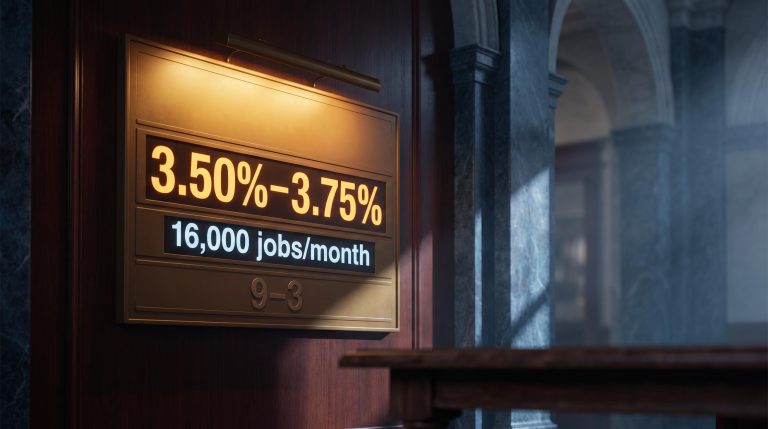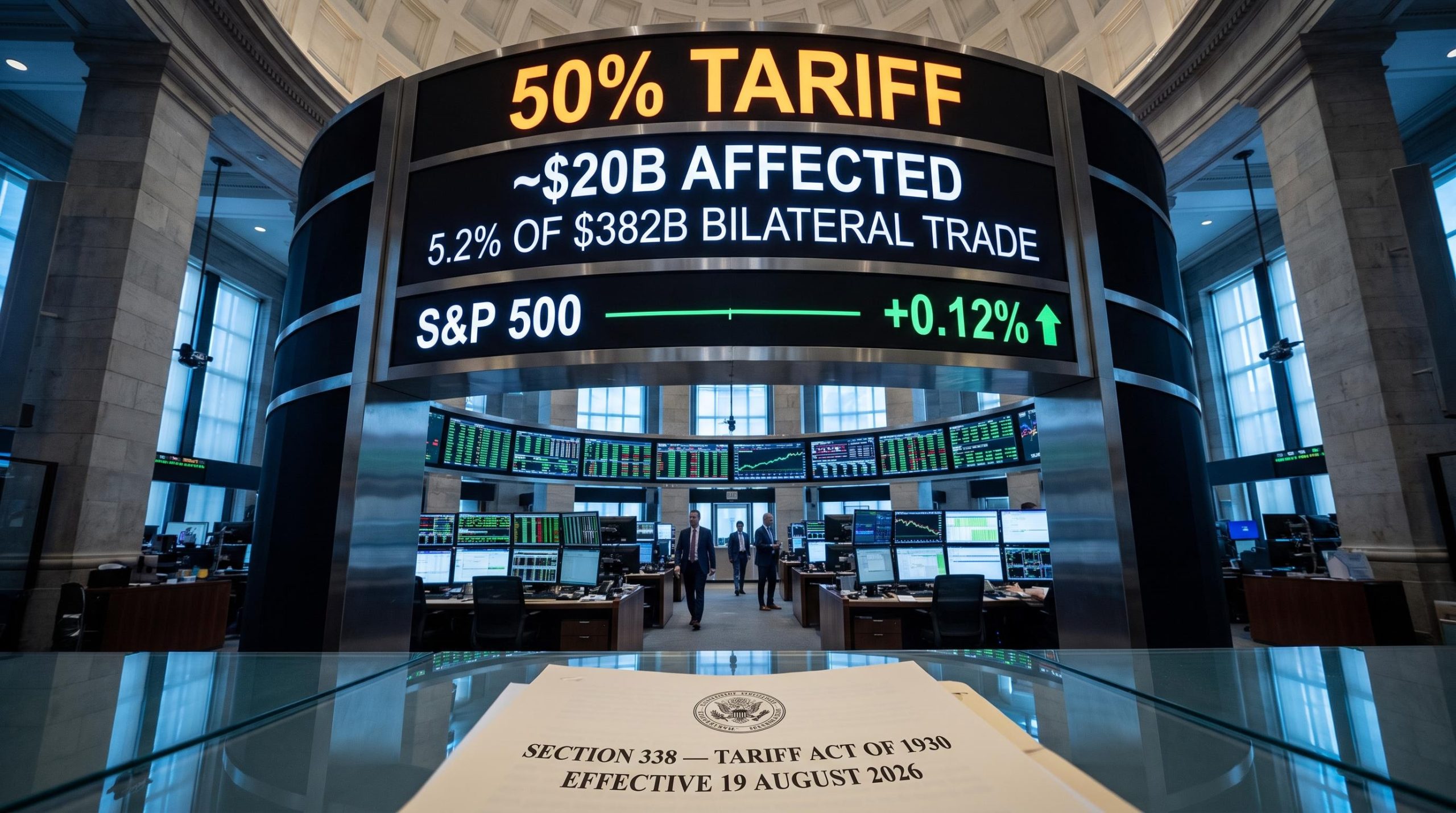
A 50% tariff on Canadian goods landed this week, and the S&P 500 barely flinched. The gap between the headline and the price action is the story worth understanding.
President Trump signed three proclamations on approximately 20 July 2026 under Section 338 of the Tariff Act of 1930, imposing a 50% levy on specified Canadian imports, effective 19 August 2026. The scale sounds like a regime change. The market reaction says otherwise, and not because investors are asleep. After more than a year of announce-delay-revise cycles, markets have developed a calibrated framework for reading trade headlines, and this announcement fits squarely inside it.
Here is how to read trade headlines the way markets are now reading them, what this particular tariff round actually covers, and what specific developments would force a repricing before 19 August.
A 50% tariff with a very selective price tag
The number demands attention. 50% is a punitive rate by any historical standard, and Section 338 is a rarely invoked provision of the Tariff Act of 1930, giving the president authority to impose duties when a trading partner is found to discriminate against U.S. commerce. The White House cited “discriminatory treatment” of American cars, alcohol, and dairy as the justification.
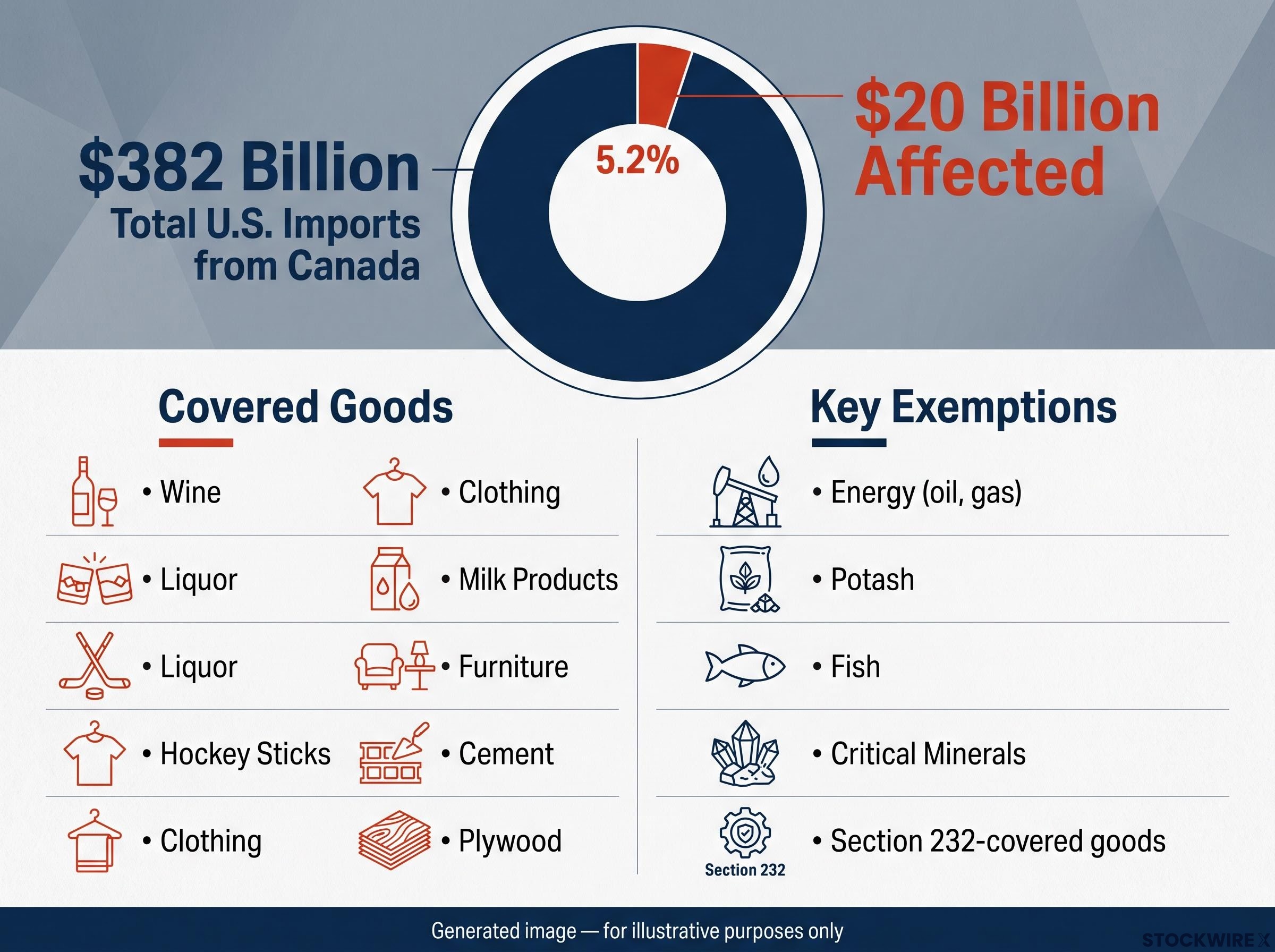
But the number narrows quickly once you read the exemption list. The tariff applies to a specific set of consumer goods and industrial inputs: wine, liquor, hockey sticks, clothing, milk products, furniture, cement, and plywood, among others. It does not touch the categories that dominate the bilateral trade relationship.
| Category | Detail |
|---|---|
| Covered goods | Wine, liquor, hockey sticks, clothing, milk products, furniture, cement, plywood |
| Key exemptions | Energy (oil, gas), potash, fish, critical minerals, Section 232-covered goods |
| Affected import value | ~$20 billion |
| Share of bilateral trade | ~5.2% of $382 billion in total U.S. imports from Canada |
| Effective date | 19 August 2026 (30 days post-signing) |
That $20 billion figure is the real scope. It makes this round a meaningful bilateral irritant, but for a diversified portfolio, the macro shock is modest. Hold that proportion in mind when weighing the headline against your actual exposure.
The USMCA exemption question
One element does mark a departure from earlier rounds. Official proclamations state that the 50% tariffs apply regardless of whether a good originates under the USMCA (the U.S.-Mexico-Canada trade agreement), a framework that governs tariff treatment for qualifying North American goods. In prior rounds, USMCA-compliant goods often received protection. This time, they do not.
That raises the legal and diplomatic stakes. It does not, however, dramatically alter the immediate macro impact, given that the largest trade categories, energy and critical minerals, remain exempt under separate provisions.
When big ASX news breaks, our subscribers know first
How markets learned to discount the announcement
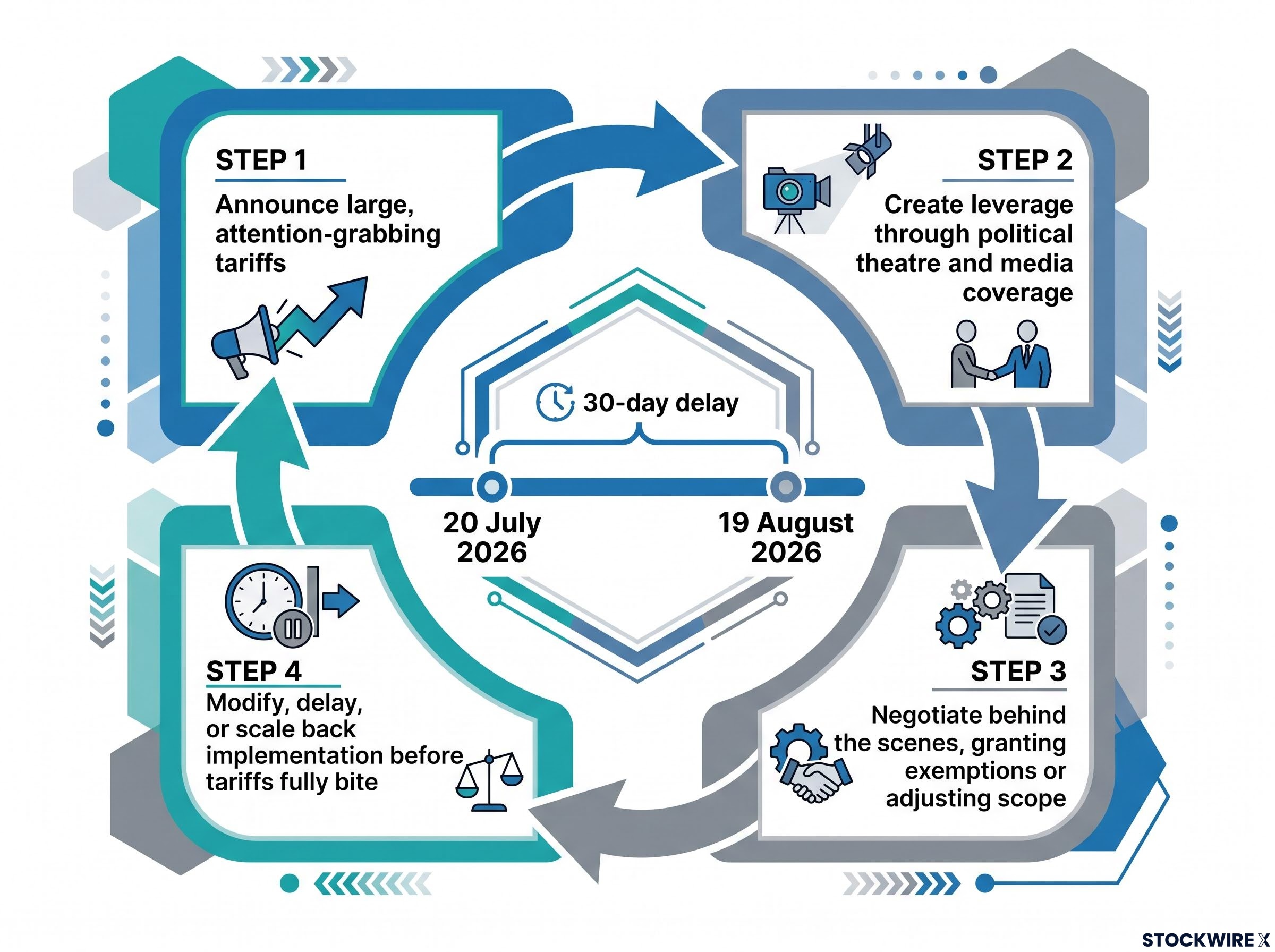
The muted reaction did not arrive overnight. It was built across more than a year of trade-policy whiplash, and the pattern that taught investors to recalibrate is now well-documented:
- Announce large, attention-grabbing tariffs
- Create leverage through political theatre and media coverage
- Negotiate behind the scenes, granting exemptions or adjusting scope
- Modify, delay, or scale back implementation before tariffs fully bite
Each repetition of this cycle eroded the surprise value of the next headline.
The clearest evidence arrived in February 2026. The Supreme Court struck down the bulk of the previous year’s tariffs, a ruling that would have sent markets sharply in either direction some eighteen months prior, yet prices moved within the bounds of an ordinary trading session.
The February 2026 Supreme Court ruling that invalidated prior tariff rounds was itself part of this recalibration: by shifting trade risk from a binary executive shock model to what analysts at Goldman Sachs and Brookings describe as a legislative uncertainty model, the court ruling paradoxically made the overall tariff environment more priceable for diversified portfolios, even as it removed a significant executive tool.
Contrast that with the broad-based tariff packages of 2025, which blindsided investors through their sheer scale and unprecedented scope, helping to drive a substantial market correction as volatility surged. The distance between those two reactions, the 2025 shock and the February 2026 shrug, is the measure of how much the market’s prior has shifted.
The 30-day delay in the current round is consistent with this established cycle. It is not a countdown to impact. It is the administration’s built-in negotiation interval, structurally identical to the windows that preceded prior-round modifications.
What “tariff fatigue” actually means as an analytical concept
The phrase “tariff fatigue” gets used loosely. It sounds like investors have stopped paying attention. The reality is more precise: investors have updated their probability estimates.
This is Bayesian updating in practice. In Bayesian reasoning, you adjust your expectations as new evidence arrives. Early in a trade conflict, a 50% tariff headline carries high information value because investors cannot yet distinguish signal from noise. But as exemptions, delays, and reversals accumulate across successive rounds, the distribution of likely outcomes shifts. Investors assign lower probability that any given announcement will persist in its announced form, because the evidence tells them it usually does not.
NBER trade policy uncertainty research provides a quantitative framework for precisely this dynamic, modeling how repeated policy signals cause investors to revise their probability distributions around implementation outcomes rather than treating each announcement as a clean signal of final policy intent.
The gap between headline scope (the announced rate) and effective scope (what actually gets implemented) has widened across each successive tariff round in 2025-2026. That widening gap is the data behind the calm.
Signals that confirm the pattern:
- Exemptions added during the negotiation window
- Implementation date pushed back
- Scope narrowed following diplomatic talks
- Legal challenges filed or advanced
Signals that would break the pattern:
- Tariffs expanded into currently exempt energy or critical mineral categories
- Retaliatory escalation reaching financial instruments or capital controls
- Implementation without a negotiation window or diplomatic engagement
- Congressional action codifying tariffs into durable legislation
When the pattern would break
The specific developments that would represent a genuine departure from the announce-negotiate-delay cycle deserve a checklist, not a paragraph of hedging. Expansion into energy and critical minerals would materially change the macro calculus. Signs that retaliation has moved from goods to financial instruments, such as restrictions on cross-border capital flows, would signal a different kind of conflict. And implementation without the now-familiar negotiation window would tell investors the prior rounds’ playbook no longer applies. These are early warning signals, not forecasts. Monitor them.
Negotiating posture vs. final policy: reading the July announcements through that lens
The White House’s own language tells you how to read this round. Phrases like “discriminatory treatment” and “levelling the playing field” are the vocabulary of an opening position, not an immovable policy endpoint. They are designed to establish leverage, not to describe a concluded deal.
The 30-day window reinforces that reading. It is not administrative procedure. It is the structural feature that separates an opening bid from a final outcome, and every prior round has used a similar window as the space in which scope narrowing, exemption additions, and diplomatic resolution actually happen.
Fisher Investments framed the July 2026 announcements as elements of an ongoing negotiating process rather than settled policy, noting that the administration has repeatedly fallen short of fully enforcing its stated tariff rates once diplomatic engagement has run its course.
The precedents support this framing:
- Prior rounds where announced hikes were softened following talks
- Implementation dates that arrived with revised, lower rates
- Exemption lists that expanded between announcement and effective date
- The administration’s own track record of not following through on the full announced scope
Investors who treat the announced rate as the final rate systematically misread the policy process. The worst repositioning tends to happen on day one of the announcement-to-implementation cycle, before the negotiation window has played out.
The gap between announced and confirmed commitments has been a recurring feature of 2026 trade diplomacy: in the May US-China summit, Trump’s claim that Beijing committed to purchasing US oil was not corroborated by any Chinese official statement, a pattern that validates the broader investor discipline of discounting announced rates until implementation evidence arrives.
What this means for portfolio positioning before August 19
Investors with globally diversified holdings face a relatively contained direct exposure. The tariff covers roughly 5.2% of bilateral trade, the largest categories are exempt, and the measures are not yet in force. The USMCA departure adds a variable worth monitoring, but it does not by itself change the macro arithmetic given the other exemptions.
The downstream effect of successive tariff rounds extends beyond bilateral irritants: the broader global trade realignment already underway includes three major trade agreements ratified without US participation, a 5.1% dollar decline, and a structural shift in capital flows toward emerging markets, all of which inform how diversified investors should read any new bilateral measure.
The 30-day window between announcement and implementation is your equivalent of the negotiation window. It is a monitoring period, not a trigger for immediate repositioning.
Variables to watch before 19 August:
- Whether exemption lists expand or contract during the negotiation window
- Any diplomatic signals between Washington and Ottawa indicating scope modification
- Congressional or legal challenges to the Section 338 authority
- Any indication that tariffs might expand into currently exempt categories (energy, critical minerals)
Fisher Investments expressed confidence that the global economy has the foundations in place to sustain its expansion and that the current bull market retains room to run, even as tariff disputes and geopolitical tensions remain features of the investment landscape, assuming the established pattern of negotiated outcomes continues.
The distinction that matters most is between measures already in force and measures subject to active negotiation. This round falls squarely in the second category. The 19 August effective date carries more information value than the 20 July announcement, because it is the point where you learn whether the tariff survived the negotiation window intact, was modified, or was delayed.
This article is for informational purposes only and should not be considered financial advice. Investors should conduct their own research and consult with financial professionals before making investment decisions. These statements regarding future policy outcomes are speculative and subject to change based on political developments and negotiation dynamics.
What the calm tells you, and what it does not
Markets are calm not because investors are ignoring trade risk. They are calm because more than a year of announce-delay-revise cycles has produced a more sophisticated framework for distinguishing between what is announced and what gets implemented. That framework is rational under the conditions that have prevailed so far.
But it contains an embedded assumption: the pattern holds. The $20 billion scope, the 5.2% bilateral coverage, and the 19 August effective date are the factual anchors. The pattern-break signals, expansion into energy, capital controls, implementation without a negotiation window, are the thresholds that would force a repricing.
The market’s calm is a data point about investor expectations, not a guarantee that those expectations are correct. Bayesian updating works in both directions: the same rational process that taught markets to shrug off announcements will teach them to react forcefully if the evidence shifts.
The monitoring work does not begin on 19 August. It begins now. The question is not whether to worry about tariffs in the abstract. It is which specific developments would break the pattern, and whether you are positioned to recognise them before the market does.
Geopolitical fragmentation compounds what any single bilateral tariff round can capture: as major economies commit hundreds of billions to competing industrial policies across semiconductors, EVs, and green technology, the portfolio risk from trade disputes increasingly reflects structural bloc divergence rather than transient diplomatic friction.
—