The S&P/ASX 200 has gained 3.3% in the first seven weeks of FY27. The full FY26 price return was 2.8%. Seven weeks have already outrun twelve months.
That comparison tells you something about the shape of this rally. The index is not climbing on broad strength. Healthcare and technology are the two sectors carrying the load, and each spent a prolonged period underperforming before the new financial year began. The ASX 200 sits at approximately 9,072 points as of 18 August 2026, heading deeper into earnings season at a pace that looks extraordinary on paper.
Here is what matters now: which sectors are actually driving the gains, why the speed of the move creates a specific kind of earnings-season risk, and what company results need to show for this early FY27 momentum to hold rather than unwind.
Seven weeks in, the ASX 200 has already outrun all of last year
The numbers are straightforward. The ASX 200 opened FY27 on 1 July 2026 and has climbed 3.3% to approximately 9,072 points by 18 August 2026. The index was trading around 9,145 points on 4 August, confirming the rally built steadily through the first five weeks before pulling back slightly.
The comparison that frames the rest of this article: that 3.3% gain in seven weeks already exceeds the 2.8% price return the index posted across all of FY26.
The FY27 pace in context: The ASX 200 has gained 3.3% in seven weeks, surpassing the 2.8% price return delivered across the entire twelve months of FY26.
For long-term holders, the full FY26 picture was more nuanced than the price figure alone suggests. Including dividends, the ASX 200’s total return for FY26 reached 7%, a meaningfully better outcome than the headline price gain implies.
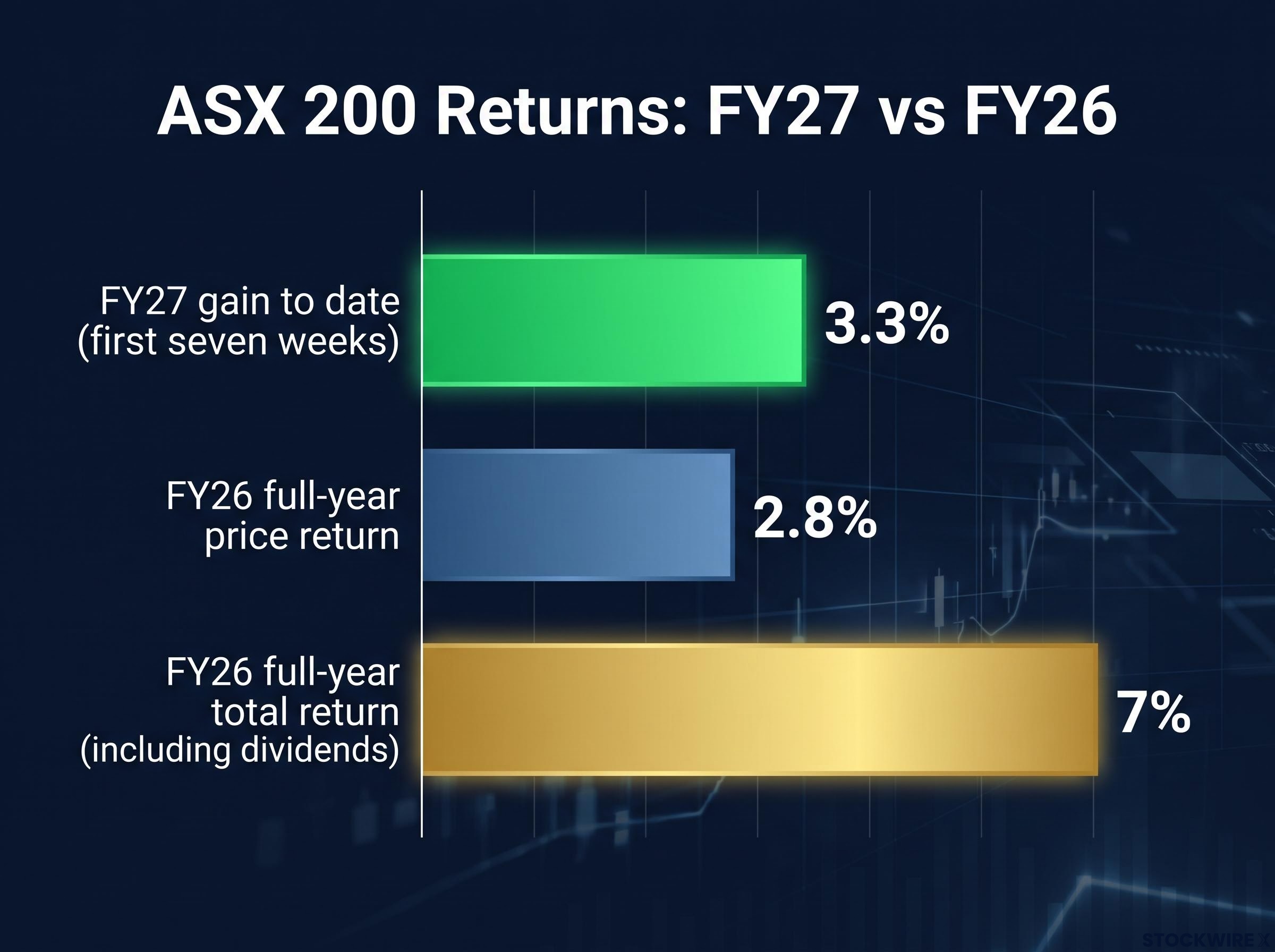
- FY27 gain to date (first seven weeks): 3.3%
- FY26 full-year price return: 2.8%
- FY26 full-year total return (including dividends): 7%
If you are benchmarking your portfolio against the index, the pace of this FY27 start matters. A 3.3% advance in seven weeks would annualise at a rate well above anything FY26 delivered. That is not a prediction; it is the frame through which the sector stories, the rotation dynamics, and the earnings-season risk all need to be read.
When big ASX news breaks, our subscribers know first
Healthcare’s 17% surge is the standout story behind the rally
The healthcare sector has risen approximately 17% since 1 July 2026, making it the single largest sector contributor to the early FY27 index gains. That is a remarkable number in isolation. It becomes a different kind of number once you understand where the sector started.
- Healthcare FY27 gain: approximately 17% (1 July to approximately 18 August 2026)
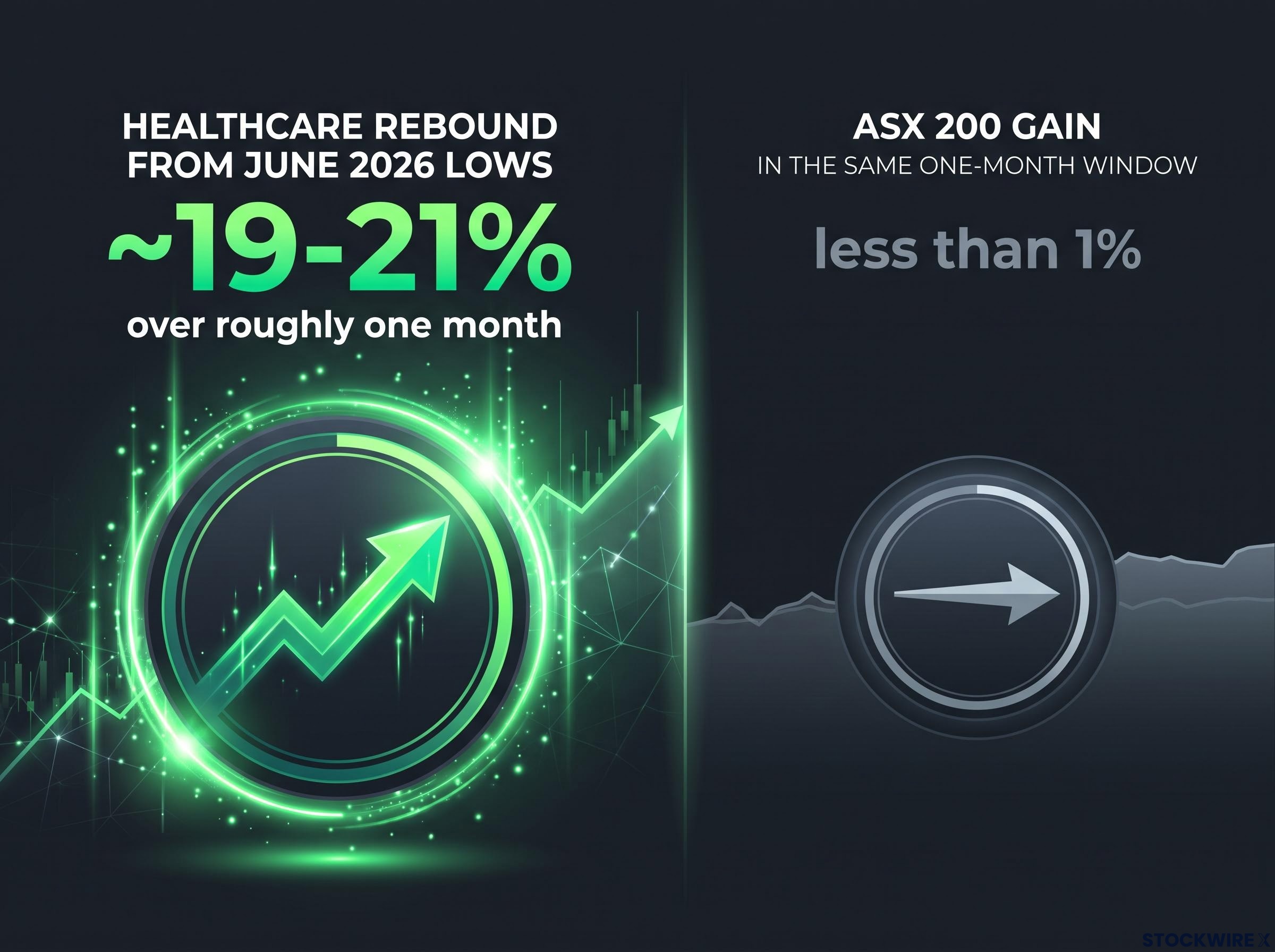
- Healthcare rebound from June 2026 lows: approximately 19-21% over roughly one month
- ASX 200 gain in the same one-month window: less than 1%
The gap between the sector and the index in that window is striking. Healthcare surged 19-21% while the broader market barely moved. This was not a rising tide lifting all boats.
How a nine-year low set the stage for a sector-leading recovery
Healthcare entered FY27 as one of the ASX’s most beaten-down sectors. Market commentary describes the starting point as approximately a nine-year sector low, meaning the valuations were at levels not seen since around 2017.
That context changes how you should interpret the 17% gain. A sector recovering from a nine-year trough has further to travel before it reaches anything resembling fair value, which partly explains the speed and scale of the move. Value-driven buying and sector rotation accelerated the recovery once momentum built, but the structural setup was already in place: a sector with long-term growth tailwinds trading at prices that reflected years of accumulated underperformance.
The valuation compression that preceded this recovery was extraordinary in scale: Cochlear’s price-to-sales ratio stood at 2.85x in May 2026 against a five-year historical average of 9.18x, illustrating the headroom available once earnings trajectories began improving and interest rate pressure on long-duration names started to fade.
For investors with healthcare exposure, the starting point matters when assessing whether these gains are sustainable. A 17% move from fair value would raise different questions than a 17% move from a nine-year low.
Technology added 8%, confirming this is a growth-sector rotation story
If healthcare were the only sector surging, you could dismiss it as an isolated recovery. Technology’s performance makes that harder to argue.
The ASX 200 technology sector has gained approximately 8% since 1 July 2026, making it the second strongest sector contributor to the early FY27 rally. Technology has repeatedly led weekly sector return tables in recent weeks, posting gains of approximately 7-8% on at least two separate occasions. From its late-March 2026 lows, the sector has climbed roughly 26-27%.
The pattern across both sectors is the same: long-term structural growth names that had spent extended periods underperforming, followed by a sharp rotation as capital moved back in.
| Sector | FY27 Gain | Prior Trend | Structural Characterisation |
|---|---|---|---|
| Healthcare | ~17% | Recovery from ~nine-year sector low | Long-term demographic and innovation tailwinds |
| Technology | ~8% | ~26-27% rise from late-March 2026 lows | Long-term digital adoption and AI tailwinds |
That pairing is what gives the FY27 rally a coherent thesis. This is not random sector noise. It is a deliberate rotation into previously undervalued structural growth sectors, and the thesis either gets confirmed or tested when earnings results arrive.
What the pace of this rally means when earnings season arrives
Here is the tension. When sectors re-rate sharply from depressed valuations ahead of earnings, the bar for meeting market expectations rises materially. The market has already priced in a significant portion of a recovery story; results now need to justify it.
Three compounding factors make this earnings season particularly consequential for the sectors driving the rally:
The earnings season risk is compounded by a historic disconnect in market positioning: ASX 200 FY26 earnings are forecast to grow approximately 12% year-on-year while investor sentiment has simultaneously collapsed to the 95th percentile of all historical bearishness readings, creating an unusually wide gap between fundamental expectations and market mood.
- Rapid re-rating from multi-year lows. Both healthcare and technology entered FY27 at or near their lowest valuations in years, meaning the rally has already priced in a meaningful recovery before results confirm it.
- Significant outperformance relative to the benchmark. Healthcare gained 19-21% in a window where the broader ASX 200 rose less than 1%. That degree of sector concentration means the index’s gains are disproportionately exposed to results from a narrow set of companies.
- An unusually fast FY27 start. Surpassing the full FY26 price return of 2.8% within seven weeks makes the early move look stretched relative to the prior year’s pace.
The countervailing scenario is equally real. If healthcare and technology companies deliver results that confirm the structural re-rating, there is a credible path for further upside. These are sectors with genuine long-term growth profiles supported by demographic trends and technological adoption.
The same sectors driving the FY27 gains are now the ones most exposed to earnings-season validation. Confirmation accelerates the move. Disappointment can unwind it quickly.
The index was trading relatively flat on 18 August 2026 as earnings season continued. That flatness tells you something specific: the market has run hard on rotation and sentiment, and now it is waiting for company results to decide whether the move was justified or premature.
What the ASX 200 rally is, and what it is not
A 3.3% index gain sounds like broad market strength. It is not. Understanding the distinction matters for how you interpret your own portfolio performance and any further market updates.
A broad-based rally, where gains are distributed relatively evenly across sectors, typically shows smaller performance gaps between the strongest and weakest sectors. That is not what happened here. In the one-month window where healthcare rebounded 19-21%, the broader ASX 200 rose less than 1%. Technology climbed roughly 26-27% from its late-March lows while the index moved far more modestly.
Sector rotation is the term for what is happening. It means capital is shifting from sectors that have recently outperformed into those that are undervalued relative to their long-term growth potential. In this case, healthcare and technology are the recipients of that rotation.
Sector rotation is the mechanism at work here: institutional capital repositions ahead of confirmed economic changes, making shifts in sector leadership a forward-looking signal that precedes official data by weeks or months, which is why healthcare and technology began repricing before FY27 earnings validated the move.
The characteristics of this rally versus a broad-based advance:
- This rally: Concentrated in two sectors, driven by rotation into previously underperforming structural growth names, with the broader index barely participating in the same windows
- A broad-based rally: Index-wide gains with smaller dispersion between the strongest and weakest sectors, suggesting rising confidence across the economy rather than targeted repositioning
If you hear “ASX 200 up 3.3%” and assume your whole portfolio should be up similarly, this distinction corrects that assumption. Concentration, not breadth, is the defining feature of this move.
This article is for informational purposes only and should not be considered financial advice. Investors should conduct their own research and consult with financial professionals before making investment decisions.
The numbers ahead that will define whether FY27 stays ahead of schedule
The FY27 story is genuinely open. The early momentum is real, but so is the dependence on a narrow set of sectors that now need earnings results to match the valuations the market has already assigned them.
The variables that matter from here:
Forward guidance is the primary price driver this season, with algorithmic and institutional flows capable of producing single-session moves of 10-15% in high-beta sectors when guidance surprises, regardless of the reported profit number, a dynamic that amplifies the risk for healthcare and technology positions built on pre-earnings rotation.
- Healthcare earnings results: These will either confirm the structural recovery from nine-year lows or expose the re-rating as premature. The sector’s 17% FY27 gain has priced in a meaningful improvement in fundamentals.
- Technology earnings results: The 8% FY27 gain and the 26-27% climb from late-March lows mean valuations have moved ahead of last year’s earnings base. Results need to close that gap.
- The pace of further rotation: Whether capital continues flowing into healthcare and technology, or begins rotating back out, will shape whether the concentrated nature of this rally broadens or reverses.
The asymmetry at current levels is the practical takeaway. Strong results may add incremental upside, but the gains from here are earned from an already elevated base. Disappointments carry the potential to unwind sharp pre-earnings moves quickly in the sectors that drove them.
The benchmark itself is a low bar. Beating FY26’s 2.8% full-year price return is not a stretch if the structural re-rating thesis holds through results season. Whether it does is no longer a question of sentiment or positioning. It is a question of numbers, and those numbers are arriving now.
Past performance does not guarantee future results. Forward-looking statements regarding sector performance and earnings outcomes are speculative and subject to change based on market developments and company performance.