The firm that grades the creditworthiness of nations and corporations has just bought the firm that grades the security of blockchain code. On 17 September 2026, S&P Global announced an agreement to acquire OpenZeppelin, the smart-contract security company whose libraries and audits sit underneath much of the on-chain financial system.
The timing is not incidental. Institutional capital has been moving into tokenized assets, stablecoins, and on-chain financial instruments at scale, and the infrastructure underwriting that movement has been built largely on OpenZeppelin’s open-source code and security reviews.
Institutional on-chain capital flows have grown systematic enough that 195 public entities now hold approximately 1.23 million BTC as engineered treasury positions, a structural shift in corporate reserve management that represents precisely the institutional demand S&P Global is positioning to service through the OpenZeppelin acquisition.
S&P Global’s move signals that the risk infrastructure of traditional finance is now following institutional money into the on-chain layer, rather than watching it from a distance.
This is a deal that is far smaller in dollars than it is large in signal. Here is the full picture: what OpenZeppelin actually does, why a legacy ratings giant wants it, and what the deal’s structure and unresolved tensions reveal about where mainstream finance is heading with blockchain infrastructure.
What the deal actually involves
The facts are clean, and they are deliberately narrow. S&P Global agreed to acquire OpenZeppelin, which will keep its name and run as a separate, independent business unit inside the larger company.
Co-founder and CEO Demian Brener, who started the company in 2015, stays in the role. He will report to Yann Le Pallec, President of S&P Global Ratings.
Here are the core terms:
- Announcement date: 17 September 2026
- Financial terms: undisclosed
- Post-close structure: OpenZeppelin operates as a standalone unit, retaining its name
- Leadership: Brener remains CEO, reporting to S&P Global Ratings President Yann Le Pallec
- Closing: subject to customary conditions, with no specific close date or regulatory jurisdiction identified
The most telling line in the announcement was not the price, because there was no price. It was S&P Global’s statement that the acquisition is not expected to have a material impact on its financial results.
That characterisation is not a throwaway disclosure. For investors, it reframes the entire transaction: this is a capability bet and a strategic option, not a transformational capital allocation.
You should weigh the deal’s significance on that basis. S&P Global is telling the market that OpenZeppelin does not move its numbers. What it might move is S&P Global’s position in a market that does not yet exist at scale, which is a different kind of value entirely.
When big ASX news breaks, our subscribers know first
OpenZeppelin’s role in blockchain infrastructure, and why it matters who owns it
Start with the number that makes this acquisition worth anyone’s attention.
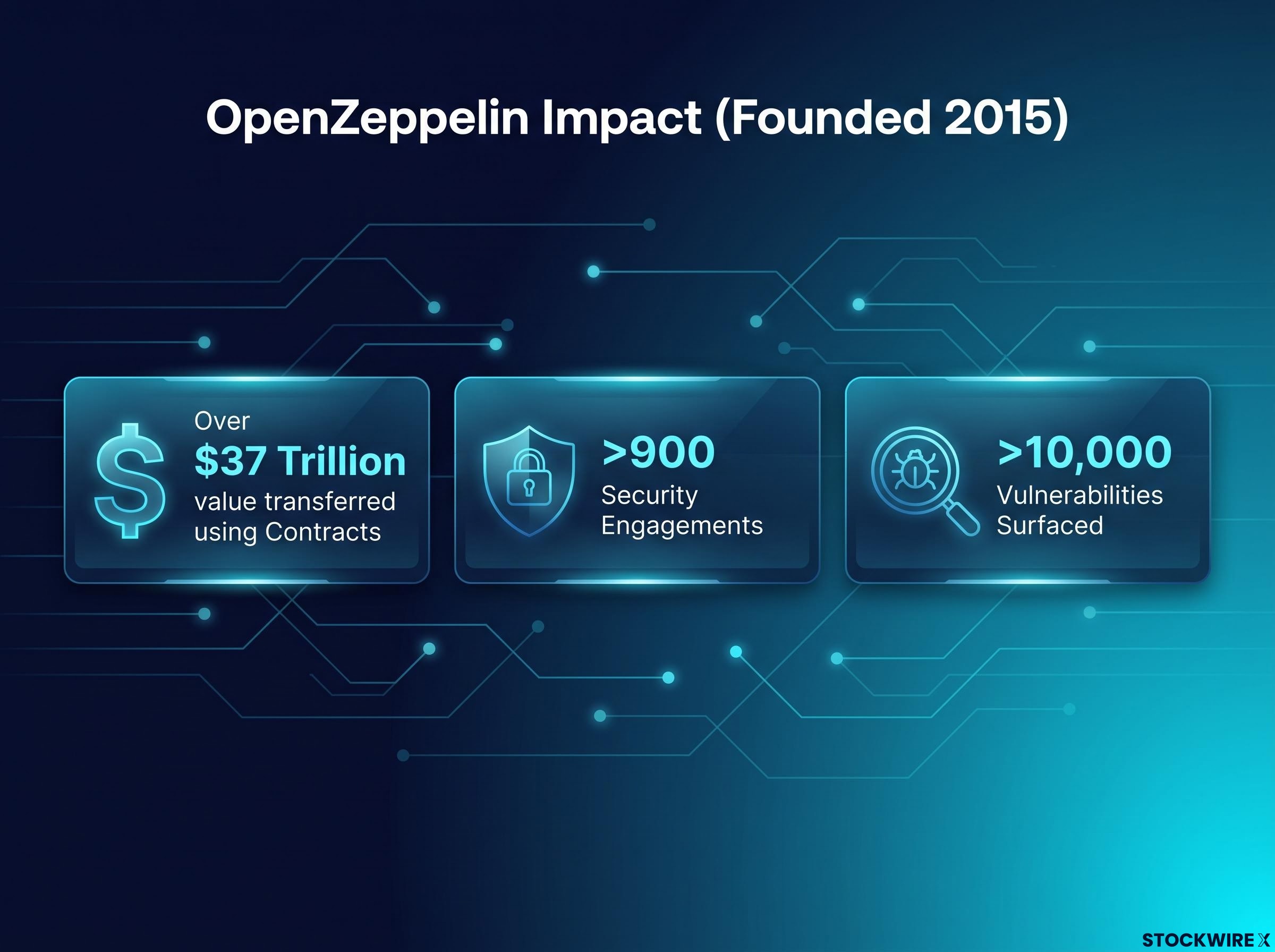
Over $37 trillion in value has been transferred using OpenZeppelin’s Contracts.
That figure, reported alongside the announcement, is the reason OpenZeppelin is not a niche crypto-security firm. It is a piece of financial plumbing that already underpins institutional-scale on-chain activity.
OpenZeppelin does three things, and each one matters to a different part of the ecosystem:
The Ethereum Foundation’s smart contract security best practices document the common vulnerability classes that auditors screen for, including reentrancy attacks, integer overflow, and access control failures, which are precisely the categories OpenZeppelin’s 900-plus security engagements have worked to surface before code reaches production.
- Open-source smart-contract libraries (“Contracts”): reusable code that developers plug in rather than writing core functions from scratch. Most of the largest stablecoins and tokenized funds rely on them, making these libraries the de facto standard for building common token types and access controls.
- Security audits: more than 900 security engagements conducted, surfacing over 10,000 vulnerabilities before code reached production.
- Developer tools and infrastructure: used across major blockchain ecosystems to build and manage on-chain applications.
For a reader unfamiliar with the space, the simplest way to understand OpenZeppelin is this. It supplies both the templates that developers build financial products with, and the reviews that check those products before they go live.
Founded in 2015, the company’s work now sits behind stablecoins, tokenized funds, and decentralised finance (DeFi) applications, the on-chain protocols that let people lend, borrow, and trade without a bank in the middle.
Acquiring it is closer to acquiring a ratings methodology than a consultancy. That distinction is exactly why the ownership question carries weight beyond the undisclosed deal price.
The concentration risk built into the ecosystem
The same reach that makes OpenZeppelin valuable is what makes its ownership consequential.
When one code standard is adopted this widely, a flaw in it does not stay contained. A bug in OpenZeppelin’s Contracts does not affect a single protocol; it can propagate across hundreds simultaneously, because they all draw on the same underlying code.
That systemic exposure is why the question of who sets the roadmap for those libraries is not incidental. Whoever controls the standard influences the security posture of a large slice of on-chain finance.
There is a further limitation worth naming. Audits cannot guarantee the absence of vulnerabilities, and critics have long argued they can function as marketing signals rather than genuine security guarantees. A clean audit reduces risk; it does not eliminate it, and ownership by a ratings giant does not change that reality.
Three ways to read S&P Global’s strategic logic
The deal supports three different readings, and the honest position is that it is not yet clear which one is correct. Each carries different implications for how you weight S&P Global’s digital-asset ambitions.
- Offensive expansion. S&P Global’s own language positions it as aiming to become the default provider of risk metrics and benchmarks for on-chain financial instruments. On this reading, the company is extending its core credit and ratings business directly into the smart-contract layer, treating code as the next asset class it grades.
- Defensive necessity. Traditional data and ratings firms may have no choice but to follow institutional capital into tokenized assets. On this reading, buying OpenZeppelin gives S&P Global immediate credibility and tooling at the code-analysis layer, rather than ceding that ground to crypto-native competitors.
- Option-value experimentation. Given the explicit non-material financial framing, the deal may simply be a small bet to build expertise and hold optionality in an evolving market, without committing transformational capital.
Le Pallec’s own words point toward the first frame, though they leave room for the others.
S&P Global’s competitive moat has survived decades of regulatory expansion, a tripling of approved rival agencies, and repeated enforcement scrutiny without meaningful market share erosion, a structural durability that now becomes the baseline from which its on-chain ambitions are being launched.
“S&P Global’s digital assets strategy focuses on providing reliable data, benchmarks, and transparent risk evaluations as markets transition to on-chain frameworks,” said Yann Le Pallec, President of S&P Global Ratings.
Brener framed it as mission continuity, describing a vision of building a secure global financial system powered by blockchain-based smart contracts.
The deal also follows S&P Global’s recent strategic investment in Kaiko, a digital-asset data provider. That pattern suggests deliberate expansion into on-chain data and infrastructure rather than a one-off purchase.
Which frame proves accurate will decide whether this becomes a foundational move in S&P Global’s next growth chapter or a quietly forgotten capability bolt-on. If you are tracking the digital-asset space, the thing to watch is which narrative S&P Global’s subsequent moves actually validate.
What previous deals reveal about the risks ahead
Precedent is useful here, but not as reassurance. It is a calibration tool, and what it calibrates is expectations.
When traditional incumbents have bought crypto-native firms before, they have integrated the capability reasonably well while repeatedly hitting the same walls: product adoption, developer mindshare, and community trust.
| Acquirer | Target | Year | Key integration outcome |
|---|---|---|---|
| Mastercard | CipherTrace | 2021 | Compliance-driven, back-office integration; measured in risk reduction, not standalone revenue |
| PayPal | Curv | 2021 | Crypto custody embedded into mainstream products; remained non-core to overall results |
| ICE | Bakkt | Late 2010s | Slower-than-expected customer uptake despite strong brand and infrastructure |
The pattern is consistent. These deals delivered incremental capability and regulatory comfort more often than transformative growth, and PayPal’s framing of Curv as non-core maps almost exactly onto S&P Global’s own language about OpenZeppelin.
One risk, though, has no clean precedent. S&P Global Ratings may issue opinions on instruments whose core contracts are audited by its own subsidiary. That creates a perceived independence problem the earlier deals never faced at the same scale.
The tension between ratings and underlying asset integrity is already visible in traditional credit markets, where Meta’s 2036 bonds price at triple-B-equivalent spreads despite a double-A rating, a dislocation that illustrates how ownership of both the rating and the audited infrastructure could sharpen or complicate S&P Global’s credibility problem in on-chain instruments.
The specific risks worth tracking are:
- Open-source independence: whether a large owner shapes the Contracts roadmap over time
- Conflict of interest: the ratings-and-audit overlap and how S&P Global governs it
- Talent retention: whether corporate structure erodes the autonomy that keeps engineers in place
- Regulatory exposure: reputational risk if a high-profile protocol using OpenZeppelin code fails
Both parties have committed to keeping OpenZeppelin Contracts open source, free, and publicly maintained on GitHub, with existing audits and ecosystem programmes continuing under the same teams. The commitment reads as genuine.
Even so, the developer community’s concern is structurally rational. A commitment made today does not bind roadmap priorities indefinitely, and the incentive to favour institutional tokenization use cases over grassroots DeFi will exist regardless of intent. The dimension worth watching is whether S&P Global introduces structural separations or governance mechanisms to address the ratings-audit overlap.
What this signals for on-chain finance, and what remains unresolved
Set aside whether the deal succeeds. What matters most is what its existence already confirms.
The on-chain layer of finance is now attracting the same incumbent infrastructure players that built the ratings, index, and data architecture of traditional markets. S&P Global buying OpenZeppelin is a structural acknowledgment that on-chain risk assessment requires native expertise, not borrowed analogies from legacy frameworks.
Tokenized asset demand sits within a broader capital rotation that fund flow data from mid-2026 captures clearly: bond funds recorded 56 consecutive weeks of net inflows while crypto funds suffered sharp outflows in the same period, a barbell dynamic that reflects institutional appetite for yield certainty alongside selective, infrastructure-level bets on the on-chain layer.
Two questions will decide the deal’s long-term significance. Can S&P Global keep OpenZeppelin’s developer community trust under corporate ownership? And can the combined entity address the conflict-of-interest tension credibly enough to become the default risk standard for institutional on-chain activity?
For anyone tracking digital-asset equities, tokenized funds, or DeFi exposure, the clearest takeaway is competitive. The on-chain infrastructure layer is now a site of active contest among incumbent financial data firms, and whoever wins is likely to become the de facto standard-setter for risk in programmable finance.
This deal does not confirm that the tokenized-asset market has matured. It confirms that at least one major incumbent is betting it will, and is positioning its infrastructure accordingly.
“Joining S&P Global will help the standard built by our team and community become the foundation for the next generation of global finance,” Brener said, framing mission continuity against a set of structural questions the deal has not yet answered.
This article is for informational purposes only and should not be considered financial advice. Investors should conduct their own research and consult with financial professionals before making investment decisions.
These statements are speculative and subject to change based on market developments and company performance.