
On the morning of 17 September 2026, gilt yields fell by as much as 12.5 basis points, and several major outlets told their readers the Bank of England had ended its bond-selling programme. It had not.
What the Bank actually did was pause open-market gilt auctions and announce that future sales would run through HM Treasury’s Debt Management Office (DMO) rather than directly to the market. The destination, zero Asset Purchase Facility (APF) gilt holdings by 2034, did not change. The route did.
That distinction matters more than the headlines suggested, because the yield move that followed may have priced in a policy reversal that never actually happened.
Here is what the new Bank of England Gilt sales framework actually does: how the mechanics work, why the market moved the way it did, and what the shift changes for the investors and borrowers who hold or price UK government debt. You will leave with a more accurate picture than the first-day coverage gave you.
What the Bank of England actually decided on 17 September 2026
Start with the precise decision, because the detail is where the misreading happened. At its meeting ending 16 September 2026, the Monetary Policy Committee (MPC) voted unanimously to reduce the Bank’s APF gilt holdings to zero by 2034, through an annual average reduction of £46 billion that includes £20 billion of active sales alongside maturing bonds.
Read that again. The vote was unanimous, and the end-date is fixed. That is not the shape of a policy in retreat.
The redesign has two stages. Open-market APF gilt auctions are paused until at least April 2027, at which point the Chancellor is expected to make a final decision on the DMO-mediated mechanism. The pause is operational; the commitment underneath it is not up for renegotiation.
The portfolio itself splits into three buckets, and understanding them tells you exactly how much supply is genuinely coming off the table:
- Bonds for active sale: shorter and medium-dated gilts, sold at the reduced £20 billion annual pace.
- Bonds rolling off through maturity: approximately £221.7 billion of designated holdings left to mature naturally through to 2034.
- Ultra-long gilts retained: roughly £120 billion of bonds maturing in 2049 or later (13-45 year maturities), held indefinitely to back future banknote issuance and excluded from active sales entirely.
That third bucket is the one to remember. The Bank has stopped selling its very long-dated gilts altogether.
The retreat from long-dated gilt sales did not begin on 17 September; it started with a single rescheduled auction in April 2025 and has since moved steadily in the same direction, with the 30-year yield hitting 5.948% before the formal framework change was announced.
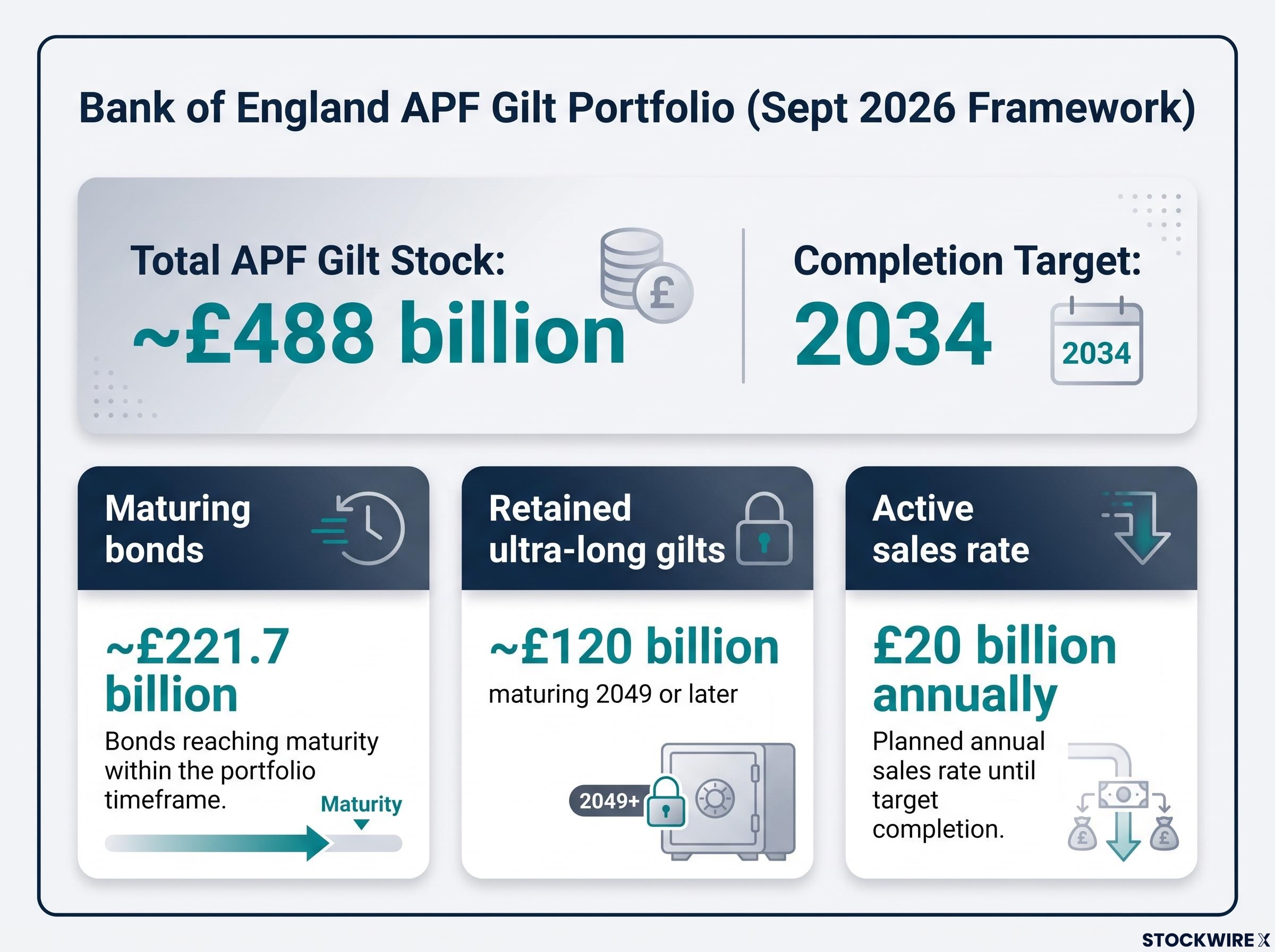
At the announcement, total remaining APF gilt stock stood at approximately £488 billion. Governor Andrew Bailey made clear the change was not a rescue mission for the balance sheet.
“Halting QT outright would only stretch losses across a longer time horizon.”
Andrew Bailey, post-meeting remarks reported by The Telegraph, 17 September 2026
The numbers, in one place:
| Metric | Figure | Source |
|---|---|---|
| Annual active sales | £20 billion | BoE Market Notice, 17 Sep 2026 |
| Annual average reduction (inc. maturities) | £46 billion | MPC Minutes, Sep 2026 |
| Auction pause duration | Until at least April 2027 | BoE Market Notice |
| Completion target | 2034 | MPC Minutes, Sep 2026 |
| Total APF gilt stock | ~£488 billion | Announcement coverage |
| Ultra-long gilts retained | ~£120 billion | BoE Market Notice |
For anyone repricing long-term gilt supply on the back of this news, the scope of the pause is what matters. Nothing about the ultimate volume of gilts destined to leave the Bank’s balance sheet has changed. Only the mechanism for delivering it has.
When big ASX news breaks, our subscribers know first
How the DMO mechanism works, and why it differs from open-market auctions
So if the Bank did not stop selling, what exactly is different? The answer sits in who buys the gilts and how the resulting supply reaches the market.
Under the old model, the Bank auctioned gilts directly into the open market. Those auctions landed alongside the DMO’s own regular issuance of new government debt, meaning investors faced supply arriving from two official-sector sources at once, often on overlapping schedules.
Under the new arrangement, the Bank sells gilts directly to HM Treasury at prevailing market prices. The DMO then issues replacement debt to finance the purchase, folding quantitative tightening into the standard debt-management machinery rather than running it as a separate BoE operation. Quantitative tightening, or QT, is the process of a central bank shrinking the pile of bonds it bought during earlier stimulus programmes.
Quantitative tightening does not mirror quantitative easing in reverse: in a high-debt environment, selling gilts raises the government’s debt-servicing costs and can unsettle the overseas investors who hold roughly 25% of outstanding gilts, which is why the channel from QT to currency moves is more complex than the simple monetary-policy transmission that rate decisions follow.
The DMO Debt Management Report 2026-27 sets out the operational framework governing how the DMO manages gilt issuance and integrates disposal flows from the Bank’s APF portfolio, providing the foundational policy context for understanding how the new coordinated mechanism sits within the broader debt-management machinery.
Crucially, the DMO keeps flexibility. It can retire the bonds it receives and reissue debt in whichever maturities it judges optimal, and active sales under the framework concentrate on shorter and medium maturities rather than the long end.
The mechanical sequence, step by step
Here is how a single disposal now travels through the system:
- The Bank holds a gilt in its APF portfolio.
- The Bank sells that gilt directly to HM Treasury at the prevailing market price.
- The DMO issues replacement debt to fund the purchase, embedding the disposal in its normal issuance programme.
- The DMO can retire the received bond and reissue in the maturities it considers most efficient.
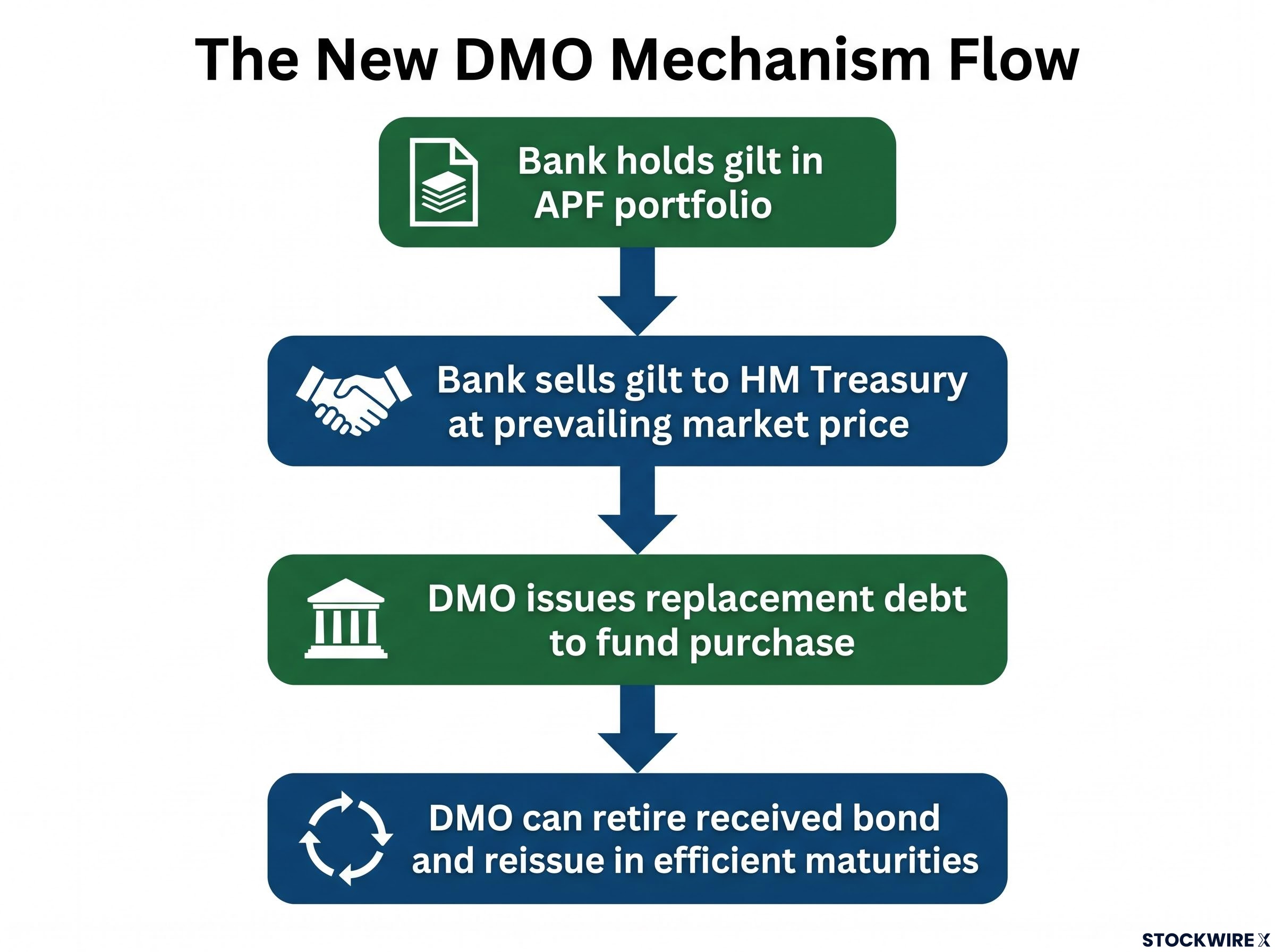
The Guardian’s explainer framed the shift plainly: the Bank stops offloading bonds directly to investors and instead routes short and medium-term disposals through the Treasury’s DMO.
From dual supply shock to single coordinated channel
The old “dual supply shock” was exactly that, two streams of official gilt supply, BoE auctions and fresh DMO issuance, arriving at the same time and competing for the same buyers. Consolidating both into a single DMO-managed flow removes the unpredictability of that overlap.
Saxo Bank’s bond strategy note of 17 September 2026 argued the redesign “could further ease some of the upwards pressure on yields” precisely by cutting that dual shock. And the Resolution Foundation has estimated that QT has added roughly 15-25 basis points to the term premium on 10-year gilts, which tells you that how supply is channelled has a real, measurable effect on pricing.
The Bank has already halved its gilt holdings since February 2022. What this means for you is straightforward: the supply is not disappearing, it is being coordinated. That coordination, not any termination of QT, is the genuine mechanism behind any yield relief.
Why the 8-12 basis point yield drop may have been an overreaction
Now to the number that drove the headlines. Before the announcement, the market was primed for any excuse to rally.
Gilt yields had climbed to multi-decade highs in mid-September. The 10-year peaked at 5.426% and the 30-year at 5.951%, according to Morningstar/Dow Jones data, with the long end near levels last seen in 1998.
Against that backdrop, the moves on 17 September 2026 looked dramatic but were modest in context.
| Metric | Pre-announcement peak | 17 Sep move | Post-announcement range |
|---|---|---|---|
| 10-year gilt yield | 5.426% | -8 basis points | ~5.25-5.35% |
| 30-year gilt yield | 5.951% | -12.5 basis points | ~5.3-5.7% |
A genuine QT termination would imply a lasting reduction in gilt supply. This announcement delivered no such thing. It redirected supply; it did not remove it.
There is also a reason QT rarely shocks markets. Because these actions are pre-announced and scheduled, they lack the surprise element that moves prices most forcefully. Everyone already knew the sales were coming.
Putting BoE sales in the context of a £230 billion-a-week market
The scale comparison is where the overreaction becomes obvious. According to the DMO Annual Report 2025-26, average daily gilt turnover was £47.6 billion in the 2025-26 financial year, which works out to roughly £230-238 billion of secondary-market trading every week.
Set the Bank’s selling against that. At its historical peak, the Bank sold £50 billion of gilts a year, around £1 billion a week.
At the new £20 billion annual sales pace, the Bank’s weekly gilt disposals are a small fraction of average secondary-market turnover of £230-238 billion per week.
Analysis based on DMO Annual Report data, 2025-26
For a sense of the maximum plausible effect, the Resolution Foundation’s ceiling for QT’s total impact on the 10-year term premium is 15-25 basis points. That is the whole programme, not a single week’s sales.
The term premium on UK gilts is shaped by global macro forces as much as domestic supply, and the Resolution Foundation’s 15-25 basis point estimate for QT’s total contribution sits inside a market where US Treasury yields, German Bunds, and French OATs traced almost the same arc across H1 2026.
Japan offers a parallel worth noting. The Bank of Japan adopted gradual, pre-announced ETF disposals in September 2025, at a pace of roughly ¥330 billion a year (a figure that remains unverified), and Japanese equities still outperformed global stocks over the same period. Scale and predictability mattered more than the act of selling itself.
What this tells you is uncomfortable but useful. If you bought gilts on 17 September pricing in QT termination, you may have paid up for a supply-relief story the mechanics do not fully support. The price signal that day was driven far more by the word “pause” than by any real change in the volume of gilts reaching the market.
What the framework leaves unresolved, and the risks that remain
None of this makes the redesign a bad idea. The logic is sound: better coordination, a more predictable annual envelope, and less overlapping supply. But several genuine questions remain open, and they deserve straight treatment.
- Loss crystallisation: Continuing QT via the DMO still realises mark-to-market losses sooner than halting would, though Bailey’s counter is that halting merely defers the losses rather than avoiding them.
- The ultra-long overhang: The Bank retains around £120 billion of very long-dated gilts with no current disposal plan, leaving a large stock of long-duration risk on its balance sheet.
- Policy-consistency stakes at April 2027: A significant redesign at the decision point could raise questions about whether QT plans are stable.
- The fiscal-monetary boundary: Routing sales through HM Treasury makes QT look like conventional debt management, which the market will watch for signs that it is becoming entangled with fiscal decisions.
The consistency point has institutional weight behind it. The Treasury Select Committee has set a deliberately high bar for changing QT plans between reviews.
The Committee stressed a “high bar for amending the planned reduction in the stock of purchased gilts outside a scheduled annual review.”
Treasury Select Committee Report on Quantitative Tightening and official responses, 2025
That framing means the April 2027 Chancellor decision carries real stakes. A clean ratification signals stability; a substantial revision invites doubt about plan durability.
International experience is reassuring on the mechanism itself. The US Treasury launched a buyback programme in May 2024, and IMF research found it enhanced the liquidity of off-the-run Treasuries without altering the Federal Reserve’s policy stance, which supports the view that debt-office-led disposal can work without destabilising markets.
The single most important unpriced risk is the ultra-long holding. No disposal timeline exists for that £120 billion, and any future decision to sell into the long end of the curve would need careful handling to avoid a disproportionate yield response. For long-dated gilt holders and pension funds running liability-matching mandates, that overhang and the April 2027 date are the two things worth tracking, not the current auction pause.
What the new framework means for gilt investors before April 2027
Pull the threads together and the practical picture is clear. This is a procedural improvement to how QT is delivered, not a policy reversal. If you read the 17 September move as a fundamental shift in gilt supply, that assumption is worth revisiting.
Two variables will decide whether the yield relief proves durable:
- The April 2027 decision: Whether the Chancellor ratifies the DMO mechanism without significant revision. A clean sign-off converts a temporary pause into a structurally better-functioning programme.
- The ultra-long disposal signal: Whether long-dated yields stay anchored while the £120 billion of ultra-long gilts sits in indefinite suspension. Any hint of a disposal plan for that stock would move the long end.
Treat the Resolution Foundation’s 15-25 basis point term-premium estimate as a ceiling on the benefit of smoother QT delivery, not a floor. Saxo Bank’s view that DMO-channelled disposals “could further ease some of the upwards pressure on yields” is the best case, not the expectation. You should not anticipate sustained falls well beyond the current 8-12 basis point move.
For investors wanting to understand how the MPC vote split and QT revision interact with sterling positioning, our full explainer on the GBP repricing risk examines why BBH describes current market pricing as ‘too aggressive’ and what a dovish repricing of the front end implies for EUR/GBP.
This is for informational purposes only and should not be considered financial advice. You should conduct your own research and consult a financial professional before making investment decisions. Past performance does not guarantee future results, and any forward-looking projections are subject to market conditions and various risk factors.
A procedural redesign with one very large open question
The core distinction is worth stating one final time. The Bank did not end quantitative tightening. It paused open-market auctions and redirected future sales through the DMO, while keeping a firm commitment to reach zero APF holdings by 2034.
What the framework genuinely improves is real: less dual supply shock, tighter coordination with DMO issuance, and a predictable £20 billion annual sales envelope that HM Treasury can plan around. Those are meaningful gains in market functioning, even if they are less dramatic than the headlines implied.
What it leaves open is the part to keep watching. The £120 billion of retained ultra-long gilts has no disposal timeline, and that stock is the framework’s largest outstanding policy question.
The 17 September yield move reflected narrative relief, not mechanical supply relief.
Judge this framework by what happens at the April 2027 decision, and eventually by how the Bank handles its ultra-long holdings. Do not judge it by the yield move that greeted the announcement. That way, when the next round of headlines arrives, you will already know which numbers actually matter.
—