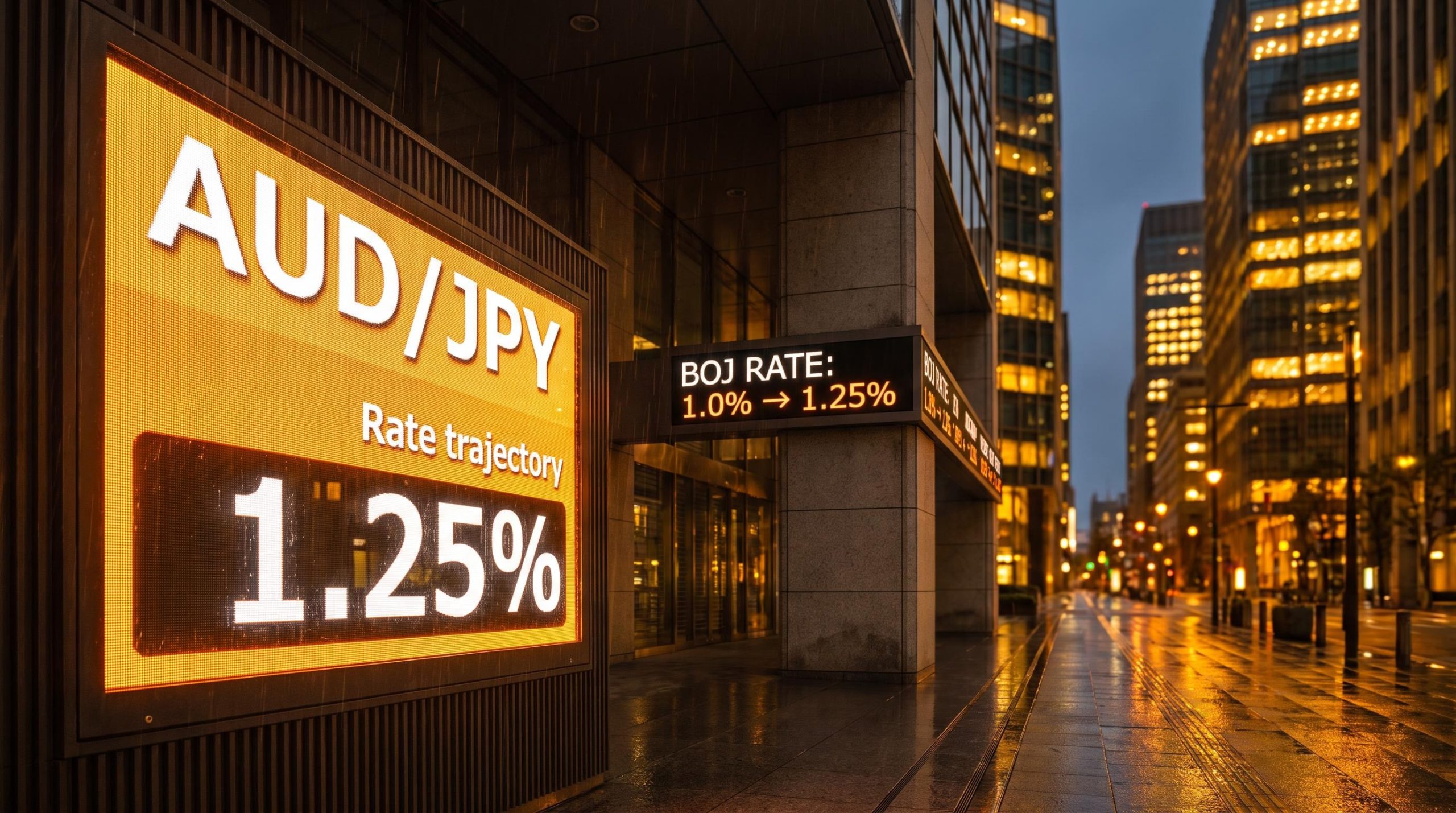
Two events that rarely share a calendar date are about to collide. This Friday, the Bank of Japan is widely expected to raise interest rates to a 31-year high at the same moment the quarterly triple witching options expiry runs its course across global derivatives markets.
Either event moves markets on its own. Together, they create a session that demands a different kind of attention than a normal trading day.
If you invest from Australia, you are not insulated from either one. The BoJ decision carries documented consequences for the AUD/JPY carry trade and Asia-Pacific risk sentiment, while the triple witching expiry adds a mechanical layer that can make Friday’s price moves look far more dramatic than the underlying news justifies.
The risk is treating Friday like any other session and mistaking expiry noise for a genuine signal, or the reverse.
Here is what each mechanism actually does, how they interact Friday, and what that means for anyone watching Australian markets this session.
What the Bank of Japan is expected to decide Friday, and why it matters
To understand why today’s decision matters, you need to see where it sits in a sequence, and that sequence has been remarkably consistent.
At the 28 April 2026 meeting, the Policy Board held the rate at 0.75%, even though three members dissented in favour of an immediate hike. The majority judged there was no immediate need to move, despite inflation having sat near 2% for close to four years.
Then in June, the direction became clear. On 16 June 2026, the board voted 7-1 to raise the short-term policy rate from 0.75% to 1.0%, a 25 basis point move that took effect the following day.
Reuters described the June hike as a “landmark step in its policy normalisation,” lifting Japanese borrowing costs to a 31-year high, the highest level since 1995.
At the most recent meeting on 31 July 2026, the board held at 1.0% by an 8-1 vote. The lone dissenter, board member Hajime Takata, argued for a hike to 1.25%. The BoJ also warned that core inflation could push above its 2% target, a signal that the tightening cycle was far from finished.
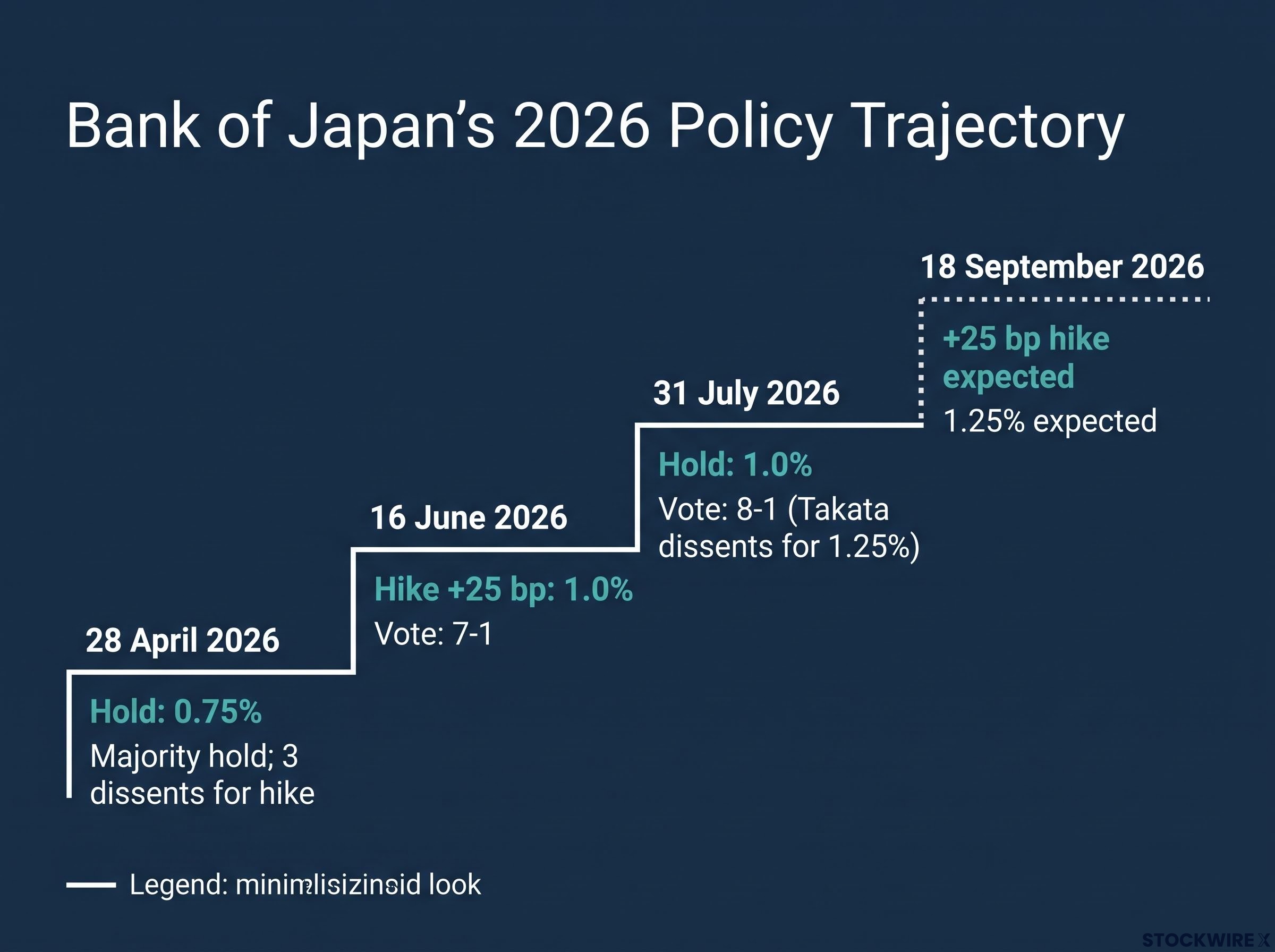
| Meeting date | Decision | Vote split | Resulting rate |
|---|---|---|---|
| 28 April 2026 | Hold | Majority hold; 3 dissents for hike | 0.75% |
| 16 June 2026 | Hike +25 bp | 7-1 | 1.0% |
| 31 July 2026 | Hold | 8-1 (Takata dissents for 1.25%) | 1.0% |
| 18 September 2026 | +25 bp hike expected | Pending | 1.25% expected |
What you should take from those vote splits and inflation warnings is that the BoJ’s direction is settled even if the timing of each step can vary. Today’s announcement is less a coin flip than a question of when.
The BoJ Monetary Policy Meeting minutes for 2026 document the exact language the board has used across the April, June, and July decisions, including the dissenting arguments, inflation assessments, and forward guidance that reveal how the board is communicating its intentions meeting by meeting.
What the September decision means if it lands as expected
Market participants broadly expect a 25 basis point hike today, lifting the rate to 1.25%. That would be the third increase of the visible normalisation cycle and a new post-1995 high, consistent with the exact level Takata pushed for in July.
The distinction between “expected” and “confirmed” matters. Nothing is decided until the statement lands, and the July hold, an 8-1 vote when a hike looked plausible, is a reminder that this board can and does surprise. A confirmed hike reads as continuation. A hold would read as the board managing pace again.
The 25 basis point hike is widely treated as a done deal, which is precisely why the forward guidance carries more informational weight than the rate number itself: hawkish language compresses the implied timeline for subsequent hikes, while cautious phrasing can trigger a sell-the-news selloff even with the hike delivered.
When big ASX news breaks, our subscribers know first
What triple witching actually is and why September’s expiry is significant
On the screen, a triple witching day announces itself through volume that spikes well above average and intraday swings that feel disconnected from the news flow. The label is straightforward. The mechanics behind it are what actually explain the behaviour.
Triple witching is the simultaneous expiry of three classes of derivatives on the same day:
ASX triple witching mechanics differ from the US version in one critical way: the peak structural risk window falls around midday on the third Thursday, not at the close, because ASX equity derivatives settle against the opening auction price rather than an end-of-day reference.
- Equity index futures
- Equity index options
- Single-stock options
This happens four times a year, always on the third Friday of the quarter:
- Third Friday of March
- Third Friday of June
- Third Friday of September (this Friday)
- Third Friday of December
The volume alone does not create the volatility. The amplification comes from how dealers manage their positions.
When dealers are short options, they often carry large negative gamma, which means their hedges force them to sell into falling markets and buy into rising ones to stay balanced. When a large amount of open interest sits at specific strike prices, spot prices moving toward those strikes trigger aggressive hedging that pushes the move further rather than cushioning it.
Expiry-driven flows do not create price moves out of nothing. They amplify moves that are already underway, which is why a triple witching session can look more violent than the underlying story warrants.
There is also pin risk: heavy open interest concentrated at a particular strike can effectively pull the spot price toward that level into the closing auction. The result is a closing price shaped as much by mechanical positioning as by any new information.
Why expiry-driven volatility is not the same as a market signal
The elevated volume you see on an expiry day comes largely from position squaring, roll flows where traders move contracts to a later date, and benchmark rebalancing by index and volatility-targeting funds. None of that reflects a change in fundamentals.
That is why large closing-auction moves on triple witching days frequently reverse, at least partially, in the following session once the flows clear. The move was structural, not a verdict on value.
Carry this forward: elevated volatility on a triple witching day is often a feature of market plumbing, not a judgement on fundamentals. Friday layers that structural noise on top of a genuine policy signal from the BoJ.
How the BoJ decision and triple witching interact to amplify market moves today
Here is where the two stories stop being separate. The interaction runs as a cascade.
First, the policy decision resets the fundamental anchor. A BoJ move, whether it lands as expected or surprises, reprices three things at once: Japanese government bond yields, equity earnings multiples, and the yen exchange rate. Each of those repricings generates its own flow of buying and selling.
Second, that repricing lands during an expiry session, which means it is far more likely to drag spot prices through the concentrated strike levels where large options positions sit. Once prices move through those strikes, the gamma-driven hedging described earlier kicks in and adds momentum.
Third, three groups of actors reinforce each other in the same direction: options dealers adjusting their delta hedges, trend-following systematic strategies chasing the move, and discretionary macro traders positioning on the policy news.
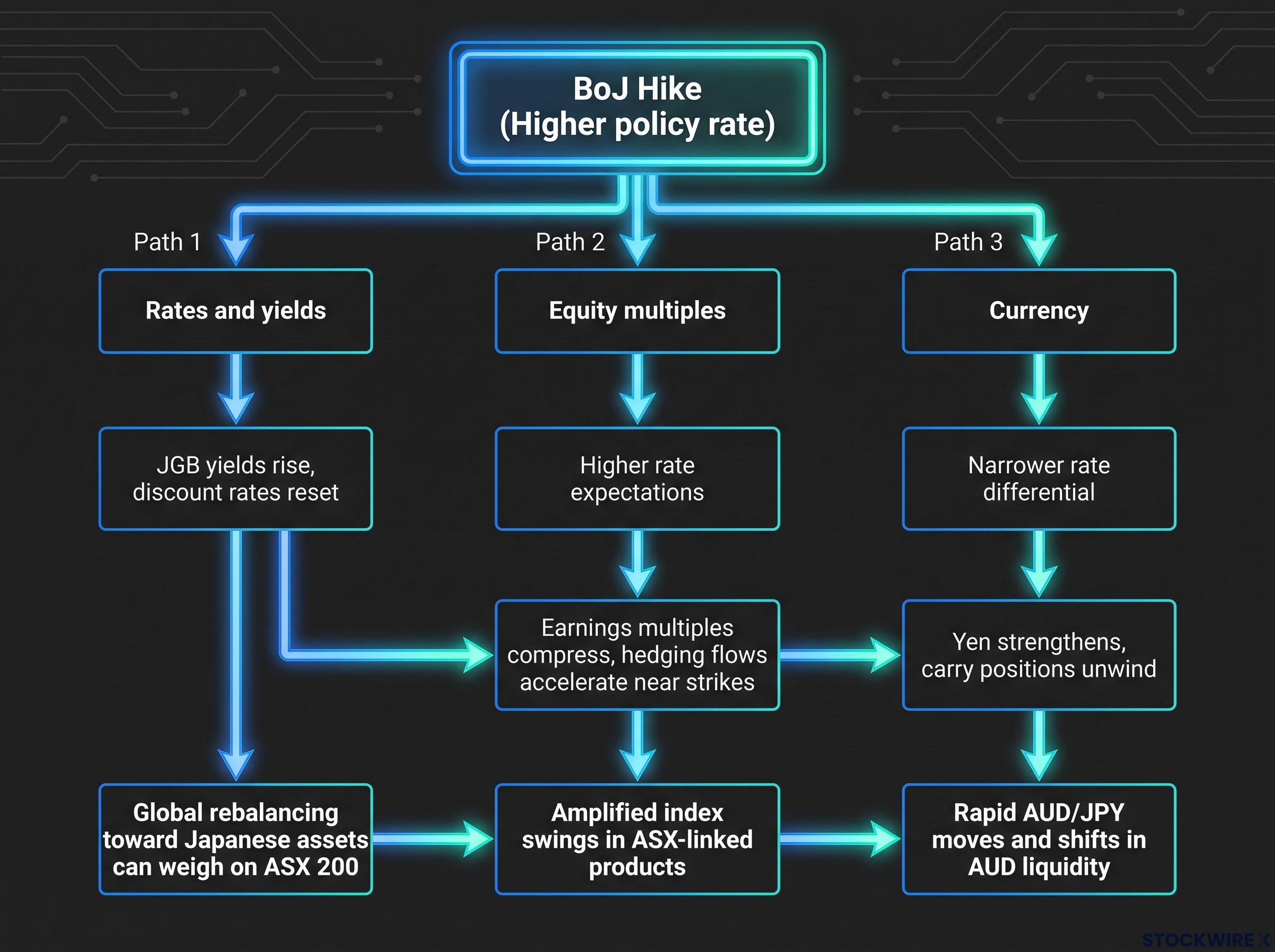
| Channel | Trigger (BoJ hike) | Mechanism | Australian market impact |
|---|---|---|---|
| Rates and yields | Higher policy rate | JGB yields rise, discount rates reset | Global rebalancing toward Japanese assets can weigh on ASX 200 |
| Equity multiples | Higher rate expectations | Earnings multiples compress, hedging flows accelerate near strikes | Amplified index swings in ASX-linked products |
| Currency | Narrower rate differential | Yen strengthens, carry positions unwind | Rapid AUD/JPY moves and shifts in AUD liquidity |
The practical implication is that moves in AUD/JPY or the ASX 200 today may be larger than the policy change alone would justify. Understanding that the extra size is structural, not fundamental, stops you drawing oversized conclusions from intraday price action.
What a yen move means for Australian investors specifically
The carry trade is the most direct channel to Australia. For years, Australia’s higher cash rate has made the Australian dollar an attractive destination for capital funded by cheap yen borrowing.
A BoJ hike compresses the rate differential between the two economies, tends to strengthen the yen, and can trigger a rapid unwind of AUD/JPY carry positions, which is the clearest way this decision transmits to Australian markets.
Carry unwinds tend to be fast and can overshoot the fundamental shift. That is precisely why an AUD/JPY move on a BoJ decision day can be larger than the change in the rate differential alone would suggest.
Carry unwind dynamics can overshoot the fundamental rate shift by a wide margin, as the 2024 episode demonstrated when 40-60% of speculative positioning cleared within weeks yet no cascading structural breakdown followed in global equity markets.
What to watch and what to ignore as the session unfolds
You now have the mechanics. The useful question becomes where to direct your attention and what to let pass.
The signals worth tracking come from the BoJ itself, not from the price screen. The official statement and the vote split are far more reliable guides to the policy trajectory than Friday’s market reaction, because the board-level pattern across the April to July meetings has already shown you how this group communicates its intentions.
The four BoJ signals that matter most today
Track these from the announcement:
- The rate decision itself: confirmed hike versus hold, and the basis point size if a hike lands.
- The vote split: whether Takata’s dissent for 1.25% is now joined by other members, which would signal a faster pace ahead.
- Inflation language: any change relative to the July warning that core inflation could exceed 2%.
- Forward path: any explicit or implicit guidance on the timing of the next move.
By contrast, these structural noise sources deserve to be discounted:
- Thin liquidity ahead of the event, which lets modest flows produce outsized moves.
- Position squaring and roll flows around expiry.
- Benchmark rebalancing by index and volatility-targeting funds.
- Closing-auction mechanics that can pin the final price to a strike level.
The policy narrative is best inferred from the path of rates, inflation, and data across multiple meetings, not from a single expiry-distorted session.
What this means in practice is that your read on Friday should come from the statement language and the vote split, not from where the ASX 200 or AUD/JPY closes. The closing price on a triple witching day is among the least reliable signals the session will produce.
What today’s convergence tells you about the months ahead, and what it does not
Today confirms a direction. It does not settle a schedule.
What is durable is the BoJ’s normalisation path: from 0.75% in April to an expected 1.25% in September, three meetings in which the direction has held even when the majority voted to pause. What today cannot tell you is the exact pace and endpoint of the hikes still to come.
The April meeting is the reminder here. The majority judged there was no immediate need to raise rates despite three dissents, which shows the board actively manages pace and further pauses remain possible.
Context matters too. At 1.25%, Japanese rates would sit at a 31-year high yet remain well below the cash rates of most other major central banks, a sign of how far the normalisation from decades of near-zero and negative policy still has to run.
The BoJ’s shift from passive liquidity provider to active rate-setter is already redirecting global capital flows at the margin, with Japanese institutional investors facing a rational case to repatriate capital as domestic yields rise, a dynamic that reduces demand for US Treasuries and indirectly lifts yields across sovereign debt markets worldwide.
For Australian investors, three considerations extend well beyond Friday:
- The pace of future hikes, best read through board vote splits rather than any single decision.
- The AUD/JPY carry trade as an ongoing structural risk across the remainder of the cycle.
- ASX 200 indirect exposure through global portfolio rebalancing toward Japanese assets as yields rise.
Friday’s volatility is best understood as an early data point in a multi-meeting story, not a resolution of it.
This article is for informational purposes only and should not be considered financial advice. Investors should conduct their own research and consult with financial professionals before making investment decisions. These statements are speculative and subject to change based on market developments.
Reading today with the right lens
You now have the tools to separate what is durable from what is distorted. The BoJ’s policy direction is the lasting signal from Friday. The expiry-amplified volatility is a one-session artefact of market plumbing.
The takeaway is to anchor your read on the statement language and the vote split, and to treat single-session price action as a data point to revisit once the expiry flows have cleared.
Whether the September decision confirms a hike or holds, it is one step in a normalisation cycle that will keep generating AUD/JPY and ASX 200 spillovers in the meetings ahead. Watching it with a calibrated eye, rather than a reactive one, is the difference between reading the signal and reacting to the noise.