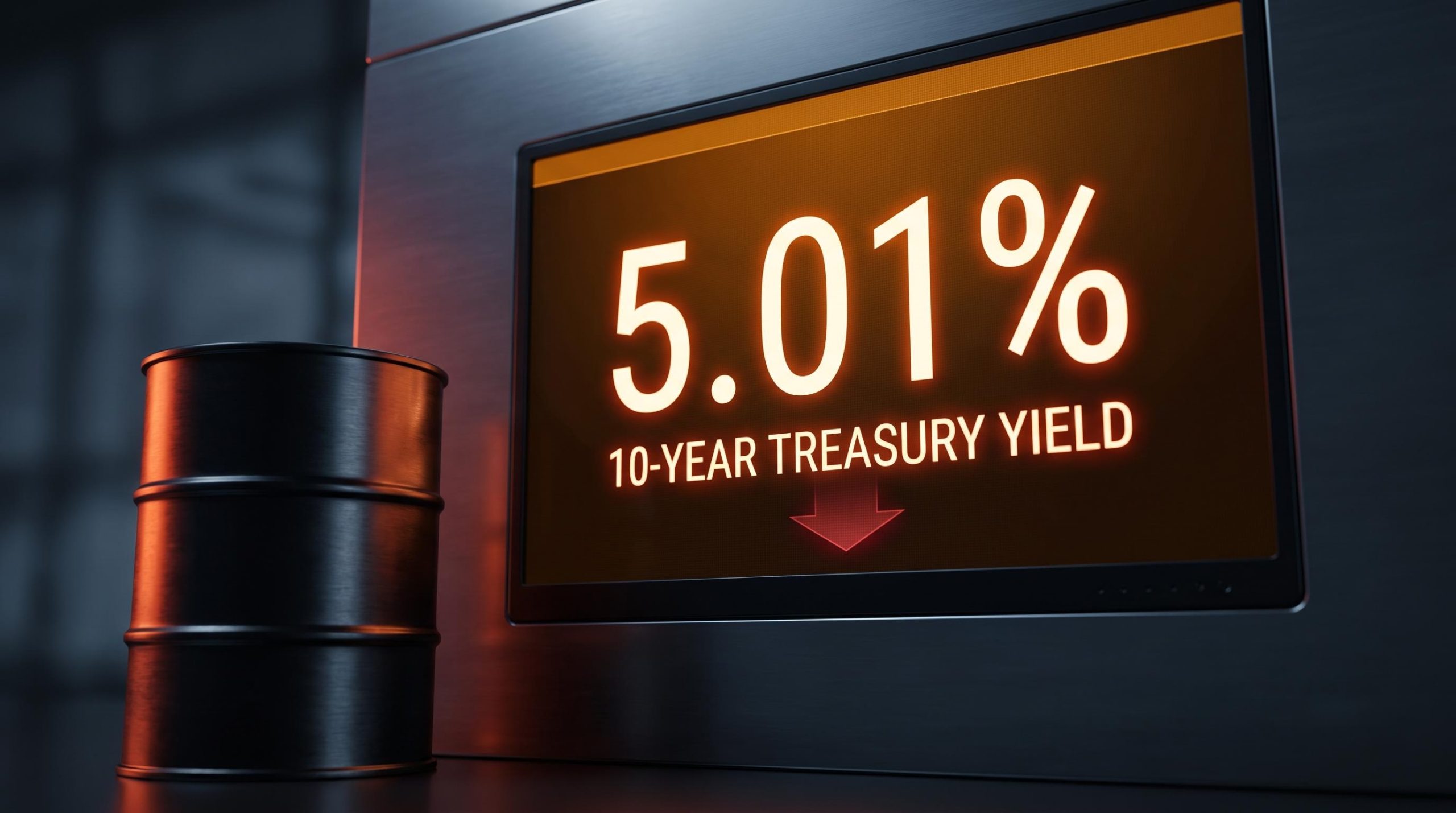
“Money matters.” For most people, that phrase sounds too obvious to be worth saying. Of course money matters. It is the thing prices are measured in.
But for the people who actually run central banks, those two words have been close to heretical for the better part of twenty years. The idea that the quantity of money in the economy should guide interest rate decisions was quietly shelved by the profession, treated as an artefact of a bygone era.
So when Kevin Warsh stood at the Federal Reserve podium and made that phrase central to his thinking, it demanded an explanation. Yesterday, on 16 September 2026, the Fed voted unanimously to raise rates by 25 basis points to a range of 3.75%-4.00%. The more consequential story may not be the rate move at all. It may be the analytical lens Warsh used to justify it.
This is where Kevin Warsh’s monetarist policy orientation becomes something you need to understand, not just as economic trivia but as a practical matter. After reading this, you will know which signals to watch under Warsh’s Fed, why those signals differ from what the last decade trained markets to follow, and whether the shift changes anything for how you should read inflation and interest rates from here.
How Warsh broke from the Powell playbook
The contrast between the two most recent Fed chairs is about as sharp as it gets in central banking. Jerome Powell once stated the profession needed to “unlearn monetarism,” treating the growth of money in the economy as background noise with little useful signal.
Warsh has done the opposite. His “money matters” formulation is a deliberate reversal, a decision to put monetary aggregates back on the policy dashboard after a generation of neglect.
What does that actually mean in practice? It does not mean Warsh is targeting a fixed money growth rate the way Milton Friedman originally prescribed. Policy commentary has described his stance as a “softer form of monetarism”: he treats measures like M2 and Divisia M4 as information variables, useful for forecasting inflation and growth, while still using the interest rate as the main instrument.
The subtler shift is in what Warsh treats as the headline signal. He downplays the interest rate as the primary read on policy stance, which is a meaningful communication change even though rates remain the Fed’s main tool. At his FOMC press conference, he described current monetary conditions as not restrictive, a reading that watching money aggregates can produce even when watching rates alone might suggest otherwise.
His priorities on inflation, though, are anything but soft.
Warsh operates within an institution whose formal mechanics shape what any individual chair can actually do: the FOMC structure and rate tools, from the voting composition of 12 members to the QE and QT levers that move long-term yields, define the transmission channels through which a monetarist analytical lens eventually reaches your portfolio.
“The Fed’s price stability objective of 2%, as measured by the PCE price index, is a firm, fixed target.” Kevin Warsh, Jackson Hole Economic Symposium, 28 August 2026
Here is how the two frameworks line up:
- Primary signal: Powell-era Fed led with the interest rate path. Warsh-era Fed adds broad money growth as a co-signal.
- Role of monetary aggregates: Powell treated them as low-signal noise. Warsh treats them as useful forecasting inputs.
- Inflation focus: Both prioritise the 2% target, but Warsh has made it his stated predominant focus, with inflation “running above our 2% target.”
For you as an investor, the takeaway is uncomfortable but clear. If you have spent years reading Fed intentions purely through interest rate guidance, you are now working with an incomplete map. A chair who takes money growth seriously will communicate, and eventually act, differently from one who dismissed it.
When big ASX news breaks, our subscribers know first
What monetarism actually says, and why it fell out of favour
Strip away the jargon and monetarism rests on one idea. If the amount of money in an economy grows faster than the economy itself can produce goods and services, prices rise to soak up the excess.
This is the quantity theory of money, and the relationship holds most reliably over long horizons and across large samples of countries. Steve Hanke, Professor of Applied Economics at Johns Hopkins University, documented a tight long-run link between M2 growth and inflation across 147 countries from 1990 to 2021.
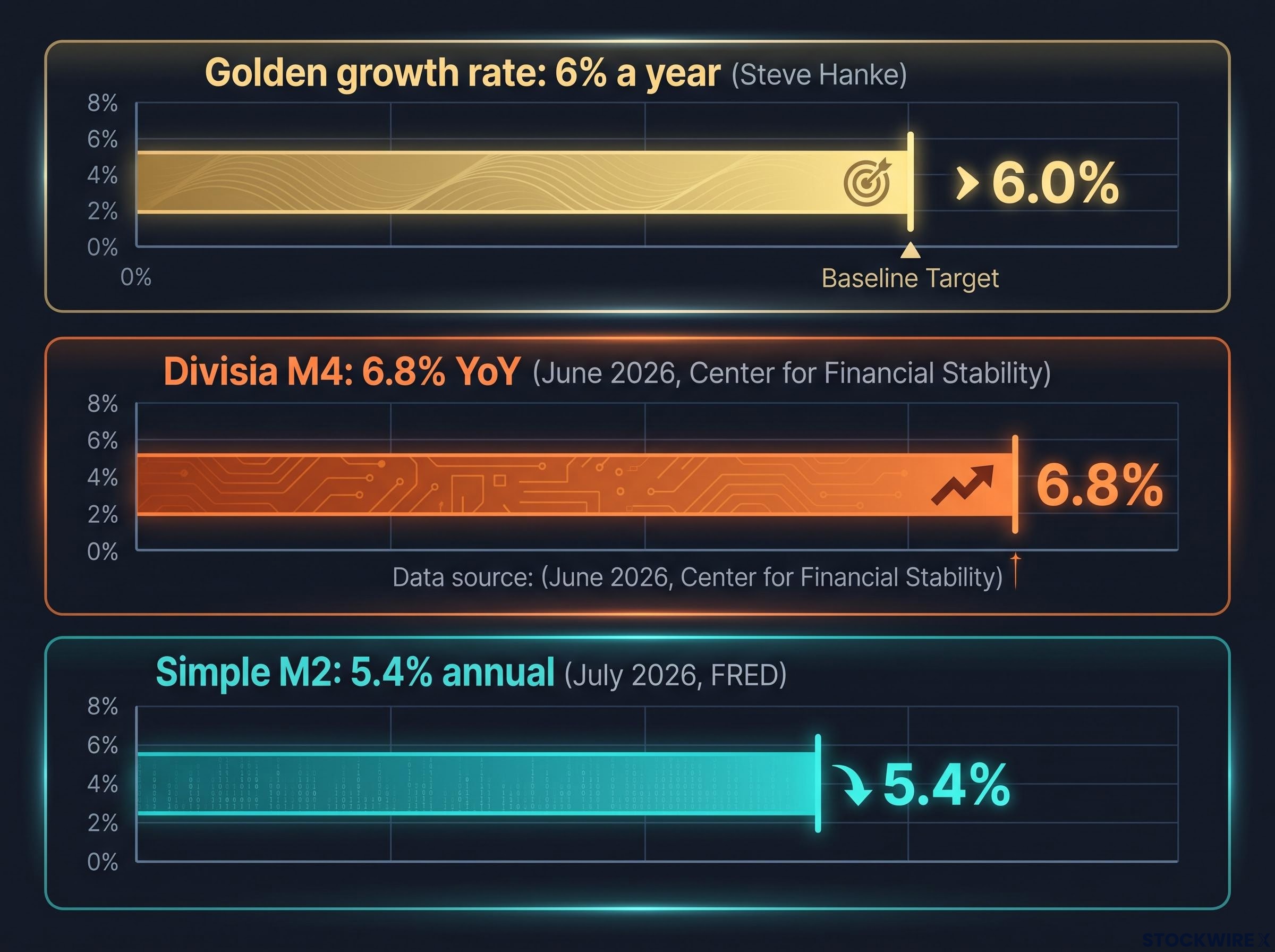
From that identity, Hanke derives what he calls a “golden growth rate.” Broad money growing at roughly 6% a year is, on his framework, the pace consistent with hitting a 2% inflation target. Grow money faster and you invite inflation; grow it slower and you risk weak growth or disinflation.
Not all money is created equal, which is where Divisia M4 enters. Simple M2 counts up cash and deposits and treats every dollar as equally spendable. Divisia M4 weights different assets by how “money-like” they actually are, giving heavier weight to funds people spend readily and lighter weight to those parked for the longer term.
“Forget the propaganda and focus on the money supply.” Steve Hanke, on assessing inflation risk
Here is how the two measures compare:
| Dimension | Simple M2 | Divisia M4 |
|---|---|---|
| What it measures | Cash, chequing and savings deposits, some money-market funds | A broader set of monetary and near-money assets |
| Weighting methodology | All components counted equally, dollar for dollar | Components weighted by how readily they function as money |
| What it tracks best | Narrow spending money | Broad monetary conditions and future inflation pressure |
| Recent growth rate | Around 5.4% annual (July 2026, FRED) | 6.8% YoY (June 2026, Center for Financial Stability) |
The case is not one-sided, and this is where you should calibrate rather than convert.
Why the Fed moved away from monetary targets in the 1980s and 1990s
Monetarism had its moment at the Fed and then lost it for reasons worth understanding. Under Paul Volcker in the early 1980s, the Fed experimented with explicit money growth targeting, and the experience produced sharp interest rate volatility.
The bigger problem was that the relationship stopped behaving. The velocity of money, how quickly each dollar circulates, became unstable, which broke the clean link between money growth and inflation that the framework depends on. Research from the Banque de France notes that velocity and the money multiplier have shifted markedly since the financial crisis, weakening the reliability of simple aggregates as policy guides.
The ECB working paper on the Quantity Theory of Money examines how severe velocity shocks destabilised the reliable link between money growth and inflation that monetary targeting depends on, which is precisely the empirical problem that pushed the Fed away from monetarist frameworks in the first place.
Under Alan Greenspan, the interest rate became the primary instrument, and that approach entrenched itself for the next two decades.
The empirical record remains genuinely mixed. A study from the Institute for New Economic Thinking examined 47 episodes of rapid money growth across 47 countries and found no reliable link to subsequent high inflation in every case. Against that, SUERF’s 150-year cross-country review concluded that persistent money growth exceeding real output is a fundamental factor in long-run inflation. The honest read is that money data is a useful lens for long-run inflation risk, not a precise real-time forecasting tool, and you should weight it accordingly.
Energy prices, food prices, and the monetarist argument that supply shocks alone cannot cause sustained inflation
Most people carry an intuitive theory of inflation. Oil goes up, everything gets more expensive, and that is inflation. It feels obvious.
The monetarist framework says that intuition is wrong, or at least incomplete. The logic runs through a fixed pool of money.
Follow the sequence:
- Energy prices spike sharply.
- The money supply stays fixed, because the Fed does not expand it.
- Consumers spend more on fuel and food, leaving less for everything else.
- Prices in other categories decelerate or fall to match that reduced demand.
- The overall price level does not sustain a rise; the spike is a relative price change, not generalised inflation.
The critical point is what converts a shock into lasting inflation. On this view, it is not the shock itself but the central bank’s decision to accommodate it by expanding the money supply.
“The Fed cannot influence individual commodity prices, but it can prevent relative price changes from spreading through the broader economy.” Kevin Warsh, FOMC press conference, 16 September 2026
The 1970s is the canonical case for this argument. Research from the Bank for International Settlements notes that the oil shocks of the 1970s and 1980s coincided with roughly a doubling of global inflation rates, whereas more recent oil price increases not accompanied by money accommodation produced far more limited pass-through to core inflation.
The August 2026 CPI breakdown offers a live test of the monetarist supply-shock argument: headline CPI hit 3.4% on the back of a gasoline spike, yet Divisia M4 was running well below its 2020 peak, which is exactly the configuration the framework predicts should produce limited sustained pass-through.
The mainstream response deserves a fair hearing, because it complicates the tidy story. IMF and BIS research shows supply shocks can produce sustained inflation through second-round effects, when wage demands and inflation expectations spread the initial shock, even without explicit money supply expansion, particularly where central bank credibility is weak. A post-pandemic paper linked to NYU found that both oil shocks and policy accommodation contributed to the 2020-2022 inflation surge, with accommodation amplifying the price-level impact rather than causing it alone.
The IMF also finds that advanced economies with credible, independent central banks experience much weaker long-term pass-through from food and fuel shocks.
For you, this reframes the question entirely. When energy or food prices spike, the useful thing to watch is not whether prices are rising but whether the Fed is letting money growth accommodate those rises. That single distinction is what separates a temporary relative price adjustment from a durable repricing, and it stops you from reading every commodity headline as a definitive inflation signal.
What changes for investors when the Fed starts watching money supply
Here is the practical shift. If you were trained in a rate-signal-first world, you now need to add broad money growth to your monitoring dashboard.
The reason is that a rate hike and accelerating money growth can coexist. When they do, the environment is looser in monetarist terms than the rate move alone would suggest.
Warsh’s monetarist turn compounds a separate but related shift: the forward guidance regime that trained markets to anchor on projected rate paths has been formally scrapped, meaning investors must now track both money aggregates and real-time data releases without the buffer of a Fed-provided expectations anchor.
The current data creates exactly this tension. Divisia M4 grew 6.8% year-over-year in June 2026, according to the Center for Financial Stability, above Hanke’s roughly 6% golden growth rate consistent with 2% inflation. M2, for context, was growing at around 5.4% annually in July 2026 FRED data. On a monetarist reading, conditions still look inflationary even after yesterday’s rate rise.
Here is how the two frameworks differ in practice:
| Dimension | Rate-signal framework | Monetarist-aggregate framework |
|---|---|---|
| Primary indicator to watch | The federal funds rate and forward guidance | Broad money growth (Divisia M4, M2) |
| How “tight” is defined | High or rising nominal rates | Money growth below the golden rate, regardless of rate level |
| Inflation signal source | Expectations, wage data, rate path | Sustained money growth above real output growth |
| Key risk of relying solely on it | Missing money-driven inflation surprises | Underweighting supply shocks and financial conditions |
If money growth stays above the golden rate, the monetarist framework points to continued inflation risk, which flows into several asset classes:
- Long-duration bonds: Sustained above-target money growth pressures long bonds, with the 10-year Treasury yield identified by Hanke as a key transmission point.
- Equities: Excess money can fuel asset-price inflation before it triggers a tightening cycle, supporting valuations for a while and then threatening them.
- Real estate: The same excess-money dynamic can inflate property prices, another channel monetarists watch for bubble risk.
The honest complication is that markets read money data in complicated ways. NBER research shows investors sometimes interpret money growth as a signal of future tightening and sometimes as a driver of higher inflation expectations, which means money-data literacy will matter more under a Warsh Fed than it has in years.
The interpretive read for you is direct. With Divisia M4 running above the golden growth rate right now, monetarist analysis suggests yesterday’s rate rise may not yet be enough to bring inflation durably to 2%, a meaningfully different conclusion than the rate level alone would offer. You do not need to abandon interest rate analysis to use this. You add a second dimension that surfaces divergences between what rates say and what money conditions imply.
Whether the monetarist revival holds, and what to watch next
None of this resolves cleanly, and pretending otherwise would do you a disservice. Warsh’s monetarist turn is not a rejection of interest rates as a tool. It is a broadening of the Fed’s analytical lens, and for you it means a richer but more demanding information environment.
The framework will be tested in real time. Warsh set his own benchmark at Jackson Hole, saying the Fed “must be confident that underlying inflation is moving to our objective, clearly and at sufficient speed.” Whether that happens is the test of whether the approach is working.
Three variables will tell the story over the next two to three quarters. Watch the PCE inflation trajectory relative to the 2% target. Watch the Divisia M4 trend, released quarterly by the Center for Financial Stability. And watch whether FOMC statements start referencing monetary aggregates more explicitly than they do now.
The empirical record keeps you honest on both sides. The money-inflation link is mixed in the short run, and mainstream institutions like the IMF and BIS continue to stress supply dynamics, second-round effects, and expectation anchoring as co-equal inflation drivers a money-only lens can miss.
For investors, our full explainer on fiscal dominance constraints examines why U.S. federal debt at 122% of GDP structurally limits how aggressively Warsh can tighten even if money growth stays above the golden rate, covering the debt servicing arithmetic that makes a Volcker-scale campaign fiscally prohibitive at current debt levels.
Yesterday’s 12-0 unanimous vote shows an FOMC united on the inflation-first priority, even as the analytical tools shift from the Powell era. The most useful posture for you is not conversion to monetarism but treating broad money growth as a second opinion on Fed stance, one that will carry more weight under Warsh than it has for a generation.
This article is for informational purposes only and should not be considered financial advice. Investors should conduct their own research and consult with financial professionals before making investment decisions. Past performance does not guarantee future results, and economic projections are subject to market conditions and various risk factors.
One framework to add, not one to swap in
The cleanest way to hold all of this is to see Warsh’s “money matters” revival for what it is: a corrective to a decades-long over-reliance on the interest rate as the sole signal of policy stance. It is not a return to the rigid money targets that misfired in the 1980s.
The practical skill is treating broad money growth as a cross-check on rate signals. When Divisia M4 runs above the golden growth rate, as it does now, treat that as a yellow flag on inflation even when a rate hike suggests the Fed is tightening.
The move from Powell to Warsh is more than a change of personnel. It is a change in the grammar of Fed communication, and fluency in that grammar is now a genuinely useful skill with portfolio consequences.
You do not need to become a monetary economist to benefit from this. You need to watch one more signal than you did before, hold both the monetarist and mainstream lenses at once, and let the next several quarters of data settle a debate that neither side has yet won.