
Most industries treat rising interest rates as a problem to be managed. Insurers treat them as an accident of timing that quietly works in their favour, because they collect billions in premiums from customers long before they ever spend a cent paying out claims.
That gap between collecting money and paying it out is where the sector earns a second income that most investors overlook. With the Reserve Bank of Australia (RBA) cash rate sitting at 4.35% as of 12 August 2026, and Suncorp reporting its FY26 portfolio yield rising to roughly 5%, this is not a theoretical dynamic. It is showing up in reported earnings right now. The Australian insurance sector has advanced roughly 25% from its March 2026 lows even as bond yields have climbed higher, the opposite of how most rate-sensitive sectors behave.
After reading this, you will understand the structural mechanics that explain why insurance stocks respond so differently to a rate cycle than banks or REITs, and what the AI-driven pricing revolution now adds on top of that structural advantage.
What is insurance float, and why does it become more valuable when rates rise?
Start with the simplest version. When you pay your car insurance premium, the insurer does not immediately hand that money to a claimant. It holds it, sometimes for months, sometimes for years, until a claim arrives. In the meantime, that pool of premium money belongs to the insurer to invest.
That pool has a name: float. It is effectively an interest-free loan from policyholders, and the insurer keeps every dollar of investment return it earns on that money before the claims come due.
The insurance float mechanics that Warren Buffett refined over decades at Berkshire Hathaway illustrate just how powerful this structure becomes at scale: Berkshire’s float reached $176 billion in 2025 with a combined ratio of 87.1%, meaning policyholders were effectively paying Berkshire to hold their money.
Warren Buffett built much of Berkshire Hathaway’s wealth on exactly this mechanism, using insurance float as a permanent, low-cost source of investable capital that compounds over decades.
Here is where the compounding logic clicks into place. Around 80% of Australian general insurers’ investment portfolios sit in interest-earning assets, mostly conservative fixed-income securities. When the yield on those assets moves from roughly 2% to roughly 5%, the same float pool suddenly generates far more investment income, with zero additional operating cost. No new customers. No new policies. Just higher returns on money the insurer was already holding.
The reported figures make this concrete. Suncorp posted net investment returns of $553 million for the year ended 30 June 2026, with its portfolio yield reaching approximately 5% and exit yields hitting 5.3%. QBE Insurance recorded investment income of US$1,633 million for the year ended December 2025, a 4.9% portfolio return, with its core fixed-income yield exiting the year at 3.7%.
| Insurer | Portfolio yield | Investment income | Exit yield |
|---|---|---|---|
| Suncorp (FY26) | ~5% | $553 million | 5.3% |
| QBE (FY25) | 4.9% | US$1,633 million | 3.7% (core fixed income) |
What those numbers tell you is that float reinvestment is not a slide in an investor deck. It is a live earnings line already flowing through reported results, and Australian insurers are currently sitting near the peak of this benefit window.
When big ASX news breaks, our subscribers know first
Life, property, and health insurers do not all benefit equally
Not every insurer captures this tailwind to the same degree. The single variable that decides how much any insurer gains from higher rates is the duration of its liabilities, meaning how far into the future its expected claim payouts stretch.
The longer those obligations run, the more powerfully higher rates work in an insurer’s favour, and the reason is that two separate forces move at once.
Why life insurers sit at the top of the spectrum
Life insurers write the longest-duration business in the sector. Their obligations can extend decades, which means two things happen simultaneously when rates rise.
First, they reinvest incoming premiums into higher-yielding assets, exactly as any insurer does. Second, and this is the part specific to long-duration writers, higher interest rates raise the discount rate applied to their future liabilities.
Liability discounting works like this: a payout owed in thirty years is worth less in today’s money when interest rates are high, because that future dollar can be matched by a smaller investment now. Higher discount rates therefore shrink the present value of expected future payouts, which strengthens the balance sheet of a long-duration writer.
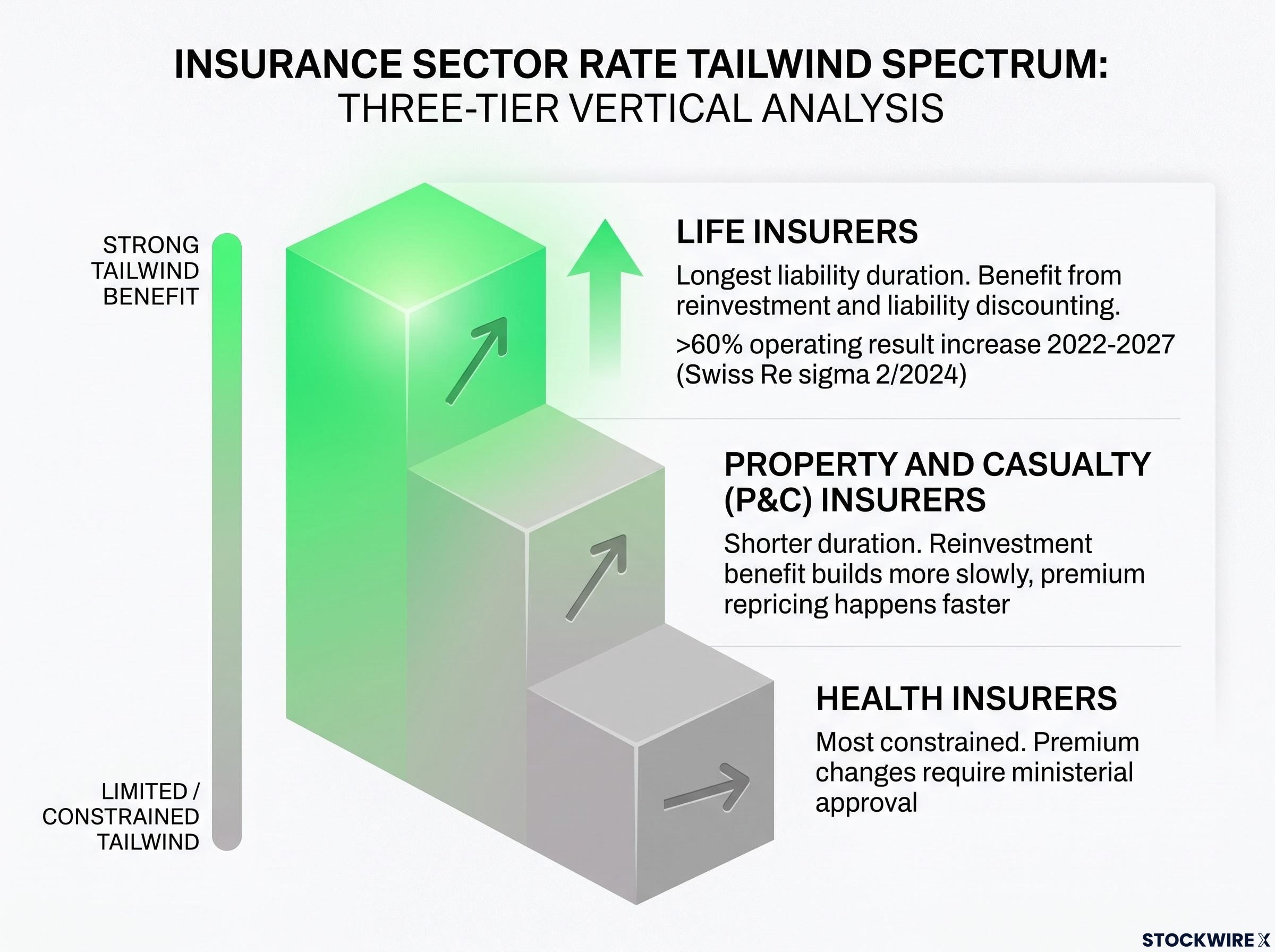
According to Swiss Re’s sigma 2/2024 report, operating results in major life markets could increase by more than 60% across the 2022-2027 period as a direct result of the higher-rate environment.
Here is how the three sub-sectors line up on rate sensitivity:
- Life insurers: Longest liability duration. Benefit from both reinvestment and liability discounting simultaneously. The clearest structural winners.
- Property and casualty (P&C) insurers: Shorter duration. Reinvestment benefit builds more slowly, but premium repricing happens faster.
- Health insurers: Most constrained. Premium changes require ministerial approval, limiting their ability to capture rate tailwinds or pass on costs.
For anyone weighing exposure to Australian insurance stocks, this breakdown matters. Duration is the filter that separates the structural winners from those with more limited upside, and treating the sector as one homogeneous block is a mistake.
Why property and casualty insurers face a more complex picture
P&C insurers, the ones writing home, motor, and commercial cover, hold shorter-duration portfolios, so the reinvestment benefit takes longer to fully materialise. Their advantage is that premiums can be repriced more frequently, letting them respond to changing conditions faster than a life insurer can.
That flexibility is needed, because P&C insurers also carry headwinds that can partly cancel out the investment income tailwind. Claims inflation and reinsurance costs are both climbing at the same time as investment returns.
The Insurance Council of Australia (ICA) reports that the average private motor claim size rose 42.2% from June 2019 to June 2024, driven by replacement parts, labour, and increasingly complex vehicle technology. Reinsurance costs for home and contents insurance rose roughly 11% in 2023-24 as extreme weather worsened the global pricing of Australian risk.
For P&C names, then, the rate tailwind is real but contested. You cannot read their investment income in isolation without also tracking what is happening to claims and reinsurance costs.
How AI and big data are reshaping what insurers can charge, and why it matters beyond the rate cycle
Suncorp’s data models found that households consuming less yogurt tended to file larger claims and showed less sensitivity to price. Sit with that for a moment.
Suncorp’s analysis reportedly revealed that lower yogurt consumption correlated with larger claim payouts and reduced price sensitivity, one of many behavioural signals now feeding modern pricing engines.
The point is not the yogurt. The point is that insurers can now hunt for correlations this granular, moving far beyond broad demographic categories into behavioural and geospatial segmentation. Two households that look identical on the surface can now receive materially different premiums.
Suncorp builds these models by combining Australian Bureau of Statistics (ABS) census data, consumer spending patterns, and its own historical claims records. The more precisely an insurer can sort genuine risk, the better it prices, and that improves margins regardless of what interest rates are doing.
AI is being deployed across three main areas:
- Pricing segmentation: Sorting customers into far narrower risk bands using behavioural and location data.
- Claims triage: Automating the assessment and routing of incoming claims to speed settlement.
- Fraud detection: Flagging suspicious patterns before payouts are made.
This precision cuts both ways. Genuinely low-risk customers may see more affordable cover, while some high-risk groups can be priced out of the market entirely, which is exactly why regulators are paying attention.
The scale of the expected payoff is large. AXA has established a central AI hub targeting €500-700 million (roughly $810 million to $1.13 billion) in annual recurring pre-tax benefits by 2029, drawn from automated claims management and optimised pricing.
The urgency behind this spending becomes clear in the profit numbers. According to KPMG, industry net profit fell to $5.2 billion in 2025 from $6.2 billion in 2024, despite positive investment returns, as elevated natural hazards and rising claims costs bit into margins.
That decline tells you something important. AI-driven pricing is not a discretionary tech project. It is a structural response to cost pressures that are steadily eroding the investment income tailwind, and insurers without pricing sophistication are already falling behind. For anyone assessing insurer fundamentals, this is a second, rate-independent profitability lever that keeps working even if the rate cycle eventually turns.
The regulatory guardrails now closing around AI-powered pricing
Regulators have moved from watching to acting. What was recently an emerging area of interest is now codified in rules that directly shape which AI capabilities an insurer can deploy without inviting legal and reputational risk.
APRA AI governance requirements have sharpened considerably since April 2026, when APRA’s supervisory letter formally declared AI risk management controls across Australian insurers materially inadequate and made board-level AI literacy an enforceable accountability, not a discretionary best practice.
The fairness concern sits at the centre of this attention. AI models that lean on location or behavioural proxies can accidentally reproduce demographic discrimination, and the Australian Human Rights Commission has warned specifically that using location as a proxy for ethnicity creates anti-discrimination exposure.
| Regulation | Effective date | Key requirement |
|---|---|---|
| APRA CPS 230 | July 2025 | AI systems in underwriting and pricing classified as operational risks requiring board-level governance |
| Privacy Act amendments | 10 December 2026 | Mandatory disclosure when automated systems substantially influence decisions significantly affecting individuals |
The Actuaries Institute has issued guidance urging insurers to set explicit fairness objectives and to audit deployed AI systems for indirect discrimination. Regulators want three specific risks addressed:
- Proxy discrimination: Variables like location standing in for protected characteristics such as ethnicity.
- Lack of explainability: Black-box models that cannot justify why a given customer received a given price.
- Inadequate human oversight: Pricing decisions made without clear human accountability.
There is also a cost embedded in the distribution layer that AI efficiency has to work against. Broker commissions run at 15-25% of gross written premium for home and contents insurance and 10-15% for motor, and these remain exempt from conflicted-remuneration bans.
The regulatory direction tells you where the real edge lies. The competitive advantage from AI pricing will increasingly belong to insurers with explainable, auditable models rather than opaque correlations. Governance quality is no longer a compliance footnote. It is a genuine differentiator in the durability of an insurer’s earnings.
What the two tailwinds together mean for how you read insurer fundamentals
Two tailwinds are blowing at once, and that combination is unusual. Float reinvestment is lifting investment income while AI-driven pricing is sharpening margins, and each works independently of the other. Neither is permanent.
The rate story carries an obvious ceiling. If the RBA eventually cuts from 4.35%, the investment income tailwind fades, and the durability of insurer profitability then rests almost entirely on how deeply AI-driven pricing discipline has been embedded in the business. The next RBA decision lands on 29 September 2026, and NAB has flagged a possible 25bp hike to 4.60%, so the peak of the rate window may not yet have passed.
The RBA Statement on Monetary Policy sets out the Board’s full assessment of economic and financial conditions, including the inflation and labour market dynamics that drive the cash rate decisions shaping insurer investment income.
Sophisticated capital allocators appear to see structural value in this positioning. On 21 August 2026, Steadfast Group entered a binding scheme deal to be acquired by a consortium of Amwins, Dragoneer, and KKR.
The Steadfast deal values the broker at $6.00 cash per share, roughly $7.7 billion in total, and remains at the scheme stage pending shareholder, court, and regulatory approval.
Suncorp’s capital management points the same way, with an on-market buyback of up to $250 million planned for FY27 and a fully franked dividend yield near 4%. Yet the KPMG profit decline from $6.2 billion to $5.2 billion is the counterweight, a reminder that cost headwinds are real and the tailwinds are not frictionless.
Insurer dividend yields have attracted fresh attention from income-focused allocators, with Market Partners analysts calling ASX insurers the superior yield vehicle within financials for FY27, citing a 50-100 basis point premium over most major bank shares as staggered bond portfolios continue rolling into higher prevailing rates.
When you evaluate any Australian insurer, four signals bring both stories together:
- Portfolio exit yield: How well positioned the investment book is to capture current rates.
- AI investment disclosures: Whether the insurer is building auditable, explainable pricing capability.
- Claims inflation trend: How fast settlement costs are rising against premium income.
- Reinsurance cost movement: Whether catastrophe pricing is eroding the investment gains.
Check portfolio duration and yield for the rate story, then check AI governance and pricing sophistication for the structural story. Neither alone is enough. The sector is currently priced for optimism, and the question that decides the next few years is whether AI-driven cost discipline can hold margins together once the rate tailwind softens.
This article is for informational purposes only and should not be considered financial advice. Investors should conduct their own research and consult with financial professionals before making investment decisions. Past performance does not guarantee future results. Financial projections are subject to market conditions and various risk factors.