
When a corporation places bitcoin on its balance sheet, the instinct is to see it as a punt: an executive with too much cash and too much conviction rolling the dice. That reading is now several years out of date.
The largest corporate cryptocurrency positions are engineered structures, built with convertible notes, fiat liquidity buffers, and net leverage ratios that would be familiar to any treasury desk. Institutional crypto balance sheet management has become a discipline, not a gamble, and the scale confirms it.
By September 2026, trackers record 195 public entities holding roughly 1.23 million BTC, equal to about 5.87% of the total circulating supply. That is a systemic pivot in how public companies think about reserves. What follows here gives you a framework for reading these balance sheets, so you can separate the resilient treasury models from the fragile structures that break in the next downturn.
How fiat devaluation theories trigger corporate hoarding
Strip away the ticker-watching and a single macroeconomic argument sits underneath almost every corporate bitcoin purchase. Proponents hold that fiat money loses purchasing power over time because central banks keep creating it, so wealth stored in unbacked government currency slowly erodes.
Under this thesis, the fix is to convert reserves into a strictly scarce asset. Bitcoin, capped in supply and outside any central bank’s control, becomes the reserve of choice. The argument extends further: supporters contend that governments will keep injecting liquidity to prop up markets, making a total systemic collapse unlikely and reinforcing the case for holding scarce assets.
That belief is not a fringe position anymore. It is moving billions across borders and onto the balance sheets of nearly 200 public companies, up sharply from the 61 to 172 firms tracked across 2025 depending on methodology. When you buy shares in one of these firms, you are not simply buying a business. You are taking a position on a debate about the future of central bank money creation.
The debasement trade has shifted well beyond the fringe: gold surged roughly 10% in August 2026 while bitcoin’s 90-day correlation with gold climbed above 50%, suggesting that institutional capital is now treating both assets as structural responses to fiscal expansion rather than opportunistic crisis bets.

The institutional resistance
The world’s official financial bodies see the same trend and reach the opposite conclusion. A 2023 IMF working paper warned that the extreme volatility, opaque linkages, and leverage inside unbacked crypto assets can transmit shocks into the wider financial system once adoption spreads.
The Bank for International Settlements (BIS) has been blunter. Its research argued that the crypto ecosystem is largely self-referential, does not finance real economic activity, and carries structural flaws that make it unsuitable for a serious role in the monetary system. BIS official Claudia Buch has separately warned that bank exposures to crypto need close monitoring for contagion risk.
A joint 2023 IMF-FSB synthesis paper explicitly recommended that crypto assets not be granted official currency or legal-tender status, arguing that widespread adoption could undermine monetary sovereignty, circumvent capital flow management, and threaten global financial stability.
The disconnect matters to you. Corporate confidence is building at exactly the moment global regulators are drawing red lines, and that tension is a risk factor priced into every share you buy.
When big ASX news breaks, our subscribers know first
The mechanics of the net-zero leverage structure
The fear with any leveraged bitcoin position is the margin call: the price drops, a lender demands more collateral, and the company is forced to dump assets at the worst possible moment. The strongest corporate treasuries are engineered specifically to remove that trigger.
The tool of choice is the convertible senior note. This is a hybrid instrument: it pays a fixed coupon like a bond, but lenders can convert it into equity if the share price rises. For the issuing company, this means lower cash interest than straight high-yield debt, deferred share dilution, and, most importantly, no direct margin call on the bitcoin itself.
Alongside that debt, resilient firms hold substantial fiat reserves. Cash sitting in dollars insulates operations from a price crash and lets the company meet obligations without selling coins into a falling market. The combination pushes the net leverage ratio, the gap between debt and liquid assets, toward zero.
To see why this matters, look at what failed. In the 2022 bear market, public bitcoin miners collapsed, with sector shares falling more than 70% year-to-date by October. Core Scientific, one of the largest US miners, filed for Chapter 11 bankruptcy in December 2022, brought down by slumping mining revenues, rising energy costs, and a $7 million receivable stuck inside the failed Celsius Network.
Bitcoin’s 2022 inflation test is the most important data point regulators cite when arguing the asset is speculative rather than a reserve: bitcoin lost roughly 77% of its value during the highest inflation in four decades, while gold remained broadly stable, a divergence that sits at the centre of the IMF and BIS objections to crypto as a monetary instrument.
The miners that broke shared a common structure that the modern treasury firms deliberately avoid.
- Distressed 2022 miners: high operating leverage, debt used to fund rapid capacity expansion, and short-to-medium-term secured loans collateralised directly by mining hardware or continuous bitcoin sales.
- Modern treasury holders: lower debt ratios, flexible cost structures, and longer-dated, unsecured or convertible financing that treats bitcoin as a long-term reserve rather than daily operating fuel.
The distinction is everything. Miners tied their debt to the daily grind of running machines and selling coins to survive, which meant any revenue slump hit solvency immediately. Treasury firms separate their digital assets from operating cash flow, so a price drop dents the balance sheet without threatening the lights staying on.
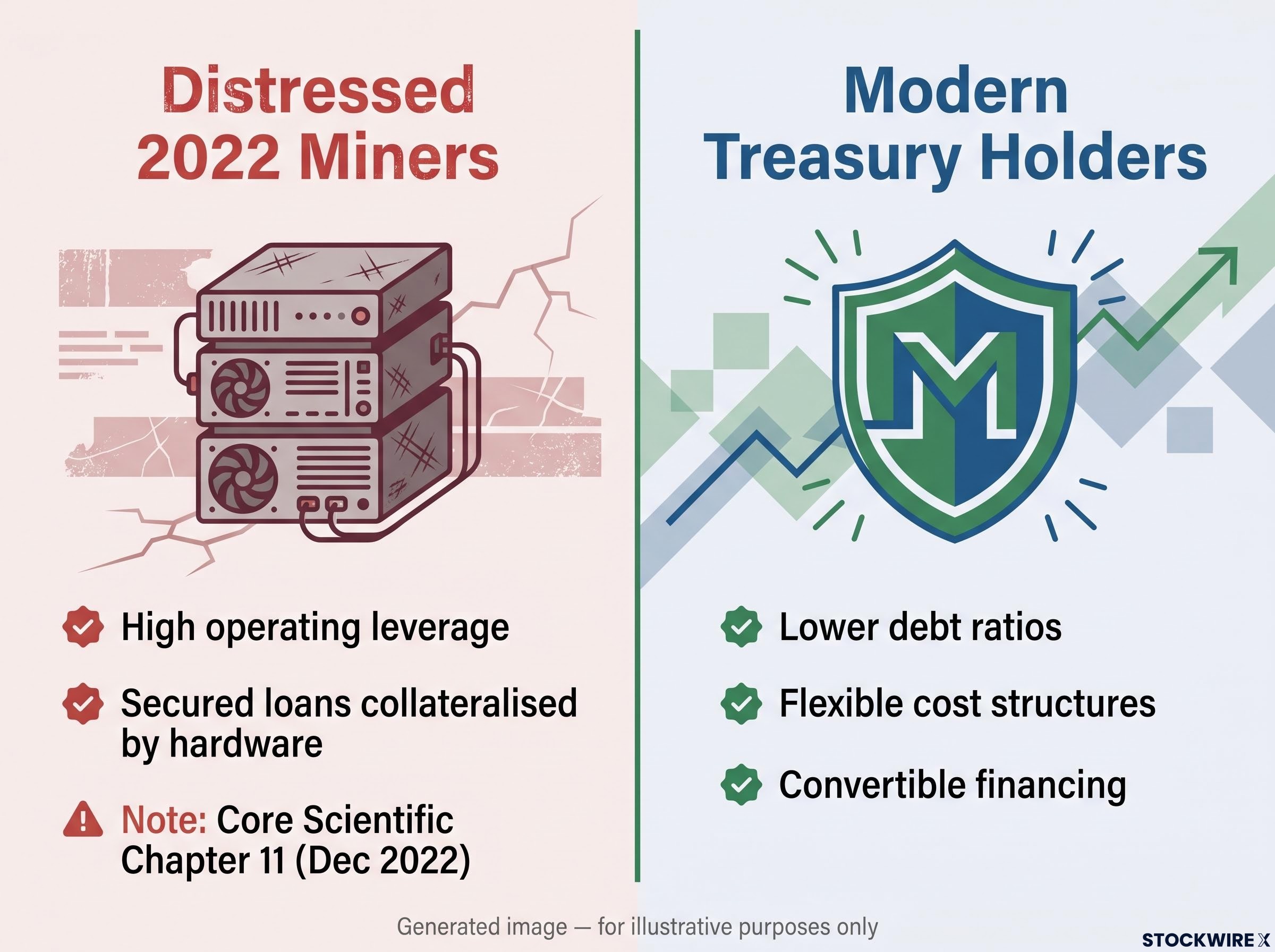
Once you can tell hardware-backed debt from unsecured convertible notes, you can spot at a glance which public companies are one market crash away from bankruptcy and which are structurally shielded.
The Q2 2026 reality test: executing the strategy at scale
Theory is one thing. A headline net loss of more than $8 billion is another, and that is exactly what Strategy (formerly MicroStrategy) reported for Q2 2026.
The company held approximately 843,775 BTC as of late July 2026, carried at a market value of $54.77 billion against a bitcoin price near $64,915, below its $63.69 billion cost basis. The resulting $8.22 billion quarterly net loss came almost entirely from unrealised fair-value adjustments, meaning paper losses on coins it has not sold. Holdings themselves grew roughly 11% quarter-on-quarter.
Your instinct on seeing an $8 billion loss might be to panic. The liability side tells the real story. Strategy reduced its convertible debt to around $6.7 billion, down from prior levels near $8.2 billion, and built its USD reserve to $3.75 billion, achieving a near-zero net leverage position. The paper loss is real; the structural threat is not.
Strategy’s USD reserve mechanics reveal an important constraint: the $4.8 billion reserve is restricted to preferred dividends, interest, and digital credit repurchases and cannot be redeployed directly into new bitcoin purchases, meaning the fortress balance sheet and the accumulation engine operate on separate tracks.
Two other firms show how differently the same idea can be executed.
| Company | Estimated BTC Holdings | Stated Q2 2026 Net Loss | Financing Model |
|---|---|---|---|
| Strategy | 843,775 BTC | $8.22B | Convertible notes plus large USD reserve |
| Galaxy Digital | $1.16B-$1.2B digital assets | $85M | Net of operating and investment activity, no treasury convertibles |
| Coinbase | 15,389-17,311 BTC | Not stated | Corporate treasury separate from customer custody |
Galaxy Digital posted an $85 million GAAP net loss and a firm-wide adjusted EBITDA of around minus $77 million, with net digital assets and investments of $1.16 billion to $1.2 billion, down about 15% on Q1 as prices fell and exposure was trimmed. Its treasury runs net of operating and investment activity, with no convertible debt flagged for accumulation.
Coinbase sits at the conservative end, with trackers estimating a corporate treasury of 15,389 to 17,311 BTC, held separately from the customer assets it custodies.
The read for you is that a giant paper loss and a fortified balance sheet can coexist in the same earnings report. Reading the fiat reserve and net leverage figures alongside the headline loss is the only way to tell whether a company is actually compromised.
The hidden structural risks still threatening the model
Eliminating the margin call is not the same as eliminating risk. The near-zero leverage structure removes the most violent failure mode, but three quieter traps remain in the debt.
- Refinancing stress. Fixed debt sitting against a volatile asset can still create solvency and refinancing pressure in a deep crash, even without a mechanical margin call. Older analyses flagged danger thresholds at severe bitcoin price drops where voluntary asset sales or refinancing become necessary, and a sharp decline can erase billions in market value in a single quarter.
- The stagnant price trap. Convertible notes only convert to equity if the share price climbs. If bitcoin drifts sideways, those notes never move into the money, leaving the issuer carrying a high debt load with limited free cash flow and no easy conversion escape.
- Index exclusion. This is the risk most investors never see coming. Because bitcoin can dominate these balance sheets, index providers such as MSCI may exclude a firm if digital assets exceed a threshold reported around 50% of its asset base. Exclusion forces passive funds tracking that index to sell, regardless of how strong the company’s cash buffer is.
That last point deserves your full attention. A fortress balance sheet protects against creditors, but it cannot stop an index rule from triggering institutional algorithms to dump the stock all at once. When you assess these companies, look past the treasury and ask how close the asset mix sits to an exclusion trigger.
This article is for informational purposes only and should not be considered financial advice. Investors should conduct their own research and consult with financial professionals before making investment decisions.
Past performance does not guarantee future results, and the scenarios above are speculative and subject to change based on market developments and company performance.
Evaluating corporate treasury resilience in the next cycle
The evolution is clear. Corporate crypto treasury management has moved from the fragile operating leverage that sank miners like Core Scientific in 2022 to the near-zero net leverage structures dominating late 2026, where fiat reserves and convertible debt are balanced to survive a crash rather than merely bet on a rally.
For your own analysis, the single most useful lens is a company’s fiat liquidity relative to its convertible debt maturities. A firm with deep dollar reserves and modest, long-dated debt can absorb a brutal quarter; a firm without one cannot, no matter how much bitcoin it holds.
Bitcoin allocation sizing for individual investors follows a different logic than corporate treasury construction: while companies engineer leverage ratios and fiat buffers around large concentrated positions, individual exposure is broadly supported in the 1-5% range, contingent on cleared high-interest debt, a written position plan, and tested readiness for drawdowns exceeding 50%.
The open question is regulatory. With the IMF, BIS, and FSB all pushing against official crypto adoption, global policy could eventually force adjustments to these hybrid financing models. Watching how issuers adapt to that pressure will tell you which treasury structures are built to last.