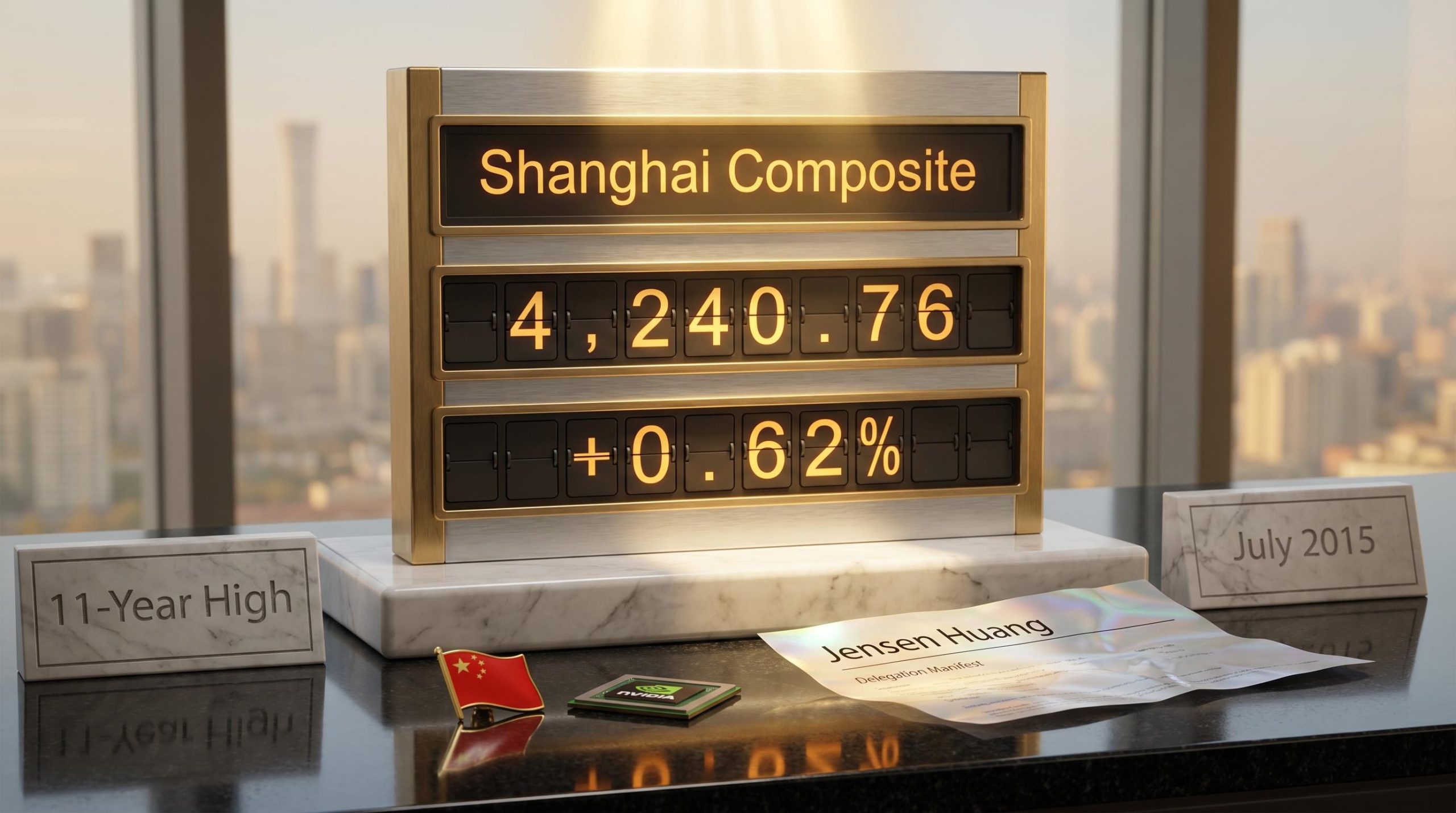
The Shanghai Composite closed at its highest level since July 2015 on Tuesday 13 May 2026, and the catalyst was not a trade deal, an earnings beat, or a central bank pivot. It was a CEO’s name on a delegation list. As President Donald Trump arrived in Beijing for the first face-to-face meeting with President Xi Jinping in more than six months, confirmation that Nvidia chief executive Jensen Huang was travelling with the presidential delegation sparked an immediate rally in Chinese AI-related stocks, pulling the broader Shanghai index to an 11-year high by the close of Wednesday’s session. What follows explains what moved markets, why one executive’s inclusion in a diplomatic trip carries that kind of signal weight, and what analysts expect from summit talks on trade and AI security.
Shanghai closes at its strongest level since 2015 as tech buying takes over
The Shanghai Composite settled at 4,214.49 on 12 May before climbing to an intraday 4,240.76 on 13 May, a gain of 0.62% that carried the index to levels not seen since July 2015. The milestone landed mid-session, not at the open.
11-year high: The Shanghai Composite reached its highest level since July 2015, when the index peaked during a leveraged retail bubble that subsequently collapsed.
Markets opened in negative territory on Tuesday morning. The reversal came after midday, once confirmation of Jensen Huang’s delegation role filtered through trading desks, turning a cautious open into a broad, sentiment-driven rotation into technology and AI names.
The CSI 300 advanced 1% on the day, confirming the move was not confined to speculative small-cap names but extended across mainland large-cap equities. The Hang Seng recovered from earlier weakness to finish the session at approximately 26,345.16.
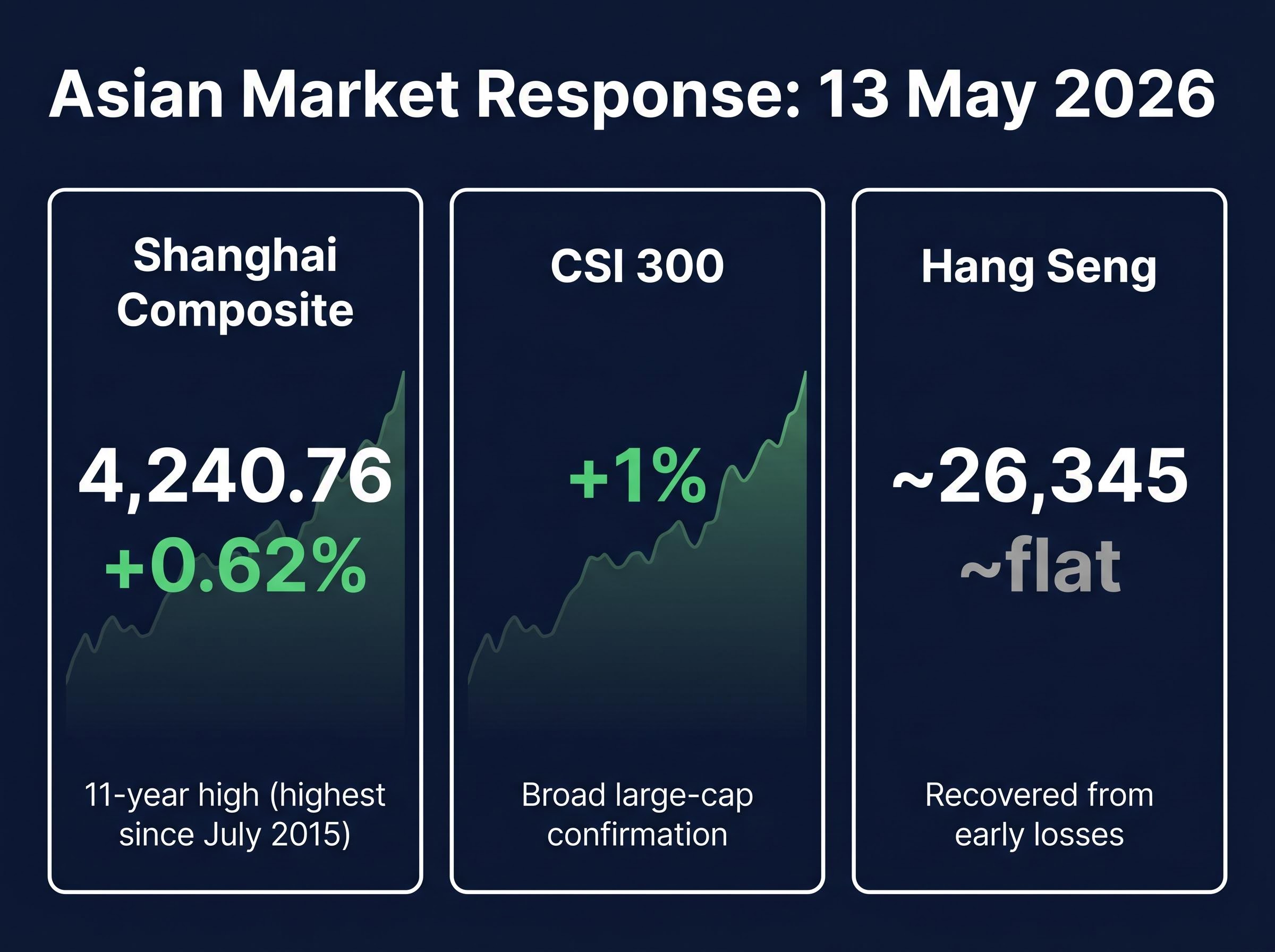
| Index | 13 May Level | Move on Day | Context |
|---|---|---|---|
| Shanghai Composite | 4,240.76 | +0.62% | 11-year high (highest since July 2015) |
| CSI 300 | — | +1% | Broad large-cap confirmation |
| Hang Seng | ~26,345 | ~flat | Recovered from early losses |
When big ASX news breaks, our subscribers know first
Why Jensen Huang’s name on a delegation list moved an entire sector
President Trump confirmed that Jensen Huang would travel with the presidential delegation to Beijing, according to Investing.com reporting dated 13 May 2026. The confirmation preceded, and directly catalysed, the rally in Chinese AI-sector stocks that pulled the Shanghai Composite to its 11-year high.
The signal was not ceremonial. Nvidia’s core China business, data centre AI hardware and GPU sales, is directly constrained by U.S. export control restrictions that have limited the company’s addressable market for over two years. The CEO’s physical presence in a presidential trade delegation implies those restrictions are, at minimum, under active bilateral discussion.
Nvidia’s data centre revenue model explains why export control restrictions carry such direct market consequences: the company generated $193.7 billion in data centre revenue in FY2026, and the China addressable market represents a ceiling on that trajectory that has been artificially constrained by U.S. export rules for over two years.
The BIS export controls on advanced computing imposed in late 2023 established the core regulatory ceiling that has constrained Nvidia’s China-facing data centre business, capping the performance thresholds of chips that can be sold to Chinese buyers without a licence.
How delegation composition functions as a policy signal
The composition of a presidential trade delegation is a deliberate political act. Each name represents a commercial relationship the administration is prepared to defend or advance in front of a counterpart government. Markets read these lists as forward-looking policy signals for three specific reasons:
- The inclusion of a sector-specific executive signals that the administration is willing to negotiate on that sector’s regulatory constraints.
- A CEO who stands to benefit from policy relief would not be invited unless the White House believed concessions were at least possible.
- Delegation visibility raises the political cost of leaving the summit empty-handed on the relevant issue, creating its own momentum toward a deal.
For investors tracking China’s domestic AI buildout or Nvidia’s total addressable market, Huang’s presence became a live data point about whether the regulatory ceiling on chip exports was about to shift.
Micron’s delegation-driven rally offers a parallel read on the same signal: Micron CEO Sanjay Mehrotra’s inclusion in the presidential delegation sent the stock up more than 20% over two sessions, while analyst KC Rajkumar argued that the absence of semiconductor capital equipment CEOs was equally significant, as it preserved the export restrictions limiting Chinese memory rivals YMTC and CXMT.
What investors need to know about the Shanghai Composite and China’s AI rally
The July 2015 benchmark is not arbitrary. That peak marked the height of a leveraged retail bubble in which millions of margin-funded retail accounts drove the Shanghai Composite to valuations that collapsed within weeks. Reaching those levels again in 2026 represents a qualitatively different event, driven by institutional flows and sector-specific demand rather than margin-fuelled speculation.
Three things to know about the Shanghai Composite:
- What it measures: The Shanghai Composite tracks all stocks listed on the Shanghai Stock Exchange, giving it broad exposure to mainland Chinese equities. The CSI 300, by contrast, covers the 300 largest stocks across both the Shanghai and Shenzhen exchanges, functioning as a large-cap benchmark.
- Why July 2015 matters: The prior peak was a bubble top. Returning to those levels on institutional and AI-sector demand is a structurally different signal than retail leverage repeating the same pattern.
- What is driving it now: AI and semiconductor stocks have replaced property-sector names as the primary growth engine for Chinese equity sentiment in 2026.
JPMorgan Private Bank upgraded Chinese equities for 2026, forecasting approximately 13% earnings growth for the year, citing stabilising macro conditions.
The tech-heavy ChiNext index also showed upward movement around the 12 May open, though a specific closing percentage has not been independently confirmed.
Summit agenda: trade dominates, but AI security talks face analyst skepticism
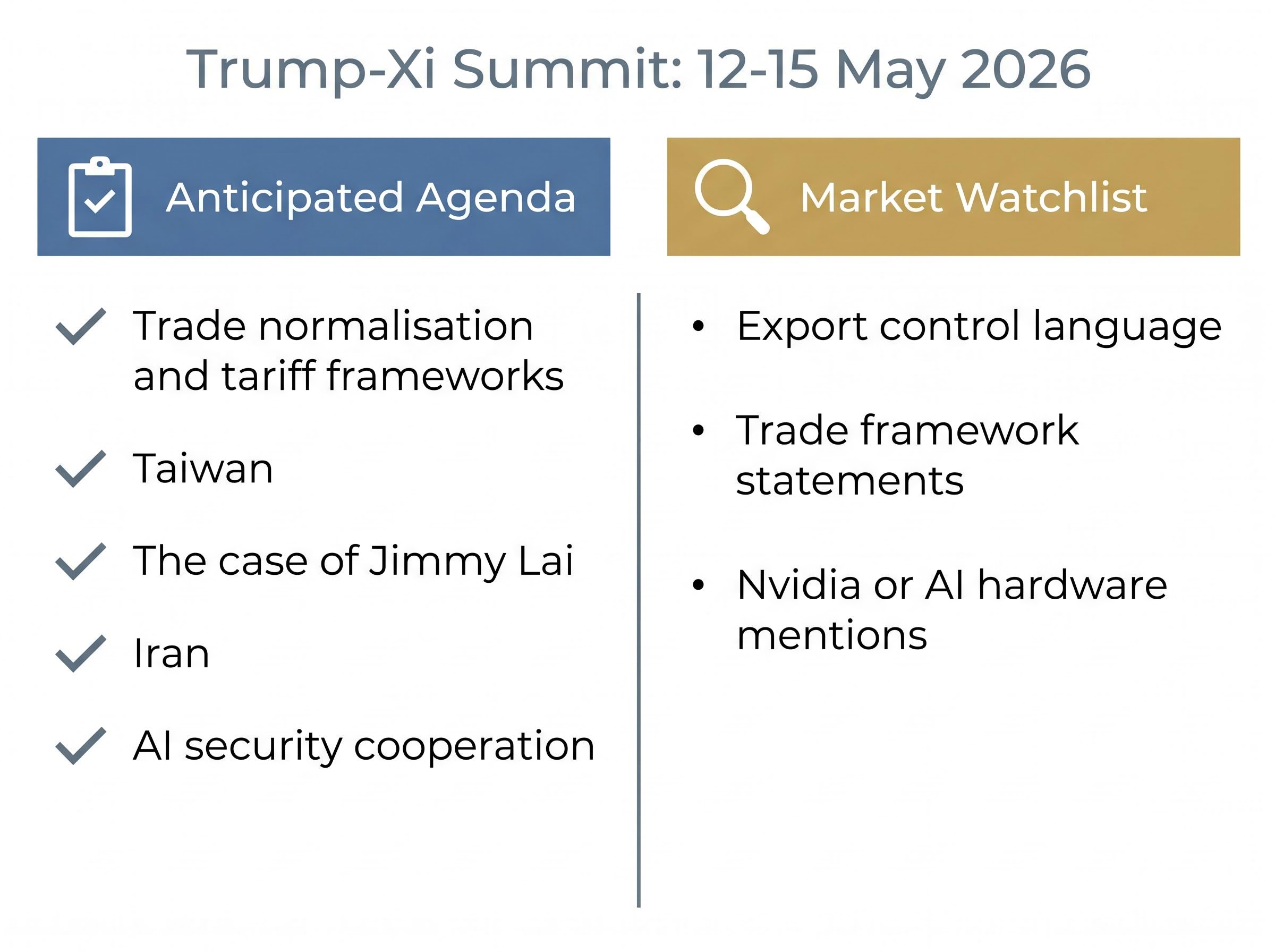
The Trump-Xi summit, spanning 12-15 May 2026, marks the first face-to-face meeting between the two leaders in over six months. Pre-summit coverage has identified several anticipated agenda items:
- Trade normalisation and tariff frameworks
- Taiwan
- The case of Jimmy Lai
- Iran
- AI security cooperation
Jonas Goltermann, Chief Markets Economist at Capital Economics, framed trade as the more probable centrepiece of the summit agenda. He noted uncertainty over whether Xi could or would assist the United States on Iran, positioning it as a secondary and less predictable topic.
U.S. executive tariff authority is simultaneously more constrained and more legally contested than it was six months ago: two federal courts struck down the broadest statutory pillars of the administration’s unilateral tariff toolkit within three months of each other, shifting trade policy risk from a binary executive shock model toward a slower, more priceable legislative process.
All gains on 13 May occurred before any confirmed summit statement or outcome had been released.
What analysts expect on AI security
Ed Yardeni, writing in his daily blog, expressed direct scepticism that AI security talks would produce fully cooperative or transparent exchanges. Both nations benefit abstractly from AI safety frameworks, but neither side is expected to concede competitive advantage in a domain where technological leadership carries strategic consequences.
Goltermann’s framing reinforced this reading: the summit’s primary commercial value sits in trade normalisation, not technology security agreements. The gap between what markets are pricing (positive summit momentum across AI names) and what analysts expect (limited AI security concessions) is precisely where investment risk concentrates in the days ahead.
The 11-year high is real. What happens when the summit ends will tell us if it holds.
The market data is confirmed and cross-referenced. The Shanghai Composite reached an 11-year high, and the CSI 300’s 1% advance suggests genuine institutional participation rather than thin-volume speculation.
No confirmed summit outcomes had emerged as of early UTC hours on 13 May. Every point of gain on the day was priced into anticipation, not results.
A pre-event rally that prices in positive outcomes creates the conditions for a sharp reversal if summit results disappoint. Three things to watch before the summit ends:
The asymmetric risk profile for chip stocks heading into the summit is worth mapping precisely: Bloomberg Intelligence puts a 70% probability on partial de-escalation unlocking $20 billion or more in Nvidia and TSMC China revenue, but the downside scenario, carrying a 25% probability, projects a 10-20% decline in the SOXX and SMH if talks harden.
- Export control language: Any reference to AI hardware, semiconductor restrictions, or technology trade in summit communiques.
- Trade framework statements: Whether a joint statement formalises tariff or trade normalisation steps.
- Nvidia or AI hardware mentions: Any bilateral commercial reference to specific companies or product categories in official readouts.
Investor anxiety over the Iran conflict eased on 13 May as market attention shifted to the summit, according to Investing.com reporting. Whether that calm holds depends entirely on what emerges from Beijing over the next 48 hours.
This article is for informational purposes only and should not be considered financial advice. Investors should conduct their own research and consult with financial professionals before making investment decisions. Market gains referenced in this article occurred before any confirmed summit outcomes, and forward-looking expectations are subject to change based on developments from the 12-15 May summit sessions.