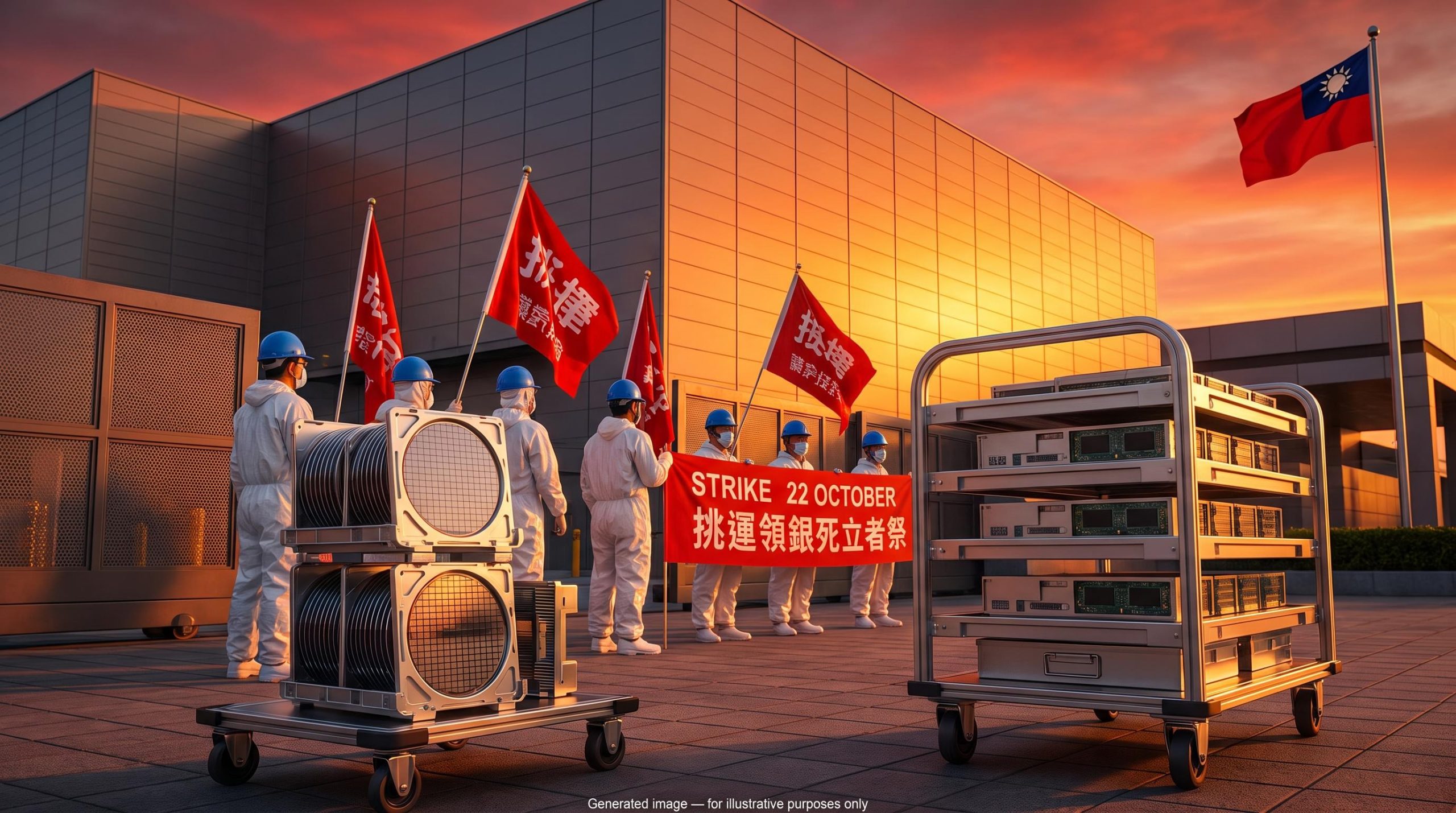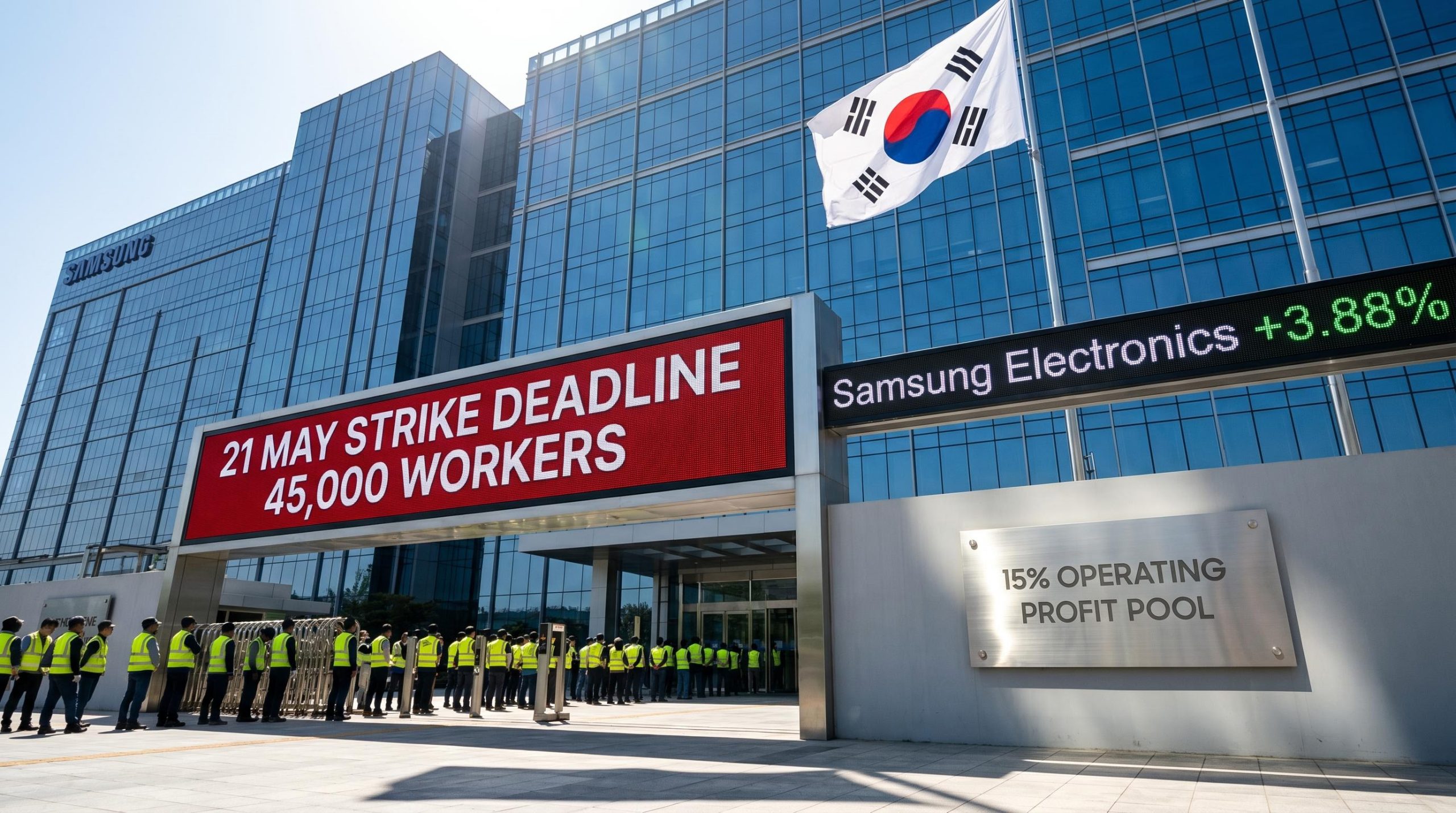
More than 45,000 Samsung semiconductor workers are hours from walking off the job, and South Korea’s government is treating the threat as a national emergency. Prime Minister Kim Min-seok warned over the weekend that the planned strike would inflict “unprecedented economic harm” on the country, while a court moved to impose daily fines on the union for non-compliance with no-strike orders. Fresh negotiations resumed on 18 May 2026 with a government mediator present, but no agreement has been reached. The 21 May strike deadline remains live, the outcome is unresolved, and the world’s AI hardware supply chain is watching. What follows covers what triggered this dispute, why the South Korean state intervened so forcefully, what the union’s AI profit-sharing demand reveals about a new structural tension in the chip industry, and what China’s simultaneous economic miss adds to the risk picture.
Government steps in as Samsung strike deadline looms
The sequence of government escalation tells the story before the numbers do. Over a compressed 48-hour window, South Korea deployed nearly every tool available to prevent a shutdown at its most strategically valuable company.
- President Lee Jae Myung posted a public statement on social media affirming both labour and management rights, framing the dispute as one the state had a direct interest in resolving.
- Prime Minister Kim Min-seok followed with a weekend address warning of “unprecedented economic harm” and confirming that all options for averting the strike were being pursued.
- A court issued a no-strike order backed by fines of 100 million won per day (approximately $66,500) against the union for non-compliance.
- Government-mediated negotiations resumed on 18 May, described in multiple reports as “last chance” talks.
Prime Minister Kim Min-seok warned the planned Samsung semiconductor strike would inflict “unprecedented economic harm” on South Korea, reflecting the government’s view that a stoppage at the country’s largest employer constitutes a macro-level event.
Samsung Electronics shares gained approximately 3.88% on 18 May 2026, suggesting the market is already pricing the probability that state intervention succeeds. The planned strike window runs from 21 May to 7 June 2026, a span of 18 days involving more than 45,000 workers at Samsung semiconductor facilities. That combination of scale and duration would make it one of the most significant labour actions in the global chip industry in recent years.
When big ASX news breaks, our subscribers know first
What workers are actually demanding, and why AI profits are at the centre of it
The political urgency becomes clearer once the specific union demands are examined. These are not requests for a modest pay rise. They are structured, formula-based claims on AI-era value creation:
- Abolishing the 50% bonus cap currently applied to worker compensation, removing the ceiling that limits how much employees can earn through performance-linked pay.
- Allocating 15% of annual operating profit to a shared bonus pool, explicitly tied to earnings from memory and AI chip operations.
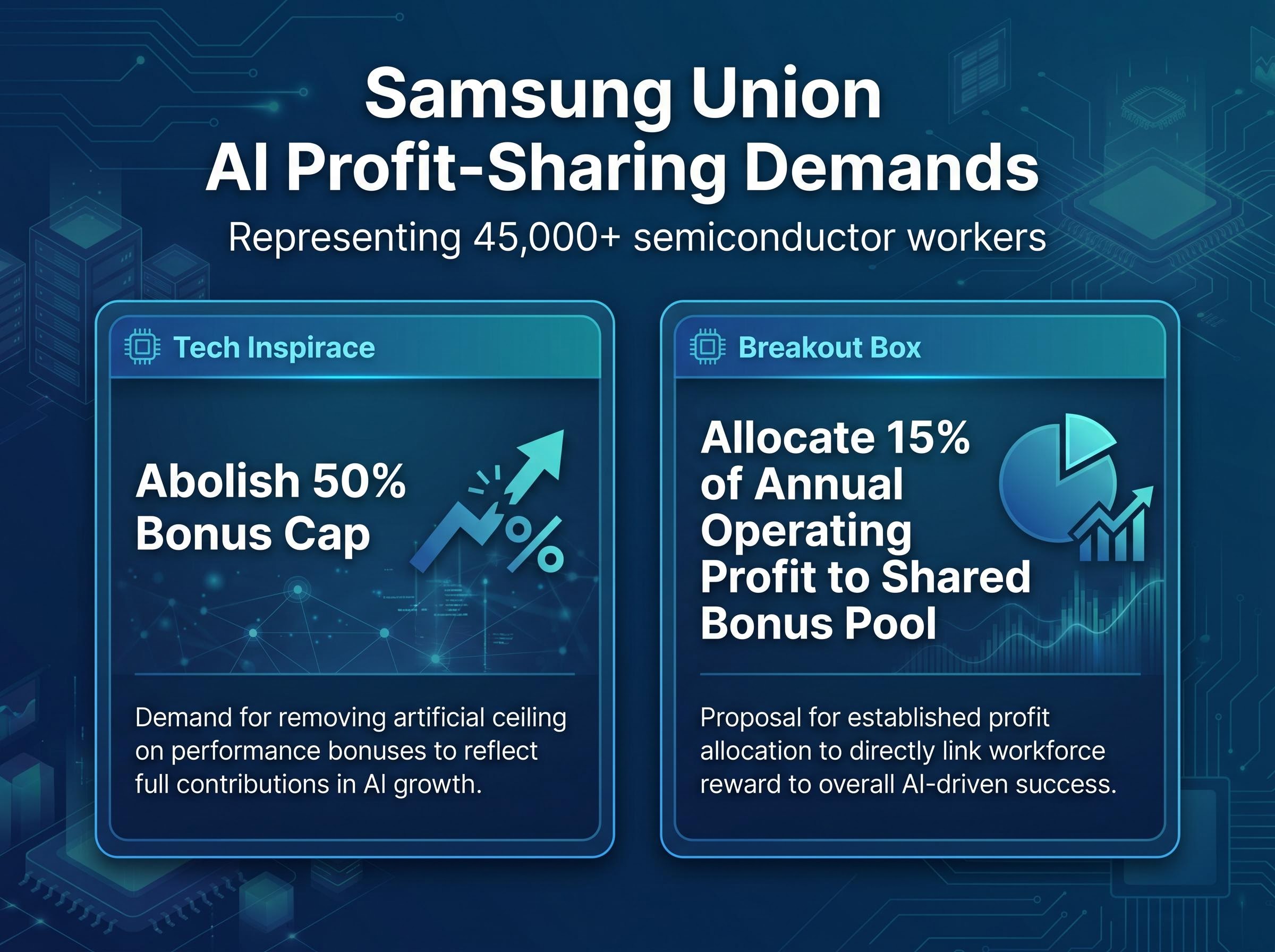
The distinction matters. A flat wage increase would be absorbed into Samsung’s cost base and forgotten within a reporting cycle. A 15% operating profit pool is a permanent structural claim on the company’s most profitable growth engine.
Why a profit-sharing formula, not a flat pay rise
Samsung semiconductor employees are seeking formal contractual recognition that their labour directly enables the AI-driven margin expansion now flowing through the company’s earnings. By linking the bonus pool to operating profit rather than revenue or headcount, the union has designed a demand that scales with Samsung’s AI success, not one that can be inflated away or capped by management discretion.
Samsung is South Korea’s largest employer and most valuable listed company. The demands reflect a calculation that the workers who build AI memory chips should participate in the financial upside those chips generate.
Samsung’s HBM market position sits at below 30% compared to SK Hynix’s approximately 62% share, a gap that makes the company’s ability to close the yield deficit on advanced memory nodes as strategically significant as any near-term labour resolution.
AI hardware supply chains and the chokepoint problem
Samsung’s position in the global semiconductor supply chain elevates this from a corporate labour dispute to a systemic concern. The company is a dominant supplier of DRAM and NAND flash memory, components that flow into AI servers, smartphones, data centre infrastructure, and consumer electronics. When a single firm sits at that intersection, a production interruption does not stay contained.
TrendForce memory market share data from Q4 2025 placed Samsung at 36% of global DRAM supply and 28% of global NAND, figures that quantify exactly why a production stoppage at a single company carries systemic implications for AI server procurement timelines worldwide.
The current assessment from analysts treats the strike threat as a supply-chain risk and sentiment overhang rather than a confirmed disruption. No agreement or breakdown has been confirmed as of 18 May, and no downstream customer impacts on AI hardware buyers such as Nvidia, Apple, or hyperscale data centre operators have been publicly quantified.
HBM supply constraints at SK Hynix and Micron are already sold out through 2026-2027, meaning any reduction in Samsung DRAM output would land in a market with no slack capacity to absorb it, a dynamic that helps explain why the strike threat has amplified memory sector pricing beyond Samsung’s own share price.
Analysts have framed the Samsung labour dispute as a “supply-chain risk and sentiment overhang” rather than a confirmed disruption to global chip flows, reflecting the unresolved nature of the talks as of 18 May 2026.
Nvidia shares were down 4.42% on 18 May, trading at $225.32, with the company’s earnings expected later in the week. That concurrent event adds a second AI hardware sentiment signal for investors already watching the Samsung situation.
| Company | Role in AI supply chain | Known labour dispute status (18 May 2026) | Primary investor risk flag |
|---|---|---|---|
| Samsung | DRAM, NAND flash memory for AI servers and consumer devices | Active: 45,000+ workers, strike deadline 21 May | Production interruption, AI supply disruption |
| TSMC | Advanced logic chip fabrication for Nvidia, Apple, AMD | No verified AI profit-sharing dispute | Precedent contagion from Samsung case |
| SK Hynix | HBM and DRAM memory for AI accelerators | No verified AI profit-sharing dispute | Precedent contagion from Samsung case |
How South Korea handles strategic industry disputes (and why this case is different)
The speed and scale of government intervention may look unusual from outside South Korea. Within the country’s governance architecture, it is predictable.
Samsung operates within the chaebol model, a structure in which a small number of conglomerate groups account for an outsized share of national economic output, employment, and export revenue. When a chaebol’s flagship operation faces disruption, the South Korean state treats it as a macroeconomic event, not a private sector dispute.
Key features of this governance framework include:
- Chaebol dependency: Samsung alone employs more people and generates more export revenue than most mid-sized national economies, giving the government a direct fiscal interest in continuity of operations.
- Court intervention powers: South Korean labour law permits courts to issue no-strike orders and impose financial penalties (in this case, 100 million won per day) in industries deemed strategically significant.
- Prime ministerial mediation: Direct involvement by the prime minister’s office in labour negotiations is an established tool, not an emergency measure.
What chaebol governance means for strike risk pricing
The 3.88% share price gain on 18 May reflects something specific: investors familiar with South Korean governance treat mediation as a stabilising signal. The resolution pathway is well-defined even when the outcome remains uncertain. For investors evaluating South Korean technology exposure, the governance architecture around Samsung provides a structural backstop that reduces (but does not eliminate) tail risk from labour disruptions.
South Korean political signals have demonstrated remarkable capacity to move global chip valuations: on 12 May 2026, a single Facebook post from a presidential aide about an unconfirmed AI tax proposal erased more than $300 billion in market value intraday before three government bodies issued coordinated denials within hours.
China’s April data adds a second pressure point for chip demand
China’s April 2026 economic data, released 18 May 2026 by the National Bureau of Statistics, arrived well below expectations, adding a demand-side headwind to the supply-side labour risk already facing Samsung.
| Indicator | April 2026 (actual) | Forecast | March 2026 |
|---|---|---|---|
| Industrial output (YoY) | 4.1% | 6.0% | 5.7% |
| Retail sales (YoY) | 0.2% | 2.0% | 1.7% |
The retail sales miss is the more direct channel to Samsung’s earnings. Weak consumer spending in China translates into softer demand for smartphones, PCs, and consumer devices, all of which consume Samsung memory chips. ING analysts described domestic demand indicators as remaining “notably subdued.”
ING analysts noted that China’s domestic demand indicators remained “notably subdued” in April 2026, reinforcing concerns about near-term consumer electronics demand.
The resulting picture for Samsung is mixed rather than uniformly negative. AI server chip demand holds firm, but consumer-facing semiconductor demand softens. Investors evaluating Samsung or broader Asia-Pacific semiconductor exposure need to hold both signals simultaneously; conflating the two in either direction produces a mispriced view.
What the next 72 hours mean for Samsung investors and the AI supply chain
The decision window is narrow. Three specific developments will determine whether this remains a sentiment overhang or escalates into a production disruption:
- Mediation outcome before 21 May: Whether the government-brokered talks produce a deal or collapse ahead of the strike start date.
- Court order enforcement: Any change in the court’s no-strike order or the union’s compliance posture.
- Nvidia earnings release: Due later in the week of 18 May, providing a concurrent AI hardware demand signal that will interact with Samsung sentiment.
The binary near-term scenario is straightforward. Mediation succeeds before 21 May and the strike is averted, or talks collapse and more than 45,000 workers walk out for up to 18 days through 7 June 2026. The 3.88% share price gain on 18 May reflects the market’s current lean toward the first scenario.
The structural tension that survives any deal
Even a successful mediation will likely leave the core dispute unresolved. The specific demands, a 15% operating profit pool and removal of the 50% bonus cap, represent a new baseline expectation from semiconductor labour. Whether Samsung concedes, compromises, or defers, the claim has been publicly established.
A dispute that will outlast its deadline
The South Korean government’s intervention has been market-positive in the short term. It has not answered the underlying question: whether AI-driven semiconductor profits will be formally shared with labour through contractual mechanisms.
No comparable AI profit-sharing labour disputes have been confirmed at TSMC, SK Hynix, Intel, or Micron. The Samsung case is the first major confirmed instance in the semiconductor labour market, and the 15% profit pool demand creates a visible benchmark that unions elsewhere will reference.
For investors, the broader context compounds the uncertainty. Rising bond yields, elevated oil prices, and Iran conflict uncertainty frame an environment where a semiconductor labour disruption does not arrive in isolation. The Samsung dispute is not a story that ends on 21 May. It is the opening chapter of a recurring tension that will shape semiconductor sector labour costs and governance premiums through the AI hardware cycle.
Semiconductor export controls on advanced AI chips to China are grounded in national-security law with bipartisan Congressional backing, placing them outside the jurisdiction of trade negotiators and creating a structural constraint on chip demand that operates independently of any labour dispute resolution.
This article is for informational purposes only and should not be considered financial advice. Investors should conduct their own research and consult with financial professionals before making investment decisions. These statements regarding potential supply chain impacts and market outcomes are speculative and subject to change based on market developments and company performance.