A single Facebook post from a South Korean presidential aide erased more than $300 billion in market value on 12 May 2026. Kim Yong-beom, Senior Secretary at South Korea’s Presidential Office, floated the idea of taxing excessive AI company profits to fund a citizen dividend for workers displaced by automation. The post landed during thin pre-holiday liquidity ahead of Buddha’s Birthday on 13 May, amplifying an already sharp algorithmic response. Within hours, the Kospi had shed as much as 5.1% at its intraday low, dragging chipmakers in Seoul and New York down with it. What follows is a breakdown of what was said, how every major semiconductor name moved, what officials said to contain the damage, and what the episode signals for investors monitoring AI-sector regulatory risk globally.
What Kim Yong-beom actually said, and what he meant
The original post, published to Facebook on 12 May 2026, proposed a citizen dividend funded by taxing “excessive AI company profits” to support workers facing displacement from automation. Markets read the proposal as a direct windfall tax on corporate earnings.
The clarification told a different story. Kim issued a follow-up on the same platform, reframing his intent:
“This is a personal idea for discussion, not official policy. The government has no plans to introduce such a tax imminently.”
The distinction between the two versions is where the confusion, and the market damage, originated:
- Original framing: A new tax on AI company profits, directed at redistributing corporate earnings to displaced workers.
- Clarified framing: A proposal to channel surplus government tax receipts, generated by AI sector growth, toward a citizen dividend, with no new direct levy on companies.
The Presidential Office confirmed via Yonhap News that Kim’s remarks were “exploratory and do not reflect current policy deliberations.” By then, the Kospi had already absorbed the initial reading.
When big ASX news breaks, our subscribers know first
The swift market impact: $300 billion evaporated
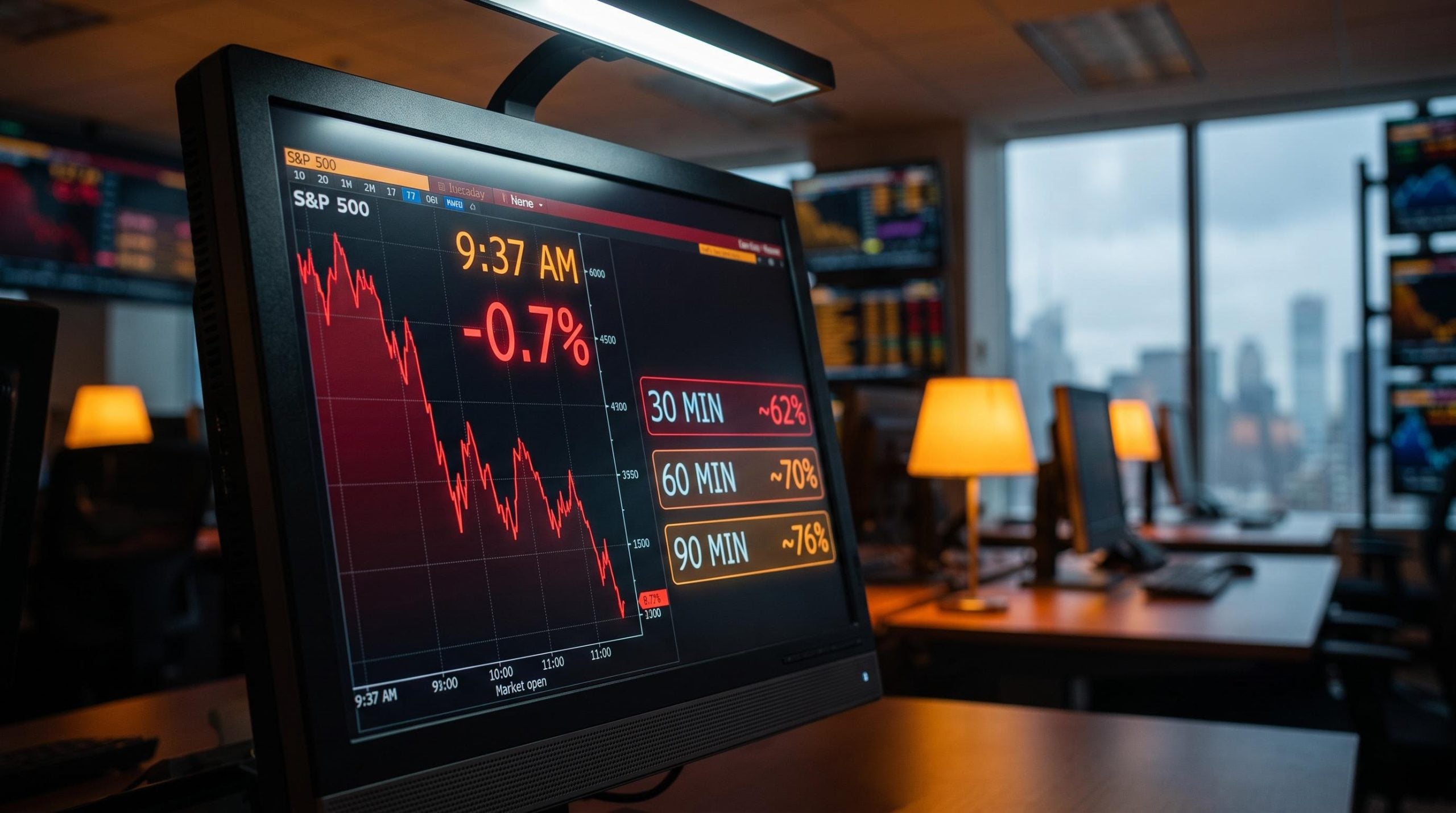
The Kospi dropped as much as 5.1% at its intraday low before recovering to close down approximately 2.3%, with the index touching approximately 7,643 during the worst of the selling. Thin liquidity ahead of the Buddha’s Birthday holiday on 13 May KST contributed to the amplification of intraday moves, as algorithmic responses cascaded through order books with fewer counterparties to absorb them.
The concentration of institutional capital into AI hardware stocks had already reached a historic inflection point in the days before 12 May, with foreign investors directing a record approximately $2.88 billion into Korean equities in a single session and Samsung crossing $1 trillion in market capitalisation on 6 May 2026.
South Korean names led the decline
Samsung Electronics (005930.KS) fell approximately 4% during the session, trading in the range of 278,500-285,500 KRW. SK Hynix (000660.KS) also declined approximately 4% from a prior close level of approximately 1,590,000 KRW.
US-listed semiconductors followed within hours
The contagion crossed the Pacific before any official clarification had landed. Micron Technology (NASDAQ: MU) fell approximately 2.3%, SanDisk (NASDAQ: SNDK) dropped approximately 3.3%, Advanced Micro Devices (NASDAQ: AMD) declined approximately 2%, and Nvidia (NASDAQ: NVDA) slipped approximately 0.75%.
| Stock / Index | Exchange | Approximate Decline | Sector |
|---|---|---|---|
| Kospi | KRX | -2.3% (close); -5.1% intraday low | Broad Index |
| Samsung Electronics | KRX | ~4% | Semiconductors |
| SK Hynix | KRX | ~4% | Semiconductors / Memory |
| Micron Technology | NASDAQ | ~2.3% | Semiconductors / Memory |
| SanDisk | NASDAQ | ~3.3% | Semiconductors / Storage |
| Nvidia | NASDAQ | ~0.75% | AI / Semiconductors |
| AMD | NASDAQ | ~2% | AI / Semiconductors |
The total market value erased across these names and the broader index exceeded $300 billion intraday. The breadth of declines across Seoul and New York confirmed this was not a Korea-specific event: any stock with meaningful AI or memory chip exposure was treated as a potential target of regulatory profit-sharing risk, regardless of domicile.
Understanding AI and chip stock valuation sensitivity
AI and semiconductor stocks trade at elevated price-to-earnings multiples built on expectations of sustained, largely uninterrupted profit growth from AI infrastructure demand. The pricing assumes that the margin trajectory stays intact. Any mechanism that could compress future margins, whether a direct tax, a levy, or a mandatory profit-sharing arrangement, introduces a discount rate effect that hits high-multiple names disproportionately hard.
The distinction between types of policy intervention matters here, and conflating them has been a persistent source of investor confusion in the AI policy debate:
- A regulatory framework (such as the EU AI Act, amended on 7 May 2026 to delay high-risk AI provisions to late 2027) governs how AI systems are built, deployed, and monitored. It imposes compliance costs but does not directly tax profits.
- A profit-sharing tax or levy would directly reduce after-tax earnings, compressing the profit growth trajectory that justifies current multiples.
The EU AI Act regulatory framework, which entered into force on 1 August 2024, draws a clear boundary between compliance obligations and fiscal measures, imposing implementation costs on developers and deployers without directly taxing corporate profits or earnings.
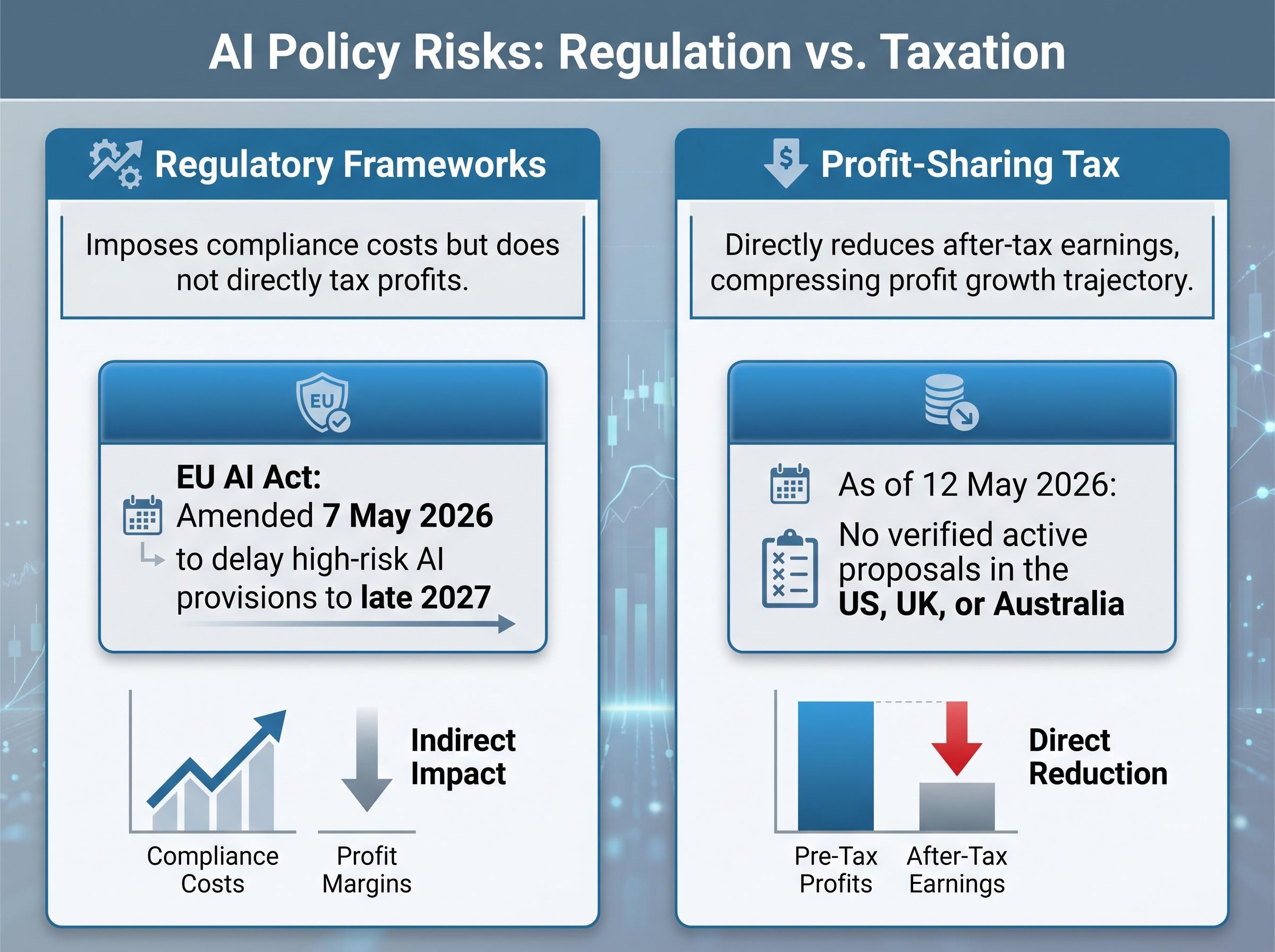
As of 12 May 2026, no verified, named AI-specific tax proposals are active in the US, UK, or Australia. The policy environment consists of regulatory frameworks and political discussion, not enacted fiscal legislation targeting AI profits.
Morgan Stanley’s commentary on the episode framed the selloff as an illustration of a regulatory risk premium building into AI valuations, noting that even speculative proposals now carry measurable pricing power in a sector trading at these multiples.
This is the structural reason markets treated a personal Facebook post as a price-relevant event. When valuations are built on near-perfection, even hypothetical threats to margin trajectory demand immediate repricing.
AI valuation frameworks that apply Minsky’s financing stages and the Shiller CAPE ratio provide a structural lens for understanding why speculative tax proposals carry such immediate pricing power: when the sector trades at a Shiller CAPE of 40.11 and major infrastructure investors are already classified in the speculative financing stage, any credible threat to margin trajectory compresses multiples faster than in a normally-valued market.
Official damage control and what governments actually said
Three separate government bodies issued aligned clarifications within the same trading session:
- Presidential Office (via Yonhap News): Confirmed Kim’s remarks were exploratory personal views, not current policy deliberations.
- Ministry of Economy and Finance (MoEF): Stated no AI-specific tax proposals are under consideration in the 2026 budget framework, with fiscal policy remaining focused on growth incentives for AI and semiconductors.
- Ministry of Trade, Industry and Energy: Echoed continued support for South Korea’s AI hardware sector.
“No AI-specific tax proposals are under consideration in the 2026 budget framework. Fiscal policy remains focused on growth incentives for AI and semiconductors.” — Ministry of Economy and Finance
The speed and alignment of those responses is itself notable. Multiple government bodies coordinating within a single session to distance themselves from a senior aide’s personal post signals that policymakers understood, in real time, the sensitivity of AI-sector valuations to tax rhetoric.
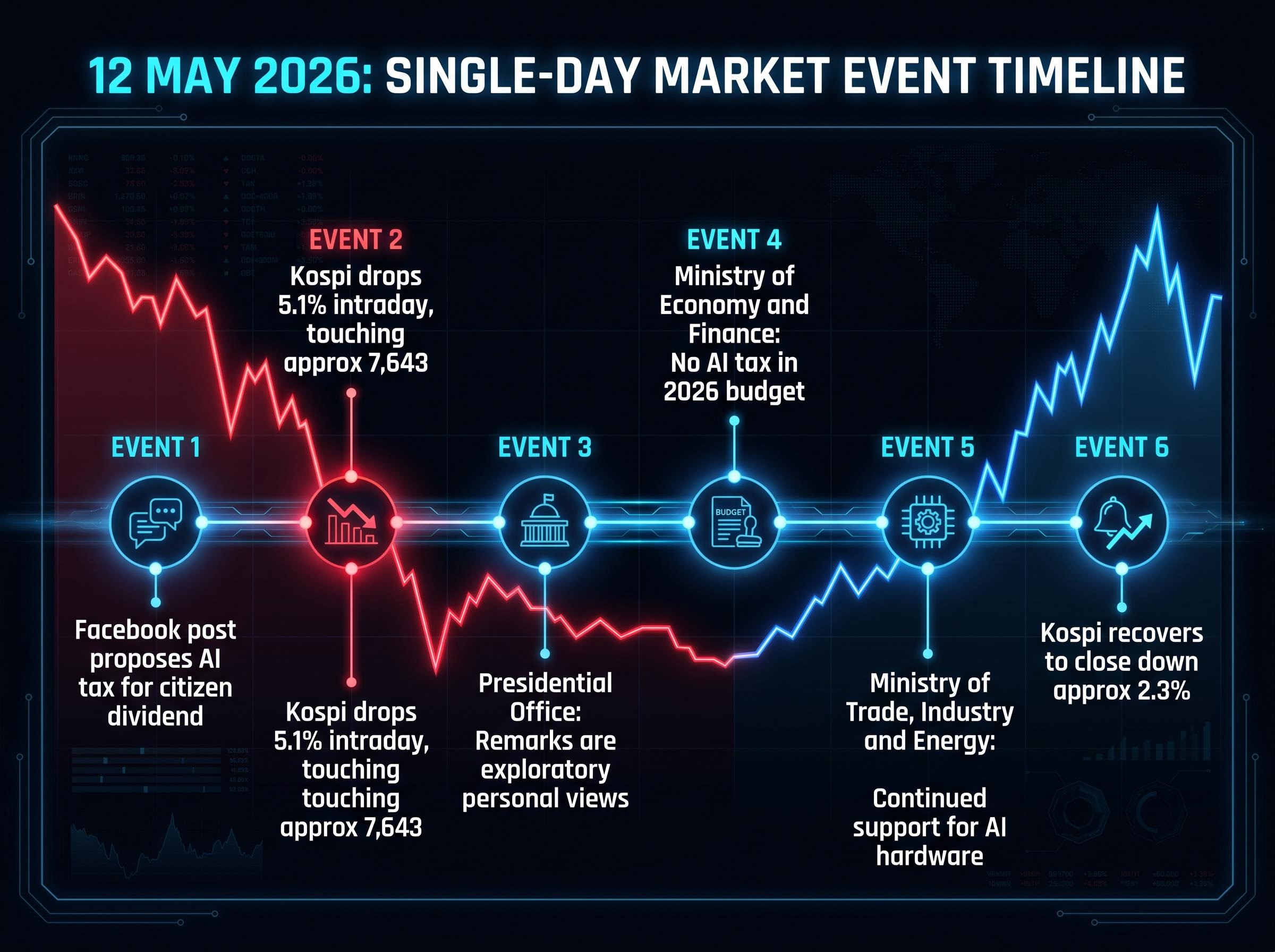
The clarifications contributed to the Kospi’s partial recovery from the -5.1% intraday low to a close of approximately -2.3%. The gap between market open, the initial selloff, and the arrival of official clarification is where the bulk of the intraday damage was done.
What analysts made of the selloff, and what it signals going forward
The dominant analyst verdict landed quickly: overreaction, amplified by thin liquidity, with no fundamental policy shift to justify the scale of the move.
- Goldman Sachs: Characterised the semiconductor dip as noise, maintaining that Samsung and SK Hynix HBM dominance remains intact. Goldman noted “tax rhetoric unlikely to materialise pre-elections.”
- Morgan Stanley: Maintained Overweight on both SK Hynix and Samsung with no rating changes, while framing the episode as illustrative of emerging AI regulatory risk in valuation models.
- Nomura: Characterised the selloff as a potential entry point, citing Samsung and SK Hynix positioning in Nvidia’s supply chain.
- Deutsche Bank analyst Peter Sidorov described the Kospi drop as one of the more notable overnight market movements, citing the citizen dividend concept as the driver of wider technology sector sentiment drag.
The regulatory risk premium that Morgan Stanley flagged is not isolated to Korean policy: Paul Tudor Jones estimated in early May 2026 that the AI bull market has one to two years of runway, framing the current period as a risk horizon rather than an immediate exit signal, but noting that hyperscaler capex growth dropping below 25% year on year is the single most important signal to monitor.
Retail investor sentiment
Retail forums leaned heavily toward treating the dip as a buying opportunity. Approximately 70% of sentiment on Reddit (r/stocks, r/wallstreetbets) favoured buying the dip, while approximately 65% of Seeking Alpha commentary characterised the move as an overreaction.
The minority view deserves attention. Some analysts flagged that this episode marks the first visible instance of a regulatory risk premium being applied to AI stocks in real time. The sensitivity investors showed on 12 May is unlikely to disappear even if this specific proposal never advances. The question for investors with semiconductor exposure is not whether Kim’s idea becomes law; it is whether markets will price a permanent regulatory risk premium into these names regardless.
One social media post, $300 billion gone: what this episode changes
The speed and scale of the selloff in response to a non-policy personal post confirms that AI and semiconductor valuations are priced with little buffer for regulatory uncertainty. More than $300 billion in market value evaporated intraday on the back of a proposal that three government bodies disavowed within hours.
Deutsche Bank’s Peter Sidorov described the Kospi drop as one of the more notable overnight market movements, with the citizen dividend concept driving wider technology sector sentiment drag.
The conditions that made 12 May possible are not receding. The EU AI Act’s scope expanded as recently as 7 May 2026, and political discussions about AI productivity taxation continue across multiple jurisdictions. No verified AI tax proposals are active in the US, UK, or Australia, but the absence of current legislation does not eliminate future legislative risk.
Investors wanting to see how AI regulatory and disruption risk is distributed across markets beyond Korea will find our full explainer on HSBC’s global AI disruption mapping, which scores nearly 2,000 business categories across Europe, Asia, and emerging markets and identifies which national indices carry the greatest downside exposure under both moderate and severe disruption scenarios.
PwC’s 2025 global tax policy outlook documents how governments across multiple jurisdictions are actively reframing tax policy as an instrument of industrial strategy in response to AI sector growth, a trend that gives political credibility to proposals like Kim’s even when they lack immediate legislative backing.
For investors holding AI or semiconductor positions, the episode carries a durable implication: monitoring policy signals from non-traditional sources, including social media, think tanks, and individual officials, has become a necessary part of managing sector risk alongside traditional regulatory and earnings tracking.
This article is for informational purposes only and should not be considered financial advice. Investors should conduct their own research and consult with financial professionals before making investment decisions. Forward-looking statements regarding policy developments and market conditions are speculative and subject to change based on political, regulatory, and economic factors.