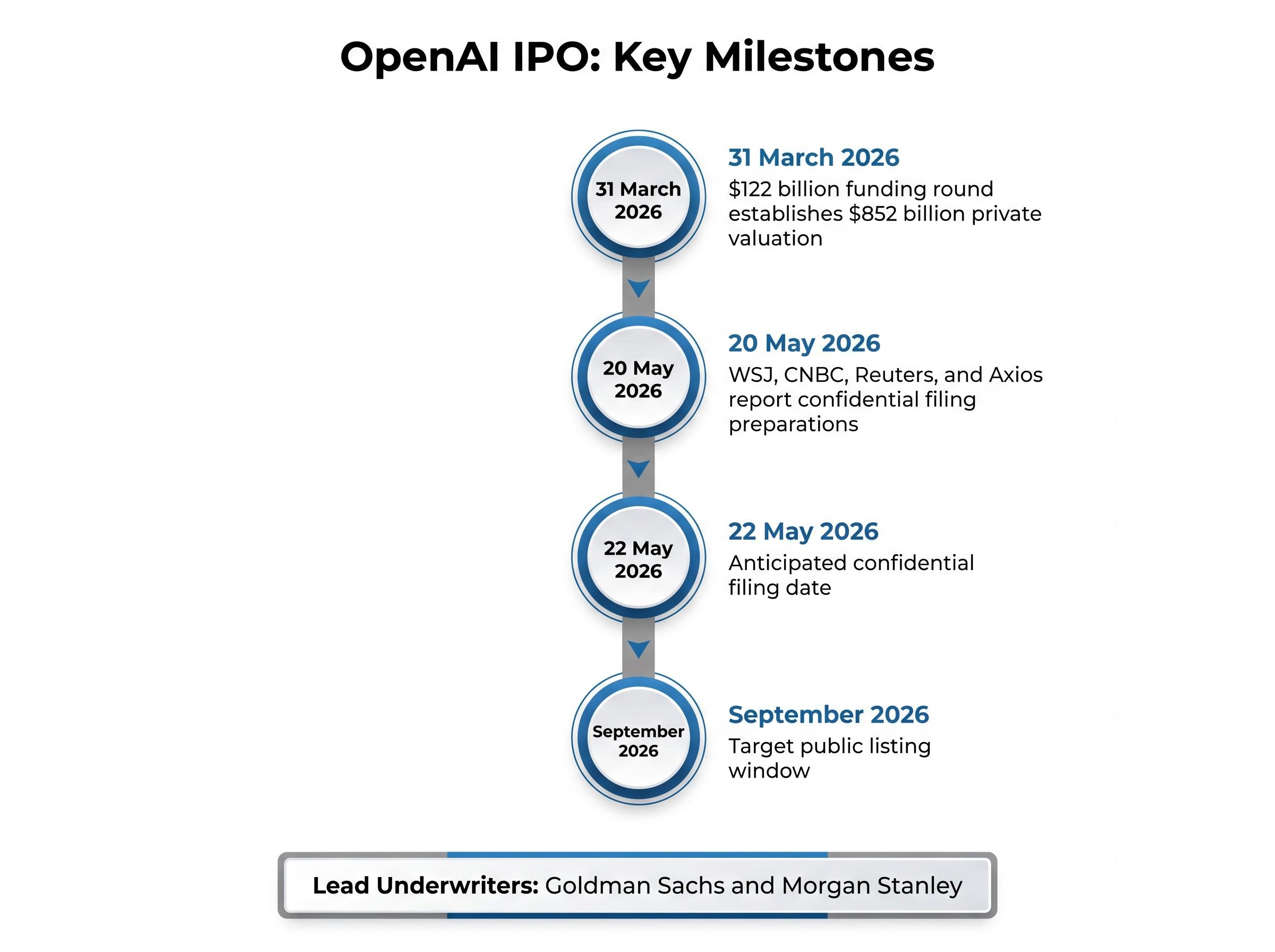
OpenAI, the company behind ChatGPT, is preparing to confidentially file a draft IPO prospectus as soon as 22 May 2026, according to reporting from the Wall Street Journal, CNBC, Reuters, and Axios. The private valuation attached to the filing: $852 billion, a figure that would place the company among the largest public market debuts in history if it lists anywhere near that number.
The filing arrives during an extraordinary week for U.S. capital markets. SpaceX submitted its own S-1 registration statement on 20 May 2026, targeting $80 billion or more in proceeds on Nasdaq. Goldman Sachs and Morgan Stanley are named as OpenAI’s lead underwriters. A public listing could come as early as September 2026, though that timeline remains fluid. What follows is a breakdown of what the confidential filing actually means, how OpenAI’s valuation compares to history, what risks investors should weigh, and how ordinary shareholders can realistically access shares when trading begins.
OpenAI just filed a confidential IPO prospectus. Here is what that actually means.
A confidential IPO filing is not a secret. Under the Jumpstart Our Business Startups (JOBS) Act, large private companies preparing for public markets can submit a draft S-1 prospectus to the Securities and Exchange Commission (SEC) for review without making the document publicly available. The SEC examines the filing, provides feedback, and the company revises the draft, sometimes through multiple rounds, before a public version is eventually released. The process is standard for firms of this scale.
Reading an S-1 prospectus critically means separating the company’s own narrative from the audited financial disclosures, risk factor language, and use-of-proceeds sections that carry legal weight; the same discipline applies to OpenAI’s eventual public filing as it does to any other registration statement.
The SEC confidential IPO filing process, established under the JOBS Act, allows companies meeting certain criteria to submit draft registration statements for regulatory review before any public disclosure is required, giving companies and their underwriters time to address SEC feedback across multiple revision rounds without market-moving exposure.
The Wall Street Journal, CNBC, Reuters, and Axios each reported on 20 May 2026 that OpenAI was preparing the confidential submission, working with bankers on the draft prospectus.
The confirmed details at this stage are narrow but specific:
- Anticipated filing date: On or around 22 May 2026
- Target public listing window: As early as September 2026 (described as fluid)
- Lead underwriters: Goldman Sachs and Morgan Stanley
No exchange has been confirmed. No public prospectus exists yet. The September target is a starting point for planning purposes, not a guarantee that shares will be available for purchase by that date.
When big ASX news breaks, our subscribers know first
At $852 billion, how does OpenAI’s valuation compare to the biggest IPOs ever?
The scale of OpenAI’s private valuation becomes clearer against the short list of companies that have listed at comparable figures.
Saudi Aramco set the benchmark in December 2019, listing at a valuation of approximately $1.7 trillion and raising roughly $25.6 billion in proceeds, the largest IPO in history by both measures. Alibaba’s 2014 debut on the New York Stock Exchange valued the company at approximately $168 billion, with proceeds of roughly $25 billion.
OpenAI’s $852 billion private valuation, established in the 31 March 2026 funding round that raised $122 billion, places it closer to Aramco’s territory than to any prior U.S. technology listing. SpaceX’s concurrent filing adds another data point to the same extraordinary week.
| Company | IPO Year | Valuation at Listing | Proceeds Raised |
|---|---|---|---|
| Saudi Aramco | 2019 | ~$1.7 trillion | ~$25.6 billion |
| Alibaba | 2014 | ~$168 billion | ~$25 billion |
| SpaceX (pending) | 2026 | TBD | Targeting $80 billion+ |
| OpenAI (private valuation) | 2026 (target) | $852 billion (private) | IPO price TBD |
Private valuations and public listing prices often diverge. No public IPO pricing has been set for OpenAI, and the eventual offer price may differ materially from the $852 billion figure established in private funding rounds.
IPO valuation methodology at this scale involves multiples that price in decades of anticipated growth, and analysts covering the SpaceX deal have flagged approximately 30% overvaluation risk at the $2 trillion target, a caution that applies equally to any mega-listing where private funding round prices are treated as the anchor.
What is OpenAI, and why is an $852 billion valuation even plausible?
OpenAI is the developer of ChatGPT, the generative AI chatbot that reached mass consumer adoption faster than any software product in history. The company operates a commercial API (application programming interface, a tool that lets other software connect to OpenAI’s models), an enterprise product suite, and a consumer subscription service. Its position at the centre of the generative AI industry, combined with revenue growth fuelled by enterprise contracts and consumer subscriptions, underpins the valuation.
Microsoft is OpenAI’s primary cloud infrastructure partner and a strategic investor, providing the Azure computing power that trains and runs the company’s models. The relationship is both an asset and a dependency, one the eventual public prospectus will need to address in detail.
The governance structure public investors need to understand
OpenAI’s corporate structure is unlike any company that has approached the public markets at this scale. The organisation operates as a Public Benefit Corporation (PBC) controlled by a nonprofit board. The nonprofit retains oversight authority and an equity stake exceeding $100 billion.
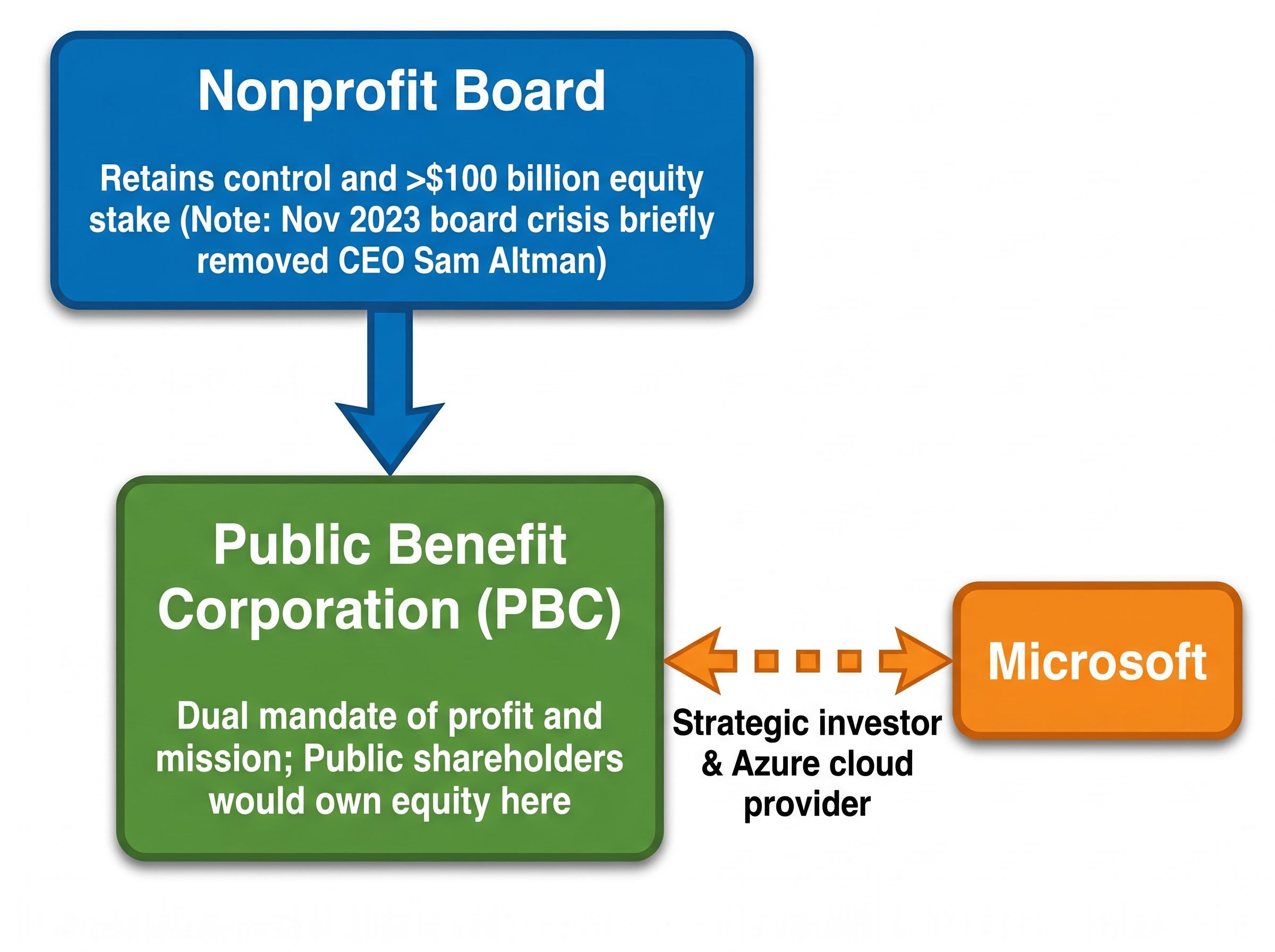
- Nonprofit board control: The nonprofit retains governance authority over the PBC, meaning public shareholders would not hold traditional governance control
- Public Benefit Corporation equity: Investors in the IPO would own equity in the PBC, which operates under a dual mandate of profit and mission
- Microsoft strategic relationship: Microsoft’s role as both cloud provider and investor creates a layered commercial and financial relationship
The November 2023 boardroom crisis, during which CEO Sam Altman was briefly removed and then reinstated, remains a reference point for the governance questions that will follow prospective public market investors into any listing. The mission-versus-profit tension embedded in the PBC structure differs meaningfully from a standard C-corporation IPO.
Five risk factors every investor should read before the public prospectus drops
No public risk section exists yet. The filing remains confidential, and the eventual public prospectus will contain the authoritative disclosure. The following five themes are drawn from consistent coverage across U.S. financial and technology press and represent the questions investors should expect that document to address.
No public risk prospectus has been released. All current risk discussion is derived from press coverage and industry analysis, not from OpenAI’s own disclosures.
- Compute cost structure and unproven profitability. Training and operating frontier AI models is extremely capital-intensive. OpenAI’s cost base is heavily driven by GPU infrastructure and cloud usage via Microsoft Azure, and long-term profitability at scale remains unproven.
- Competitive pressure. Anthropic, Google (Gemini), Meta (open-source large language models), and a growing field of foundation-model startups are each investing billions to challenge OpenAI’s position. The risk of model commoditisation is real.
- Governance and corporate structure. The nonprofit-controlled PBC structure means public shareholders would not hold traditional governance control. The November 2023 board crisis illustrates the type of governance event this structure can produce.
- Microsoft dependency and potential conflicts of interest. OpenAI’s reliance on Microsoft for cloud infrastructure, combined with Microsoft’s role as a strategic investor, creates dependency and potential conflict-of-interest dynamics.
- Regulatory and geopolitical exposure. Regulatory uncertainty across U.S. and EU AI governance frameworks, data privacy requirements, and geopolitical tensions affecting chip supply chains remain unresolved.
Each of these should be treated as an open question, not a conclusion. The public prospectus is the document that will provide OpenAI’s own framing, and investors should read it critically when it arrives.
How retail investors can actually access OpenAI shares before and after the IPO
The allocation structure of a mega-IPO of this scale is straightforward in its implications for individual investors: the vast majority of shares at the offer price go to institutional buyers. Mutual funds, hedge funds, pension funds, and large private clients of the underwriting banks receive the bulk of the allocation. Retail access at the IPO price is limited.
The three realistic pathways for individual investors, ordered from least accessible to most accessible:
- Direct brokerage IPO allocation. Some full-service brokerages and select large online brokers receive IPO share allocations and offer them to qualifying clients. Eligibility criteria vary and often favour high-balance accounts.
- Open market purchase after listing. Once trading begins on the public exchange, shares become available to any investor through a standard brokerage account. The open market price may differ significantly from the IPO offer price.
AI IPO debut dynamics in the current market cycle have been volatile in both directions: Cerebras priced at $185 on 14 May 2026, surged 68% on the first day to imply a $95 billion market capitalisation, and carried a 186x trailing sales multiple, illustrating how aggressively institutional demand can reprice AI-adjacent listings even when concentration and profitability risks are clearly disclosed.
- Indirect exposure through ETFs or mutual funds. Funds that track broad market or technology indices will likely purchase OpenAI shares at or after the listing, providing indirect exposure without requiring direct IPO participation.
A standard 180-day lock-up period typically applies to founders, insiders, and early investors in U.S. IPOs, restricting share sales during that window. This affects post-listing supply dynamics and, by extension, price. All OpenAI-specific allocation terms, lock-up schedules, and participation structures remain undisclosed. No reporting indicates OpenAI is pursuing a direct listing or SPAC route; all coverage points to a traditional underwritten IPO.
The IPO that will define the AI era has not even launched yet
The confidential filing places OpenAI on a formal path to public markets. The September 2026 target listing window is the next milestone to watch, and the dual filing week, with SpaceX’s S-1 submitted on 20 May 2026 targeting a Nasdaq listing as early as mid-June, marks a moment without precedent in recent U.S. capital markets history.
Stretched tech sector valuations entering this dual-filing week already showed institutional concern: sell-side consensus forecasts for technology growth had climbed above independent industry estimates, and at least one major asset manager had moved underweight the sector before either IPO was formally announced.
The public prospectus, once released, is the document that will answer the valuation, governance, and risk questions that remain unanswerable today. Investors should monitor SEC EDGAR for the eventual public S-1 filing as the primary source of authoritative information.
At $852 billion in private valuation, OpenAI’s listing would approach the scale of Saudi Aramco’s 2019 debut, the largest IPO in history. Whether the public market agrees with that valuation is the question the coming months will answer.
This article is for informational purposes only and should not be considered financial advice. Investors should conduct their own research and consult with financial professionals before making investment decisions. Past performance does not guarantee future results. Financial projections are subject to market conditions and various risk factors.