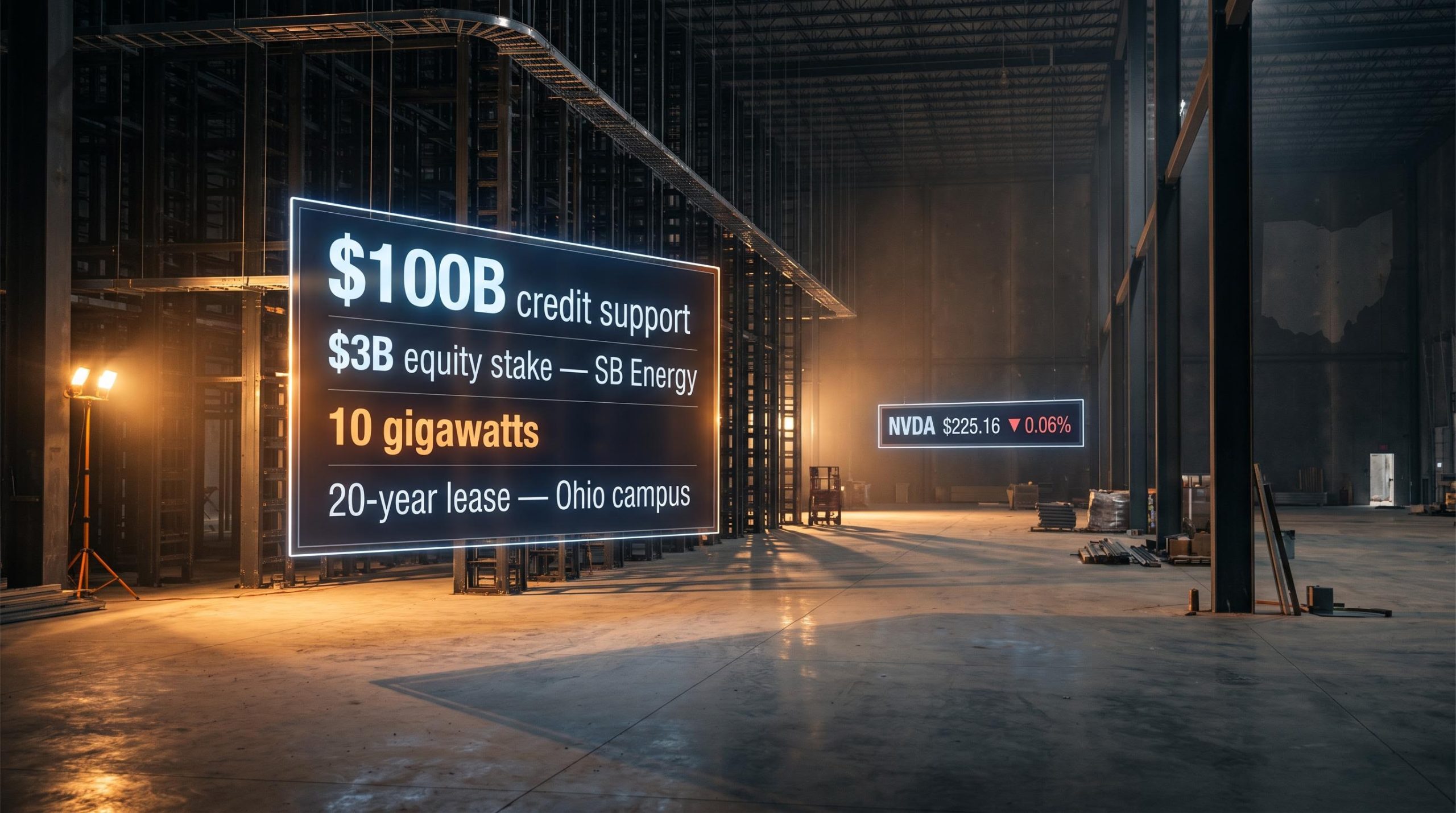
Nvidia is reportedly in talks to do something chipmakers do not normally do: take a billion-dollar equity stake in an energy company and backstop a $100 billion lease for AI computing space it does not own.
The report, published 15 August 2026 by The Information, describes early-stage negotiations between Nvidia and SoftBank’s SB Energy subsidiary, tied to a planned 10-gigawatt AI data centre campus on former U.S. Department of Energy (DOE) land in southern Ohio. Reuters published its own account of the story on the same date, noting that the details from The Information had not been independently confirmed by the wire service. Neither Nvidia nor SoftBank has commented. The deal is unconfirmed, and the financial figures in circulation conflict with each other.
What follows is a clear separation of what is corroborated from what is contested, and what either version of the deal would mean for Nvidia as a company and as an investment. This story is both significant and incomplete, and understanding both dimensions matters before drawing any conclusions.
What the August 15 report actually says
The Information’s 15 August 2026 report makes three specific claims about Nvidia’s involvement in the Ohio AI campus project:
- A potential equity stake of up to $3 billion in SB Energy, SoftBank’s energy and data centre development subsidiary
- Approximately $100 billion in credit support to enable OpenAI to lease the Ohio campus, with subsequent indications placing the figure below $120 billion
- The equity stake is being negotiated as one component of a broader commercial arrangement between Nvidia and OpenAI
Reuters published its own coverage the same day, citing The Information’s sources.
Reuters was unable to independently confirm the reported deal when it published its coverage. Neither Nvidia nor SoftBank responded with comment.
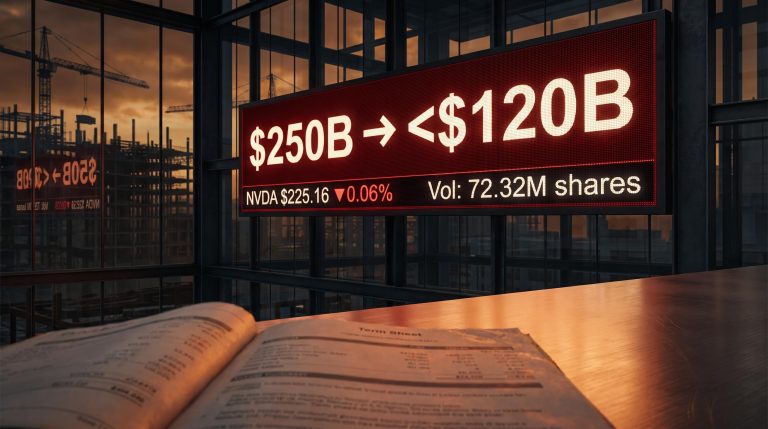
No term sheet, regulatory filing, or joint announcement exists as of today. That verification gap is not a footnote. It is a central fact that shapes how you should weight every figure in this story. The claims are significant enough to warrant close attention, but they remain unconfirmed, single-source reporting. At the time of the report, Nvidia shares were changing hands at $225.16, a fall of around 0.06% on the session, a muted move that suggests the market has not treated the reported deal as a confirmed event.
When big ASX news breaks, our subscribers know first
The Ohio campus at the centre of this deal
The August report did not arrive in a vacuum. The Ohio project has been developing since at least June 2026, when The Information first reported that OpenAI was in advanced talks to lease capacity at a massive AI data centre campus being built by SB Energy.
| Specification | Detail |
|---|---|
| Planned capacity | 10 gigawatts |
| Location | Pike County, southern Ohio (former Portsmouth Gaseous Diffusion Plant, DOE site) |
| Developer | SB Energy (SoftBank subsidiary) |
| Primary tenant | OpenAI |
| Lease term | Approximately 20 years |
| Estimated total cost | Approximately $500 billion+ over time (unconfirmed) |
OpenAI’s lease and the DOE connection
OpenAI is in talks to sign an approximately 20-year lease for capacity at the campus, with a phased build-out beginning in the late 2020s. The initial phase targets several hundred megawatts before scaling toward the full 10-gigawatt target.
The DOE land component matters. This is former uranium enrichment infrastructure being repurposed under a public-private structure in which the federal government leases land to SoftBank/SB Energy. For U.S. readers, that puts federal government infrastructure at the foundation of what is being positioned as a private AI buildout. A $3 billion equity stake in the developer of a campus of this scope looks different once the project’s physical and contractual scale is visible.
The DOE fact sheet on the Portsmouth site redevelopment confirms that the federal government leased former uranium enrichment land in Pike County to an SB Energy-affiliated entity, establishing the public-private foundation that underpins the entire campus financing structure.
Why the credit support figures conflict, and what that means
Two credible outlets have published materially different figures for the same component of the same deal, and the gap between them is too large to ignore.
| Source | Date | Reported figure | Status |
|---|---|---|---|
| Wall Street Journal | Late July 2026 | Approximately $250 billion | Unconfirmed |
| The Information | 15 August 2026 | Approximately $100 billion (below $120 billion) | Unconfirmed |
There are three plausible explanations for the discrepancy. The reports may reflect different stages of a negotiation that has evolved between late July and mid-August. They may be measuring different things: lease guarantees versus broader project-level financial support. Or the deal terms may simply have shifted.
The honest editorial position is that no confirmed figure exists from any party. What the article can say is that the range itself carries meaning.
The guarantee reduction reported on 14 August 2026, which brought the figure from approximately $250 billion to below $120 billion, was met with a near-flat NVDA close of negative 0.06%, a market signal that separates the balance-sheet backstop question from the underlying hardware demand story.
If the lower figure is correct, Nvidia’s guarantee structure is large but structurally manageable relative to its balance sheet. If the higher figure is correct, the scale is without modern precedent in technology company financing.
For anyone tracking Nvidia’s balance sheet exposure, the difference between $100 billion and $250 billion is not a rounding error. It is the difference between a calculated risk and a commitment that could reshape the company’s financial profile. Until the parties confirm a number, every figure in circulation is a negotiating data point, not a binding commitment.
Nvidia’s balance sheet, which supported an $80 billion buyback authorisation and a 25-fold dividend increase announced in Q1 FY2027, is the financial foundation against which any multi-hundred-billion-dollar guarantee commitment must be evaluated; its cash generation profile and capital return capacity provide context for how much incremental exposure the company can absorb.
What it means when a chipmaker becomes an infrastructure bank
The most striking element of the reporting is not the dollar figure. It is the role Nvidia is reportedly taking on.
Across every version of this story, from June through August 2026, Nvidia is described not merely as a GPU supplier but as a financial guarantee provider. That means Nvidia would be backstopping the lease payments that allow OpenAI to occupy the campus and SB Energy to secure project financing. A credit guarantee is a promise to cover payments if the primary party cannot. In this context, Nvidia would be telling lenders: if OpenAI cannot pay its lease, we stand behind it.
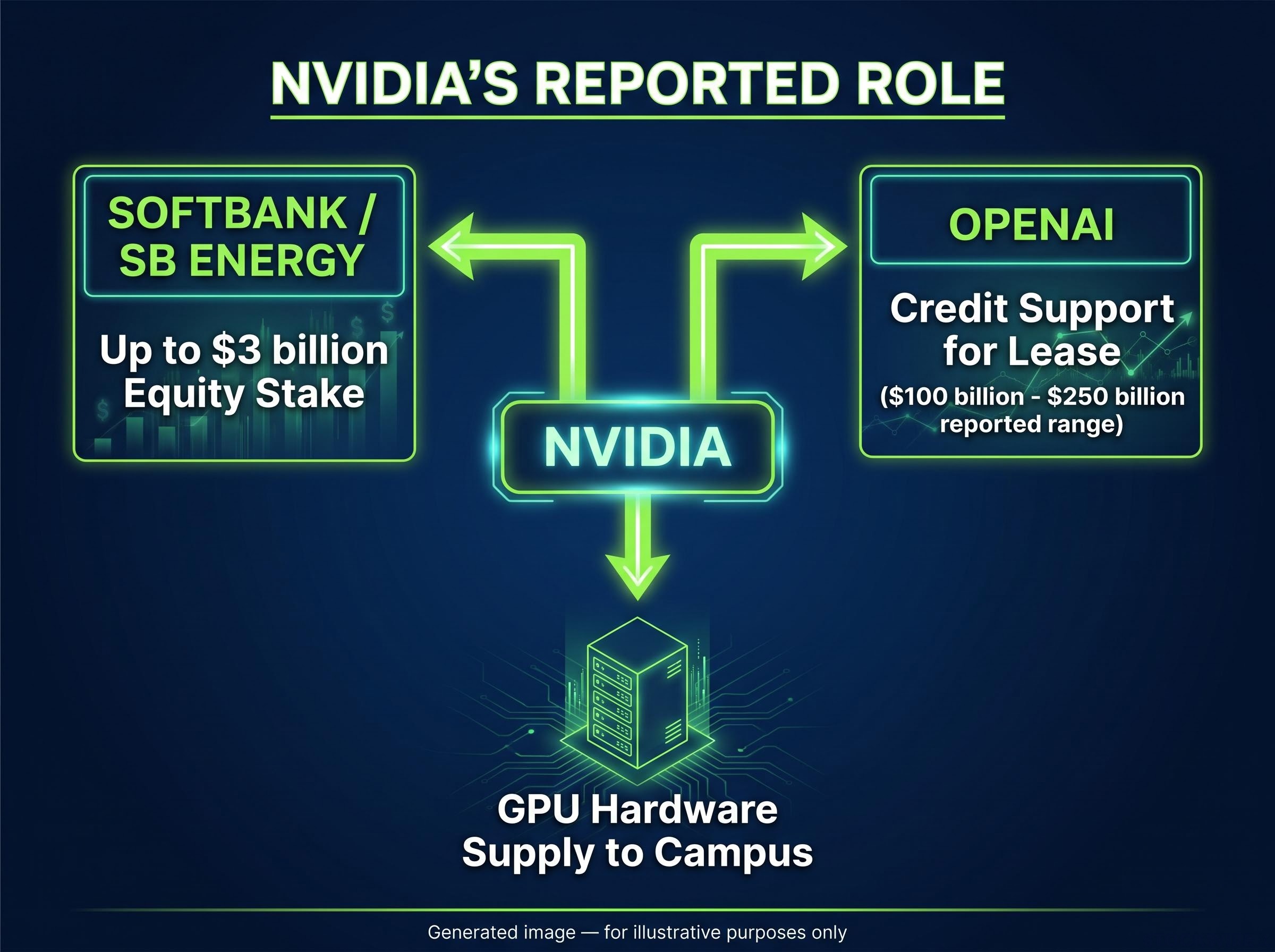
The logic is self-reinforcing. Nvidia’s credit support unlocks a campus that will consume Nvidia GPUs for approximately 20 years, creating a demand anchor that justifies the financial exposure. Nvidia’s reported role has three components:
- GPU hardware supply to the campus
- Equity stake in SB Energy (up to $3 billion)
- Credit support for OpenAI’s lease (approximately $100 billion to $250 billion range)
This is vertical integration taken to a structural extreme. Nvidia would be moving from chip manufacturer to capital partner to de facto infrastructure co-owner. Masayoshi Son, SoftBank’s founder, has stated his ambition to make SoftBank a core enabler of AI infrastructure globally. Nvidia’s willingness to embed its balance sheet alongside that ambition signals that the company sees its future not just in selling chips, but in financing the environments those chips operate within.
The risks Nvidia takes on if the deal closes
The strategic benefits come with genuine trade-offs. Three categories of new risk would land on Nvidia’s balance sheet if the deal closes as reported.
First, credit and project risk. Nvidia would be exposed to construction timelines, energy permitting, and the financial health of a single mega-tenant. If the campus is delayed or OpenAI’s financial position changes, Nvidia’s guarantees could be called.
Second, concentration risk. A significant portion of Nvidia’s guarantee book would be tied to one physical site and one customer relationship, a level of concentration unusual for a semiconductor company.
Third, balance sheet treatment. Whether these guarantees sit on or off balance sheet determines how rating agencies and investors calculate Nvidia’s leverage. On-balance-sheet guarantees compress financial flexibility. Off-balance-sheet treatment carries its own disclosure and governance scrutiny.
Balance sheet treatment of contingent guarantees is where the disagreement between bulls and bears becomes most consequential; BofA’s modelling suggests the $250 billion figure carries less near-term risk than the headline implies if standard project-finance mechanics apply, but those structural details remain unconfirmed by Nvidia.
SoftBank, OpenAI, and the dependency each side is accepting
Each principal in this arrangement is accepting concentrated dependency on the others. That is both the deal’s strategic strength and its structural vulnerability.
- SoftBank/SB Energy: Gains a major U.S. chipmaker as equity partner and credit backer, significantly de-risking financing for a highly capital-intensive project and validating SB Energy’s positioning as a global AI infrastructure developer
- OpenAI: Secures a 20-year lease for dedicated compute at a flagship campus with long-term cost visibility, but concentrates operational and financial dependence on Nvidia, SoftBank/SB Energy, and the DOE simultaneously
- DOE: Provides the land, introducing federal regulatory dependencies that none of the private parties fully control
OpenAI’s long-term compute strategy would be tied to the success of a single physical site and a small set of partners, a concentration that investors in any of these entities should be stress-testing.
If any one of the three principals encounters financial, regulatory, or operational difficulty, the others’ positions are materially affected. A DOE policy change, a shift in OpenAI’s financial trajectory, or a reassessment of Nvidia’s guarantee capacity would ripple across the entire structure. That counterparty risk is the price of a 20-year commitment built on a three-party foundation.
What needs to happen before this deal is real
The story is compelling. It is not confirmed. Here are the specific events that would change that:
- Official equity stake disclosure: A joint announcement or regulatory filing from Nvidia or SoftBank confirming whether an equity stake in SB Energy is being taken, at what valuation, and under what terms
- Credit support structure and final figure: Confirmation of the amount, tenor, recourse terms, and balance sheet treatment of any Nvidia guarantees
- DOE and regulatory approvals: Formal approvals for land use at the Portsmouth/Piketon site, clarity on the energy mix powering the 10-gigawatt campus, and any environmental or infrastructure permits required
Phased build-out timing also matters. The initial phase targets several hundred megawatts, with the full 10-gigawatt capacity as the long-term target. The timing of each phase determines when any Nvidia guarantees convert from contingent exposure to actual financial obligation. No comment has been issued by Nvidia, SoftBank, or OpenAI as of 15 August 2026.
Until at least one of these confirmation events occurs, every figure in this story remains a negotiating data point rather than a committed obligation. Calibrate accordingly.
What the deal signals regardless of the final numbers
Strip the specific dollar figures away and the directional signal remains. Nvidia is positioning itself as a capital partner in AI infrastructure, not merely a chip vendor. That shift holds whether the credit support figure settles at $100 billion, $250 billion, or somewhere else entirely.
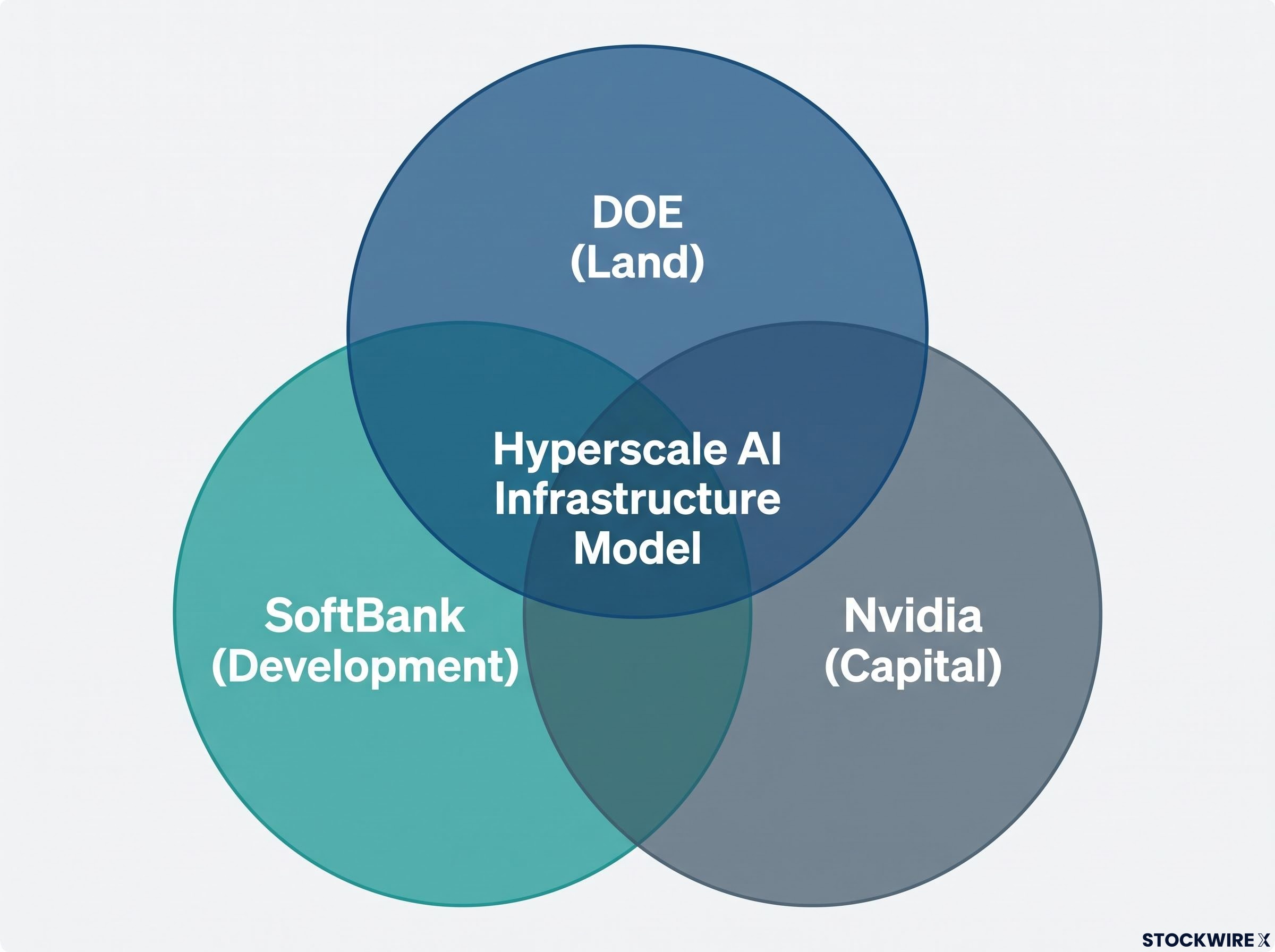
The Ohio campus is a test case for a new model: whether hyperscale AI infrastructure can be built through a public-private-corporate triad (DOE land, SoftBank development, Nvidia capital) rather than through traditional hyperscaler balance sheets alone. The consistent corroboration of Nvidia’s dual role, hardware supplier plus financial guarantor, is the element of this story most likely to reflect actual negotiating reality. The DOE land component signals government involvement in AI infrastructure at a scale not previously formalised in the United States.
The most durable takeaway is not the dollar figure but the model: a chipmaker using its balance sheet to pre-finance the demand for its own products is a new playbook. If it works in Ohio, it will not stop there.
That raises an unanswered question worth watching. If Nvidia becomes deeply embedded as a capital provider in AI infrastructure, what does that mean for competitive neutrality in the AI chip market, and for companies that might prefer to buy from a supplier that is not also their landlord’s financier?
For investors wanting the macroeconomic frame behind a deal of this scale, our full explainer on AI infrastructure spending cycles covers how US IT investment has surpassed every prior technology peak, where the rewards are concentrating, and what the Stargate Project adds to the sovereign-scale AI buildout picture.
This article is for informational purposes only and should not be considered financial advice. Investors should conduct their own research and consult with financial professionals before making investment decisions. These statements are speculative and subject to change based on market developments and company performance.