By Friday 14 August 2026, the Dollar Index had fallen through the 100 mark, though no single trigger was responsible. Instead, the move reflected a month-long accumulation of underwhelming US economic readings, with a deeply pessimistic consumer sentiment print delivering the final blow to whatever case remained for the Federal Reserve to hike rates in September.
The 100 level on the DXY is not arbitrary. It functions as both a technical threshold and a psychological anchor for institutional positioning, and sustained trading below it sends a specific message: the market has stopped pricing in rate-hike urgency. The data sequence that drove the break, spanning inflation, retail sales, and now sentiment, arrived in a rhythm that made each print harder for dollar bulls to dismiss.
Here is what the dollar’s move means for rate expectations, where gold is heading next, and what Wednesday’s FOMC Minutes will either confirm or complicate.
The dollar breaks 100: what the data built over four weeks
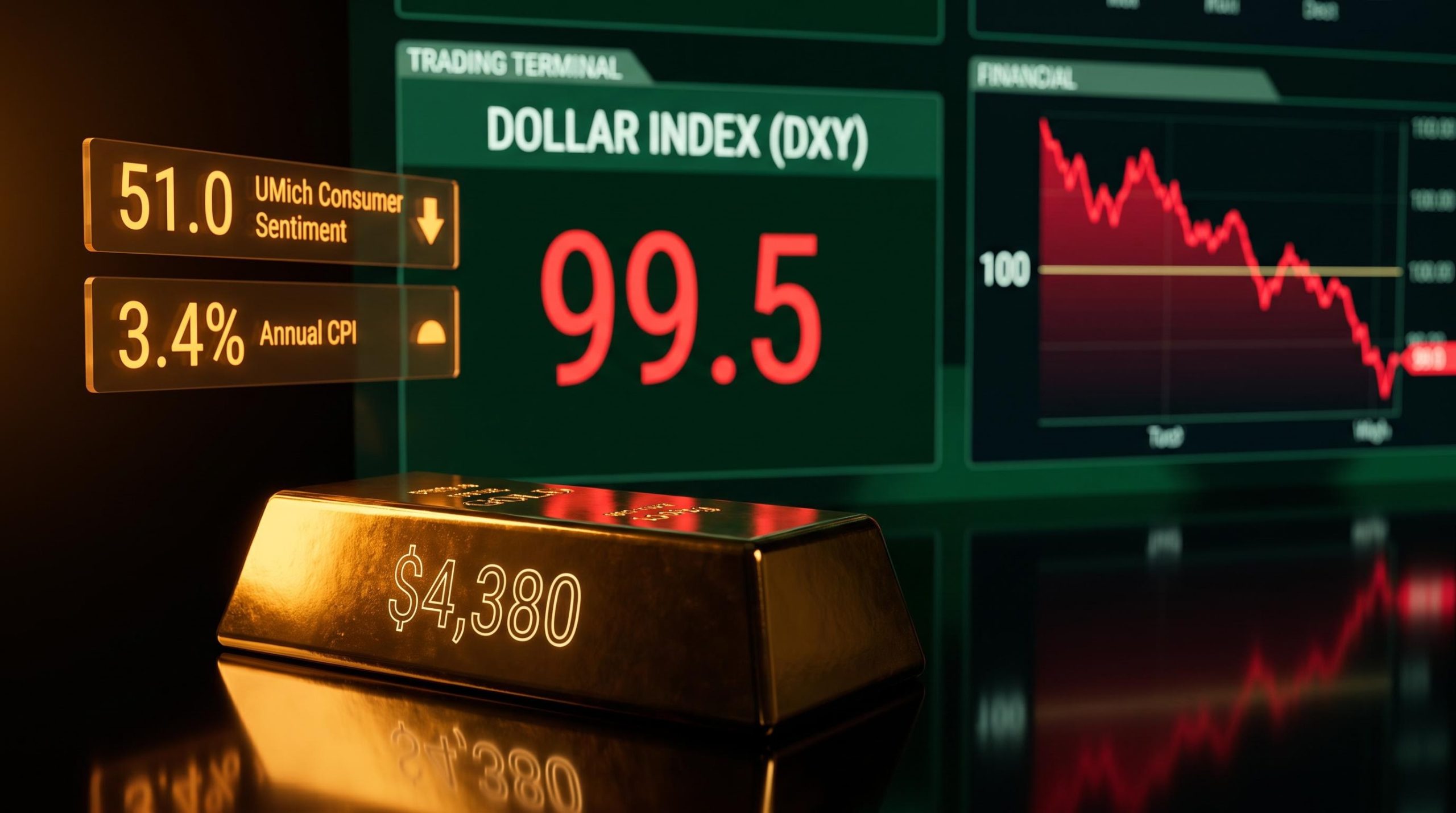
The DXY traded in a range of 99.48-99.94 on 14 August, settling near 99.5. That range sat entirely below the 100 threshold, and the break was not a momentary dip. It was the product of a four-week accumulation of softening US data that eroded the dollar’s rate-hike premium point by point.
The DXY technical structure heading into this week was already bearish, with RSI in the high-30s to low-40s and MACD below zero on the daily chart, meaning the data sequence that arrived in August found a currency index that lacked the momentum to absorb negative prints without breaking lower.
The four categories of weakness that built the pressure:
- Consumer sentiment: The University of Michigan’s preliminary August survey registered 51.0, a result that came in sharply beneath both the previous month’s figure and market expectations
- Inflation: July CPI came in contained but above target, removing the Fed’s urgency argument without giving hawks fresh ammunition
- Retail sales: July figures missed forecasts, signalling that household spending is pulling back
- Cumulative momentum: Each print compounded the last, leaving no single data point for dollar bulls to isolate and dismiss
The calendar ahead contains no significant US economic releases. That absence matters. A single-data selloff can reverse on the next strong print. A four-week pattern with no imminent catalyst to reset the narrative is structurally harder to unwind, and it means the DXY’s next directional signal will likely come from the FOMC Minutes on Wednesday rather than fresh economic data.
When big ASX news breaks, our subscribers know first
Why consumer sentiment and inflation data closed the door on September
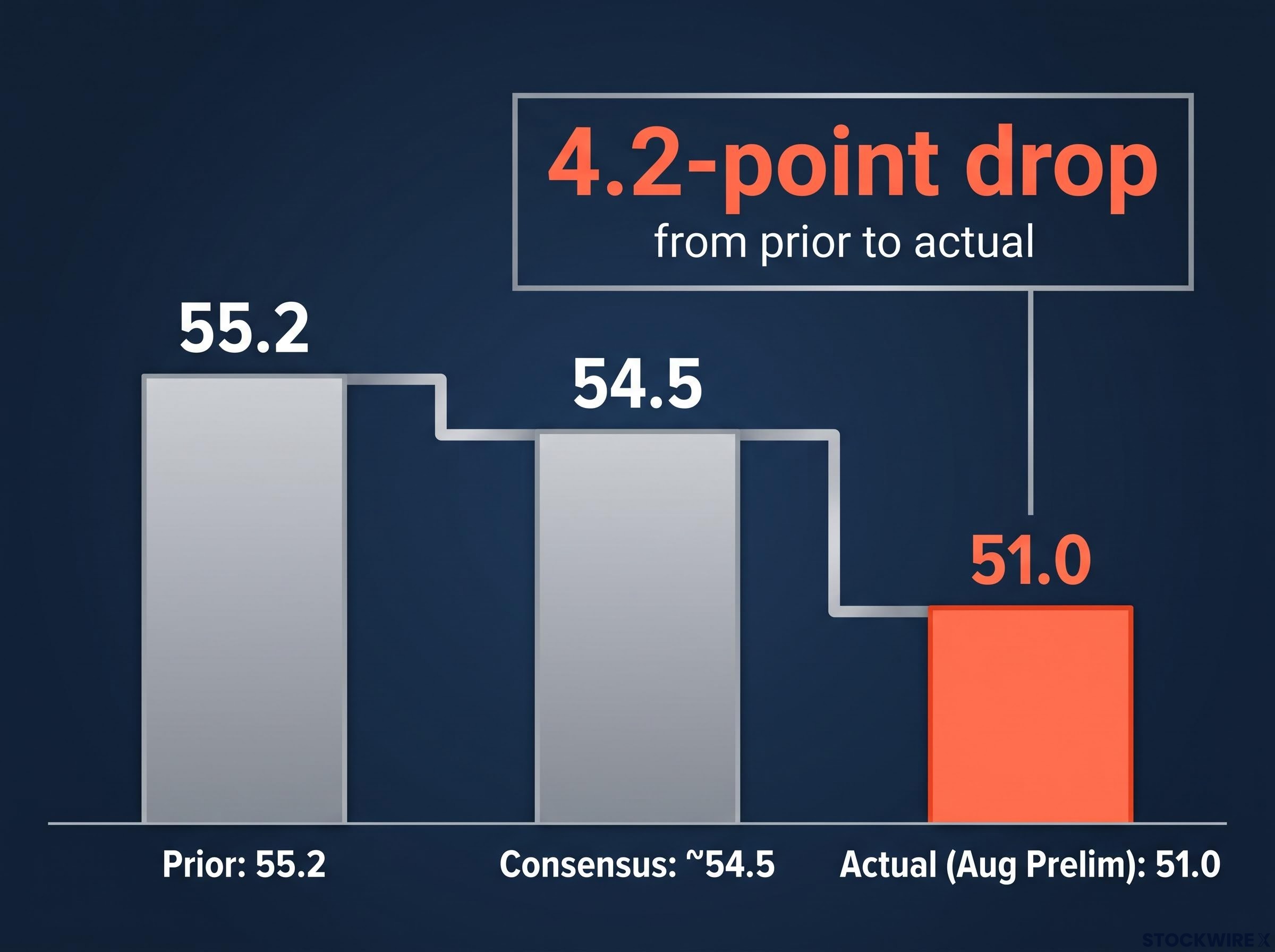
The University of Michigan Consumer Sentiment Index, a monthly survey measuring household confidence in economic conditions, dropped to 51.0 in the preliminary August reading. The prior month came in at 55.2. Consensus had expected approximately 54.5. A 4.2-point decline in a single month is the sharpest fall in recent readings, and a level of 51 tells you something beyond soft: it signals that households have become meaningfully more pessimistic about their financial outlook.
The 4.2-point drop in UMich Consumer Sentiment, from 55.2 to 51.0, represents the sharpest single-month decline in recent readings and takes the index to a level where consumer caution begins to weigh directly on spending patterns.
The inflation data, released earlier in the week, told a complementary story. July’s monthly headline CPI print registered +0.1%, while core CPI, which excludes food and energy, came in at +0.2%. On an annual basis, headline inflation stood at 3.4%, placing it above the Fed’s 2% target but showing no sign of fresh upward momentum.
The BLS Consumer Price Index data distinguishes headline CPI, which includes food and energy, from core CPI, which strips those volatile components out, a methodological separation that explains why the Fed treats the two readings differently when assessing whether inflation momentum justifies further tightening.
| Indicator | Reading | Prior | Consensus | Assessment |
|---|---|---|---|---|
| UMich Consumer Sentiment (Aug prelim) | 51.0 | 55.2 | ~54.5 | Miss |
| Headline CPI (July, monthly) | +0.1% | — | +0.1% | In-line |
| Core CPI (July, monthly) | +0.2% | — | +0.2% | In-line |
| Annual Headline CPI | 3.4% | — | — | Above target |
Connect the two and the picture sharpens. A consumer that is pulling back confidence at this rate, combined with inflation that is plateauing rather than rising, gives the Fed reason to hold rather than hike. A sentiment reading of 51 is not just a soft number; it signals that household confidence has deteriorated to a level where the Fed risks inflicting real economic damage if it hikes into weakening demand.
What the dollar’s slide tells you about where the Fed stands now
The transmission from data to dollar is not abstract. When consumer confidence deteriorates and retail spending misses, markets reduce the probability that the Fed can justify a September hike without committing a policy error, and positioning adjusts accordingly. That is precisely what happened this week: pricing for a September rate increase has been progressively unwound with each successive data disappointment.
The residual argument for hawks is core inflation. At 3.4% annually, headline inflation remains above the Fed’s 2% target, and that gives rate-hike advocates a data point to lean on. But the direction of travel in consumer confidence and retail demand has become the dominant variable in market pricing. Inflation that is elevated but stable loses its urgency when the consumer is retreating.
What matters for the dollar’s next move is not the inflation number in isolation but whether the Fed’s internal hawks can sustain their argument when consumer confidence is deteriorating this sharply. The July FOMC meeting laid bare a hawkish internal divide that rattled markets, and the forthcoming minutes will be scrutinised for any indication of whether that disagreement has since become more or less pronounced.
Three things to watch in Wednesday’s FOMC Minutes
- Whether the hawkish minority has grown or shrunk since the July meeting
- Any language shifts around the phrase “data dependence” that signal a lower threshold for pausing
- How the committee is weighing consumer demand weakness against residual above-target inflation
These three details will tell you whether the dovish repricing that drove this week’s dollar and gold moves has room to extend or is about to meet resistance from the Fed itself.
Gold near $4,400: the direct beneficiary of dollar softness
According to FXStreet, gold settled the week at approximately $4,380 per ounce on 14 August, having traded across a session range of $4,348-$4,393. The metal is now knocking on the door of the $4,400 level, a meaningful technical barrier, though it has yet to break through with any conviction.
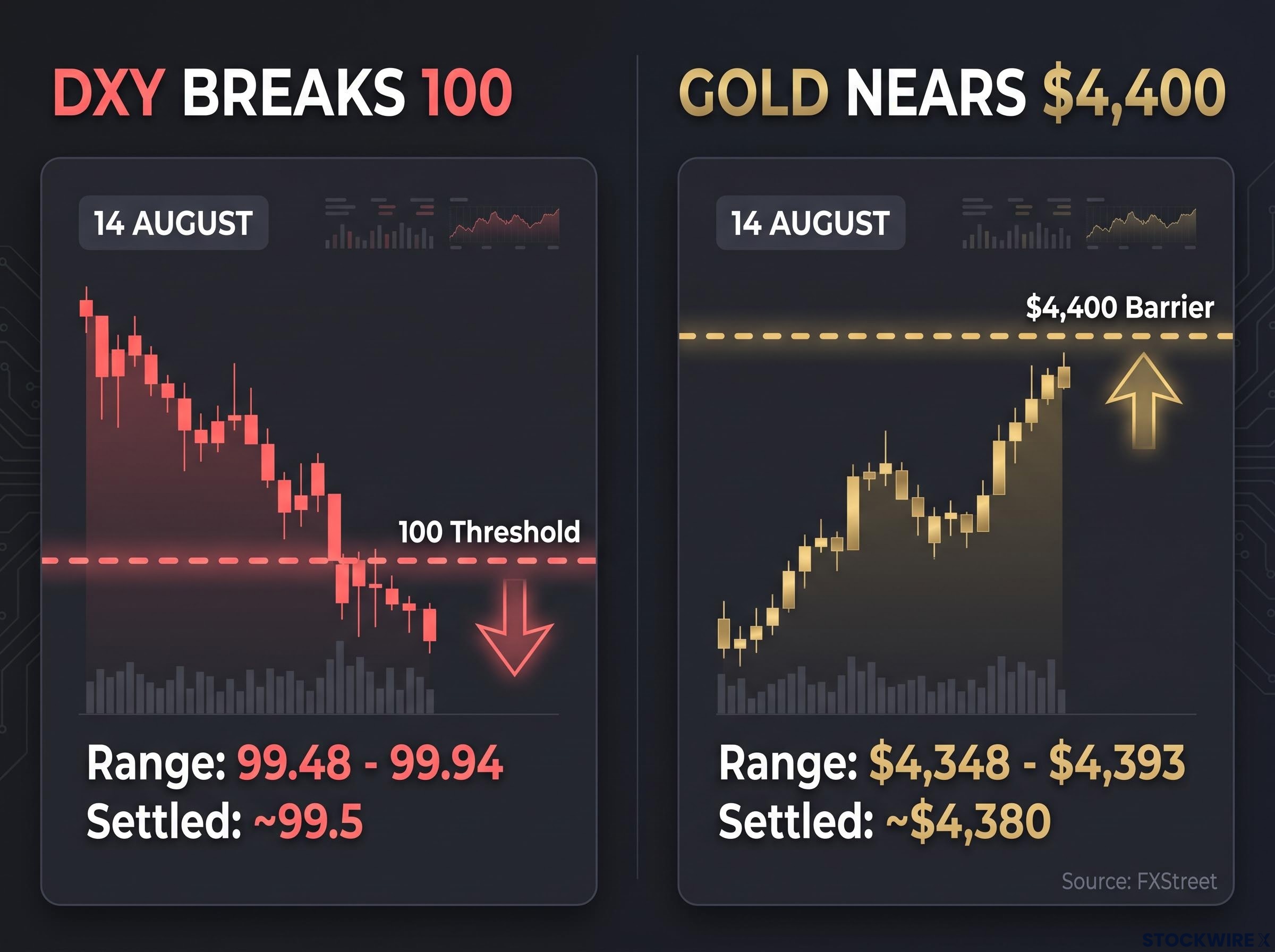
Settling around $4,380 to close the week, gold has reached its strongest point in several weeks, propelled by the dollar’s drop beneath 100 and a steady retreat in September rate-hike expectations.
Two mechanisms are driving the advance:
- Dollar weakness: Gold is priced in US dollars. When the dollar falls, gold becomes cheaper for buyers holding other currencies, which supports demand.
- Lower real rate expectations: When markets expect the Fed to hold or cut rather than hike, the opportunity cost of holding gold (which pays no yield) falls. Non-yielding assets become relatively more attractive in a lower-rate environment.
Both mechanisms are firing simultaneously, which explains why gold has held its gains rather than fading on profit-taking. But the $4,400 level has not been convincingly broken despite these strongly supportive conditions. That tells you the market is still waiting for the FOMC Minutes to confirm the dovish narrative before committing to the next leg higher. How price behaves around $4,400 in the coming sessions will signal whether this is a genuine trend or a data-driven spike that fades on the next hawkish surprise.
The gold price outlook for H2 2026 has shifted materially since the metal’s correction from above $5,500/oz, with the Federal Reserve’s October rate decision identified as the single most important near-term catalyst: a one-and-done hike opens a path to $4,300-$4,500/oz, while a multi-hike cycle brings $3,700-$3,900/oz into play.
Understanding why the 100 level matters for the dollar
The Dollar Index, or DXY, measures the US dollar’s value against a basket of six major currencies, weighted heavily toward the euro. When the DXY moves, it is not reflecting a single bilateral exchange rate; it is capturing how the dollar is performing broadly against the world’s most traded currencies.
The 100 level carries weight beyond the number itself. Institutional positioning, options structures, and market sentiment tend to cluster around round numbers. When a closely watched index breaks through one of these levels, the break can become self-reinforcing as stop-losses trigger, options hedges adjust, and momentum traders enter. A sustained move below 100 signals that the market has collectively reduced its confidence in the dollar’s rate-hike premium relative to other major central banks.
A sustained move below 100 signals that the market has collectively reduced its confidence in the dollar’s rate-hike premium relative to other major central banks, a dynamic the institutional research consensus had been flagging as the key structural risk to the DXY’s hold of that level.
What a sub-100 DXY signals to global markets
- Reduced confidence in the US rate premium relative to other G10 central banks, meaning global capital may seek yield elsewhere
- Potential capital flow shifts away from dollar-denominated assets, affecting everything from US Treasuries to dollar-priced equities
- Commodities priced in dollars becoming relatively cheaper for foreign buyers, which supports demand for oil, gold, and industrial metals
If you hold US assets priced in dollars, a sustained sub-100 DXY is not background noise. It is a signal that global capital is reducing its confidence in the dollar’s rate advantage, which reprices everything from bonds to commodities. The domestic data calendar offers nothing of consequence before Wednesday, meaning the 100 level is unlikely to face any fresh challenge from US economic releases before the FOMC Minutes land.
What comes next for the dollar and gold as the FOMC Minutes approach
Wednesday 19 August brings the release of the FOMC Minutes from the July meeting, and given that no high-priority US data is due before then, those minutes will arrive into a market starved of fresh directional cues and primed to react sharply to whatever they reveal.
Two scenarios frame the week ahead:
FOMC statement language, particularly the inflation confidence phrasing and the labour market characterisation, is where the real market-moving information sits, and the framework that applied to the July press conference will apply equally to Wednesday’s minutes, which arrive with no other high-priority US data to dilute their impact.
- Dovish outcome: The minutes reveal a narrowing hawkish minority and language suggesting the committee is increasingly responsive to weakening consumer demand. In this scenario, the dollar extends its move below 100, gold pushes through the $4,400 resistance, and the September pause becomes consensus.
- Hawkish surprise: The minutes show a committee still firmly focused on above-target inflation, with the hawkish divide holding or widening. This would put both the dollar’s breakdown and gold’s rally in question, potentially driving a sharp reversal as markets recalibrate.
Key threshold to watch: A sustained DXY below 100 combined with a gold close above $4,400 on meaningful volume would confirm trend durability. Both levels need to hold through Wednesday’s release for the current narrative to stick.
Wednesday’s minutes are not just a policy readout. They are the market’s next opportunity to confirm or abandon the dovish repricing that drove this week’s moves, and the reaction will likely be immediate. Rather than watching every tick between now and then, the specific event that will either validate or complicate the current narrative is already on the calendar.
This article is for informational purposes only and should not be considered financial advice. Investors should conduct their own research and consult with financial professionals before making investment decisions. Past performance does not guarantee future results. Financial projections are subject to market conditions and various risk factors.