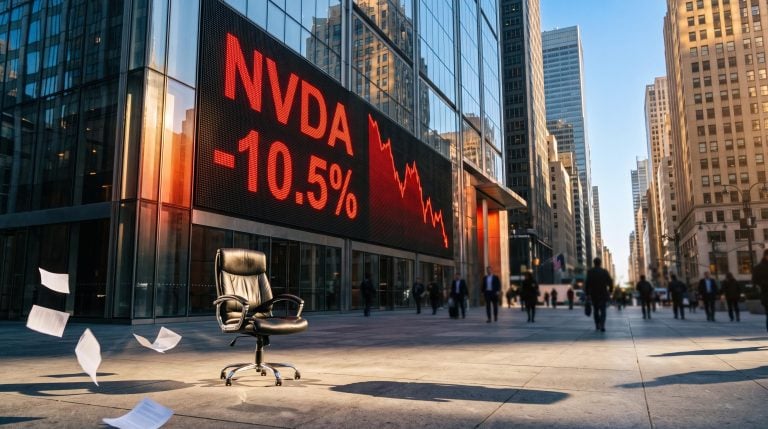
Nvidia shares fell hard on 12 November 2026 after Jensen Huang left the chipmaker. The wider stock market barely moved, while bonds, gold, silver and several currencies sold off together, an unusual pattern for an Nvidia CEO ouster that most of the equity market shrugged off.
The terms of the exit are still disputed. The original account describes the board removing Huang amid accusations. Nvidia’s own announcement called it an immediate resignation.
The timing adds pressure. Nvidia reports earnings on Tuesday, 17 November 2026, so the next few sessions carry more weight than usual.
This piece shows you how to tell a single-stock shock from a market-wide one, using equal-weighted indexes and the moves in other assets.
Where did Nvidia’s money go? Rivals and hyperscalers, not the exit
The size of the drop depends on the source. The original report has Nvidia closing down nearly 6% after an intraday low almost 20% below the prior close. A later market report puts the close at US$166.19, down 4.34%, with a low near US$148.80. A fair summary is a fall of roughly 4%-6% at the close and 14%-20% at the worst point. Closing figures are not fully confirmed.
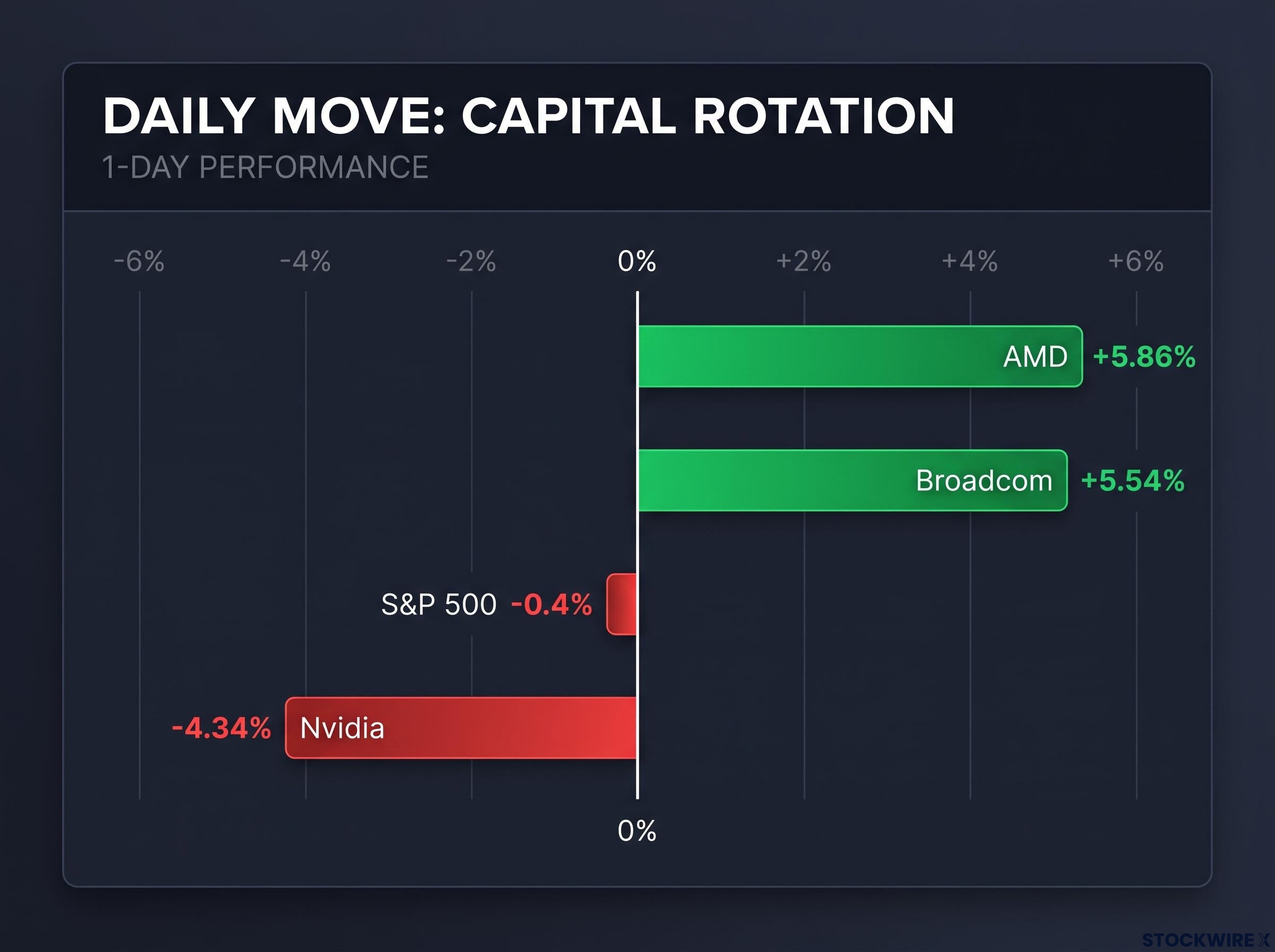
Capital rotation shifted money into rivals, with Nvidia down -4.34% and S&P 500 down -0.4%, while AMD rose +5.86% and Broadcom rose +5.54%.
Then look at where the money landed.
| Security | Close | Daily move |
|---|---|---|
| Nvidia | US$166.19 | -4.34% (other reports near -6%) |
| AMD | US$585.30 | +5.86% |
| Broadcom | US$364.36 | +5.54% |
| Alphabet | US$298.70 | +1.79% |
| Amazon | US$267.44 | +0.48% |
| Tesla | US$397.45 | +1.69% |
| S&P 500 | 7,592.40 | -0.4% |
| Nasdaq Composite | 25,366.09 | -0.4% |
AMD and Broadcom each gained more than 5%. Traders were betting that customers would look for other chip suppliers, not that they would stop spending on artificial intelligence. Alphabet, which designs its own TPU chips, also climbed, on the view that hyperscalers (the largest cloud operators) gain bargaining power if Nvidia’s transition drags.
Citi analysts argued that interim CEO Colette Kress could stabilise the company while the board searches. David Rosenberg of Rosenberg Research looked further ahead.
The roadmap question Rosenberg’s view, as reported: Kress is the natural interim pick, but the bigger issue is who controls Nvidia’s technology roadmap long term. A leadership vacuum could speed up customer diversification and hand rivals leverage.
For you, the gains at rivals point to money being reallocated within AI. Nvidia’s fall alone does not tell you that AI demand has weakened.
The split between Nvidia and its rivals fits a broader pattern in which semiconductor stock selection matters more than sector exposure, as a diversified chip ETF captured less than half of Broadcom’s single-day gain in July.
When big ASX news breaks, our subscribers know first
How to read an equal-weighted view after a single-stock shock
The headline indexes and the typical stock told two different stories yesterday.
Why index weight distorts the headline
A cap-weighted index, such as the S&P 500, gives bigger companies a bigger share of the index. When a megacap the size of Nvidia drops, it pulls the whole benchmark down even if most other stocks are flat or rising.
An equal-weighted index gives every stock the same share, so it shows how the median stock is faring. The original source said the equal-weighted market showed money spreading out rather than piling into one area. The equal-weight S&P 500 ETF (RSP) was reported near a record, though no precise closing percentage was found.
The gap between cap-weighted and equal-weighted ETFs comes down to rebalancing: equal-weight funds reset each holding to the same size at set intervals, trimming winners and topping up laggards.
You can run the same check on the next shock:
- Compare cap-weighted with equal-weight. If the headline falls while equal-weight holds, the damage is concentrated.
- Check where rivals and peers moved. Gains at competitors signal rotation, not retreat.
- Check whether support levels held. Support is a price zone where buyers have previously stepped in.
What the technical levels say
The S&P 500 ran into a former support zone that now acts as resistance and formed a lower high, leaving its downtrend since early October intact. The Nasdaq printed an inside day, meaning its trading range sat within the prior day’s range.
Nvidia briefly broke below reported support near US$164 before closing around US$166.19. These are market-structure observations, not valuations. When a cap-weighted index drops but the equal-weight view holds up, you are probably looking at a stock-specific event rather than broad risk aversion.
Why bonds, gold, silver and dollar pairs fell together
Assets that usually cushion a sell-off fell alongside Nvidia.
Reported moves, which conflict across sources on timing and size and are unverified:
- Gold: about US$3,873/oz, down 2.9%
- Silver: about US$49.94/oz, down 4.0% (the original source said “more than 3%”)
- Treasury yields: 10-year about 4.99%-5.03%, 2-year about 4.77%, 30-year about 5.33%-5.37%, meaning bond prices fell
- US dollar: stronger against the Australian dollar, euro and pound, with the Canadian dollar steadiest; US Dollar Index about 102.9
- Oil: WTI about US$86.53 (+0.57%), Brent about US$92.62 (+1.24%)
Ilio Spac, head of global macro at Tasty Live, reads this on the Macro Money programme as cash-raising to cover Nvidia losses rather than a lasting macro shift. The mechanics behind that reading fit together.
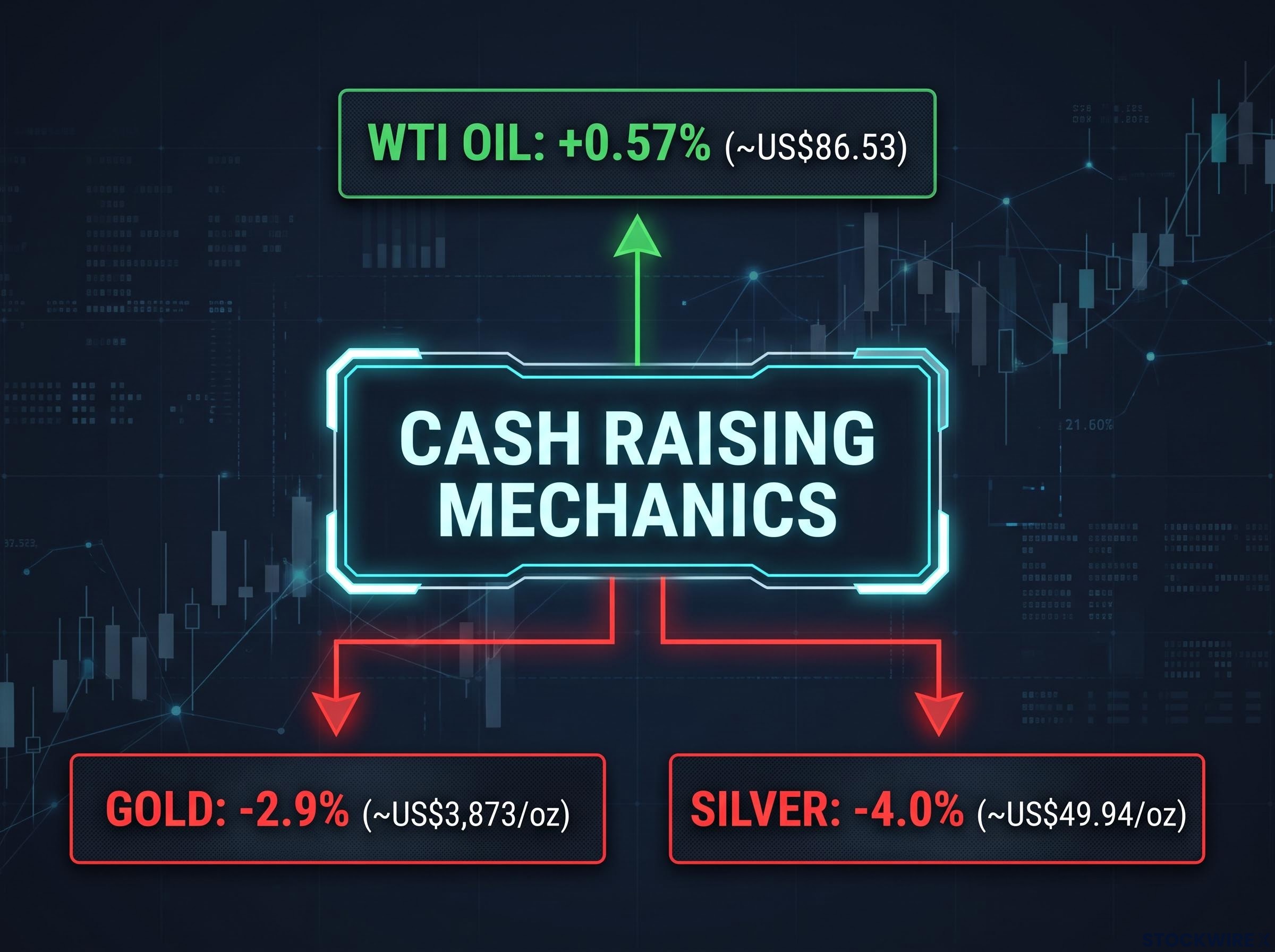
Cash raising mechanics led to sell-offs with Gold down -2.9% to ~US$3,873/oz and Silver down -4.0% to ~US$49.94/oz, while WTI Oil climbed +0.57% to ~US$86.53.
| Mechanism | How it works | Where it showed up |
|---|---|---|
| Margin calls | Falling collateral forces leveraged investors to sell other holdings | Bonds, metals, currencies |
| De-grossing | Funds cut total long and short exposure as volatility rises | Broad selling across asset classes |
| Cash raising | Investors sell liquid assets to get US dollars | Gold, silver, Treasuries, weaker currencies |
| Correlation spike | Usually unrelated assets move together as investors sell what they can | Havens falling with equities |
Oil’s modest bounce makes inflation fears a less likely driver. Bonds and gold also held prior support, keeping the early October bond rally alive and gold near its October low.
A competing reading sees an early sign of a more durable shift in the AI trade and liquidity, but available reporting does not establish it. If you hold bonds or gold, a same-day fall alongside equities points to forced selling for cash, not a change in the case for owning them.
What is confirmed about the Huang exit, and what is still open
Some parts of this story are firmer than others, though the research flags none as independently confirmed.
- Confirmed by Nvidia’s announcement: Huang left as president, CEO and board member effective 12 November 2026. Colette Kress, executive vice president and CFO, is interim CEO while staying CFO. Harvey C. Jones chairs the board, and a search for a permanent successor is under way.
- Reported, not proven: The original source describes a board removal, while Nvidia framed it as a resignation, with reports that removal had been considered. Media reports alleged extramarital affairs, and that US officials suspected a woman connected to Huang of links to a Chinese intelligence operation. The board had earlier opened an independent investigation into reports Huang was targeted by a foreign-intelligence effort.
- Pending: The permanent successor, and earnings on 17 November 2026, with the call at 2:00 p.m. Pacific.
The most serious of the unverified allegations, a link to Chinese intelligence, has not been proven, so the shares are pricing a governance problem rather than a confirmed security breach.
Nvidia’s release gave no operational or financial reason for the departure.
Board statement on continuity The board said it had no reason to believe Nvidia secrets were compromised, and that it expects operations, customer commitments and the product roadmap to continue without interruption.
Governance and succession risk is different from operating risk. Watch what the board and Kress say on the earnings call about customers and the roadmap.
What to watch before earnings, and how to read the next move
The evidence so far favours a company-specific governance shock, with rotation into rivals and temporary liquidity pressure, though a broader regime change is not ruled out.
Three signals will sharpen the picture:
- Cross-asset reversal: whether bonds, gold and the dollar unwind as the shock fades.
- Equal-weight strength: whether the median stock keeps holding up.
- Nvidia near US$164: whether that support level holds.
The 17 November earnings and any successor news are the next test. Judge this shock by how quickly the cross-asset moves unwind, not by the size of the first-day headline.
This article is for informational purposes only and should not be considered financial advice. Investors should conduct their own research and consult with financial professionals before making investment decisions.