Nvidia has lost roughly $600 billion in market value since its board announced an investigation into chief executive Jensen Huang. The most serious allegation, a link to Chinese intelligence, has not been verified by anyone.
That gap between price action and proof is the story. The shares sit roughly 25% below their 6 October record close of $239.24, and the forward earnings multiple is near its lowest in more than a decade.
Two decisions are still pending: the board’s verdict on Huang’s future, and a requested House briefing on 18 November. Either could move the stock further.
Here is how to separate what is confirmed from what is alleged, which scenarios matter, and how a Huang exit would reach you even if you only own Nvidia through a semiconductor exchange-traded fund (ETF). This analysis is current as of 12 November 2026, and the situation is moving quickly.
What is confirmed, what is alleged, and what the board has done so far
The allegations and their verification status
The claims around Huang fall into three tiers, and they deserve very different levels of trust.
The first tier is confirmed. Huang told employees he had been unfaithful to his wife, took “full responsibility” and apologised, without naming either woman involved.
The second tier is reported. The New York Times said Huang had a relationship with Kimberly Powell, Nvidia’s vice president of healthcare, who reportedly reported to him, and Reuters repeated the report.
The third tier is unverified. Reports alleged a close relationship with Alice Huang, an executive at Megaspeed, a major Southeast Asian Nvidia customer, who is accused of aiding Chinese intelligence and helping move Nvidia chips to Chinese companies. Reuters said it could not verify that claim, and China’s Foreign Ministry called it “groundless.”
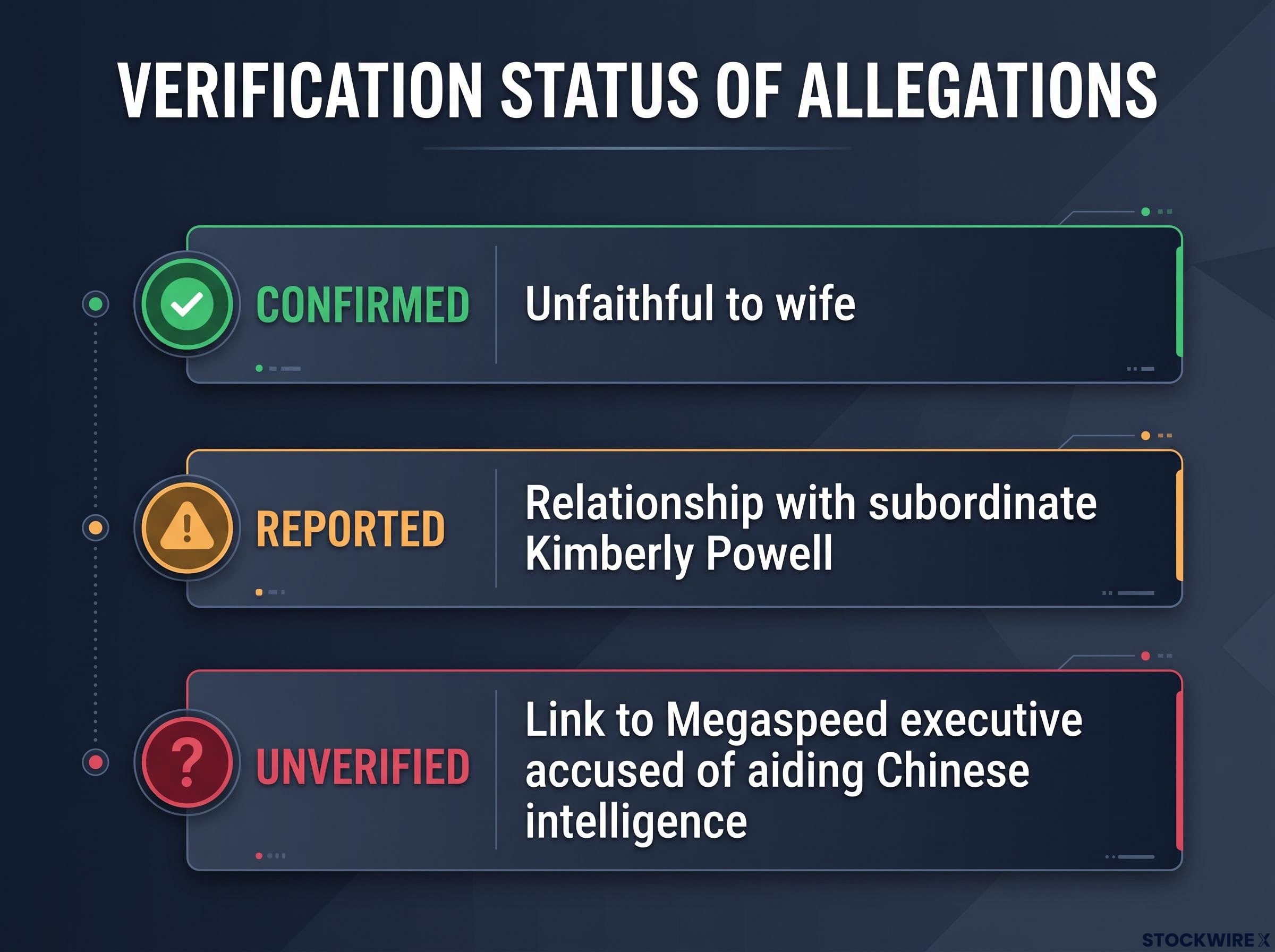
The claims driving the stock’s loss fall into three distinct tiers: Confirmed, Reported, and Unverified.
| Claim | Status | Source |
|---|---|---|
| Huang was unfaithful to his wife | Confirmed | Huang’s own statement to employees |
| Relationship with a subordinate, Kimberly Powell | Reported | New York Times, repeated by Reuters |
| Link to a Megaspeed executive accused of aiding Chinese intelligence | Unverified | Media reports; Reuters could not verify |
The board’s response
Nvidia’s independent directors formed a committee to oversee an inquiry and retained law firm Wachtell Lipton Rosen & Katz. The board said it had “no reason to believe” US national security or company secrets had been compromised, and Huang pledged full cooperation.
Reuters framed this as an independence and credibility test: a board investigating its own powerful founder. Directors have reportedly met to discuss removing Huang, but no decision has been reported.
What this tells you is that the stock is pricing a governance and uncertainty problem, not a proven security breach. Keep that distinction in mind, because it decides which scenario deserves your weight.
When big ASX news breaks, our subscribers know first
How have analysts and the market responded to the Huang uncertainty?
The headlines say Wall Street has turned on Nvidia. Taken one at a time, the analyst moves tell a more mixed story.
Baird‘s Tristan Gerra made the sharpest call, downgrading Nvidia to Neutral and cutting his price target to $200 from $500. His reasons went beyond Huang: limited visibility into 2027 data-centre spending, possible moderation in AI investment and US restrictions on chip sales to China. Some early reports attributed this downgrade to Bank of America; it was Baird.
Morgan Stanley‘s Joseph Moore removed Nvidia from the firm’s Top Picks list. That was a process decision, triggered by a stop-loss policy after the stock fell more than 25% from its 2 October Top Pick designation, and Moore kept his Overweight rating and $300 target.
Morgan Stanley’s view Moore argued the AI buildout remains strong and durable, but said near-term uncertainty persists because Huang’s leadership is central to Nvidia’s strategic direction.
Bank of America took Nvidia off its best-ideas list while keeping a Buy rating.
| Firm | Action | Rating | Target |
|---|---|---|---|
| Baird (Tristan Gerra) | Downgrade | Neutral | $200 (from $500) |
| Morgan Stanley (Joseph Moore) | Removed from Top Picks | Overweight | $300 (unchanged) |
| Bank of America | Removed from best-ideas list | Buy | Not reported |
The market has been less forgiving. Shares fell about 7.8% in premarket trading on 12 November as reports emerged that the board was weighing an ouster. Different outlets quote different percentage falls because they measure from different starting points: the record close, the investigation announcement or the previous session.
Only one of these three actions was a genuine rating downgrade. If you read analyst notes closely, the “Wall Street has turned” narrative looks weaker than the price chart suggests.
Much of the drawdown predates the probe, with the shares already well below their October peak before the board announced its inquiry, which suggests Huang-related uncertainty is amplifying a decline rather than starting one.
Why does one executive matter this much? Key-person risk and founder-exit precedents
Jay Goldberg of Seaport put it bluntly.
“Jensen is Nvidia.”
Goldberg said Nvidia would lose its central identity without Huang, that a Huang departure would end the bull case and that an ouster would be shattering for the stock. That sounds extreme for a company whose products and customers are unchanged, so it is worth unpacking.
Key-person risk is the danger that a company’s value depends heavily on one individual, so losing that person could hurt the business or how investors value it. With Nvidia, the risk travels through five channels:
- Business continuity: products, the software ecosystem, engineers and customer demand stay intact on day one.
- Strategic continuity: a successor must keep up the product cadence, supply-chain coordination and relationships with hyperscalers (the giant cloud operators).
- Governance discount: investors may demand a lower multiple once dependence on one executive is exposed.
- Talent and competitive risk: a successor may find it harder to retain senior engineers.
- Estimate revision: analysts may cut long-term growth forecasts.
The succession gap sharpens every channel. Nvidia has no clear public succession plan, and Fortune named chief financial officer Colette Kress as a possible interim CEO. She would offer operational continuity, but not necessarily Huang’s technical authority, customer access or political relationships.
Dan Ives reportedly estimated Nvidia could be worth 25-30% less without Huang, though that figure has not been independently confirmed. Past founder exits at HP and Wesfarmers were followed by weak share performance, but detailed comparative data on those cases was not available.
The lesson for you is subtle. A lower multiple after an exit would reflect lost certainty about Nvidia’s AI lead, not any fall in current demand. That framework applies to any stock built around one leader.
Three scenarios for Nvidia, and the Washington pressure that could shape them
In the most benign case, investigations clear Huang and the affair is treated as private conduct. Morgan Stanley’s durable-buildout view supports a recovery here, although the reported relationship with a subordinate still raises oversight questions.
The middle case keeps Huang in place but leaves a lingering governance discount and higher export-control costs.
The severe case is where spying is substantiated, controls tighten, Huang is pressured out and further downgrades follow.
| Scenario | Trigger | Likely market effect | Key risk |
|---|---|---|---|
| Optimistic | Investigations clear Huang | Recovery as uncertainty fades | Oversight questions over the subordinate relationship |
| Middle | Huang stays; tighter rules advance | Persistent discount | Governance and export-control costs |
| Worst | Spying substantiated | Further downgrades, deeper selloff | Forced exit and tighter controls |
Washington is where the odds could shift. Senator Kevin Cramer has called for Huang to resign, describing the controversy as a national security risk. House chairmen Brian Mast, John Moolenaar and Rick Crawford have requested a closed-door briefing on Huang’s relationship with Alice Huang and Nvidia’s espionage safeguards.
Moolenaar said a subpoena was likely if Huang declined, and Mast said his committee was prepared to issue one. None had been reported as issued.
Congress is also weighing chip export provisions in the National Defense Authorization Act, including the AI Overwatch Act, the MATCH Act and the Chip Security Act. Proposals include more congressional review of export licences, limits on sales to high-risk countries and location verification for controlled chips.
The China sales deadlock around H200 chips shows how little Nvidia’s guidance relies on that market, since management already excludes China data-centre compute revenue, which limits how much a tougher export regime could add to current estimates.
- 18 November: requested House briefing, with a subpoena possible
- 11 December: government funding deadline, a potential vehicle for export-control provisions
Treat those two dates as the moments scenario odds are most likely to move, rather than reacting to every headline in between.
Is Nvidia cheap, and what does it mean for semiconductor ETF holders?
Cheap or justified?
Nvidia trades at roughly 11.7-12 times forward earnings. The forward price-to-earnings (P/E) ratio compares the share price with expected earnings over the next 12 months; a lower figure means you pay less for each dollar of expected profit.
By some data series that is the lowest in about 15 years, with Morningstar and MarketWatch placing the comparable low in 2011-12. Other datasets point to 2012-13, so treat the exact comparison loosely.
The cheap case is simple: the multiple sits far below the premium investors once paid for AI growth. The justified-discount case argues the market is pricing slower AI spending, poor 2027 visibility, China limits, customer concentration and governance risk, largely the same concerns Baird cited.
Nvidia’s fiscal 2028 guidance of roughly 70% revenue growth, well above prior consensus, is the demand baseline that the market is now discounting against governance and export risks.
What it means for ETF holders
Even if you never bought Nvidia directly, you may hold a lot of it.
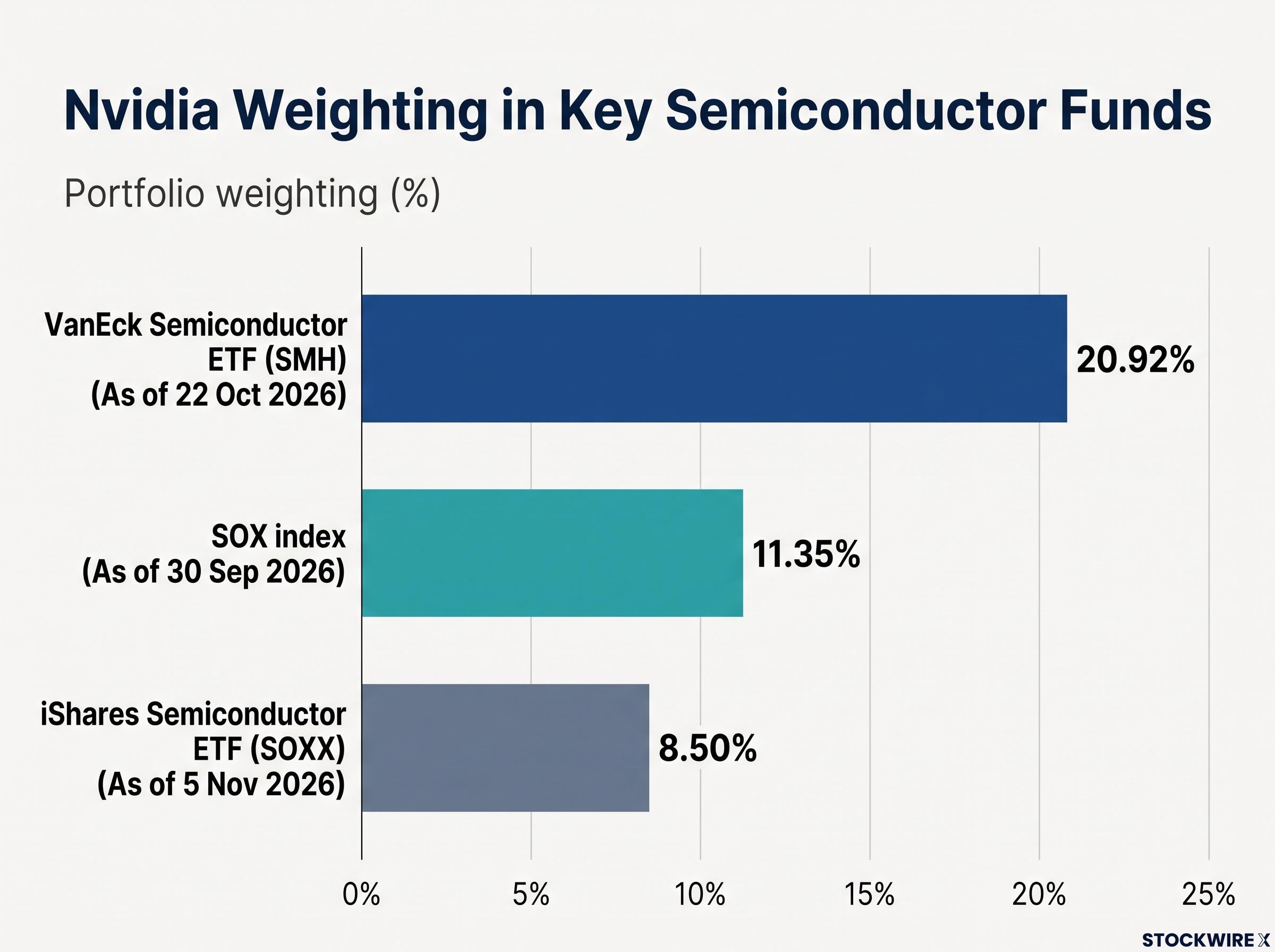
Indirect exposure to Nvidia varies widely across semiconductor funds, with the VanEck Semiconductor ETF reaching a 20.92% weighting.
| Fund or index | Nvidia weighting | As of |
|---|---|---|
| VanEck Semiconductor ETF (SMH) | 20.92% | 22 October 2026 |
| iShares Semiconductor ETF (SOXX) | 8.50% | 5 November 2026 |
| SOX index | 11.35% | 30 September 2026 |
| Invesco PHLX Semiconductor ETF (SOXQ) | No figure located | Not available |
The figures come from Pacific Tape, updated 11 November 2026, and they shift with share prices and rebalances. An SMH holder has roughly one-fifth of the fund tied to Nvidia-specific outcomes.
A falling Nvidia price can change weightings at the next rebalance. Even a more diversified fund like SOXX stays exposed indirectly, because tighter export rules or weaker AI spending would pressure other chipmakers too.
Check your own fund’s current Nvidia weighting before assuming you are diversified. A cheap multiple does not remove concentration risk.
What to watch before making a call on Nvidia and semiconductor exposure
The facts are only partly verified, the valuation is low for reasons that remain debatable, and the outcome rests on the board, Washington and the AI spending cycle. These are the signals that matter:
- The board’s decision on Huang’s future
- The 18 November briefing and any subpoena
- The 11 December funding deadline and export-control provisions
- Any verification of the Megaspeed allegation
- The 2027 data-centre spending outlook
SMIC reports on Thursday, which may offer an indirect read on Chinese chip demand amid the fallout.
Facts may have changed since 12 November 2026. Past performance does not guarantee future results, and analyst targets are subject to market conditions and various risk factors.
This article is for informational purposes only and should not be considered financial advice. Investors should conduct their own research and consult with financial professionals before making investment decisions.