Apple shares are already trading lower today, and KeyBanc Capital Markets has picked this moment to tell investors the stock has further to fall. That timing is rare: a bearish analyst note and live market weakness reinforcing each other on the same day.
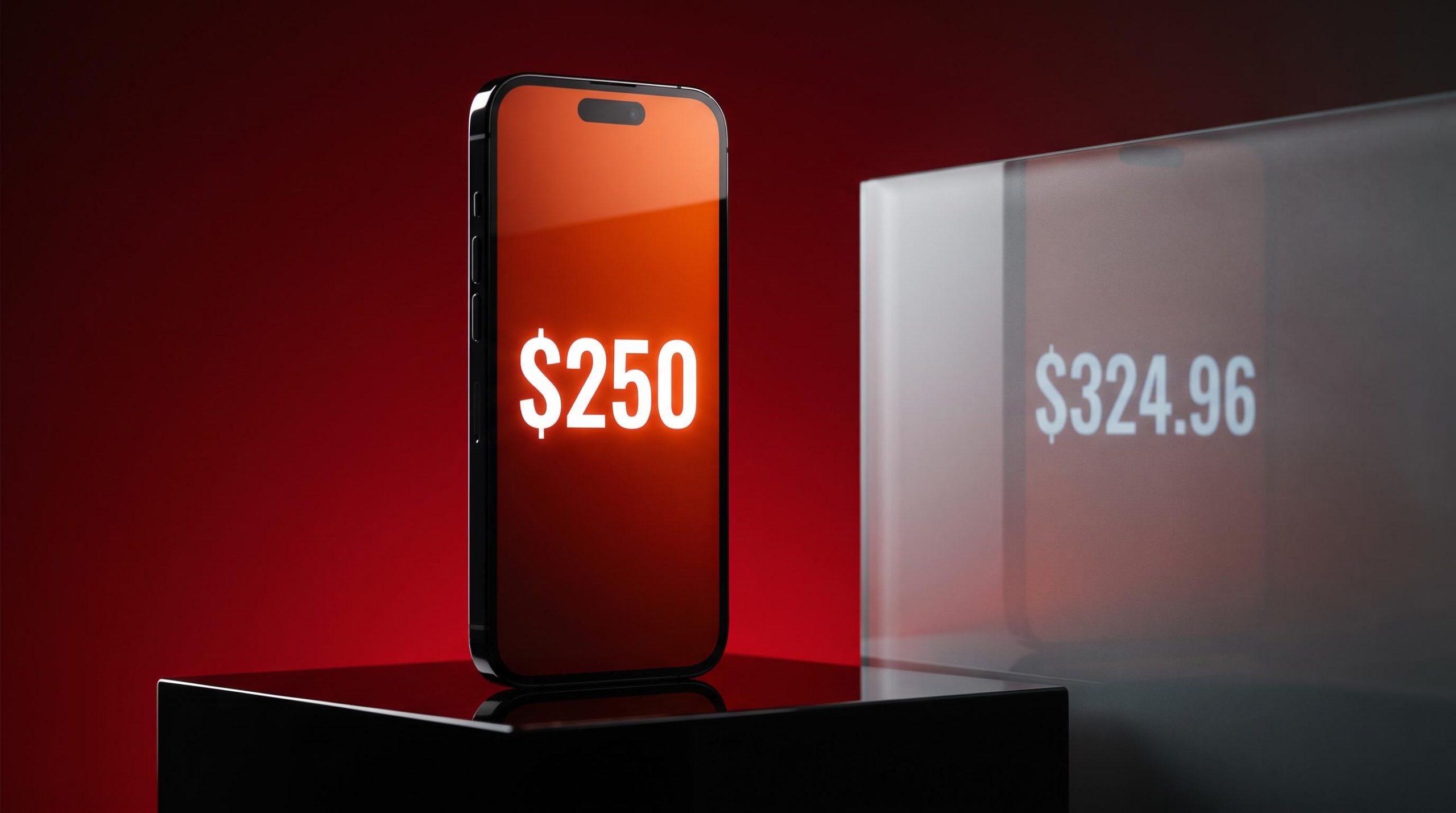
The number that matters is $250. That is KeyBanc’s price target on Apple, paired with an Underweight rating, while the stock changed hands at roughly $324.96 when the note landed on 6 September 2026. The iPhone 18 event is three days away, and the gap between KeyBanc’s target and the Street consensus of about $330.61 is the tension worth understanding before 9 September.
Here is what the evidence actually says about that gap. After reading, you will know which data points to watch on launch day, and why the announcement itself may matter far less than what happens to the stock in the five sessions that follow.
What KeyBanc actually sees that the bulls are missing
Start with the valuation gap, because that is where KeyBanc’s conviction lives. Most of the Street is bullish on Apple heading into the launch. KeyBanc is not, and the reason has almost nothing to do with the phones themselves.
The concern is the multiple. Apple currently trades at a 34x price-to-earnings ratio, meaning investors are paying $34 for every dollar of annual profit the company generates. That sits well above Apple’s three-year average of 28x, according to KeyBanc’s analysis.
Here is how far KeyBanc sits from the rest of the Street on price targets:
- KeyBanc: $250 (Underweight)
- Rosenblatt Securities: $303 (neutral)
- JP Morgan: $315
- Consensus: approximately $330.61 (Moderate Buy)
That spread is the whole story. KeyBanc is not forecasting a collapse in Apple’s business. It is arguing that a 34x multiple prices in perfection, and perfection is a difficult thing to deliver at a product launch where expectations are already elevated.
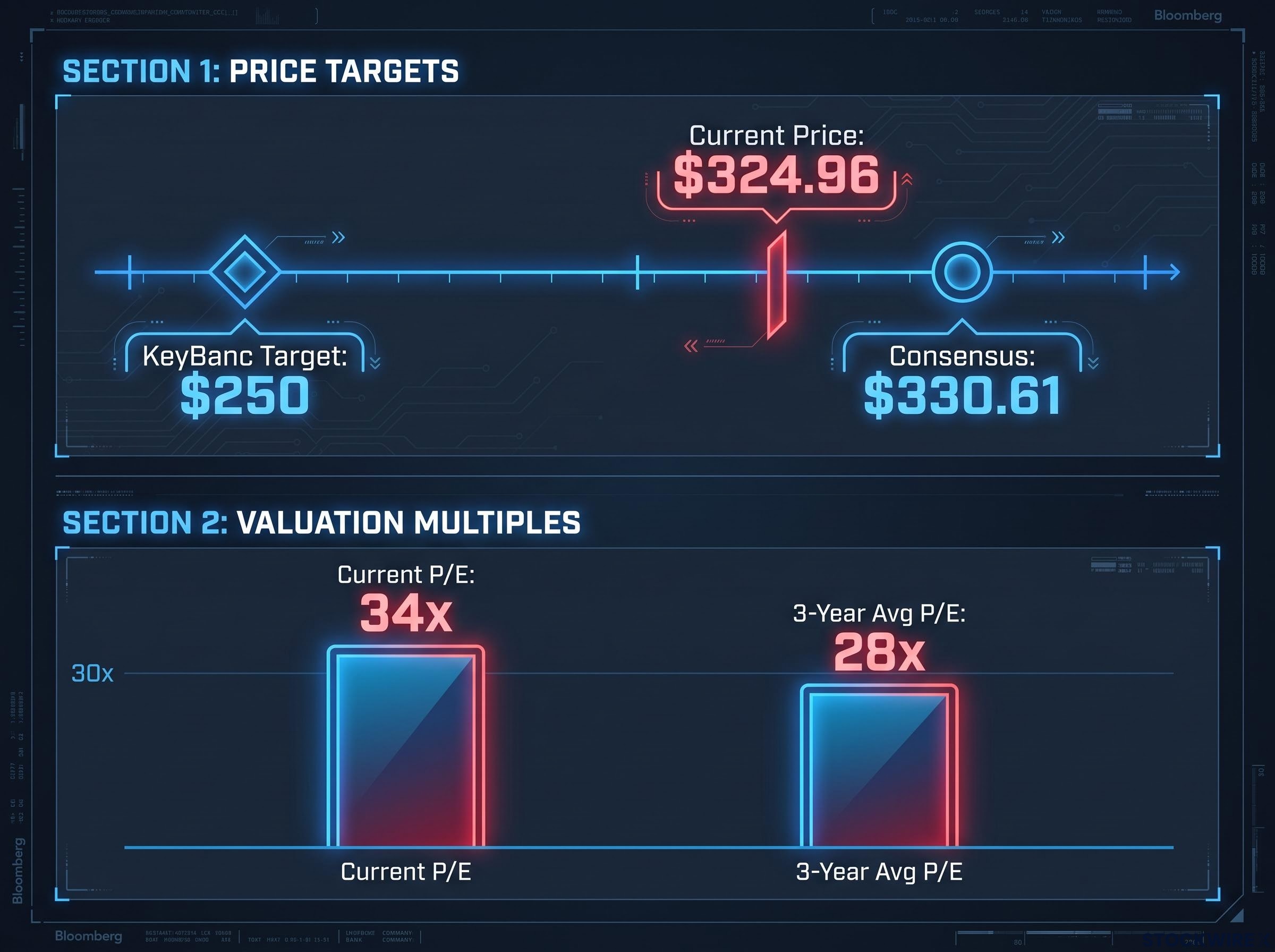
The key stat: Apple trades at 34x earnings against a three-year average of 28x. That premium is what KeyBanc believes is unsustainable heading into 9 September.
This is not the first time an analyst has flagged the multiple. Following the previous year’s iPhone 17 rollout, Jefferies raised a similar warning when Apple’s P/E sat near 39x, cautioning that solid demand was already fully reflected in the share price.
The fiscal Q2 2026 report raised the same premium valuation questions now at the centre of KeyBanc’s note: Apple posted record revenue of $111.2 billion and its first-ever Q1 global shipment lead, yet the stock fell as investors signalled that record results confirming an existing thesis are not sufficient to push a 34x multiple higher.
What the valuation gap tells you is a matter of magnitude. If KeyBanc is right about P/E compression, the downside is not a modest pullback. A move toward $250 from current levels would erase most of the year-to-date gain Apple has built through 2026. That is the difference between a note you can ignore and one worth stress-testing.
When big ASX news breaks, our subscribers know first
Five years of data say iPhone launches are when Apple investors get hurt
The valuation argument gives KeyBanc its conviction. The historical record gives it timing. And the record is remarkably consistent.
Over the preceding five years, Apple shares have averaged a 0.72% drop on iPhone announcement days. The pattern does not stop when the event ends. Measured five trading sessions after the announcement, the average decline widens to 1.22%.
That is not random noise. It is a structural sell-the-news dynamic. The benefit of new devices is typically priced into the stock well before the reveal, so the announcement itself acts as a release valve rather than a catalyst.
The most recent data point reinforces the pattern. When Apple unveiled the iPhone 17, the stock dipped between 0.24% and 1.5%, according to estimates from Wedbush and Jefferies, because investors treated the upgrades as incremental and already valued.
The most recent parallel is Apple’s fiscal Q3 2026 report, where a 6.9% earnings beat against consensus still produced a nearly 4% after-hours decline because a 22.7% year-to-date rally had already absorbed the good news, a sell-the-news dynamic that mirrors precisely what KeyBanc is flagging ahead of 9 September.
| Window | Average Apple share move | What it signals |
|---|---|---|
| iPhone announcement day (5-year avg) | -0.72% | Immediate sell-the-news reaction |
| Five sessions post-announcement (5-year avg) | -1.22% | Weakness typically deepens after the event |
| iPhone 17 unveiling (most recent) | -0.24% to -1.5% | Even a well-received launch did not protect the stock |
What 9 September looks like through this historical lens
Apply the average directly to today’s price. A 1.22% five-session decline from roughly $324.96 points to a concrete near-term downside scenario if the pattern holds, and history says the days after the reveal, not the reveal itself, are where the risk concentrates.
There is a counterpoint worth holding alongside this. Morgan Stanley notes that while Apple underperforms the S&P 500 on launch day, it tends to modestly outperform over the following three months. So the sell-the-news pattern is real, but for longer-horizon holders it has historically proven temporary rather than terminal.
The pricing and volume squeeze at the heart of KeyBanc’s bear case
If valuation is the frame and history is the timing, pricing is where KeyBanc’s bear case becomes operational. And it hinges on a trade-off Apple appears willing to make.
KeyBanc sees a two-pronged problem. Broad price increases risk destroying demand through sticker shock. Selective increases invite investors to scrutinise exactly how much margin Apple is extracting from a shrinking base of buyers. Neither path is clean.
The projected pricing tells the story:
| Model | Projected starting price | Estimated increase vs prior model | Role in lineup |
|---|---|---|---|
| iPhone 18 Pro | $1,249 | approx. +$150 | Volume workhorse of the premium tier |
| iPhone 18 Pro Max | $1,399 | approx. +$200 | Top-selling flagship |
| Fold/Ultra | $2,199 | New category entry | First foldable, untested price point |
Analyst estimates on the size of the Pro increases vary widely, from $100 (Evercore ISI and BofA) to $270 (TechInsights), so treat the exact figures as a range rather than settled fact.
Here is the quantitative centre of gravity. KeyBanc estimates total iPhone 18 production builds at roughly 80 million units across fiscal Q4 2026 and fiscal Q1 2027 combined. That is down around 11 million units from the approximately 91 million units produced in the same period a year earlier, a decline KeyBanc attributes directly to the omission of a standard base iPhone 18 model.
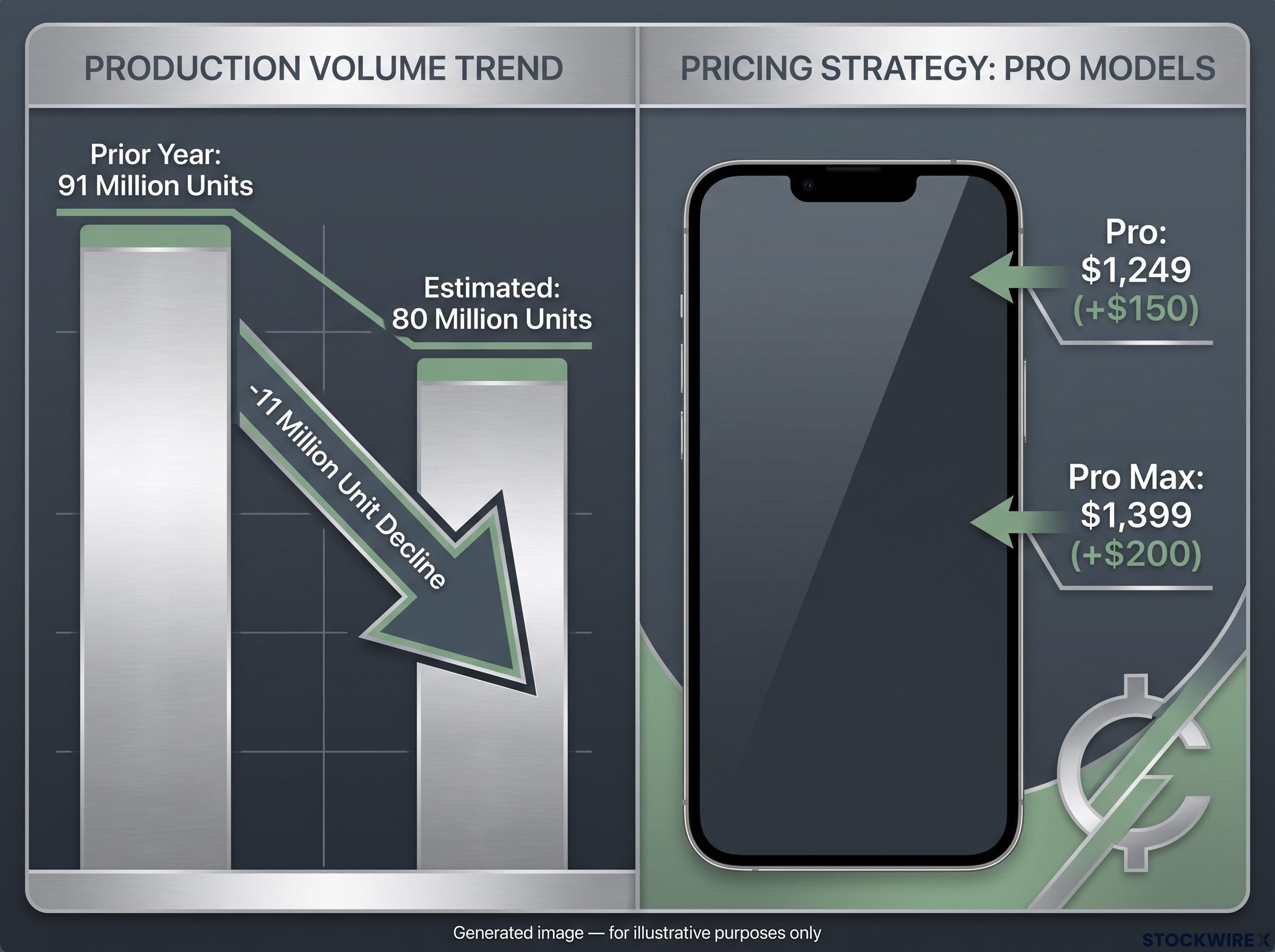
An 11-million-unit cut is not a rounding error. It signals that Apple is consciously trading volume for margin, and KeyBanc’s argument is that Wall Street will not pay a 34x multiple for growth driven by price rather than by adding new users.
The bulls see the same numbers and reach the opposite conclusion:
- Low price elasticity: Morgan Stanley argues iPhone buyers are relatively insensitive to price, estimating even a $200 increase would trim shipments by only 2-5%, boosting overall profitability.
- The super-cycle thesis: Some analysts believe the premium-only lineup will trigger a wave of upgrades from users still on iPhone 15 and 16 models.
- Mix and ASP framing: Counterpoint Research notes Apple is deliberately prioritising higher-margin Pro and Pro Max models because memory costs constrain unit growth, making future expansion mix-driven and average-selling-price-driven rather than volume-driven.
The macro backdrop cuts both ways. The US smartphone market fell 5.7% year-over-year in Q1 2026, while Apple’s ecosystem grew 1.3% in the same period. Apple is holding share in a shrinking market, which is exactly why the volume-versus-margin question matters so much to how you value the stock.
Apple’s position in a contracting smartphone market is the structural context behind both sides of the volume-versus-margin debate: the company grew global Q1 2026 shipments approximately 5% while the broader market fell 6%, which is precisely why bulls argue pricing power is durable and bears argue it cannot sustain a 34x multiple simultaneously.
The foldable factor: opportunity or distraction for Apple investors?
The Fold/Ultra is the headline of 9 September. It is Apple’s first entry into the foldable category, a 5.5-inch device when closed that opens to a 7.8-inch display, priced at $2,199. That is genuinely historic. It is also a complicated catalyst rather than a clean positive.
Start with scale. Foldables are forecast to make up only about 2% of the global smartphone market in 2026, with total worldwide volume of roughly 22 to 25 million units, according to TrendForce estimates. Even IDC and Counterpoint’s bullish projection, that Apple could capture 22 to 25% of foldable unit share and 34% of category revenue in year one, still describes a small pond.
Production adds a second constraint. Supply chain analyst Ming-Chi Kuo estimates a slow ramp of 500,000 to 1 million units in Q3 2026, rising to 7 to 8 million units across the second half of 2026, below earlier targets nearer 10 million.
Then there is the resale problem, which may be the most counterintuitive data point in the entire launch:
First-year depreciation: Foldable smartphone owners lose an average of $997.69 in value in the first year, versus $605.32 for traditional smartphones, according to research from SellCell.
That gap matters because a steep depreciation curve on a $2,199 device could suppress the upgrade enthusiasm Apple is counting on. Consumer appetite exists, a Forbes Tech Council survey found 32.6% of respondents were specifically waiting for Apple to enter the category, but appetite and repeat purchases are not the same thing.
For an investor, the three execution risks are worth isolating:
- A slow production ramp that caps the revenue contribution regardless of demand
- An untested $2,199 price point that has never been proven at scale
- First-generation durability unknowns on a device with a folding screen
The read for you is this. The foldable is a story about a niche Apple could dominate without meaningfully moving the numbers that drive the stock, unless the production ramp dramatically exceeds current estimates. Watching it at the expense of Pro and Pro Max volume trends means watching the wrong variable.
What the evidence actually says about holding Apple into the announcement
Pull the four layers together and the decision facing an Apple holder into 9 September comes down to three things worth watching, in order.
- The five-session price action after the announcement. History says the days following the reveal, not the reveal itself, carry the most near-term risk. A move in line with the 1.22% five-session average would validate the sell-the-news pattern.
- Early demand signals on Pro pricing. Watch channel data for any sign that the projected $150 to $200 increases are triggering visible softness. That is the point where KeyBanc’s demand-destruction thesis either shows up or fails to.
- The foldable production ramp versus the 7 to 8 million H2 2026 estimate. A ramp that surprises to the upside would be one of the few clean bullish catalysts on the table.
Treat KeyBanc’s $250 target not as a forecast to adopt, but as a stress-test. It asks what would have to be true for P/E compression to drag the stock down that far, and how far the current setup sits from that scenario.
The magnitude of the disagreement: The distance between KeyBanc’s $250 target and the Street consensus near $330 is roughly $80 per share. That is essentially a bet on whether premium pricing can sustain a 34x multiple, and 9 September is the first real test of it.
Morgan Stanley’s observation that Apple tends to outperform over the three months following a launch is the counterweight to keep in view. Investors who track these three variables are positioned to read the event as it unfolds, rather than react to headline sentiment.
The multi-category share gains provide a longer-horizon counterweight to KeyBanc’s near-term concern: hardware share captured in 2026 functions as a leading indicator for services revenue trajectory in 2027-2028, with a larger installed base directly expanding the addressable market for iCloud, Apple Music, and App Store spending regardless of what happens to iPhone unit volumes.
This article is for informational purposes only and should not be considered financial advice. Investors should conduct their own research and consult with financial professionals before making investment decisions. Past performance does not guarantee future results. Financial projections are subject to market conditions and various risk factors. These statements are speculative and subject to change based on market developments and company performance.