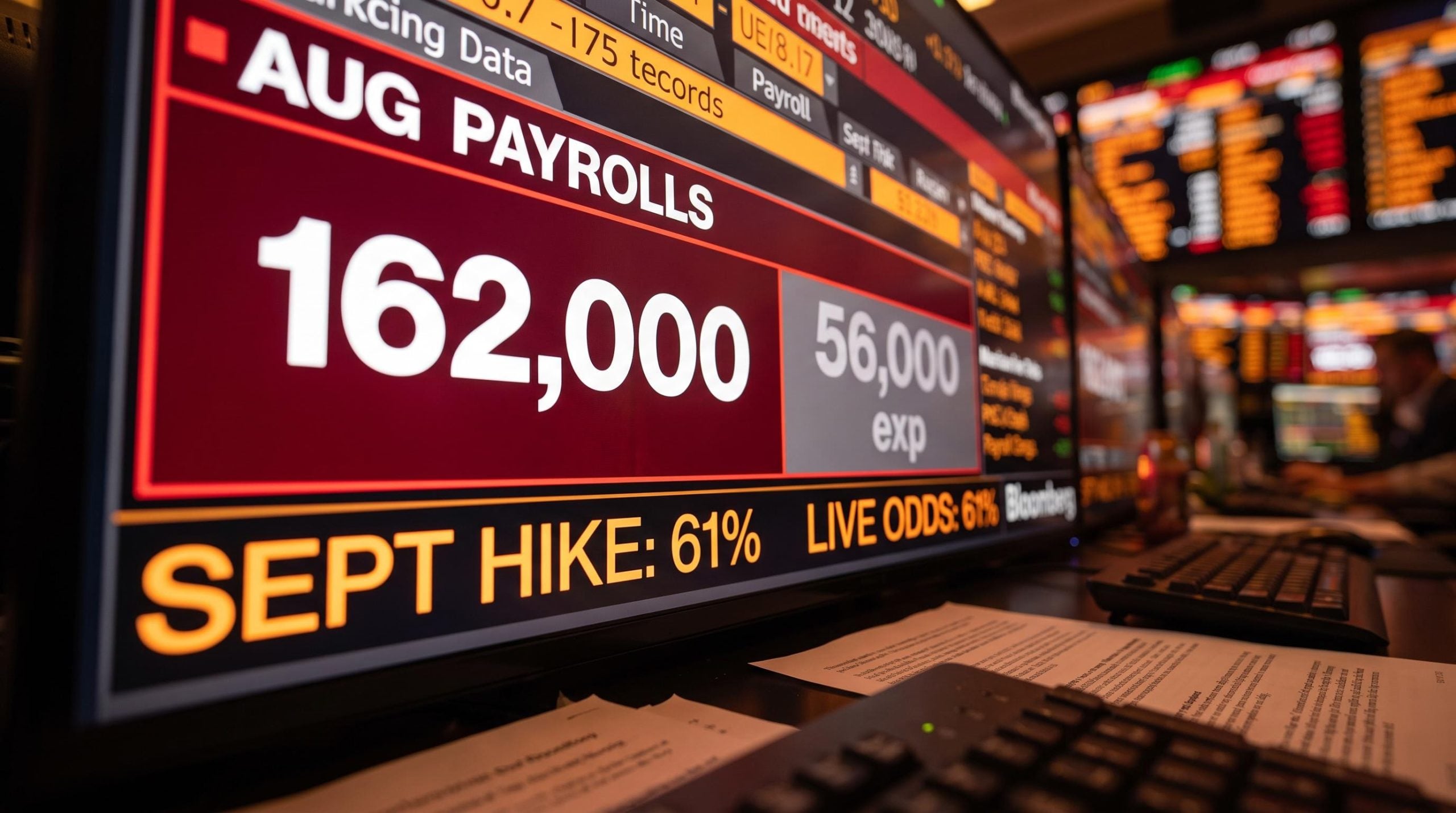
U.S. employers added 162,000 jobs in August 2026, nearly three times the roughly 56,000 economists had penciled in.
That single number did more than beat expectations. It dismantled Citigroup’s longstanding forecast for Federal Reserve rate cuts beginning in late 2026, pushing the bank’s first-cut projection entirely into 2027.
Citi’s revision is not an isolated bank call. It confirms the direction the broader Wall Street consensus has been drifting for months, converging on mid-2027 as the earliest plausible moment for relief.
What follows maps where rate policy is now headed, why Citi moved its base case to June 2027, and what the sudden shift in September Fed meeting odds means for anyone holding a mortgage, a bond, or a rate-sensitive stock right now.
How 162,000 jobs in August reset the Fed’s entire calculation
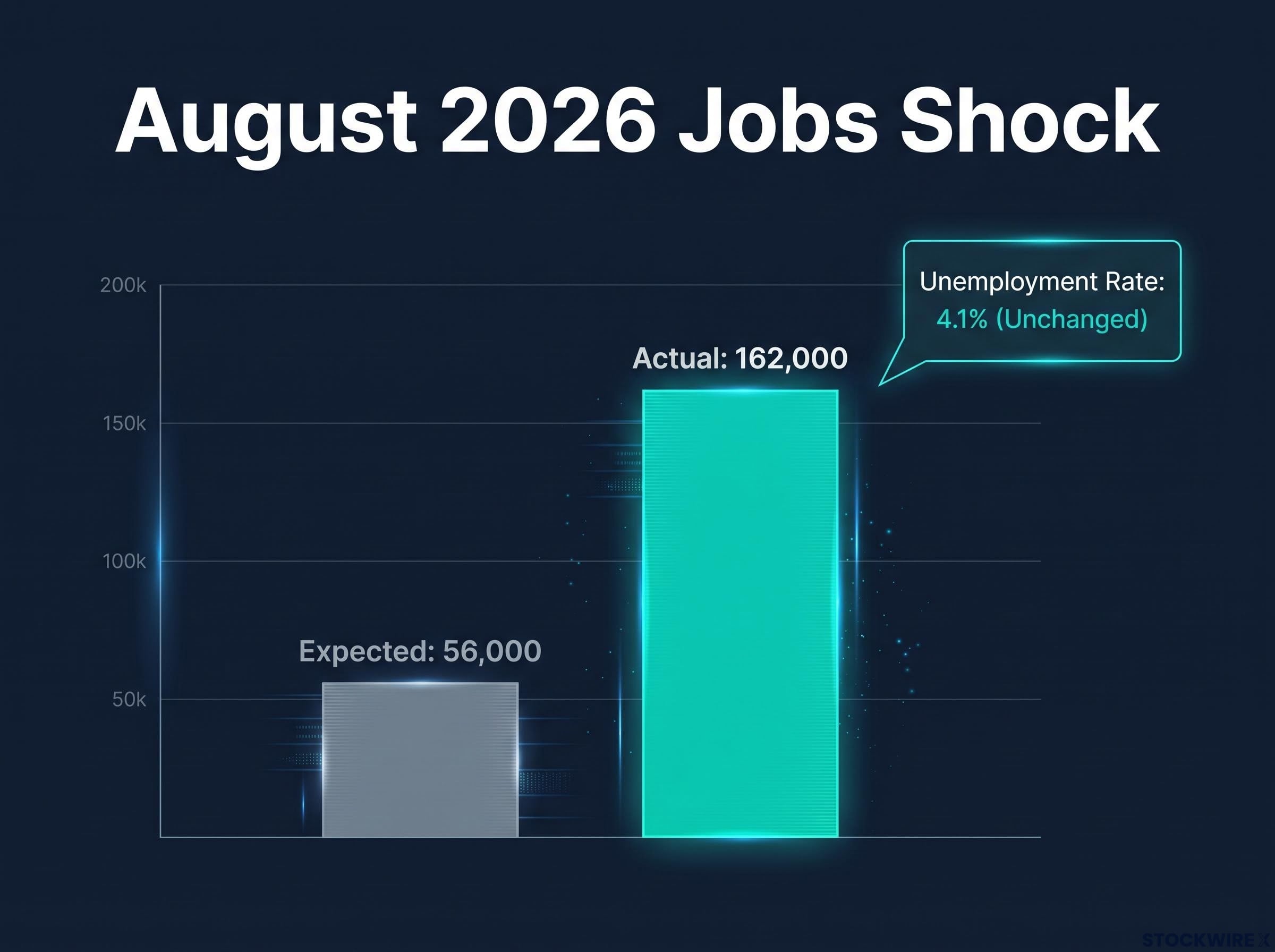
The gap tells the story. Economists expected the U.S. labour market to add roughly 56,000 positions in August. It added 162,000.
A miss of that scale, released on or around 4-5 September 2026, is not a rounding error. It is the market’s expectation of the labour market being wrong by nearly three times over.
The strength ran deeper than the headline figure. The unemployment rate held at 4.1%, and labour-force participation recovered during the month, both pointing to a jobs market holding firm across the board rather than a single flattering line in a spreadsheet.
Here are the three figures that reset the calculation:
- August 2026 nonfarm payrolls: 162,000 actual versus roughly 56,000 expected
- August 2026 unemployment rate: 4.1%, unchanged
- Labour-force participation: recovered during the month, cited as evidence of broad labour market health
For Citigroup, one figure mattered most: the unemployment rate that did not rise. The bank had specifically anticipated a meaningful climb in joblessness through the summer of 2026, mirroring the softening seen in 2024 and 2025. It never came.
That is the distinction readers should hold onto. A jobs report that beats to the upside by this margin does not merely delay a rate cut. It removes the labour-market justification the Fed would need to ease at all, because the case for cutting rests on a weakening jobs picture that August refused to deliver.
Not everyone read the number as durable strength.
“One month doesn’t make a trend,” said Orphe Divounguy of the Quantitative Research Group, who characterised the labour market as “steady,” not strong and not collapsing.
That scepticism matters, but it did not stop the market from moving.
When big ASX news breaks, our subscribers know first
Markets move fast: September hike odds jump past 60%
Before the report landed, markets were split almost evenly. As of 3 September 2026, fed funds futures priced roughly a coin flip on the Fed’s next move, with the policy rate sitting at 3.50%-3.75%.
MarketWatch, citing CME FedWatch, put the probability of a September hike at about 48.4% that day, with the rest of the field expecting a hold.
Then the payrolls print hit, and the repricing was immediate. Reuters reported that short-term interest-rate futures implied about a 59% chance of a rate increase at the 15-16 September 2026 meeting on 4 September. The primary fact-checked source placed it slightly higher, at roughly 61%, up from around 52% before the data.
The repricing did not emerge in isolation: September hike odds had already been climbing since Warsh’s Jackson Hole address on 27 August, when CME-linked pricing jumped roughly 20 percentage points overnight on tone alone, with no new data or numerical targets offered by the Fed.
Treat that as a directional range rather than a single precise figure. Either way, the story is the same: professional money flipped from expecting a hold to bracing for a hike, all in one session.
| Timing | Event | September hike probability | Source |
|---|---|---|---|
| Pre-report (3 Sept) | Before payrolls release | ~48.4% (or ~52%) | MarketWatch/CME FedWatch; primary source |
| Post-report (4 Sept) | After payrolls release | ~59% | Reuters |
| Post-report (4 Sept) | After payrolls release | ~61% | Primary fact-checked source |
Equities read the shift the same way. Major indices fell on the day, a sign that markets interpreted the strong jobs data as reducing the case for near-term easing rather than simply postponing it.
A market pricing a 60% chance of a hike within weeks is telling you something concrete. The risk environment has flipped from relief to tightening, and that has direct consequences for borrowing costs and portfolio positioning today, not in some distant quarter.
What the Fed was already signalling
The repricing did not come from nowhere. A day before the report, on 3 September 2026, Governor Christopher Waller said his September decision would be “heavily influenced” by August inflation data.
Waller indicated he would support holding the policy rate at 3.50%-3.75% if upcoming inflation figures showed continued moderation, while disappointing prints could justify a hike. In other words, the Fed had already told the market that the labour data alone would not settle the question.
Citi’s revised call: why June 2027 is now the base case
To understand how far the ground moved, start with where Citi stood before. The bank had forecast rate cuts in October 2026 and December 2026, followed by a third in January 2027.
That forecast is gone. In its place, Citigroup economists Andrew Hollenhorst and Veronica Clark now expect three 25-basis-point cuts, arriving in June, September and December 2027.
The logic connecting the two matters more than the dates. Citi’s underlying dovish thesis has not changed: the bank still sees softening core consumer prices, wages and underlying inflation eventually forcing the Fed’s hand.
What changed is the timeline. The strong August jobs data removed the urgency for early action, so the same expected easing simply slid a year later. Citi projects core CPI advancing at roughly a 0.18% monthly pace, a level it believes supports a hold at the 15-16 September meeting rather than a move in either direction.
That places Citi at a specific spot on the Wall Street map. It is now more dovish than most peers on the total amount of easing, yet aligned with the mid-2027 consensus on when the first cut arrives.
Dot plot projections from the June 2026 meeting had already shifted the year-end rate expectation upward from 3.4% to 3.8%, embedding at least one additional hike into the Fed’s own baseline before the August jobs data reinforced the hawkish case.
| Bank/Institution | First cut expected | Total 2027 cuts | Stance |
|---|---|---|---|
| Citigroup (revised) | June 2027 | Three x 25 bp | Dovish on total easing |
| Goldman Sachs* | June 2027 | June and December | Aligned on timing |
| BofA Global Research* | July 2027 | July and September | On hold through 2026 |
| Bloomberg median* | June 2027 | June and December | Range to 3.00%-3.25% |
| J.P. Morgan* | Q3 2027 (hike) | None (25 bp hike) | Hawkish outlier |
*Figures marked with an asterisk are unverified in the underlying research and should be treated as directional.
The Citi revision matters not because Citi controls the Fed, but because it represents where Wall Street’s dovish anchor has moved. When the most cut-friendly major bank forecast now starts in June 2027, any expectation of relief in 2026 is effectively off the table.
At the other end of the range sits the case for tightening.
The August data “favor Fed officials who want to hike,” said Claudia Sahm, chief economist at New Century Advisors, arguing the beat strengthens the argument for tighter policy.
Inflation data is now the only variable that matters for September
The jobs beat set the stage. The August CPI print will write the verdict.
The core CPI trajectory heading into August had been moving in the Fed’s favour, with July’s print showing the annual rate easing to 2.5% and monthly gains of 0.2%, a sequence that briefly pushed September hike odds below 40% before the jobs report reversed the picture entirely.
The Fed has been explicit that it is data-dependent, and with employment holding firm, the inflation report due after the jobs figures becomes the dominant variable for the 15-16 September decision. Economists are split on what the payrolls strength means, and that split is the story.
Here is where the named voices land:
- Claudia Sahm (New Century Advisors): hawkish. The data favour officials who want to hike.
- Ellen Zentner (Morgan Stanley): cautious-hawkish. The “upside surprise in payrolls will likely ramp up concerns about a rate hike,” but the outcome still hinges on inflation prints.
- Orphe Divounguy (Quantitative Research Group): cautious. “One month doesn’t make a trend.”
- Amy Glaser (ADECCO): cautious. The strong August number may partly reflect seasonal variation, and it is “too early to draw conclusions.”
On the data itself, the consensus figures conflict. The primary fact-checked source cites August headline CPI rising 0.4% month-over-month and core CPI rising 0.2%. A CNBC/Dow Jones preview, unverified here, put the figures lower at 0.2% headline and 0.1% core.
The number Citi is watching
Citi’s own threshold is more precise. The bank projects core CPI at roughly 0.18% monthly, the pace it believes would justify a hold rather than a hike.
There is a second catalyst on the horizon. A downward revision to core PCE inflation is anticipated later in September 2026, which could push the Fed toward a more dovish set of projections in its dot plot, the chart showing where individual officials expect rates to go.
For anyone tracking mortgage rates, bond yields, or the timing of a financial decision, that 0.18% figure is a specific benchmark to watch against the actual print.
The Fed’s own framing explains why no single number decides the outcome.
Monetary policy “is never on a preset course and will change as appropriate in response to incoming information,” Fed Chair Jerome Powell has said.
Until that CPI print lands, the September decision is genuinely binary for anyone with rate-sensitive exposure.
What a 2027 rate-cut timeline means for rate-sensitive decisions right now
A first cut pushed to mid-2027 is not an abstract line on an economist’s chart. It is a signal that elevated borrowing costs are structural through at least the middle of next year, and that lands hardest in three places.
The first is housing. Wells Fargo analysts have warned, in figures unverified here, that “higher for longer” mortgage rates risk pushing the U.S. housing market toward a “1980s-style” recession, as elevated costs suppress both demand and new supply. Housing economists interviewed by Yahoo Finance argue that structural pressure on Treasury yields makes a return to 3-4% mortgage rates “quite improbable.”
Mortgage rates and Treasury yields are mechanically linked through a spread of roughly 2 percentage points, meaning a policy rate held at 3.50%-3.75% into mid-2027 flows directly into 30-year fixed rates that housing economists describe as unlikely to return to the sub-4% range under current yield curve conditions.
The second is small business borrowing. An extended stretch without cuts keeps variable-rate loans and credit lines expensive, translating the policy rate directly into tighter monthly cash flow for firms weighing hiring or expansion.
The third is variable-rate credit more broadly, where a policy rate held at 3.50%-3.75% flows straight through to what households pay.
History offers some perspective on how long a plateau can last.
| Cycle | Peak rate | Plateau duration |
|---|---|---|
| 1973 | Peak rate | ~4 months |
| 1995 | Peak rate | ~5 months |
| 2000 | Peak rate | ~8 months |
| 2004-2006 | 5.25% | ~15 months |
A hold from now through 2026 into mid-2027 would sit comfortably inside that historical range, closest to the 15-month plateau after the June 2006 peak of 5.25%. The takeaway for readers is direct: factor structurally higher costs into any decision involving credit, property or fixed income made between now and then.
Three releases will shape the near-term picture, in order of immediacy:
- The August CPI print, the single most consequential data point before the September meeting.
- The core PCE revision, expected later in September 2026.
- Any updated Fed dot-plot signals in the September Summary of Economic Projections.
Before September 15, what the data still has to say
Two things are true at once, and holding both is the point.
Wall Street has converged on a 2027 first-cut timeline, with Citi’s June 2027 call now serving as the dovish anchor of that consensus. Yet the 15-16 September meeting remains genuinely live, because markets are pricing a hike at close to 59-61% rather than a comfortable hold.
No single forecast resolves that tension. Citi’s June 2027 base case rests on a specific inflation path, roughly 0.18% core monthly, that may or may not materialise. The coming weeks of data will either validate the call or force yet another revision.
Two releases will settle the near-term question:
- August CPI: the report that decides whether the Fed hikes or holds on 15-16 September.
- Core PCE revision: expected later in September, a potential trigger for a more dovish dot plot.
Watch those two figures against Citi’s 0.18% threshold, and you can read the September outcome as it develops rather than waiting for the headline to tell you.
This article is for informational purposes only and should not be considered financial advice. Investors should conduct their own research and consult with financial professionals before making investment decisions. Past performance does not guarantee future results, and these forward-looking forecasts are speculative and subject to change based on market developments and incoming data.