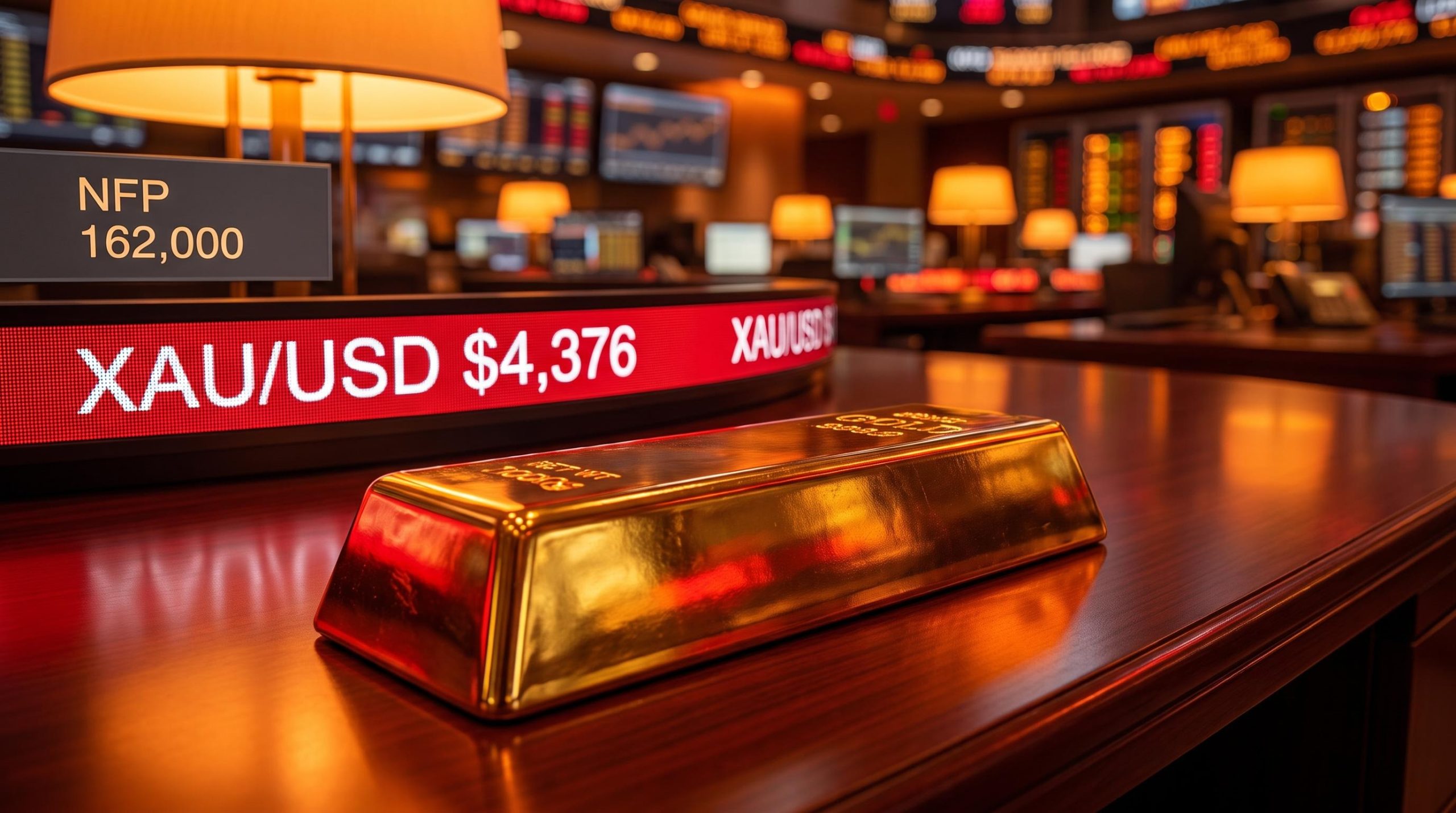
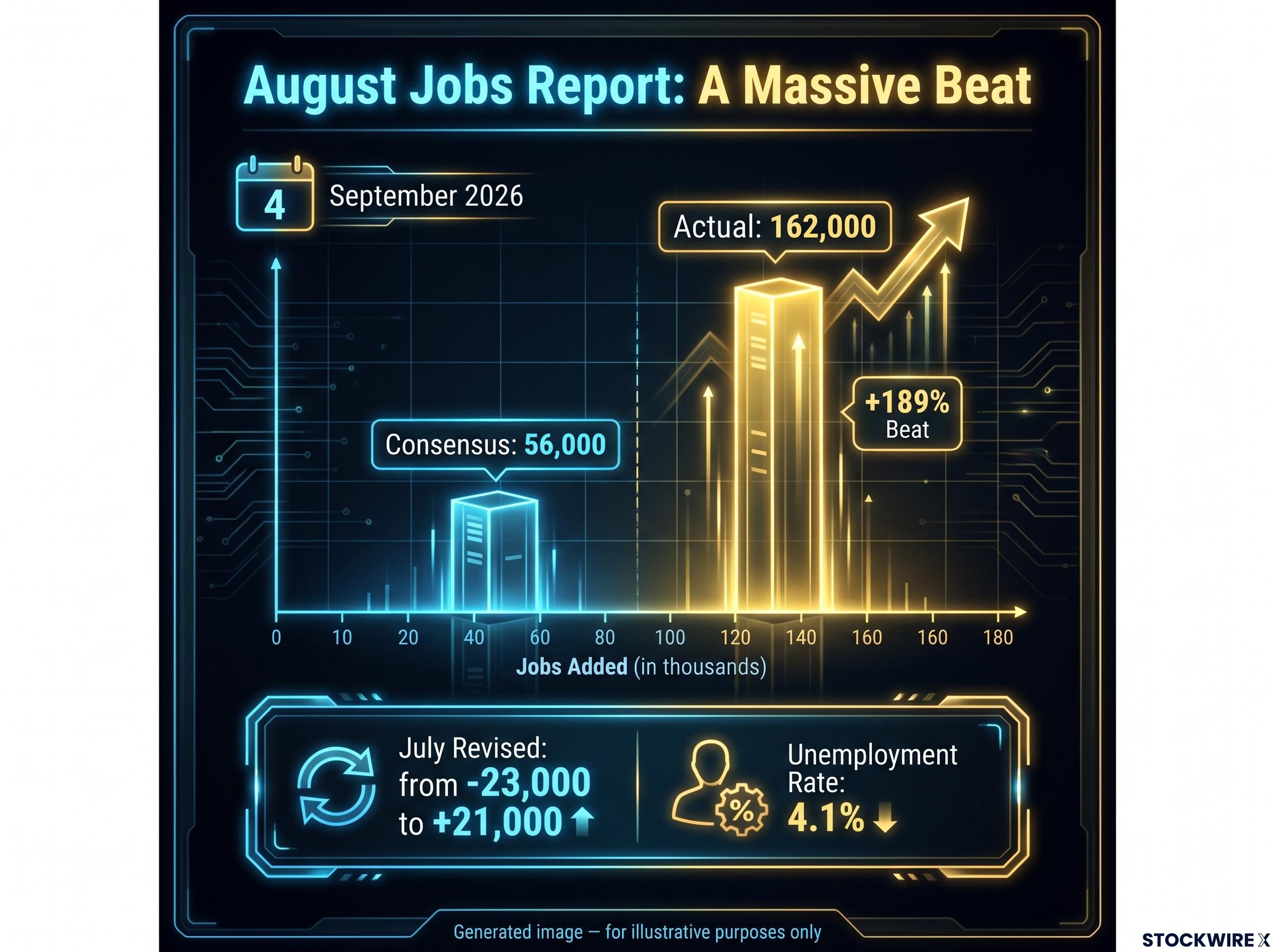
The August jobs report landed at 162,000 against a consensus of 56,000, a beat of nearly three times what economists had penciled in.
Gold dropped more than 2% within minutes of the release, erasing the prior session’s gains after the metal had briefly reclaimed $4,500. This was not a routine flinch at a data print. It was a repricing of when the Federal Reserve raises interest rates next, and it made the 15-16 September FOMC meeting a live event for a hike.
The question now facing anyone tracking gold is twofold: was Friday’s selloff a clean repricing or an overshoot, and what will the August inflation prints on 10 September and 11 September do to the metal from here. This piece walks through both.
One number changed everything: how 162,000 jobs reset the gold trade
The Bureau of Labor Statistics released August nonfarm payrolls on Friday, 4 September 2026, and the headline broke the market’s expectations wide open.
- August NFP actual: 162,000
- Consensus estimate: 56,000
- Unemployment rate: 4.1%, unchanged
A payrolls figure nearly three times the forecast is the kind of surprise that rewrites the near-term policy narrative on its own. But the print carried a second hawkish payload underneath the headline.
The producer price baseline heading into next week’s print matters as much as the monthly change: annual headline PPI sat at 4.7% and core PPI at 4.2% as of the July release, levels the Fed has consistently described as incompatible with a durable pause narrative regardless of any single month’s softness.
July payrolls, originally reported as a contraction of -23,000, were revised up to a gain of +21,000. That revision retroactively strengthens the prior month, turning what looked like a stumble into steady momentum.
NFP revisions have quietly become one of the most market-moving components of each monthly release; July’s sign flip from -23,000 to +21,000 is a textbook example of why traders who anchor to headline figures alone are consistently caught off-side when the data is restated.
| Metric | Consensus Estimate | Actual Result |
|---|---|---|
| August NFP | 56,000 | 162,000 |
| July NFP revision | -23,000 (prior report) | +21,000 |
Gold’s response was immediate. Reuters reported spot gold falling more than 2% to trade at $4,376.04 per ounce, while FXStreet’s Christian Borjon Valencia pegged XAU/USD nearer $4,437, down roughly 1.5%, with different timestamps within the same session explaining the gap. Both readings sat firmly in the red, and both followed Thursday’s brief hold above $4,500.
The detail that gives the Fed room to move is the unemployment rate. Holding at 4.1% alongside a blockbuster payrolls beat tells you the labour market is absorbing the current rate environment without cracking. That combination is precisely what hands the Fed political and economic cover to hike again, and it is why gold could not shrug the number off.
When big ASX news breaks, our subscribers know first
The dollar and yields spike, and gold pays the price
Gold did not fall simply because a jobs number was strong. It fell because of what that number did to three other variables in quick succession.
The chain ran like this:
- The dollar strengthened, making gold more expensive for overseas buyers.
- Treasury yields rose, lifting the appeal of assets that actually pay a coupon over bullion that pays nothing.
- The rate-cut trade repriced, undercutting gold’s role as the go-to hedge against falling rates.
The numbers put scale on each link. The 10-year Treasury yield hit an intraday peak of 4.81% before retreating to roughly 4.768%. The US Dollar Index (DXY) traded at 99.13, up 0.13% on the session.
FXStreet identified the blockbuster NFP surprise lifting both the dollar and yields as the direct catalyst. Reuters attributed the greater-than-2% slide to stronger jobs data boosting expectations of a Fed rate increase as soon as this month. Investing.com tied the move explicitly to higher real-rate expectations and dollar strength.
Kitco captured the mechanism in a single line as gold slipped below $4,500.
The print “lifted Treasury yields, firmed the dollar and pressured the rate-cut trade.”
Both the dollar and yields gave back part of their initial spike, and that partial pullback cushioned gold’s downside without preventing a sustained decline.
That incomplete retreat matters for the week ahead. It tells you markets are not in full agreement about the scale of the repricing, which means gold remains sensitive to any data or Fed commentary that shifts the balance before 15 September. Read intraday moves this week as signal, not noise.
Fed officials and markets now see September as a live hike decision
The repricing was not a foregone conclusion. It is a genuine policy shift happening in real time, with voices on both sides still actively arguing the outcome.
Money markets priced a 61% probability of a September hike as of 4 September, up from 54% the day before, according to Prime Terminal. CME FedWatch readings reported by CNBC showed 66.1% as of 1 September, and Morningstar put the figure near 60% on 2 September. The direction is unambiguous.
The debate among policymakers is sharper than the pricing suggests. Fed Chair Kevin Warsh set the hawkish tone at Jackson Hole, framing the labour market as consistent with full employment and naming inflation the priority.
Warsh characterised the labour market as consistent with full employment, with inflation identified as the primary policy priority.
Governor Michael Barr has said a September hike would be appropriate only if inflation fails to moderate. Governor Christopher Waller left the door unlocked in comments on 3 September, signalling no rush to raise borrowing costs if inflation cools, while conceding a weak inflation print would tilt him toward a September move. Both anchored the decision to price data, not jobs alone.
The institutional forecasts spread across the full range of outcomes.
| Institution | September Hike Forecast | Full-Year 2026 Forecast |
|---|---|---|
| J.P. Morgan | Single 25 bp hike | One hike (September) |
| Bank of America | 25 bp hike | Three hikes (Sep, Oct, Dec) |
| Deutsche Bank | 25 bp hike | Two hikes (Sep, Dec) |
| ABN Amro | Hold absent inflation shock | On hold |
The swing since Jackson Hole, from below 40% to the low-to-mid 60s, tells you Friday’s NFP did not create the hawkish repricing on its own. It accelerated a trend already running, which means gold was vulnerable before the data even landed.
The dot plot shift at the June FOMC meeting had already moved the probability of a 2026 hike meaningfully above 40% before Friday’s data landed, which is precisely why the NFP beat accelerated rather than created the hawkish repricing.
The gap between Bank of America’s three-hike call and the hold camp, which includes ABN Amro and a Reuters economist survey, tells you the September outcome is genuinely undecided. Gold’s next move is not inevitable in either direction, and that is exactly why next week’s inflation data carries so much weight.
What CPI and PPI next week mean for gold’s next move
Friday answered the first question about what 162,000 jobs means for the Fed. The next two releases answer the second, and they arrive on a tight schedule before policymakers can act.
- 10 September, 8:30 a.m. ET: August PPI. A softer producer-price read chips away at the hike case.
- 11 September, 8:30 a.m. ET: August CPI. The single most consequential print for the decision.
- 15-16 September: FOMC meeting. The verdict the first two prints will shape.
The conditional framing is straightforward. Continued disinflation across PPI and CPI weakens the case for a September hike and relieves pressure on gold. A hot print cements expectations and extends the selloff.
Underneath the rate-hike math sits a structural bid that pure policy pricing tends to ignore:
- Central bank demand at scale. World Gold Council Q2 2026 data showed net central bank demand surging to 289 tonnes, a fivefold jump from Q1, with 89% of surveyed central bankers expecting global official holdings to rise over the next 12 months. Goldman Sachs estimates monthly purchases of 50-60 tonnes as a sustained buying base.
- Historical precedent on NFP shocks. FXStreet quantitative analysis across 35 NFP releases found gold declines roughly $5-6 per ounce on average after a positive payrolls surprise, with some studies citing $6.15. The pattern points to immediate selloffs that are often short-lived.
- Hiking cycles do not equal gold bear markets. During the 2022-2023 cycle of 11 hikes that took rates from 0% to 5.5%, gold still climbed to near $2,100 by cycle end.
The structural gold demand floor documented across the broader H2 2026 outlook reflects the same central bank buying surge cited here: a record 45% of reserve managers plan to increase official holdings over the next 12 months, providing a demand backstop that rate-hike pricing cannot easily displace.
Put those forces together and the read is that this selloff has a structural backstop the rate-hike math does not capture. The risk is asymmetric: a soft CPI reading could trigger a sharper recovery than the NFP-driven decline that prompted it.
For anyone tracking gold, that leaves a concrete watch-list. Specific dates, specific pressure points, and a documented demand argument to weigh before drawing conclusions on direction.
This article is for informational purposes only and should not be considered financial advice. Investors should conduct their own research and consult with financial professionals before making investment decisions. Past performance does not guarantee future results. Financial projections are subject to market conditions and various risk factors.
The inflation prints this week will tell gold where to go next
The NFP beat has credibly lifted the odds of a September hike to somewhere around 61-66% and weighed on gold through the dollar and yield channels. Yet the outcome remains explicitly data-dependent, and the structural demand backdrop has not shifted an inch.
The uncertainty resolves on two dates. PPI on 10 September and CPI on 11 September deliver the effective verdict before the FOMC can act on 15 September.
If core CPI keeps moderating, the case for holding strengthens and gold’s rate-hike discount partially unwinds. If it accelerates, the implied hike probability firms further and gold faces renewed pressure.
Either way, next week’s prints are the ones to read closely. They are where the market gives its second, and more decisive, answer to the question Friday’s jobs report only started to ask.