China’s private-sector gauge of services activity just posted its sharpest monthly improvement in months, climbing to a level that beat forecasts and clawed back most of a near two-year low. At the same time, the government’s own measure of the same slice of the economy sat firmly in contraction.
Two numbers, same country, same month, pointing in opposite directions.
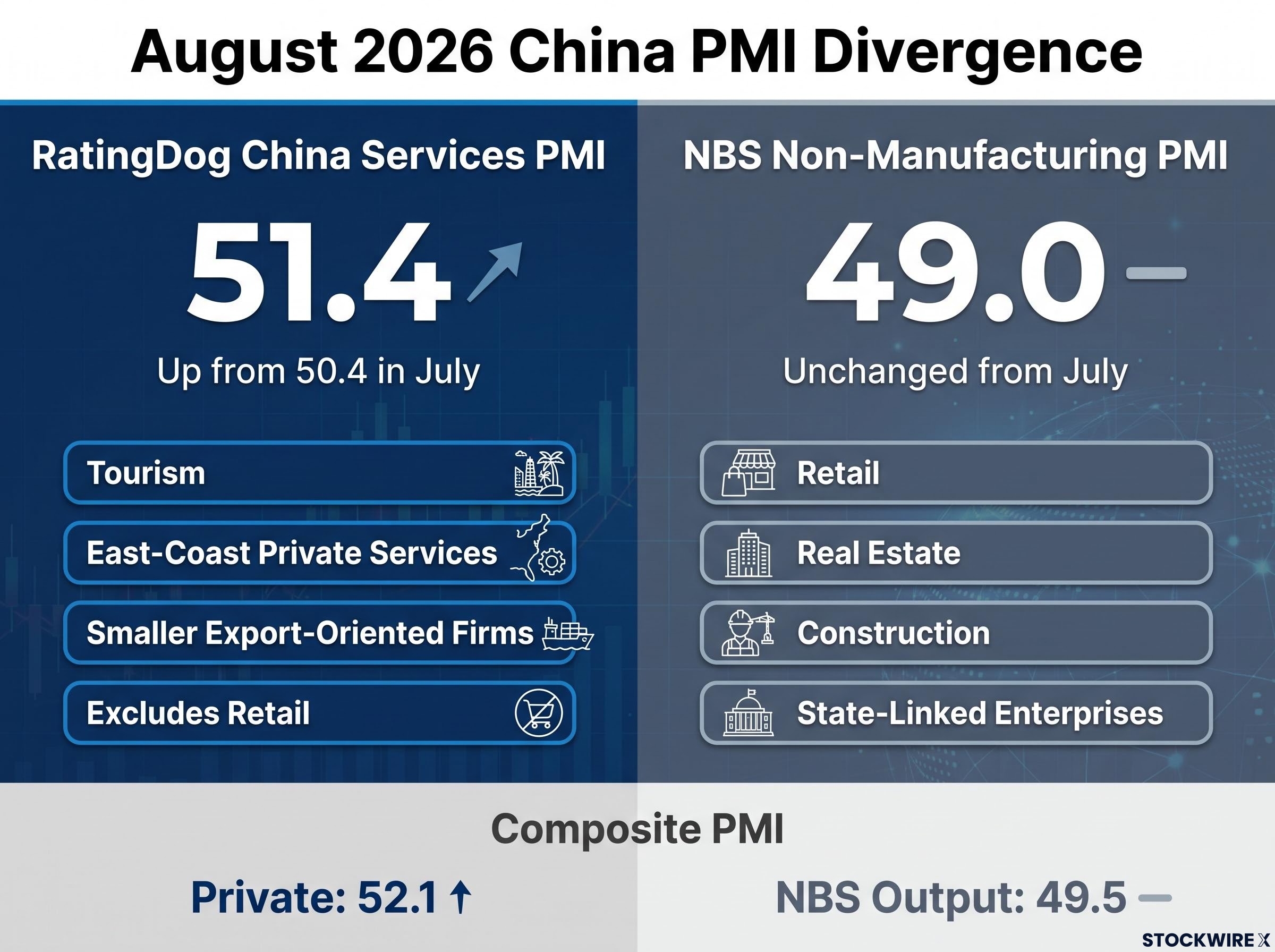
The gap is not a rounding error. The private RatingDog China Services PMI printed 51.4 in August 2026 while the official NBS non-manufacturing PMI held at 49.0, and that split reflects genuinely different exposures. Private firms surveyed lean toward tourism and east-coast service activity; the state-linked enterprises weighted in the official reading carry more retail, real estate, and construction. Underneath both, retail sales slowed to 0.6% year-on-year and youth unemployment spiked to 17.9% in July.
Here is what these two readings, taken together, tell you about where China’s recovery is actually concentrated, why a single PMI headline can mislead, and why the People’s Bank of China (PBoC) is not yet done.
Private services rebound sharply, but the official picture tells a different story
The private-sector read on China’s services economy strengthened in August, and the beat was clear.
RatingDog China Services PMI: 51.4 Above the Bloomberg consensus of 50.6, up from 50.4 in July, and a recovery from a near two-year low.
That is a real improvement in the segment this survey tracks. A reading above 50 signals expansion, and 51.4 puts private services back into growth after a shaky midyear.
Then look at the government’s equivalent, and the story changes completely.
The official NBS non-manufacturing PMI stayed at 49.0 in August, unchanged from July, below the market expectation of 49.5, and stuck at its weakest level since December 2022. Below 50 means contraction. On the broader composite measures, the divergence holds: the private composite PMI climbed to 52.1 from 50.8, while the NBS composite PMI output index sat at 49.5.
Here are the four headline gauges side by side:
- RatingDog China Services PMI: 51.4 in August 2026, up from 50.4 in July, versus consensus of 50.6
- NBS non-manufacturing PMI: 49.0 in August 2026, unchanged from July, weakest since December 2022
- Private composite PMI: 52.1 in August 2026, up from 50.8
- NBS composite PMI output index: 49.5 in August 2026
For anyone tracking China through a single PMI headline, this is the trap. Depending on which survey you read, the country’s services economy is either expanding at a healthy clip or grinding through contraction. The optimism from the private beat has to be held lightly, because the official gauge, which covers a broader and more economically weighted set of firms, is not confirming it.
PMI market pricing dynamics add another layer of complexity: equity markets typically absorb PMI trends 3-30 months before official releases, which means the August beat’s market impact is concentrated in the surprise relative to the 50.6 consensus rather than the absolute 51.4 level.
Why two surveys of the same economy produce such different readings
The split between 51.4 and 49.0 looks puzzling until you see what each survey is actually measuring. Once you do, it starts to look inevitable.
The methodology behind the RatingDog reading, built on the S&P Global framework, explicitly excludes retail and is more sensitive to tourism and private service activity concentrated along the east coast. The Caixin/S&P Global lineage it draws on is widely regarded as a better read on smaller, export-oriented firms. The official NBS non-manufacturing PMI does the opposite: it weights heavily toward large and state-linked enterprises across retail, finance, and real estate.
The NBS non-manufacturing PMI methodology uses a diffusion index approach across ten sub-indexes, weighting large and state-linked enterprises across retail, finance, and real estate in a way that produces a structurally different sample from the private-sector survey.
That difference in coverage is the whole story. According to ABN AMRO’s PMI analysis, the two measures pull apart precisely when tourism and private services hold up while retail, construction, and property soften. Lundgreen’s Investor Insights reaches the same conclusion, noting divergences emerge when tourism is robust but retail and real estate are weak.
The same headline-versus-reality problem runs through China’s industrial data: the July industrial output split between advancing EV and battery production on one side and cement collapsing 11.6% and steel falling 4.1% on the other mirrors the services PMI divergence in structure if not in sector.
Which is exactly the condition present in August 2026.
What the demand data says about the breadth of the rebound
The consumption data underneath the PMI headline shows why the official gauge is stuck. Retail sales grew just 0.6% year-on-year in July, a deceleration from June, while both the urban and youth unemployment rates worsened.
| Indicator | July 2026 | Prior month | Direction |
|---|---|---|---|
| Retail sales (year-on-year) | +0.6% | +1.0% (June) | Slowing |
| Retail sales (month-on-month) | +0.06% | – | Flat |
| Urban unemployment | 5.2% | 5.0% (June) | Rising |
| Youth unemployment (16-24) | 17.9% | 14.9% (June) | Rising sharply |
The youth figure is the standout: 17.9% in July, up from 14.9% in June, its worst reading since August 2025. For the January-July period as a whole, retail sales averaged 1.2% year-on-year, with the ex-automobiles figure at 2.7%, suggesting the headline is being partly dragged down by softness in the car sector rather than collapsing across the board.
Read together, the demand data tells you the private-services recovery is real but narrow. It is concentrated in segments, tourism above all, that do not reflect the consumption conditions facing most Chinese households. This is a two-track economy, and only one track is genuinely accelerating.
What the PBoC does next, and why the case is not as simple as it looks
On the surface, the stronger August services print weakens the case for further easing. A private gauge back in expansion reduces the immediate pressure on the PBoC to reach for its tools.
The pressure eases; it does not disappear.
Inflation is the reason. According to Commerzbank analysis, persistently weak prices and fragile domestic demand keep further support a live option before year-end. Consumer prices rose just 0.5% year-on-year in July, a six-month low, with core CPI at 0.9%. Producer prices told a similar story, up 3.5% year-on-year but falling 0.7% month-on-month, down from a 4.1% annual rate in June. That combination preserves the central bank’s room to act.
The tools analysts regard as available are well established:
PBoC policy signals in August extended beyond the rate and RRR toolkit: 10-year Chinese government bond yields broke below 1.70% while the yuan simultaneously hit its strongest level since February 2023, a rare configuration that analysts read as the central bank facing no current trade-off between domestic stimulus and FX stability.
- Reserve requirement ratio (RRR) reductions, freeing up capital that banks must otherwise hold in reserve
- Expansions of targeted lending facilities, directing credit to specific sectors
- Broader liquidity measures, including rate cuts
But here is where the calculus gets harder than one monthly print implies. The risk, according to ThinkChina, is that monetary easing misdiagnoses a structural consumption problem as a cyclical one. Citing Liu Shijin, former deputy director of the State Council’s Development Research Centre, the analysis points to a demand shortfall that a rate cut cannot reach.
The structural gap China’s household consumption share of GDP sits roughly 20 percentage points below the global average, rooted in inequality and weak social protection, according to Liu Shijin.
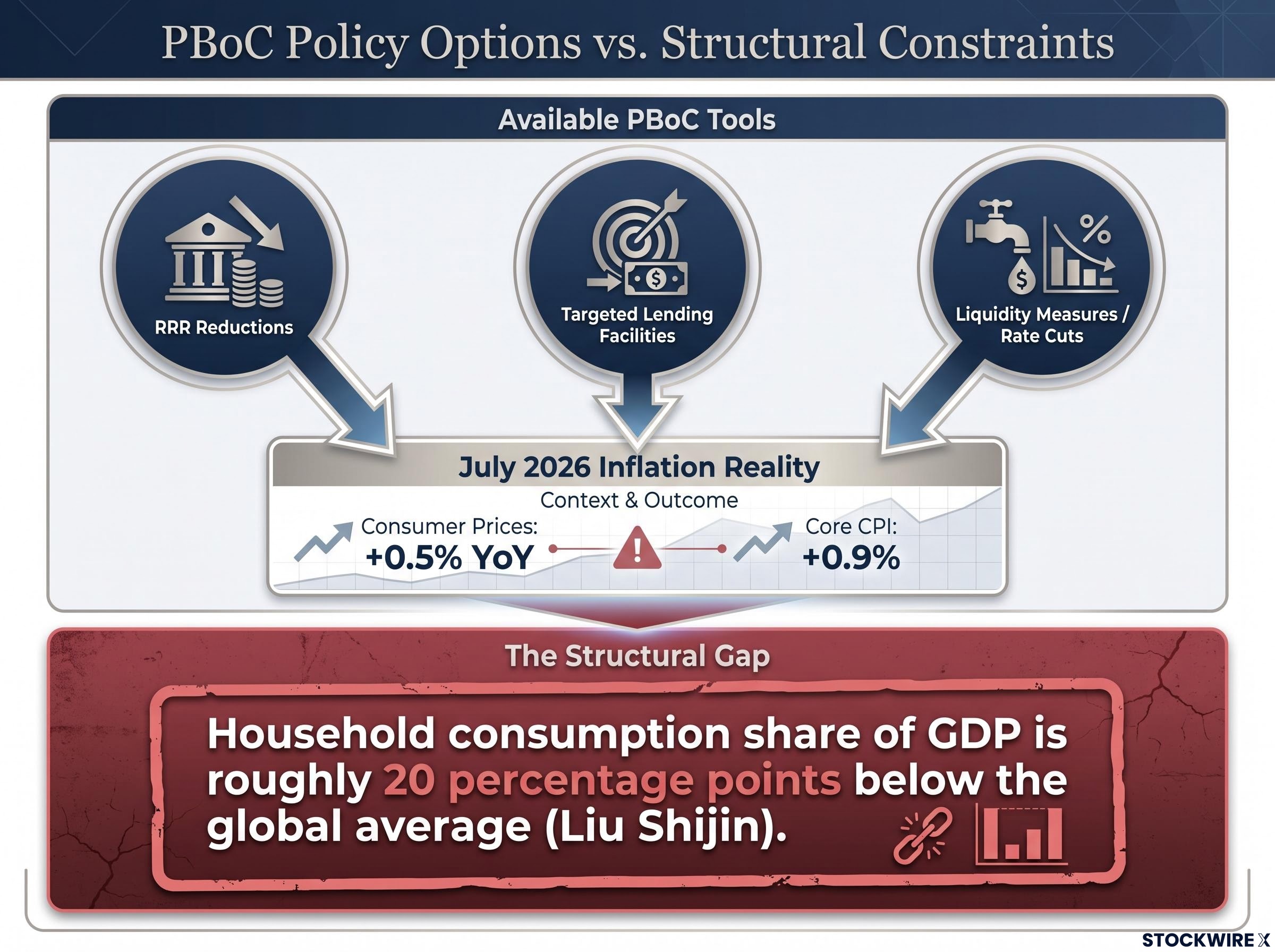
That figure reframes the whole debate. If the demand weakness is structural, then easing addresses the symptom while leaving the cause, household income and social protection gaps, untouched. For investors watching PBoC moves as a signal on China’s trajectory, the takeaway is to calibrate expectations. Further easing is possible, even likely, but its power to broaden the recovery the private PMI is showing is structurally limited.
Reading two PMIs, not one, before making a call on China
The core tension is now clear. The private services beat is a genuine positive for one slice of China’s economy, but the official non-manufacturing PMI, the retail sales trajectory, and the unemployment data collectively say the recovery remains uneven and shallow.
That is why a single number is not enough. The August split, 51.4 private versus 49.0 official, is the whole argument for reading both surveys together rather than reacting to whichever one is moving.
For investors with emerging-market exposure, here are the three indicators worth tracking in the months ahead:
- The NBS non-manufacturing PMI, for the state-sector and broad-economy read that the private survey misses
- The retail sales year-on-year rate, currently 0.6%, as the truest gauge of consumer demand
- Any PBoC announcement on RRR or targeted lending, as the clearest signal that easing is coming
The threshold to watch is consumption. If the official non-manufacturing PMI stays below 50 and retail sales fail to recover, the case for PBoC action before year-end strengthens materially. Youth unemployment at 17.9% sits underneath all of it as a latent drag on future spending.
For investors wanting to understand the structural policy response operating alongside the PMI cycle, our full explainer on China’s August housing overhaul covers the five-regulator reform package that scrapped presale mortgages and extended loan terms to 40 years, providing context for the property-linked weakness in the official NBS non-manufacturing PMI.
Check both PMIs together, pair them with the retail print, and you get a far more accurate picture of where China is heading than any single headline can offer.
This article is for informational purposes only and should not be considered financial advice. Investors should conduct their own research and consult with financial professionals before making investment decisions. These statements are speculative and subject to change based on market developments and economic conditions.