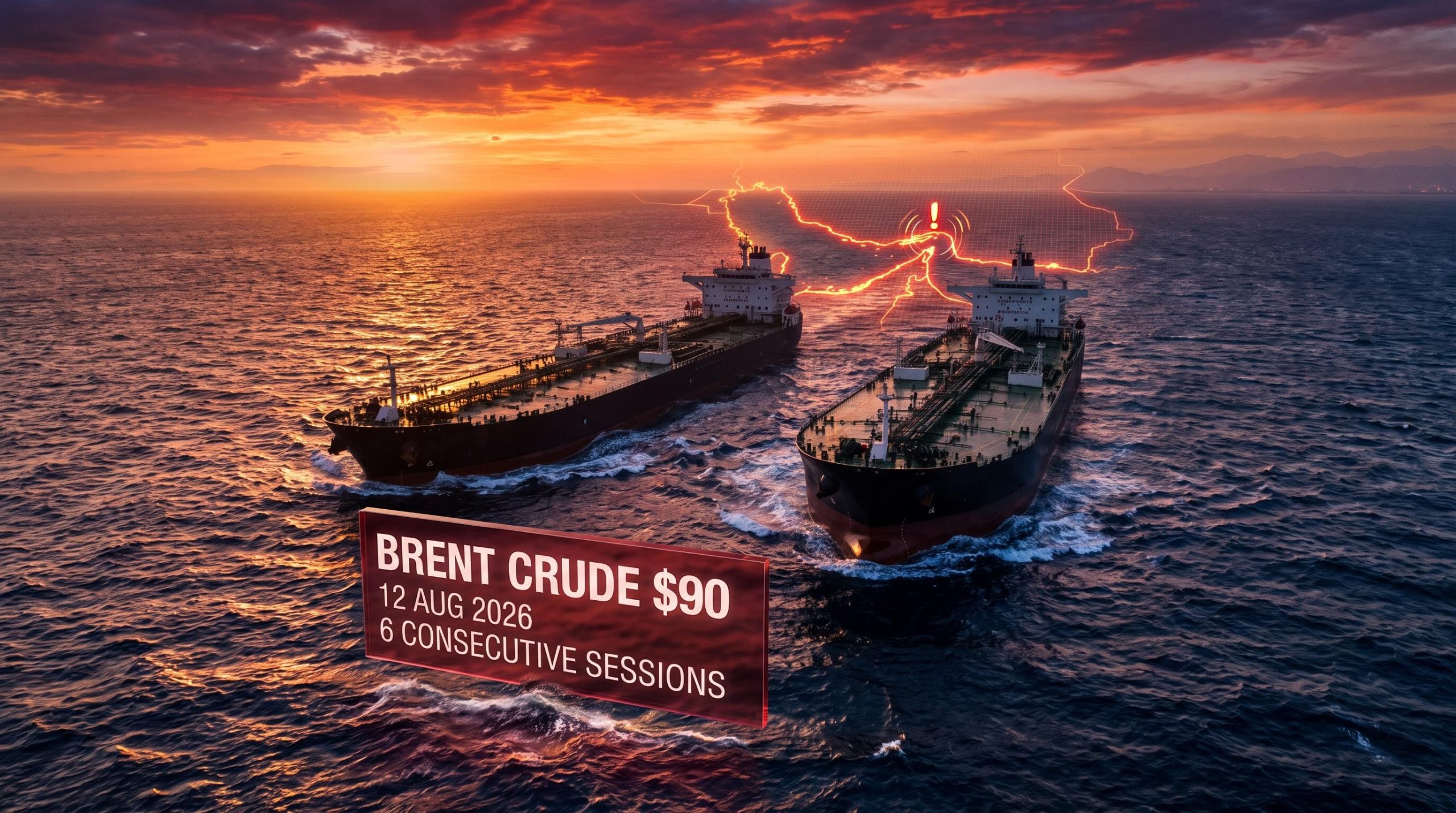
Brent crude reached approximately $90 per barrel on 12 August 2026, completing a sixth straight session of price gains driven by simultaneous pressure at the two maritime chokepoints that matter most to global energy supply: the Strait of Hormuz and the Bab el-Mandeb Strait.
The Hormuz disruption alone would be headline enough. Iran has effectively closed or severely constrained the strait since 28 February 2026, a blockade that analysts describe as the largest disruption to world energy supply since the 1970s oil crisis. But ongoing Houthi strikes against shipping in the Bab el-Mandeb corridor are adding further strain, squeezing Asia-Europe shipping lanes at the same time.
The price move reflects more than a single event. Here is what the rally actually signals about forward risk, why a diplomatic resolution is further away than most headlines suggest, and what sustained crude above $90 means if you hold energy equities, watch inflation expectations, or rely on rate-cut timing for your broader positioning.
Six sessions, one through-line: what is actually driving Brent to $90
Brent traded near $88-$89 per barrel in early August. Six sessions later, it crossed $90. That is not a spike driven by a single headline; it is a market systematically repricing the probability that supply disruptions will persist or worsen.
The mechanism matters. Markets do not wait for barrels to stop flowing before prices move. They price the risk that barrels might stop flowing, a geopolitical risk premium that reflects the credible threat of further closure, tanker attacks, or military escalation. Some oil is still moving through managed transits and alternative routes. The premium exists because traders cannot be confident those flows will continue.
Some oil is still moving precisely because bypass pipeline infrastructure, including Saudi Arabia’s East-West Pipeline running at or near full capacity to Yanbu and the UAE’s Habshan-Fujairah pipeline delivering approximately 1.8 million barrels per day, has absorbed a portion of the diverted volumes, providing a supply floor that explains why Brent has not repriced to the levels seen in mid-May.
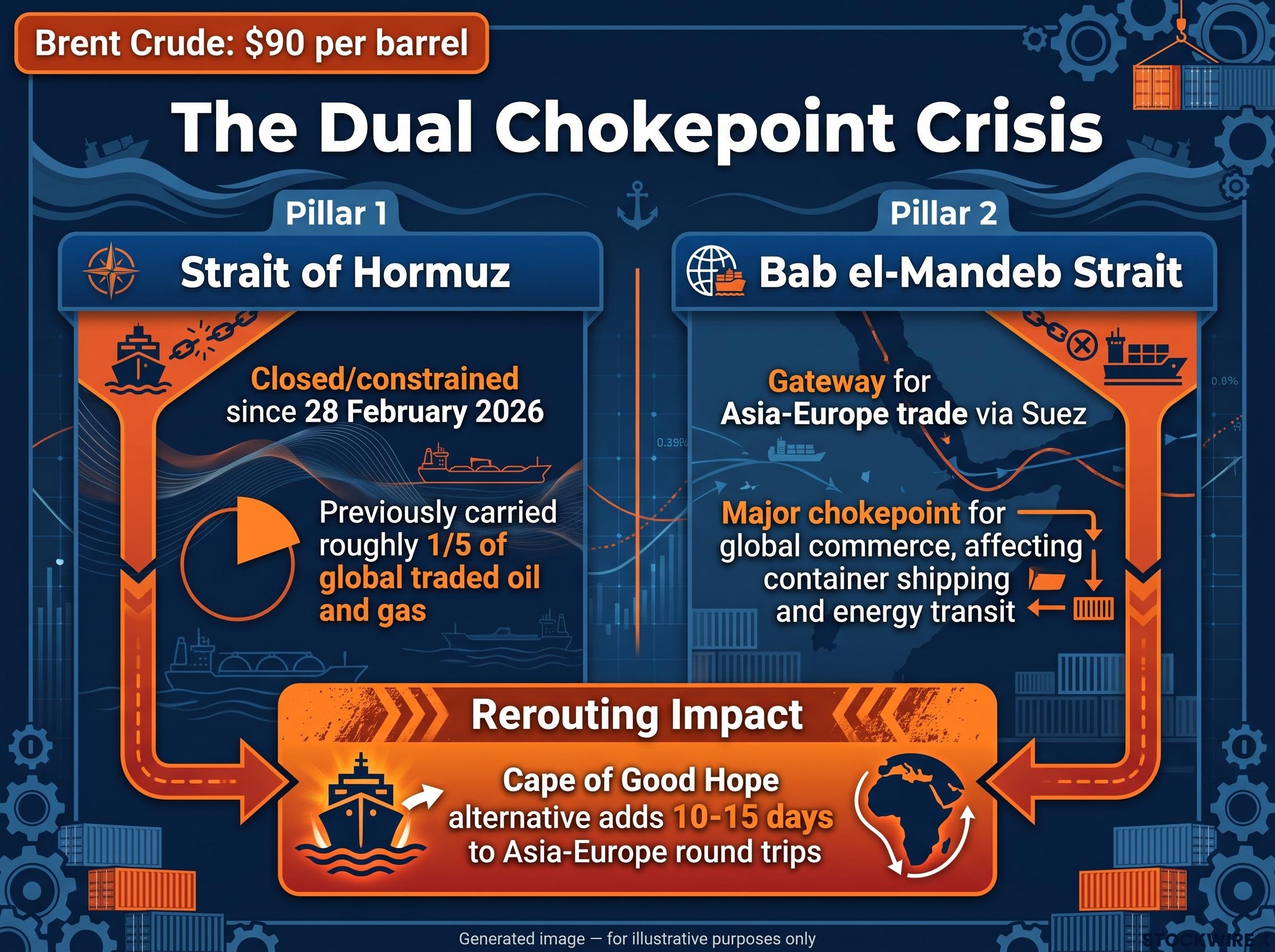
What makes the current environment unusual is that two chokepoints are under stress simultaneously:
- Strait of Hormuz: previously carried roughly one-fifth of global traded oil and gas, now effectively closed or severely constrained since late February
- Bab el-Mandeb Strait: the gateway for Asia-Europe trade via Suez, including refined product shipments, now under repeated Houthi attack
Brent crude closed near $90 per barrel on 12 August 2026, extending a run of gains that has now stretched across six consecutive sessions.
Each chokepoint alone would warrant a risk premium. Together, they tell the market that the disruption is not isolated but regional, and that is why the rally has structural legs rather than the feel of a one-day sentiment trade. For anyone with energy or inflation exposure, the signal is that this premium is being priced as a feature of the current environment, not a temporary headline.
When big ASX news breaks, our subscribers know first
Why the Strait of Hormuz remains closed and talks are going nowhere
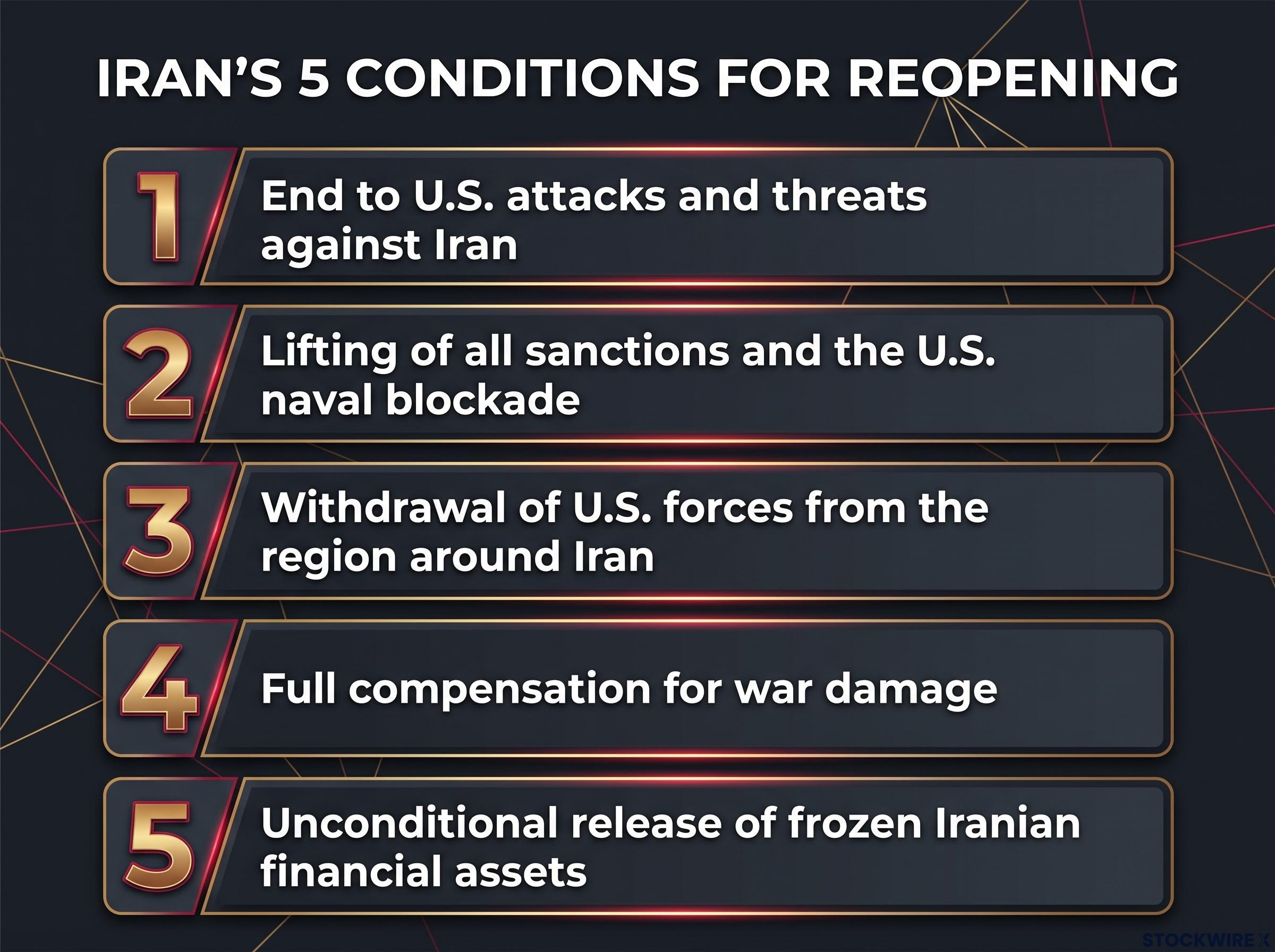
Iran’s Supreme National Security Council has issued five formal conditions for reopening the strait. These are not negotiating openers. They are stated demands:
- End to U.S. attacks and threats against Iran
- Lifting of all sanctions and the U.S. naval blockade
- Withdrawal of U.S. forces from the region around Iran
- Full compensation for war damage
- Unconditional release of frozen Iranian financial assets
Tehran has signalled that even a near-final technical deal brokered through Oman will not reopen the strait unless the U.S. meets these broader political demands. The disruption has been running since 28 February 2026, making this the longest sustained closure of the world’s most important energy chokepoint in modern history.
The U.S. counter-position and why the naval blockade compounds the impasse
The U.S. has reimposed a naval blockade in response to renewed Iranian attacks and rejected Iran’s terms outright. Rather than offering concessions, Trump publicly called on Iran to make reparation payments, a position that sits at the opposite end of the spectrum from Tehran’s five conditions.
Analysts warn that both sides currently assess they can sustain the status quo. That is why this stalemate is stable rather than fragile: neither side feels enough pressure to move. The diplomatic distance between the two positions is not a gap that closes in days or weeks, and investors should calibrate timeline assumptions for Hormuz reopening accordingly.
A parallel negotiating track concerns a proposed Hormuz toll regime under which Iran would levy up to 7% of cargo value per VLCC crossing, a fee structure that, if imposed as a mandatory control mechanism rather than a voluntary coordination model, would embed a permanent cost floor into every barrel of Gulf crude regardless of whether the strait physically reopens.
Houthi attacks in the Red Sea add a second layer of maritime risk
The Hormuz closure would be disruptive enough on its own. The Bab el-Mandeb attacks turn a single chokepoint crisis into a layered regional one.
Confirmed incidents in August include:
- Houthi forces struck cargo ships transiting the Bab el-Mandeb Strait, with reported fatalities among crew members aboard the targeted vessels and among Yemeni personnel who responded to the scene
- A Panama-flagged vessel operating in waters near the Gulf of Oman was boarded and put out of action by U.S. Navy forces
- Houthi forces continued claiming attacks on Saudi oil tankers and other vessels in the Red Sea corridor
The Bab el-Mandeb strait is less central to raw crude flows than Hormuz, but it is the gateway for Asia-Europe trade via the Suez Canal, including refined product shipments. When both chokepoints are under simultaneous pressure, tankers face a binary choice: risk the route or reroute around the Cape of Good Hope.
Cape of Good Hope rerouting adds approximately 10-15 days to Asia-Europe round trips, raising fuel consumption, charter rates, and war-risk insurance costs.
That rerouting cost hits delivered oil prices even before a single barrel is physically blocked. It is why freight rates and insurance costs are rising independently of the headline crude price, with direct implications for shipping equities and delivered inflation across importing economies.
How sustained high oil prices flow through to energy equities and inflation
The transmission from a $90 barrel to portfolio and consumer impact follows a logical chain, and each link matters for different parts of an investor’s positioning.
Upstream producers and integrated majors benefit first. Companies producing crude and gas outside the conflict zone, particularly in North American shale and the North Sea, see margin expansion as realised prices rise faster than short-term operating costs. If Brent sustains levels near or above $90, analysts are likely to revise earnings expectations upward for these groups.
Refiners face a more complicated picture. A crack spread is the difference between the price a refiner pays for crude and the price it receives for refined products like petrol, diesel, and jet fuel. When crude rises faster than product prices, that spread compresses, squeezing profitability. Whether refiners benefit or suffer depends on regional product demand and their ability to pass higher costs through to customers.
| Sub-Sector | Direction of Impact | Key Condition for Benefit |
|---|---|---|
| Upstream Producers | Positive (margin expansion) | Sustained Brent near or above $90; production outside conflict zone |
| Refiners | Mixed (crack spread dependent) | Regional product demand strong enough to pass through higher crude costs |
| Tanker and Shipping | Positive (higher freight rates) | Diversified fleet and routes; not concentrated in high-risk lanes |
The inflation and central bank dimension
Higher crude feeds directly into diesel, petrol, jet fuel, and bunker fuel, raising transportation and freight costs across the economy. Producer prices tend to react first; consumer prices follow with a lag measured in weeks to a few months.
The indirect inflation transmission channel, where elevated energy costs flow through logistics, agriculture, and manufacturing supply chains, operates on a 6-12 month lag, meaning the full consumer price impact of sustained $90 Brent has not yet appeared in published CPI data and will continue building into late 2026.
For major central banks including the Fed, European Central Bank (ECB), and Bank of England (BoE), oil-driven headline inflation re-acceleration complicates rate decisions. If crude stays elevated, the path to rate cuts could lengthen, affecting growth equities and fixed-income positioning well beyond the energy sector. Net oil-importing emerging markets face additional pressure: worsening current-account balances, currency depreciation risk, and tighter fiscal conditions.
Three scenarios investors should be tracking from here
The diplomatic and military signals point to three distinct paths from here, and the base case is not the comforting one.
- Base Case: Prolonged Stalemate. Iran maintains its five conditions. The U.S. holds its naval posture. Some managed flows resume through Hormuz, but the risk premium persists. Red Sea attacks continue intermittently. Brent trades in the high-80s to mid-90s range. Energy equities outperform broader indices. Given Iran’s maximalist stance and the absence of a comprehensive agreement, commentators judge this as the dominant near-term path.
- Acute Escalation. A major tanker attack in Hormuz, a significant escalation of Houthi operations, or direct U.S.-Iran military clashes push Brent toward or above $100. Broader equities sell off in a risk-off move. Central banks face sharply intensified inflation pressure. Emerging market vulnerabilities deepen.
- Unexpected De-escalation. A breakthrough via Oman or back-channel U.S.-Iran contacts leads to a durable reopening framework. The geopolitical risk premium compresses quickly, sending oil lower and catching investors positioned for continued strength off guard.
Base case Brent range: high-80s to mid-90s per barrel, the anchor for near-term investor planning.
Both upside and downside scenarios for oil prices are live simultaneously. That argues for position sizing and hedging discipline rather than conviction-driven concentration in energy names.
What changes if Hormuz stays closed through September and what does not
Some elements of this crisis are now structurally embedded regardless of near-term diplomatic noise. The geopolitical risk premium, elevated freight and insurance costs, and the shift in tanker routing economics are not going away quickly even if talks resume tomorrow. The disruption has been running since 28 February 2026; rerouting decisions, insurance repricing, and contract adjustments have already been baked into the market’s operating assumptions.
The geopolitical risk premium embedded in Brent is not expected to decompress quickly even under a best-case resolution; the IEA projects a two-year supply chain recovery timeline, and the near-total withdrawal of commercial war-risk insurance has effectively closed Hormuz to standard traffic even during periods when physical passage was technically possible.
What remains genuinely uncertain is the trajectory. Three variables will determine whether the current path holds, breaks higher, or reverses:
- Oman-mediated negotiation pace: the most active diplomatic channel and the best early signal of movement
- Houthi attack intensity in the Red Sea: any sustained increase would compound the existing premium
- U.S.-Iran military incidents in or around Hormuz: the escalation trigger that markets fear most
This is a geopolitically driven commodity cycle, not a demand-driven one. The normal demand-signal indicators, purchasing managers’ indices, GDP forecasts, inventory draws, are secondary right now. The primary price signals are diplomatic dispatches and military incident reports. An investor who monitors accordingly is better positioned than one watching economic data releases for direction.
This article is for informational purposes only and should not be considered financial advice. Investors should conduct their own research and consult with financial professionals before making investment decisions. These forward-looking scenarios are speculative and subject to change based on market developments and geopolitical conditions.