
CBA just posted a record A$10.98 billion cash profit for FY26, up 7.1% on the prior year. The dividend is higher. Analyst sentiment is broadly positive.
The same results package also contains a disclosure that home loan application volumes have fallen by 15% from their May 2026 peak, alongside rising arrears across two loan categories.
For investors reading the FY26 result through the headline numbers alone, the picture looks comfortably strong. But the mortgage book, which remains the core of CBA’s lending business, is entering a more demanding phase. Application volumes have pulled back sharply, arrears are tracking upward, and the macro variables that govern both trends, the RBA rate path, housing transaction volumes, and household budget stress, have not yet resolved in the bank’s favour.
Here is the analysis that the headline figures do not surface: where credit stress is building, why investor borrowers are driving the sharpest declines, and what the combination means for CBA’s earnings trajectory into FY27. This is for readers who want to understand what they are actually holding, not just what the profit number says.
The 15% pullback in home loan applications is not evenly distributed
The top-line decline is steep enough on its own. But the composition underneath it is where the real signal sits.
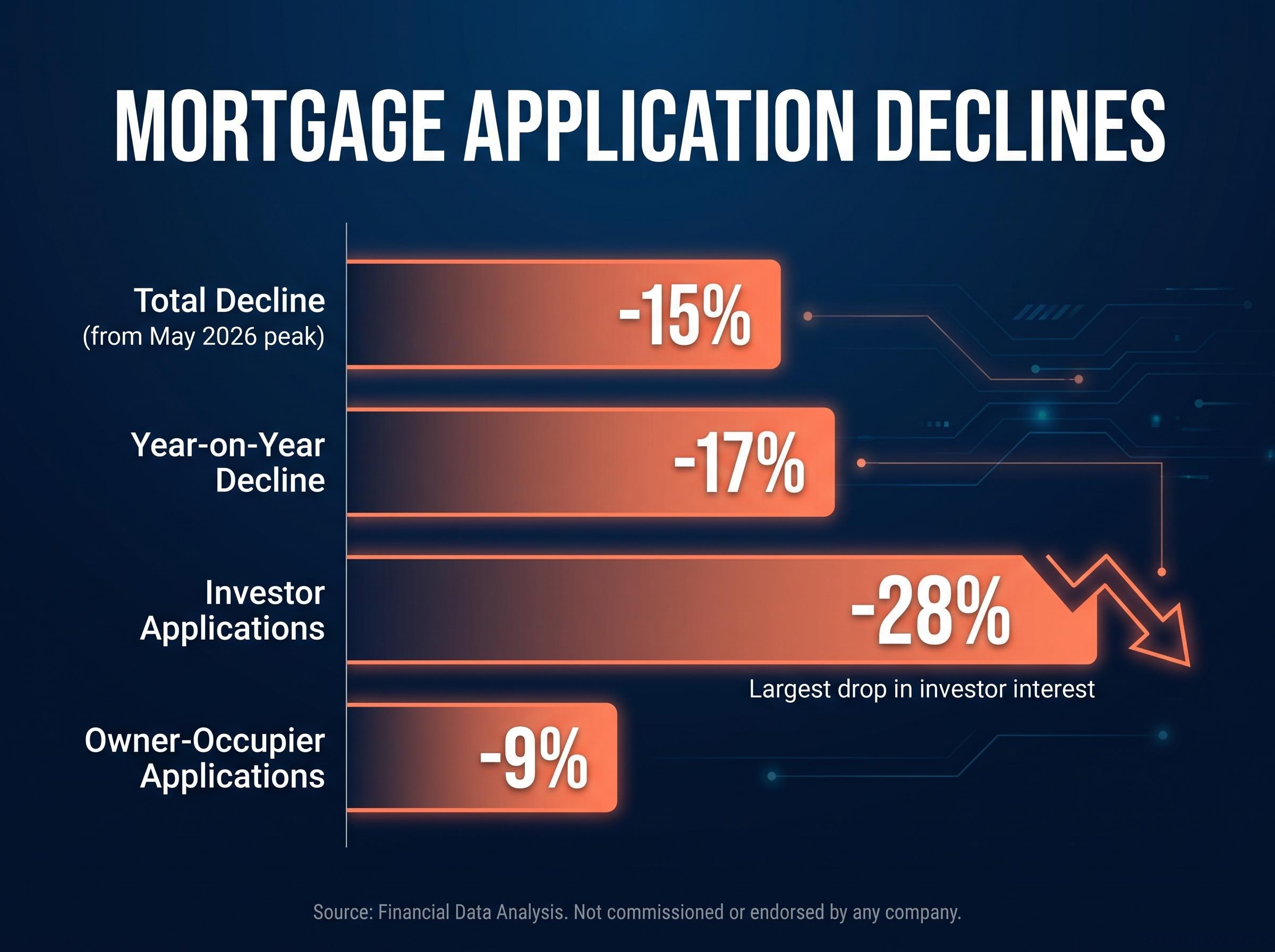
- Home loan applications down 15% from the May 2026 peak (four-week rolling average basis)
- Year-on-year application volumes down approximately 17%
- Investor applications down approximately 28% since May 2026
- Owner-occupier applications down approximately 9% since May 2026
That investor figure is doing most of the damage. A 28% decline in a borrower segment that typically carries stronger margin characteristics than owner-occupier lending is not a uniform demand softening. It is a structural repricing of who wants to borrow and why.
CBA management characterised housing activity as having “softened from a high base,” noting that application volumes “appear to have stabilised in recent weeks.”
That characterisation deserves scrutiny. Stabilisation after a 28% investor decline and a 17% year-on-year drop is not recovery. It is the bleeding slowing. The question for FY27 is whether volumes rebuild from here or simply hold at a lower base, and the answer depends on two forces that are working against investor borrowers simultaneously.
When big ASX news breaks, our subscribers know first
What is driving investor demand away from the mortgage market
The investor application collapse is not a sentiment wobble. Two structural forces converged on prospective property investors in the same quarter, and neither has reversed.
How the rate environment reduces borrowing capacity
- The RBA cash rate stands at 4.35% as of August 2026, following three hikes delivered during 2026.
- Lenders apply a serviceability buffer of approximately 3 percentage points on top of the actual rate, meaning borrowers are assessed at an effective test rate above 7%.
- That buffer disproportionately limits borrowing capacity for rate-sensitive borrower types, particularly investors and single-income applicants, who face tighter debt-to-income constraints at these test rates.
The rate environment alone would have slowed investor demand. But the second force hit at almost exactly the same time.
What the May 2026 budget changes mean for new investors
- The Federal budget announced on 12 May 2026 restricted negative gearing on established investment properties. Existing holdings are grandfathered, but new investors purchasing established properties can no longer offset rental losses against other income in the same way.
- Capital gains tax treatment was also adjusted, changing the after-tax return profile for leveraged property investment.
- These changes hit prospective new investors hardest, since they cannot rely on the tax offsets that made leveraged property acquisition economically attractive in prior years.
The May 2026 share price reaction to the Q3 result illustrated how quickly a premium-valued bank can reprice when a modest earnings miss coincides with a structural policy shock, with CBA shedding approximately $29.93 billion in market capitalisation in a single session as the budget’s negative gearing changes and the provision top-up hit simultaneously.
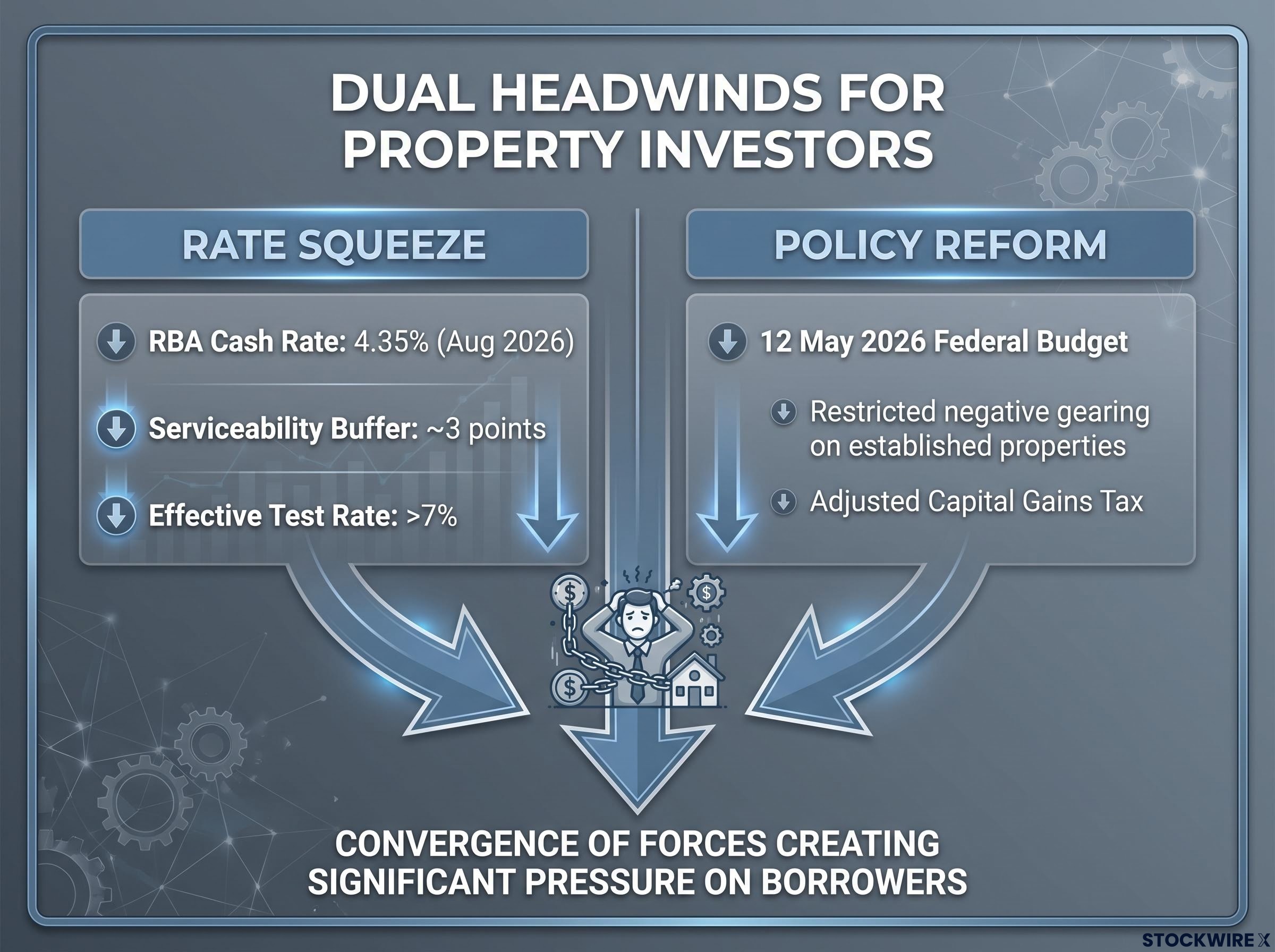
The owner-occupier decline of 9% compared to the investor decline of 28% maps directly onto this two-factor explanation. Owner-occupiers are less exposed to both the rate squeeze and the tax reform because they are not relying on rental income offsets or investment return calculations to justify the borrowing.
For investors assessing the mortgage book, this means the investor application recovery will be slower than a rate-cut-alone scenario would suggest. Rate cuts are reversible and the RBA controls the pace. The tax policy changes are structural and will shape investor economics through the entire FY27 period and beyond.
Inside the arrears data: where credit stress is building
The application volume decline tells you about future mortgage book growth. The arrears data tells you about the quality of what is already on the books.
| Loan Category | Arrears Rate | Movement |
|---|---|---|
| Home loans (90+ days) | 0.73% | Up approximately 10 basis points on prior half |
| Home loans (30+ days) | 1.33% | Rose during FY26 |
| Personal loans | ~1.72% | Rose during FY26 |
Arrears, in plain terms, measure the share of loans where borrowers have fallen behind on repayments by a specified number of days. A 90-plus day arrears figure captures borrowers who have missed multiple consecutive payments, a more serious indicator than the 30-day measure.
The pattern here matters more than any single figure. Both home loan and personal loan arrears rose concurrently during FY26. When stress appears across multiple debt types at the same time, it signals that household budgets are being squeezed broadly, not that isolated borrowers are hitting trouble on a single obligation.
The Q3 2026 result had already flagged this trajectory: a $200 million provision top-up and personal loan arrears spiking 30 basis points in a single quarter were early signals of deteriorating credit quality that the FY26 full-year figures have since confirmed across a wider range of lending categories.
CBA explicitly links rising arrears to cost-of-living pressures and higher interest rates, which are now affecting some borrowers’ ability to keep up with repayments.
CBA characterises the overall credit portfolio as “sound” and maintains a substantial provisions buffer against potential losses. That is fair at the current absolute level. But the direction of travel is unambiguous: arrears are rising, not stabilising, and the bank itself recorded a higher loan impairment expense during FY26 compared to the prior period.
For investors modelling FY27, the direction of travel on arrears is more analytically important than the absolute level. It sets the trajectory for loan impairment expense in the year ahead.
What rising credit costs mean for CBA’s FY27 profit trajectory
Record FY26 earnings of approximately A$10.98 billion are real. So is the mechanism by which those earnings could flatten in FY27.
The volume and mix headwind
Slower application volumes compound with the investor-to-owner-occupier mix shift to produce a mortgage book that grows more slowly and with a modestly different margin profile. Investor loans typically carry stronger margins than owner-occupier loans. As the investor share of new flows shrinks, the revenue contribution per dollar of new lending nudges lower, even before any credit losses materialise.
The credit cost headwind
Loan impairment expense rising from FY26 levels is the most direct earnings-level consequence of the arrears trend. Higher arrears lead, with a lag, to higher write-offs and provisions. CBA itself flagged housing activity and arrears as key areas to monitor in its FY27 outlook, and provisioning decisions over the next two reporting periods will signal how management reads the severity of this cycle.
The key FY27 risk factors, in sequence:
- Slower mortgage book growth as application volumes remain below prior-year levels
- Mix shift away from higher-margin investor lending toward owner-occupier flows
- Higher loan impairment expense as arrears trends translate into actual losses
- Provisioning risk if management positions for a more adverse credit environment
Analyst buy ratings have been maintained post-result, with diversified earnings growth across business banking and other segments cited as a mitigant. That diversification is genuine. But the mortgage book is where the most direct constraint on upside sits.
The broker valuation case against CBA does not require the bank to report losses; it requires only that the premium multiple CBA trades at normalises toward peer levels, a dynamic that slower mortgage growth and rising impairment expense would accelerate by compressing the earnings trajectory underwriting that multiple.
The combination of slower volume growth and a rising impairment expense line is the mechanism by which a record FY26 result can coexist with a more subdued FY27 trajectory. Investors should be modelling this dynamic explicitly rather than extrapolating the FY26 growth rate forward.
The macro variables that will determine how this plays out
Three external variables will shape whether the mortgage book risks intensify or resolve. Each one feeds directly into CBA’s arrears trajectory and origination volumes.
The RBA rate path is the single most consequential variable for both arrears and origination volumes. Every rate decision between now and mid-FY27 is effectively a direct input into CBA’s mortgage book performance.
The RBA tightening cycle that delivered three consecutive hikes from 3.85% to 4.35% between January and May 2026 positioned Australia as the most aggressive rate-hiking central bank in the developed world during that period, a divergence that compressed household disposable income and borrowing capacity simultaneously while peer economies held rates steady.
| Variable | Favourable Scenario | Adverse Scenario |
|---|---|---|
| RBA rate path | Rate cuts ease repayment burdens, revive origination volumes | Rates held at 4.35% or raised further, accelerating arrears and suppressing demand |
| Labour market trajectory | Employment remains stable, containing arrears at current levels | Rising unemployment deepens household stress, translating arrears into defaults |
| Housing transaction volumes | Transaction activity stabilises, supporting new loan demand | Cooling volumes dampen originations and soften collateral values |
The concurrent rise in home loan and personal loan arrears already confirms broad-based household budget stress. If unemployment or underemployment rises from here, that stress translates into more pronounced defaults and impairments. CBA holds substantial provisions in anticipation of a potentially more adverse environment, but the labour market is the variable that determines whether those provisions prove adequate or need topping up.
Each RBA meeting between now and mid-FY27 is effectively a direct input into CBA’s arrears trajectory and mortgage origination volumes. If you hold or are considering CBA, you should be reading rate decisions through this specific lens, not just as economy-wide macro events.
What to watch in the next 12 months before drawing conclusions on FY27
The analytical framework built across this piece translates into six specific signals that will tell you whether the mortgage book risks are resolving or deepening. Ordered by most direct earnings impact to longer-lag indicators:
- Home loan application volume trajectory, especially the investor segment. A rebound in investor applications would be the earliest positive signal for mortgage book growth and margin dynamics. Continued decline or stagnation at current levels confirms the structural headwind.
- Arrears direction and rate of change in half-year and quarterly updates. The rate of increase matters as much as the absolute level. Decelerating arrears growth signals the stress is peaking; acceleration signals it is not.
- Loan impairment expense trend. This is the clearest earnings-level indicator of how arrears are translating into actual losses. Rising impairment expense directly compresses net profit.
- Collective provisioning movements. Any increase in collective provisions would signal management is positioning for a more adverse credit environment, a forward-looking indicator of how the bank reads the cycle.
- Investor-versus-owner-occupier mix in new lending. The compositional shift determines both the margin profile and risk profile of the growing mortgage book.
- RBA policy decisions. Rate movements remain the single most powerful external lever on both arrears and origination volumes.
The risks in CBA’s mortgage book are disclosed and visible rather than hidden. CBA’s scale, deposit base, and diversified business segments, including strong FY26 growth in business banking, provide structural support against a purely mortgage-driven earnings shock. Analyst buy ratings were retained post-results, with the breadth of earnings growth cited as a key factor.
That visibility is itself analytically relevant. You are not being asked to price hidden credit deterioration. You are being asked to assess whether the disclosed trajectory, at CBA’s current valuation, is adequately reflected in the price.
A record result with a more complex story underneath it
The two-track picture is clear. FY26 headline strength is real: record cash earnings, a higher dividend, growth across multiple business segments. But the mortgage book is entering a more demanding phase that creates a credible headwind to the FY27 earnings trajectory through slower volume growth, a compositional shift away from higher-margin investor lending, and rising credit costs.
This is a normalising credit cycle, not a solvency concern. The distinction matters for how you size and hold the position. The question worth asking is not “is CBA in trouble?” but rather: does the current price adequately reflect a period of slower mortgage growth, rising impairment expense, and genuine macro uncertainty around the rate path?
The six watchpoints above will sharpen the answer through the year ahead. The data will update. The investment case should update with it.
This article is for informational purposes only and should not be considered financial advice. Investors should conduct their own research and consult with financial professionals before making investment decisions. Past performance does not guarantee future results. Financial projections are subject to market conditions and various risk factors.