
Most working adults understand that spending every dollar of a paycheck without saving anything is financially reckless. Yet a surprising number of retired investors do precisely that with their portfolio income, spending every distribution and reinvesting nothing.
In retirement, the income your portfolio generates, whether from dividends, REIT distributions, or bond interest, acts as the financial engine that sustains your lifestyle. Without reinvesting any portion of it, your income base stays flat or slowly erodes. That leaves you exposed to inflation, payout cuts, and unexpected expenses with no buffer to absorb any of them.
This guide lays out a practical discipline: directing 10-15% of your distributions back into the portfolio regardless of life stage. It is a baseline habit worth forming, not an onerous financial sacrifice. The ask is small, the protection is meaningful, and the mechanics are simpler than you might expect. Here is how the rule works, why it matters, and how to put it into action today.
What the 10-15% rule actually means (and where it comes from)
The savings rule in working years
You have probably heard this one before. Fidelity recommends saving at least 15% of pre-tax income (including employer match) throughout a career to maintain your lifestyle in retirement. Schwab references a 10-15% savings rate as a rule of thumb, particularly when starting in your 20s or 30s. The principle is straightforward: consistently setting aside a modest slice of your income allows compounding to work and builds long-term financial resilience.
Translating it to retirement income
The same logic applies after you stop working. Distributions in retirement are income, just as a salary was income. The discipline simply changes form: instead of new savings, you reinvest a portion of what your portfolio pays you.
At a typical 4% annual withdrawal rate, setting aside 10-15% of that income for reinvestment still leaves 85-90% of your distributions available for living expenses. The sacrifice is modest by any measure.
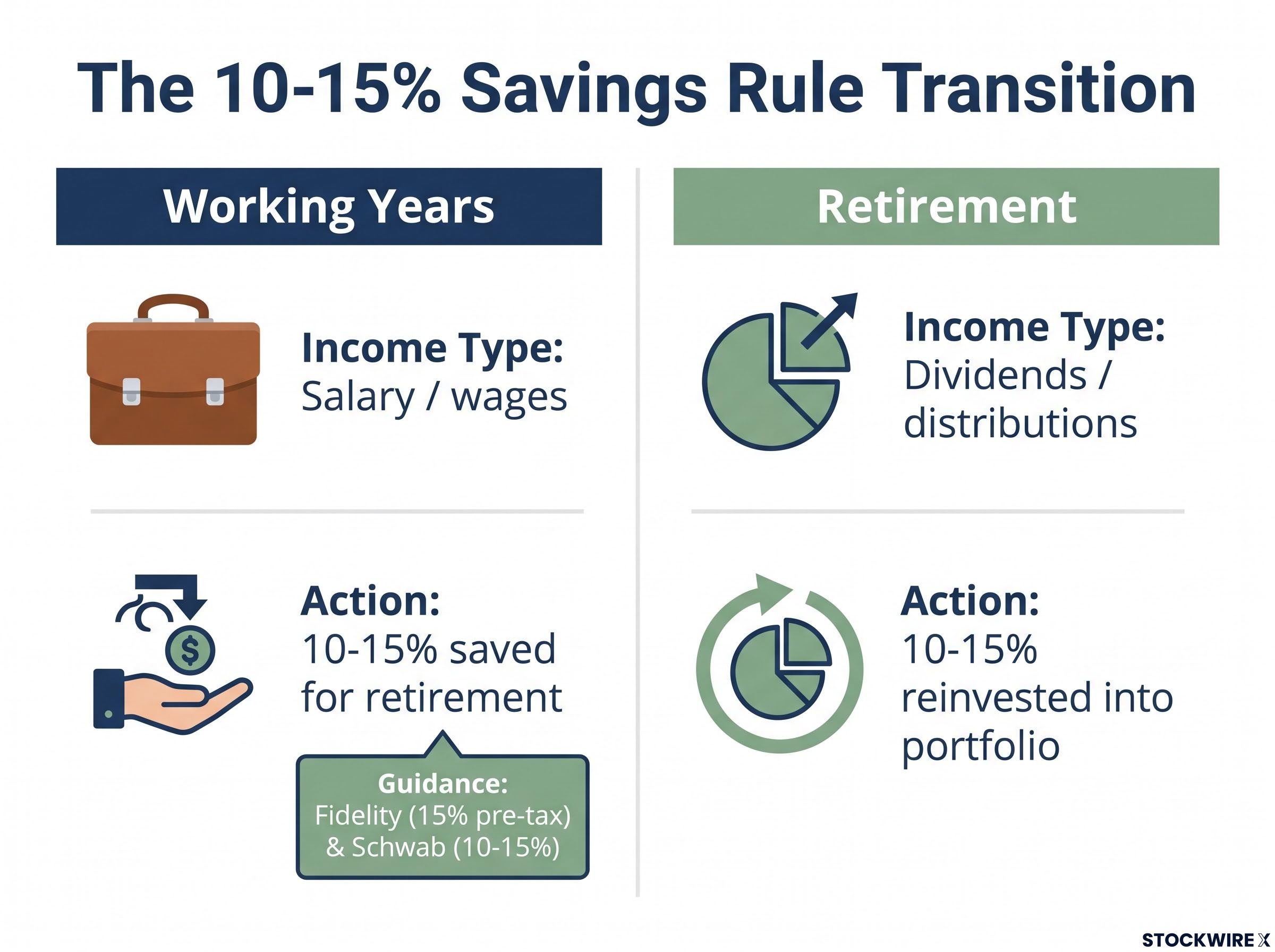
| Life Stage | Income Type | Recommended Rate |
|---|---|---|
| Working years | Salary / wages | 10-15% saved for retirement |
| Retirement | Dividends / distributions | 10-15% reinvested into portfolio |
The 10-15% reinvestment floor is not an arbitrary number. It is a disciplined extension of the most widely accepted savings guidance in personal finance, adapted for a different life stage. The same principle that justified setting aside a share of your salary applies with equal force when your portfolio has become the source of income.
When big ASX news breaks, our subscribers know first
Why spending every dollar of your distributions is riskier than it looks
A steady stream of distributions feels reassuring. Quarterly payments arrive, cover your expenses, and the rhythm of retirement income seems reliable.
That reliability is more fragile than it appears.
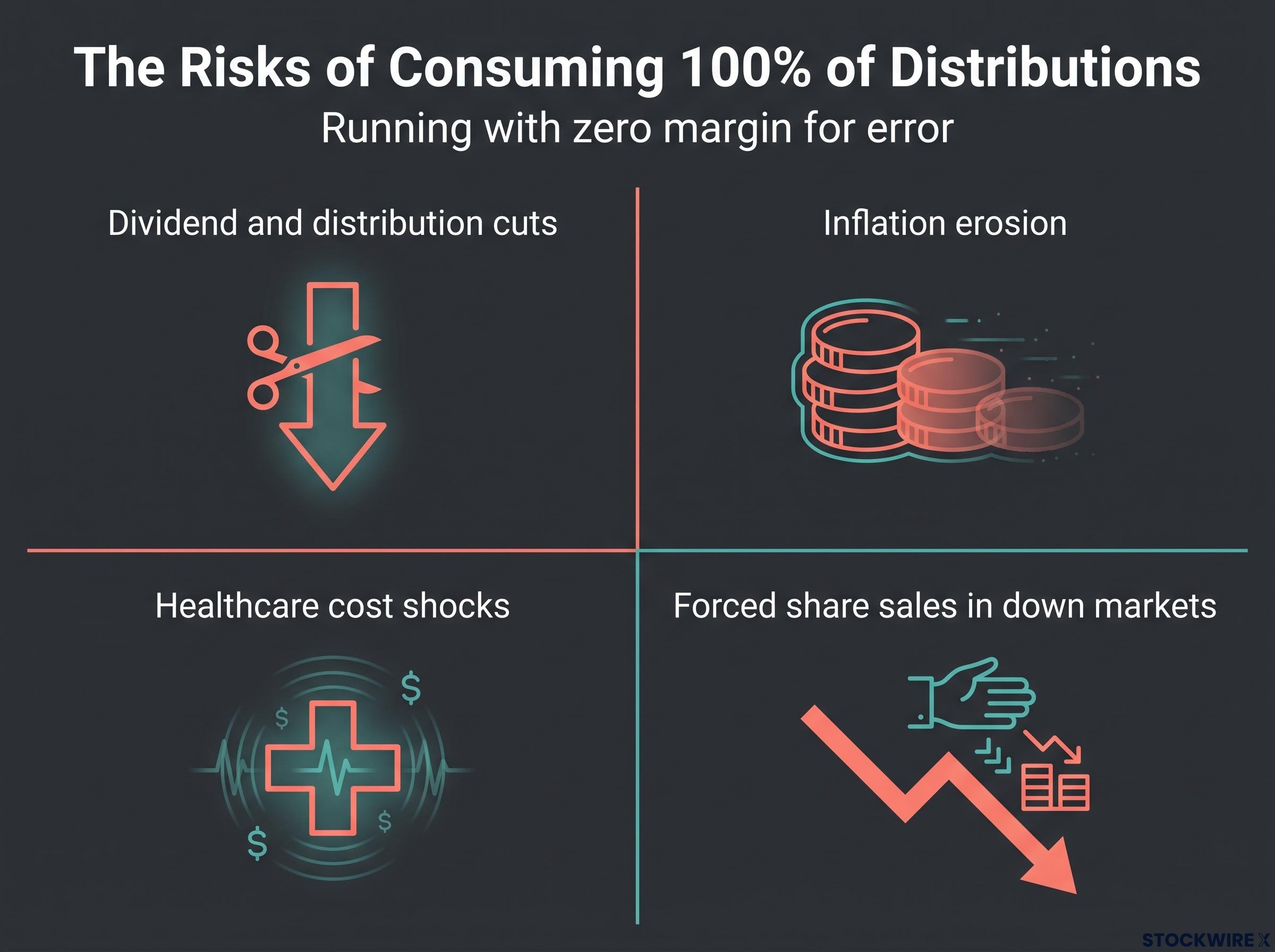
Consuming 100% of your portfolio distributions leaves you in a financial position comparable to a worker who never saves, running with zero margin for error. A single disruption, a dividend cut, a large medical bill, or a sustained market downturn, can open a gap that you have no reserves to close.
When you reinvest nothing, four specific risks become structurally harder to manage:
- Dividend and distribution cuts. Companies and funds do reduce payouts during recessions, restructurings, and sector stress. If you spend every dollar of income, a cut translates directly into a lifestyle shortfall with no buffer to bridge the gap.
- Inflation erosion. The 4% rule implicitly assumes ongoing inflation adjustments. Without any mechanism for growing your income base, your real purchasing power falls steadily over a multi-decade retirement.
- Healthcare cost shocks. Retirement planning research consistently flags medical and long-term care expenses as central, unpredictable risks. These costs tend to arrive in concentrated bursts, exactly when a financial buffer matters most.
- Forced share sales in down markets. Without reinvested income building additional shares, a market downturn can force you to sell holdings at depressed prices simply to meet expenses. You hold fewer shares going forward, and your recovery capacity shrinks.
Sequence of returns risk amplifies every one of these vulnerabilities: two portfolios starting at $1,000,000 with identical average returns and $50,000 annual withdrawals produced outcomes separated by nearly $10 million over 30 years, determined entirely by the order in which returns arrived, which is why a reinvestment buffer that reduces forced selling matters most in the years closest to a market downturn.
EBRI projections on retirement healthcare costs estimate that some couples may need as much as $469,000 saved to cover medical expenses in retirement, a figure that underscores why concentrated, unpredictable cost bursts represent one of the most significant threats to a spend-everything income strategy.
The absence of reinvestment is not just a missed opportunity. It is a structural vulnerability. Your income base cannot grow to absorb these shocks, and the longer you go without reinvesting, the wider the gap becomes between what your portfolio pays you and what your life actually costs.
How even modest reinvestment compounds into a larger income base
The compounding effect of partial reinvestment is not complicated, but it is genuinely powerful once you see the mechanics laid out step by step.
Here is how it works:
- Reinvest a slice of your distributions. You take 10-15% of each payment and use it to purchase additional shares or units in income-producing investments. The remaining 85-90% still covers your living expenses.
- Those new shares generate their own distributions. Every additional share you own pays its own dividend or interest. Your income base is now slightly larger than it was before.
- Those new distributions can themselves be partially reinvested. The cycle repeats. Each round adds a small increment, but the increments stack over time.
This is the compounding feedback loop in action. It does not require aggressive growth targets or complex strategies. It requires a consistent percentage applied each month or quarter.
The compounding feedback loop punishes inaction more severely than most investors expect: stopping contributions at the crossover point where annual market gains first exceed deposits cuts terminal wealth from approximately $366,000 to $210,000, a $156,000 gap created not by missed deposits but by the absence of those funds during the account’s peak compounding phase.
Partial reinvestment is not about accumulating wealth in retirement. It is about maintaining and growing the income machine your retirement depends on.
Over a decade, even a 10-15% reinvestment slice can noticeably increase your total income base. Your future distributions become meaningfully larger than they would be under a spend-everything approach, not because you took more risk, but because you let a small habit do repetitive work on your behalf.
The distinction matters. This is not about sacrifice. It is about income engineering: a small, consistent action that pays you back in larger future payments.
Adjusting the floor for your specific situation
The 10-15% figure is a floor, not a fixed prescription. Where you personally land within or above that range depends on four variables.
Variables that argue for reinvesting more
- Your retirement horizon. If you retired in your 50s, your income needs to last potentially 30-40 years. That longer runway argues for reinvestment rates above 15%, because inflation and healthcare costs have more time to compound against you.
- Other income sources. Retirees receiving Social Security, pension income, or part-time earnings have more flexibility. When portfolio distributions are not your only income, you can afford to reinvest a higher share of them.
- Legacy or flexibility goals. If you want to leave a bequest or maintain the option to increase spending later, a growth-oriented approach argues for reinvestment above the floor.
- Portfolio surplus. If your distributions already exceed your spending needs, the surplus is naturally available for reinvestment. You may already be reinvesting without thinking of it in those terms.
Retirement asset allocation shapes how much your reinvested capital actually grows over time: T. Rowe Price data shows investors aged 65 and older hold equity allocations ranging from 20% to 80%, and the gap between those extremes produces meaningfully different income bases over a 20-30 year horizon, which is why the portfolio structure behind the reinvestment rule matters as much as the reinvestment rate itself.
When the floor is harder to maintain
Here is the counterintuitive point: retirees who are most dependent on their distributions are the ones who most need the reinvestment discipline as self-protection. If portfolio income is your only source, you have no other buffer when cuts or shocks arrive. Even a small reinvestment slice builds the margin you currently lack.
That said, if your distributions barely cover necessities, reinvestment alone is not the solution. That situation signals a broader funding gap that may require spending reductions, additional income sources, or a different asset allocation. Be honest with yourself about which category you fall into, and consider working with a qualified financial adviser to assess the right approach.
The 10-15% rule is a starting point for self-assessment. Understanding where your own situation sits, across horizon, income mix, spending needs, and goals, changes how aggressively you should apply it.
Practical ways to put the 10-15% habit into action
Knowing the principle is one thing. Acting on it needs to be frictionless, or it will not stick. Here are three implementation approaches, ranked from simplest to most hands-on:
- Activate DRIPs on selected holdings. A Dividend Reinvestment Plan (DRIP), a programme where your custodian automatically reinvests dividends from specific holdings into additional shares of the same investment, is the lowest-effort option. Most custodians let you choose which positions use DRIP and which pay cash. By selecting a handful of holdings for automatic reinvestment, you can target an aggregate 10-15% reinvestment rate with a single instruction and zero ongoing effort.
Dividend reinvestment plans compound at a rate most investors underestimate: a $10,000 S&P 500 position in 1960 grew to approximately $5.1 million with dividends reinvested by end of 2023, compared to only $795,000 from price appreciation alone, which is the mechanical case for treating your 10-15% reinvestment slice as non-negotiable.
- Manual cash transfer to a designated vehicle. Some investors prefer to take all distributions as cash, then transfer a fixed percentage (say, 10-15%) into a chosen reinvestment holding, whether that is a broad market ETF, a bond fund, or a diversified income fund. This approach gives you more control over where the reinvested capital goes, though it requires a quarterly or monthly action.
- Scheduled percentage-based allocation rules. Budgeting frameworks that allocate fixed percentages of income to different purposes (for example, a 75/15/10 split across spending, reinvestment, and reserves) demonstrate the value of systematic allocation. You can adapt this mindset by committing that a set percentage of each quarter’s distributions will be reinvested, removing the ad-hoc decision friction that derails most good financial habits.
Directing your reinvestment slice toward under-represented areas of your portfolio serves a dual purpose: it grows your income base and reduces concentration risk at the same time.
The simplest starting point is the first option. Activating DRIP on one or two holdings requires a single instruction to your custodian and no ongoing effort. You can always refine from there.
A small discipline with an outsized protective effect
The 10-15% reinvestment rule is not about building wealth in retirement. It is about keeping your income engine running reliably through inflation, volatility, and the unexpected costs that every long retirement eventually delivers.
Because it mirrors a discipline you likely already accept in principle, saving a portion of each paycheck, the behaviour is psychologically manageable rather than demanding. You are not asking yourself to do something new. You are continuing a scaled-down version of what already worked.
One honest note to close on: the 10-15% figure is a starting floor, and your personal circumstances always shape the optimal rate. Your tax situation, time horizon, other income sources, and health outlook all matter. Reviewing this with a qualified financial adviser before making changes is a prudent step, not an optional one.
This article is for informational purposes only and should not be considered financial advice. Investors should conduct their own research and consult with financial professionals before making investment decisions.
—