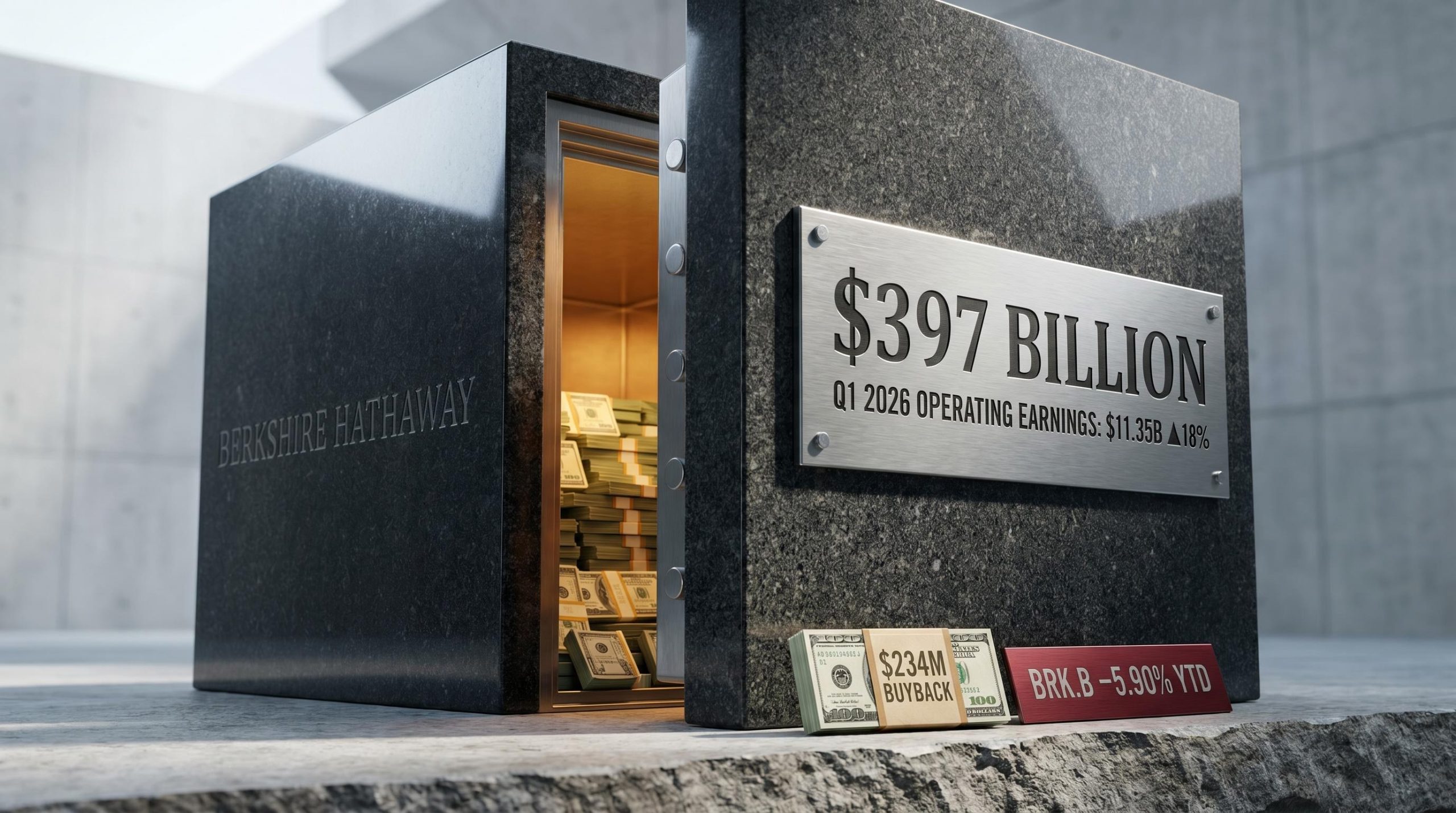
Berkshire Hathaway’s cash pile hit $397 billion in Q1 2026, a record that would rank it among the largest sovereign wealth funds on earth if it were a country. And yet its new chief executive just spent only $234 million of it buying back stock. The Q1 results, released 2 May 2026 alongside the annual shareholder meeting, represent the first full quarterly earnings under Greg Abel, who assumed the CEO role from Warren Buffett at the start of the year. Investors and analysts are reading every line for signals about whether Berkshire’s capital allocation philosophy will shift or hold. What follows is a breakdown of what the numbers show, what the buyback resumption means, how the subsidiaries performed, and what Abel’s early decisions reveal about the direction of one of America’s most influential conglomerates.
Berkshire’s Q1 profit jumped 18% but still fell short of expectations
The headline number looked strong. Berkshire Hathaway reported operating earnings of $11.35 billion for Q1 2026, an 18% increase from the $9.64 billion posted in Q1 2025.
Q1 2026 Operating Earnings: $11.35 billion, up 18% year-over-year
Then came the complication. The result missed the FactSet analyst consensus of $11.56 billion, a gap of roughly $210 million that reframed a strong absolute quarter as a modest shortfall against expectations.
- Q1 2026 operating earnings: $11.35 billion
- Q1 2025 operating earnings: $9.64 billion
- FactSet analyst consensus: $11.56 billion
The miss matters less for its size than for its timing. This was Abel’s first full quarterly report as CEO, released on 2 May 2026 concurrent with the annual meeting. Expectations had been set high, and the underlying performance, while solid, did not clear the bar Wall Street had established for the new leader’s opening act.
Forward guidance signals have consistently moved markets more than reported results in recent quarters, a dynamic that applies directly to Berkshire: with no acquisition announcements and no deployment timeline given, what Abel says at future investor events may matter more than what the income statement shows.
When big ASX news breaks, our subscribers know first
What record cash tells us about Abel’s approach to capital allocation
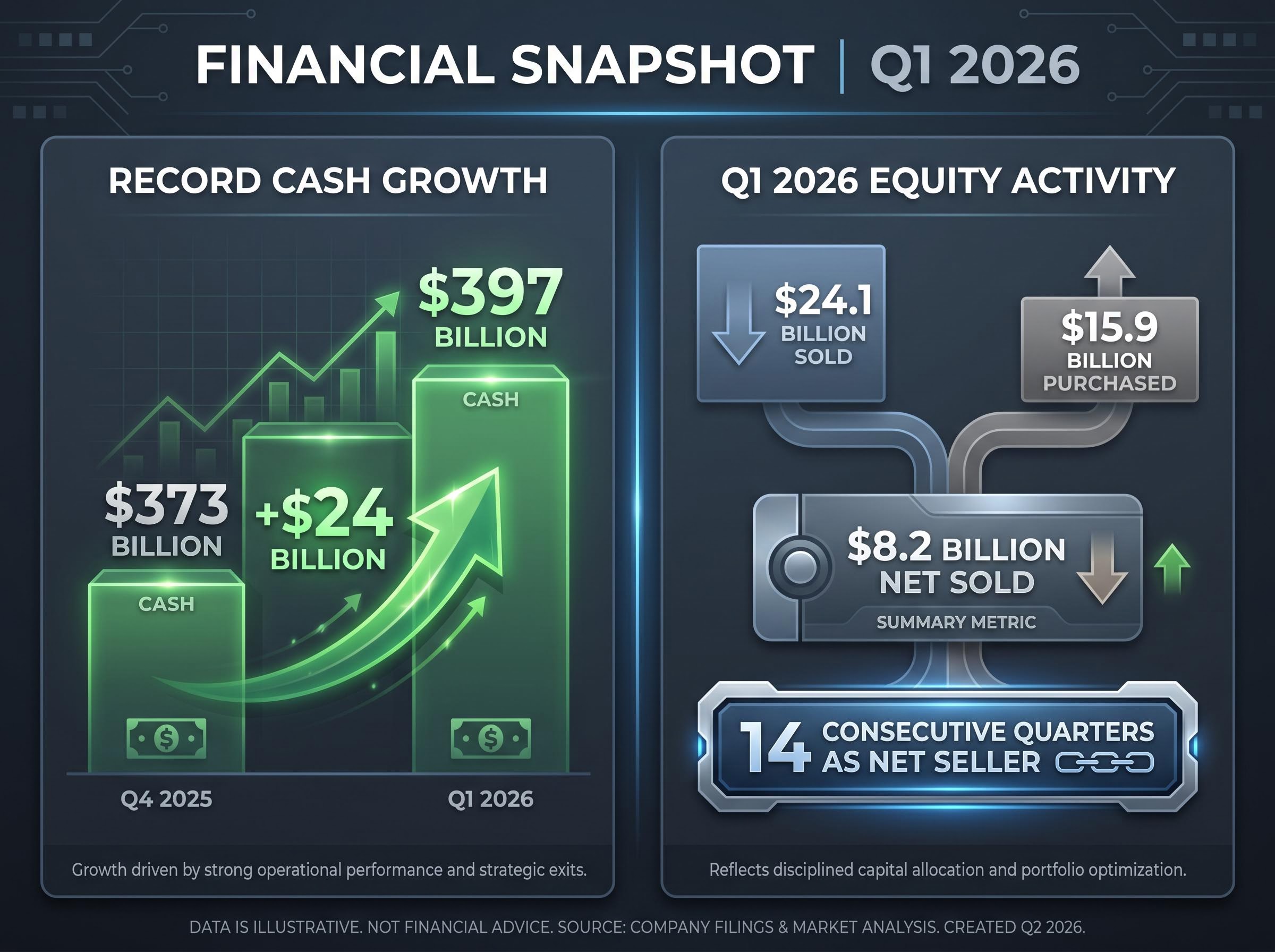
The cash pile grew again. Berkshire’s reserves rose to a record $397.38 billion, up from $373 billion the prior quarter, a single-quarter increase of more than $24 billion.
That accumulation continued despite no shortage of market activity. Berkshire offloaded $24.1 billion in equities while purchasing $15.9 billion, producing net stock sales of $8.2 billion and extending the company’s streak as a net seller to 14 consecutive quarters.
The sovereign wealth fund rankings maintained by the SWF Institute place the largest state-controlled reserves in the $300-900 billion range, a scale that contextualises Berkshire’s $397 billion cash position as genuinely comparable to the world’s most capitalised government investment vehicles.
| Period | Cash Reserves | Net Equity Position | Direction |
|---|---|---|---|
| Q4 2025 | $373 billion | Net seller | Accumulating |
| Q1 2026 | $397 billion | Net seller ($8.2B net sold) | Accumulating |
The restraint is itself the signal. Abel is not sitting on cash because he lacks authority to deploy it. He is operating in the Buffett tradition of disciplined patience when valuations do not meet Berkshire’s criteria. Fourteen quarters of net selling under two different CEOs suggests a consistent reading of the opportunity set, not indecision at the top.
The scale of Berkshire’s cash accumulation is not just a corporate balance sheet story; it also functions as a live reading of equity market conditions, with the Buffett Indicator, the ratio of total US market capitalisation to GDP, sitting near 223-230% across late 2025 and early 2026, territory historically associated with suppressed forward returns.
Insurance leads the way, but Geico introduces a note of caution
Berkshire’s insurance operations delivered the quarter’s strongest segment result. Overall insurance underwriting earnings grew 28% to $1.717 billion in Q1 2026, providing the single largest driver of the operating earnings increase.
- Insurance underwriting: $1.717 billion, up 28%
- BNSF Railway: contributor to operating earnings growth
- Berkshire Hathaway Energy: contributor to operating earnings growth
- Manufacturing and services businesses: contributors, partially offset by foreign exchange headwinds
The breadth of subsidiary contribution insulated the overall result from any single line of weakness. BNSF, the energy segment, and manufacturing businesses all added to operating growth, though FX headwinds trimmed the aggregate gains.
Geico’s higher claims warrant a closer watch
Geico’s underwriting earnings declined during the quarter due to higher claims costs, a pattern that diverged from the broader insurance unit’s strong showing. Berkshire’s Q1 report confirmed lower results at the auto insurer without specifying a percentage decline, and no independently verified figure has been published.
The softness is worth monitoring. Geico is one of Berkshire’s most visible consumer-facing businesses, and sustained claims inflation could weigh on the insurance segment’s trajectory in coming quarters even as the broader underwriting book performs well.
Why Berkshire’s buyback revival matters more than the dollar amount suggests
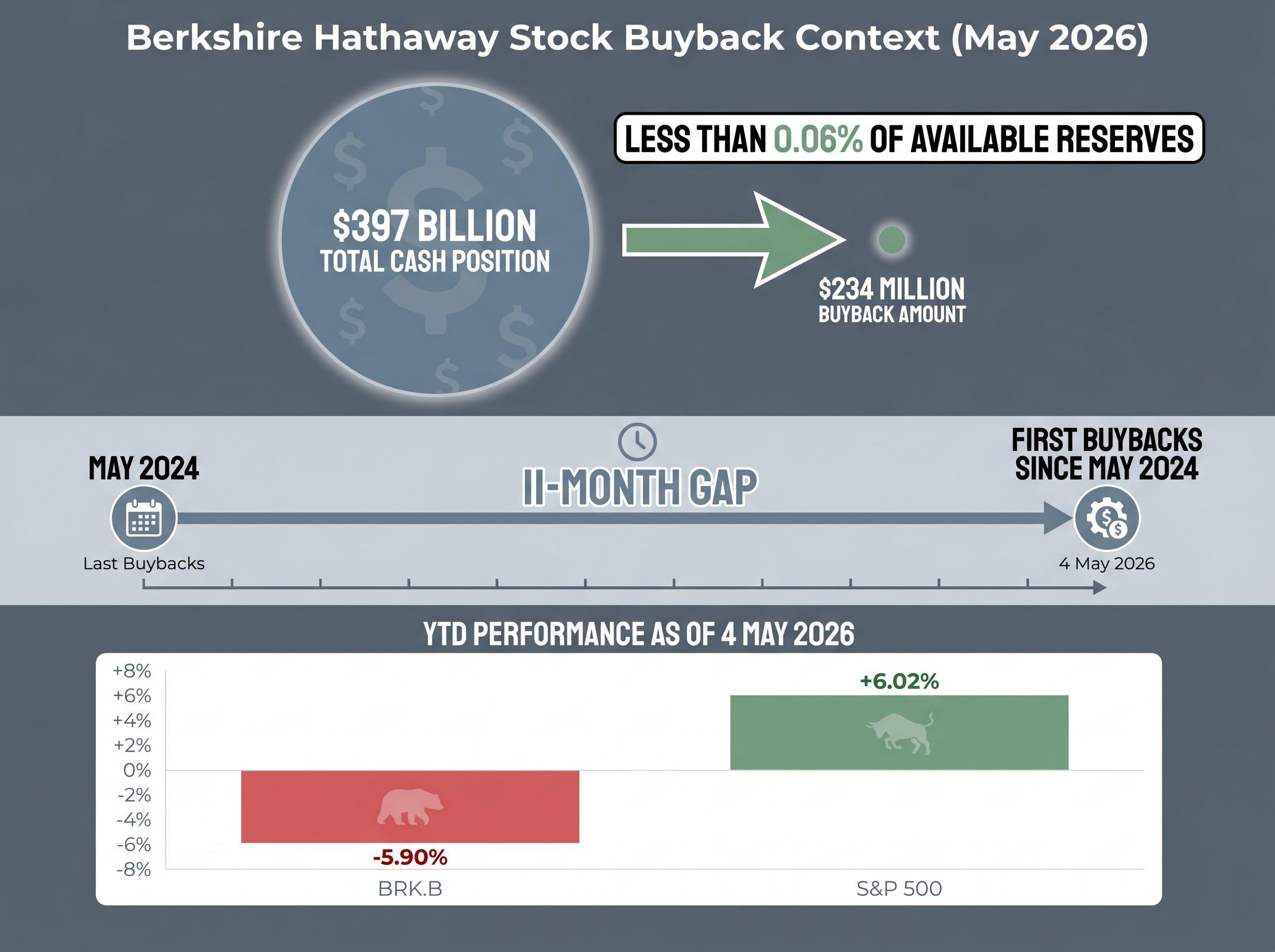
Berkshire repurchased $234 million in shares during Q1 2026, the first buybacks since May 2024, a gap of approximately 11 months.
The dollar figure is small. Against a $397 billion cash position, $234 million amounts to less than 0.06% of available reserves. The significance is not in the size of the repurchase but in the fact that it happened at all.
- Buyback amount: $234 million
- Last prior buyback: May 2024 (approximately 11-month gap)
- First two weeks of April 2026: no repurchases
- BRK.B year-to-date performance: down 5.90% as of 4 May 2026
BRK.B is down 5.90% year-to-date as of 4 May, compared with the S&P 500’s gain of 6.02% over the same period.
The resumption signals that Abel views Berkshire shares as attractively valued at current prices, a meaningful data point given the stock’s underperformance relative to the broader market. That no repurchases occurred in early April reinforces Berkshire’s established pattern: buybacks are opportunistic and price-sensitive, not scheduled.
Understanding Berkshire Hathaway’s conglomerate model and why earnings structure matters
Berkshire Hathaway reports operating earnings as its primary performance metric. This figure captures pre-tax earnings from wholly owned subsidiaries, including insurance, railway, energy, and manufacturing businesses, while excluding investment gains and losses.
The distinction matters because Berkshire’s GAAP net income, the standard accounting measure, includes unrealised gains and losses from its public equity portfolio. That portfolio is large enough to swing net income by billions in either direction based purely on stock market movements, not underlying business results.
- Operating earnings from subsidiaries: the signal. Revenue and profit generated by businesses Berkshire owns outright, including Geico, BNSF Railway, Berkshire Hathaway Energy, and dozens of manufacturing and services companies.
- Investment portfolio gains and losses: the noise. Mark-to-market changes in Berkshire’s public stockholdings that move GAAP net income but do not reflect how the operating businesses performed.
How operating earnings differ from GAAP net income at Berkshire
Buffett long advocated for investors to focus on operating earnings as the cleaner measure of business health. Abel has continued this framework. In a quarter where the equity portfolio can add or subtract billions based on market swings alone, operating earnings isolate what the businesses themselves produced: $11.35 billion, up 18%.
The Abel era begins in continuity, but investors want to know when the cash moves
Abel’s first full quarter reads as a statement of continuity. Methodical net selling, disciplined cash accumulation, a modest buyback resumption, and no acquisition announcements. The playbook is Buffett’s, executed by a different hand.
Abel’s investment aperture may be wider than Buffett’s in at least one measurable way: his addition of an Alphabet stake in late 2025 introduced AI-adjacent exposure that his predecessor largely avoided, a detail that complicates any reading of his first quarter as pure continuity.
Analysts characterise Abel’s approach as continuity-focused, with no signals of near-term large acquisitions or strategic pivots.
On 4 May 2026, BRK.B closed at $473.01, down 0.12% intraday, a muted reaction that reflects a market absorbing an expected result rather than repricing around a surprise. The question investors are asking is not whether Abel can run the business. Q1 suggests he can. The question is when, and at what scale, he will deploy a cash reserve that cannot grow indefinitely without a deployment decision.
Signals to watch in Q2 2026 and beyond:
- Acquisition announcements or reports of deal activity
- Any shift in the net-selling posture across the equity portfolio
- Pace and size of share buybacks in Q2
- Commentary from Abel at future investor events or shareholder communications
What Q1 2026 establishes about Berkshire under its new CEO
The quarter provides a three-part verdict:
- Business health confirmed: 18% operating earnings growth to $11.35 billion demonstrates that Berkshire’s diversified subsidiary base is generating expanding profits under new leadership.
- Capital discipline confirmed: a record $397 billion cash pile, $8.2 billion in net equity sales, and no major acquisitions signal that valuation discipline remains the governing principle.
- Leadership style established: the $234 million buyback resumption, the first since May 2024, places Abel firmly in the continuity camp rather than signalling a new strategic direction.
What Q1 does not resolve is the larger question: when and how the cash gets deployed at scale. Abel has earned credibility by demonstrating restraint in a market he appears to view as offering limited value. The next several quarters will reveal whether that restraint gives way to action, or whether patience itself becomes the defining feature of the Abel era.
Investors wanting to situate Berkshire’s result within the broader reporting cycle will find our full explainer on the Q1 2026 earnings season, which examines how a blended S&P 500 growth rate of 27.1% developed, where analyst estimates diverged most sharply from outcomes, and which macro headwinds, including rising Treasury yields and a softening labour market, could compress forward estimates heading into summer.
This article is for informational purposes only and should not be considered financial advice. Investors should conduct their own research and consult with financial professionals before making investment decisions.