
The Norwegian krone is trading near 9.50 per dollar today, and there is one reason the number moved: Norges Bank announced this morning that it is raising rates again. That level is not a backdrop. It is a live signal about where the pair goes next.
Norway’s central bank broke a two-meeting pause to lift its policy rate by 25 basis points to 4.50%, a move that a meaningful portion of the market had not fully priced. When a central bank surprises on the hawkish side, the exchange rate response is amplified beyond what the rate level alone would produce. That amplification is exactly what is playing out in the krone right now.
The question that matters over the coming months is whether this strength holds, fades, or deepens. What follows below is the analytical framework to answer that for yourself, built across three forces, policy divergence, energy exposure, and global risk sentiment, so that each future Norges Bank communication reads as a signal rather than noise.
What Norges Bank just decided, and why the market was not fully ready for it
This was not a routine step on a pre-announced path. Norges Bank had held its policy rate unchanged across its two prior meetings before moving today, and a pause-then-hike sequence carries more weight than a hike inside a run of expected increases. Markets had settled into the assumption of a hold, so the 25 basis point rise to 4.50%, effective 24 September 2026, forced a repricing.
The rationale sits in the inflation data. Norwegian headline consumer price inflation ran at 3.3% year-on-year in August 2026, with core inflation, which strips out energy and tax changes, at 3.0%. Both remain above the bank’s 2% target, which is the mandate Norges Bank cited when it justified continued tightening.
Norges Bank’s September 2026 policy decision confirms the 25 basis point hike to 4.50%, citing inflation that remains above the 2% target as the primary justification and signalling readiness to tighten further if price pressures prove persistent.
The surprise component matters as much as the rate level. A hike that markets had not fully priced does not just reprice one meeting; it reprices the entire expected rate path. That is why the krone’s move on the day is larger than 25 basis points alone would suggest.
What the rate path projection tells you beyond the headline move
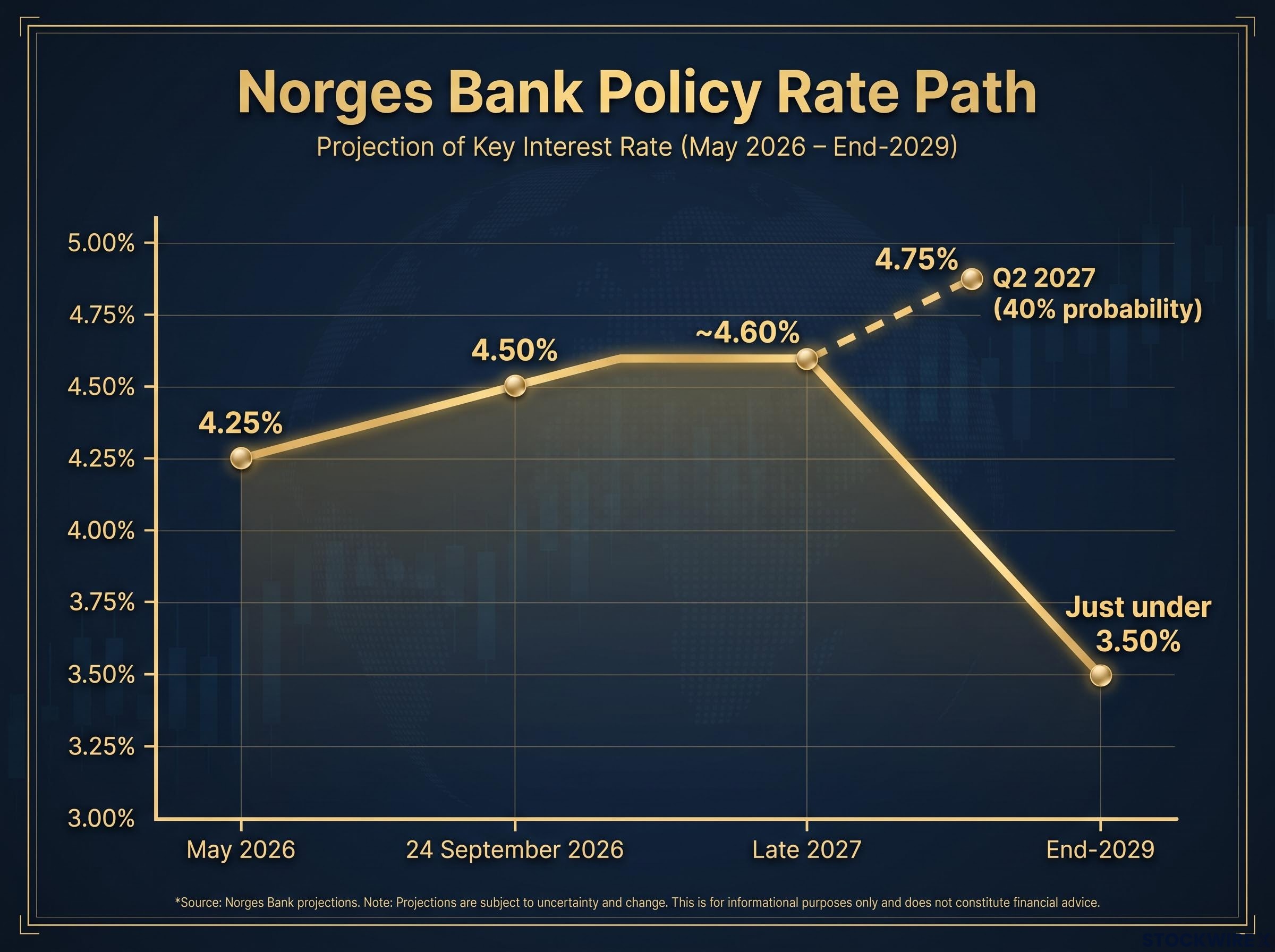
The forward guidance is where the decision becomes consequential beyond September. Norges Bank signalled readiness to tighten again if the inflation outlook warrants it, and its updated projections imply roughly a 40% probability of a further 25 basis point move that would take the terminal rate to 4.75%, potentially by Q2 2027.
Norges Bank stated it is prepared to raise the policy rate further should inflation prove more persistent than expected. The path is explicitly data-dependent, not a fixed schedule.
There are two figures worth separating here. Norges Bank’s own rate-path forecast points to a near-term peak of approximately 4.60%, lifted from 4.55% in its June projection. The 4.75% figure is the outer bound of the additional-hike scenario. These are complementary framings of the same decision, not contradictory data: one is the bank’s central path, the other is the tail case.
| Date / Period | Policy Rate | Key Event / Projection Note |
|---|---|---|
| 24 September 2026 | 4.50% | 25bp hike after two holds; partial market surprise |
| Near-term peak | ~4.60% | Norges Bank rate-path forecast; 40% chance of 4.75% |
| Through late 2027 | ~4.50%-4.60% | Extended plateau at elevated level |
| From late 2027 | Gradual decline | Easing begins as inflation pressure fades |
| End-2029 | Just under 3.50% | Inflation projected back to 2% target |
The plateau is the part that shapes the krone case. A rate held near 4.50%-4.60% into late 2027 is a long window in which Norway’s yield advantage is expected to persist.
When big ASX news breaks, our subscribers know first
How the rate-differential channel actually works, and what it means for USD/NOK today
Start with the mechanism, because the krone conclusion emerges from it rather than being asserted. When Norwegian rates sit higher than US rates, or are expected to fall more slowly, NOK-denominated assets offer a carry advantage, meaning the interest earned on holding them beats the equivalent USD position. That yield gap attracts demand for Norwegian bonds and deposits, which pushes the krone up against the dollar.
Now layer in the divergence. Norges Bank is holding at 4.50% with explicit upside optionality, while markets increasingly price the US Federal Reserve toward an eventual cutting cycle. As the gap between the two narrows or reverses, the structural upside that previously favoured the dollar erodes.
That leaves the krone with a rebuilt tailwind from a higher base, and the policy plateau extends the window in which the advantage is expected to hold. On decision day, USD/NOK traded in a 9.49-9.51 range, drawn from XE at 9.4972, Forbes, Wise and Exchange-rates.org clustered at 9.50-9.51, and the Financial Times tearsheet at 9.4868 with a 0.48% daily gain. That range is same-day pricing across multiple data providers and is the closest available read on the post-announcement level.
The carry advantage Norway currently holds is not static; central bank divergence across the Fed, BoJ, and SNB has already reshaped the rate map in 2026, with the BoJ’s move to 1.25% and the Fed’s own hiking cycle compressing the margin of safety on carry positions built during the near-zero era.
One honest constraint applies. No consulted source provided a specific consensus Fed rate path for 2026-2027, so the divergence case rests on the contrast between Norges Bank’s stated tightening trajectory and general market pricing for eventual Fed easing, not on a confirmed Fed forecast. For anyone holding USD-denominated positions or weighing krone exposure, that means the carry logic is the primary engine here, but it runs on an assumption rather than a certainty.
Three conditions that can override the rate-differential signal
The carry channel is not unconditional. It breaks down under specific circumstances, and knowing them is how you tell a genuine signal from a false one:
- A severe risk-off episode. In a global scramble for safety, investors prioritise liquidity over yield, and the dollar strengthens as a reserve currency even when US rates are lower. USD/NOK can rise despite Norway’s rate advantage.
- A growth-damage repricing. If markets conclude Norges Bank’s tight stance will slow the Norwegian economy faster than expected, they price earlier cuts, and those expectations offset the current differential even at a high spot rate.
- An energy-price shock. A sharp fall in oil and gas prices can dominate rate effects entirely, dragging the krone lower regardless of how hawkishly Norges Bank is diverging from the Fed.
That third condition connects directly to the next layer, because Norway is a petro-currency and its energy exposure cuts both ways.
Norway’s energy exposure as a compounding factor, not a safe assumption
Norway’s energy story is often treated as a simple bonus on top of the rate case. It is more complicated than that, and the honest reading is that petro-currency dynamics can either amplify or erase the rate-differential gain depending on conditions outside Norges Bank’s control.
The structural position is genuinely supportive when commodities are firm. Norway’s large energy exports and external surpluses underpin the krone, and Europe’s reliance on Norwegian supply reinforces that. Norges Bank’s own September 2026 assessment noted that oil and gas prices had risen, which handed the currency a tailwind at the moment of the decision.
On the constructive view, tight monetary policy and strong energy revenues are two independent forces pointing the same way, a compounding support for the krone. But the cautious view deserves equal weight. In a global downturn or a sustained commodity price fall, Norway’s export revenues and investment outlook compress, and the krone can slide even when the rate differential is nominally favourable.
The comparable episodes support the caution. Across resource-linked currencies including New Zealand, Canada and Scandinavian peers, rate hikes delivered into falling commodity prices have tended to produce only modest or short-lived currency responses. The lesson is that energy is a conditional multiplier on the rate story, not a standalone guarantee.
NOK as an energy-linked currency occupies a specific structural position that ING strategists have identified: alongside AUD, it is one of the pairs most consistently reflecting energy market dynamics, isolating the exporter-versus-importer terms-of-trade differential in ways that EUR/USD and DXY no longer do cleanly.
| Scenario | Energy Price Environment | Norges Bank Stance | Implied USD/NOK Pressure |
|---|---|---|---|
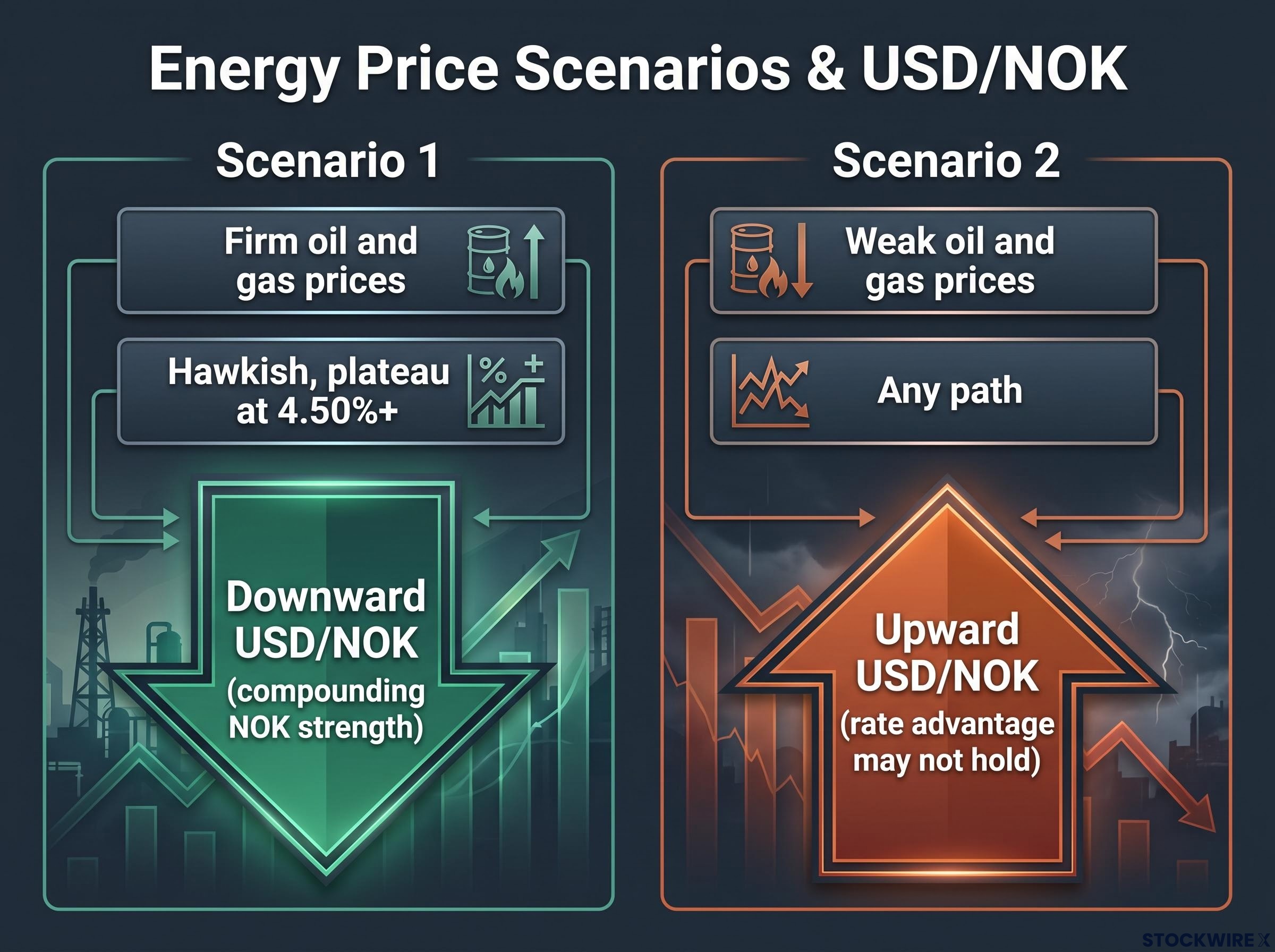
| 1 | Firm oil and gas prices | Hawkish, plateau at 4.50%+ | Downward on USD/NOK (compounding NOK strength) |
| 2 | Weak oil and gas prices | Any path | Upward on USD/NOK (rate advantage may not hold) |
The practical takeaway is that tracking USD/NOK means watching two independent variables, not one. A Norges Bank hold read alongside weak oil is a very different signal from the same hold alongside firm commodity markets.
The risks that could reset this outlook before the next Norges Bank meeting
The framework is now built, so the useful move is to translate it into specific, plausible scenarios rather than a vague sense of uncertainty. Four risks stand out, each distinct and each with its own transmission path into the pair:
- A sustained fall in oil or gas prices. This would erode Norway’s export revenues and terms of trade, undermining a core structural support for the krone even with domestic rates high. Rate divergence alone would not be enough to hold the currency up.
- A shift to global risk-off. In these phases the dollar strengthens on safe-haven demand and commodity-linked currencies including the krone often sell off regardless of yield. Any positive effect from the 4.50% rate is contingent on at least neutral risk appetite.
- A revision to Norges Bank’s rate path. The near-term peak of approximately 4.60% and the long plateau depend on incoming inflation and growth data. Faster disinflation or a sharper slowdown could bring cuts earlier than projected.
- The Fed staying restrictive for longer. The whole divergence logic assumes the Fed eventually eases more than Norges Bank. No consulted source provided a firm Fed path for 2026-2027, so if the Fed holds tight, USD/NOK could be supported above what Norwegian policy alone implies.
Reuters framed the decision by noting that Norges Bank “may hike again to contain inflation,” underscoring that the path is data-dependent rather than a fixed plan.
Weighing these matters. The 40% probability of a further hike to 4.75% also implies a 60% probability of no further move, which is the larger of the two. Set that against a currency sensitive to energy prices and a Fed path that cannot be independently confirmed, and the shape becomes clear.
Context sharpens the point. Norges Bank has been building this trajectory across multiple meetings, including an earlier hike to 4.25% in May 2026, so any reversal would be a meaningful signal shift rather than a minor adjustment. The most actionable read is that the krone-positive case has genuine structural support but is not a one-way trade, and oil prices and global risk appetite are the leading indicators for whether the carry logic is being validated or undermined in real time.
What the rate decision changes, and what the NOK outlook still depends on
Three analytical layers now sit on the table. The decision carried a surprise component that repriced the whole expected path. The rate-differential channel rebuilds a krone tailwind from a higher base, conditional on the Fed easing as markets expect. And Norway’s energy exposure acts as a multiplier that can compound the rate story or override it entirely.
The 9.49-9.51 level on decision day is the starting point for that reasoning, not the conclusion. The plateau projected through late 2027 is the window during which the carry advantage is expected to persist, conditional on the risks named above.
For a view over the next two to three quarters, these are the three variables to monitor:
- Core CPI trajectory. Track it against the 2% target; core inflation sat at 3.0% in August 2026, and if it falls toward target faster than projected, the Norges Bank path compresses and the carry case weakens.
- Oil and gas price direction. Firm prices compound the krone case, while a sustained fall can override the rate advantage outright.
- Federal Reserve rate-path signals. The divergence logic depends on the Fed easing more than Norges Bank; a Fed that stays restrictive supports USD/NOK at higher levels.
Fed rate expectations shape USD/NOK from the dollar side of the pair, and the voting-machine dynamic documented by Ken Fisher shows that a single FOMC language shift, such as the June 2026 move that pushed DXY back above 100 before any fundamental had changed, can reprice the divergence case faster than Norwegian data allows Norges Bank to respond.
The rate decision establishes a supportive structural backdrop that is real and multi-channel. Whether it translates into sustained krone appreciation, or gets periodically overridden, will be decided by commodity markets and global risk sentiment that sit beyond monetary policy’s reach.
This article is for informational purposes only and should not be considered financial advice. Investors should conduct their own research and consult with financial professionals before making investment decisions.
Past performance does not guarantee future results. Financial projections are subject to market conditions and various risk factors, and these forward-looking statements are speculative and subject to change based on market developments.