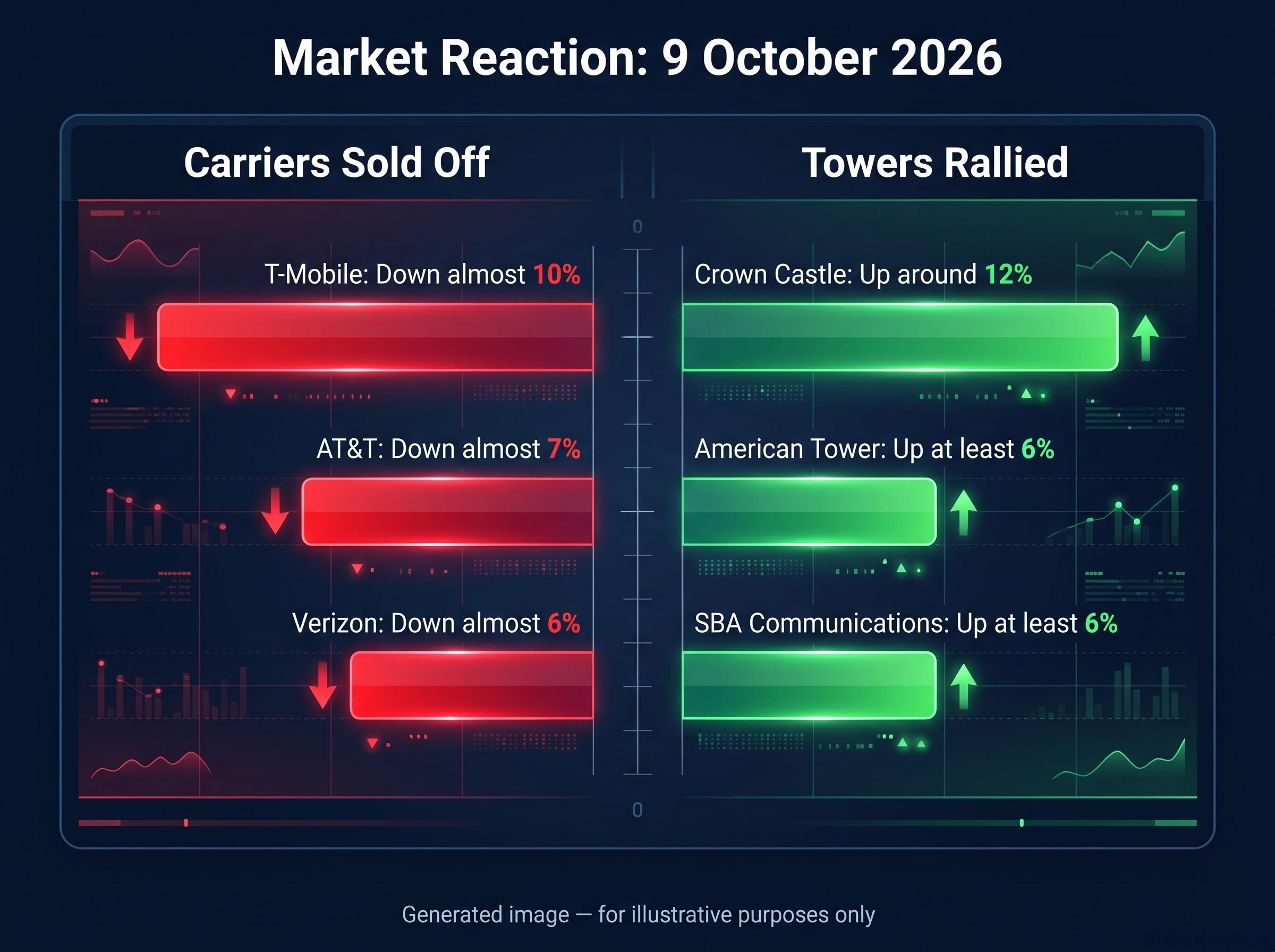
On 9 October 2026, one SpaceX wireless announcement split a single industry in two. AT&T, Verizon and T-Mobile sold off hard, with T-Mobile down roughly 10% intraday. At the same time, American Tower, Crown Castle and SBA Communications each climbed at least 6%, and Crown Castle was up around 12% at one point.
The trigger came after the close on 8 October. SpaceX agreed to buy a nationwide low-band spectrum portfolio from Grain Management, covering up to 14 MHz of paired spectrum in the 800 MHz band, subject to Federal Communications Commission (FCC) approval. Spectrum is the set of radio frequencies a wireless operator is licensed to use.
The deal builds on SpaceX’s earlier spectrum purchases from EchoStar. Taken together, the moves show the market repricing who controls value in American wireless.
Below is a framework for why one disruptor can hurt some stocks and lift others. It also covers what the tower rally does and does not tell you, and where the real risks sit.
Why did carriers sell off while towers rallied?
Carriers and tower companies usually move together, because towers earn rent from carriers. On Friday they moved in opposite directions. Sources differ on the size of the moves, but they agree on the direction.
| Company | Type | Reported move | Source |
|---|---|---|---|
| AT&T | Carrier | Down almost 7% | CNBC, original source discussion |
| Verizon | Carrier | Down almost 6% | CNBC, original source discussion |
| T-Mobile | Carrier | Down almost 10% | CNBC, original source discussion |
| American Tower | Tower REIT | Up at least 6% | CNBC |
| Crown Castle | Tower REIT | Up around 12% mid-morning | CNBC |
| SBA Communications | Tower REIT | Up at least 6% | CNBC |
Some outlets, including GuruFocus, put the tower gains closer to 7-8%, so treat the exact magnitudes loosely. Reuters reported that carriers had already fallen about 6% in extended trading on 8 October.
The carrier case: a rival with spectrum
Low-band spectrum travels far and penetrates walls well, which gives a network strong indoor coverage. That has long been the incumbents’ advantage. SpaceX now owns this kind of spectrum alongside its satellite network.
Elon Musk, SpaceX: Low-band spectrum is “the last critical piece of the spectrum puzzle needed for SpaceX to provide complete phone coverage in America.”
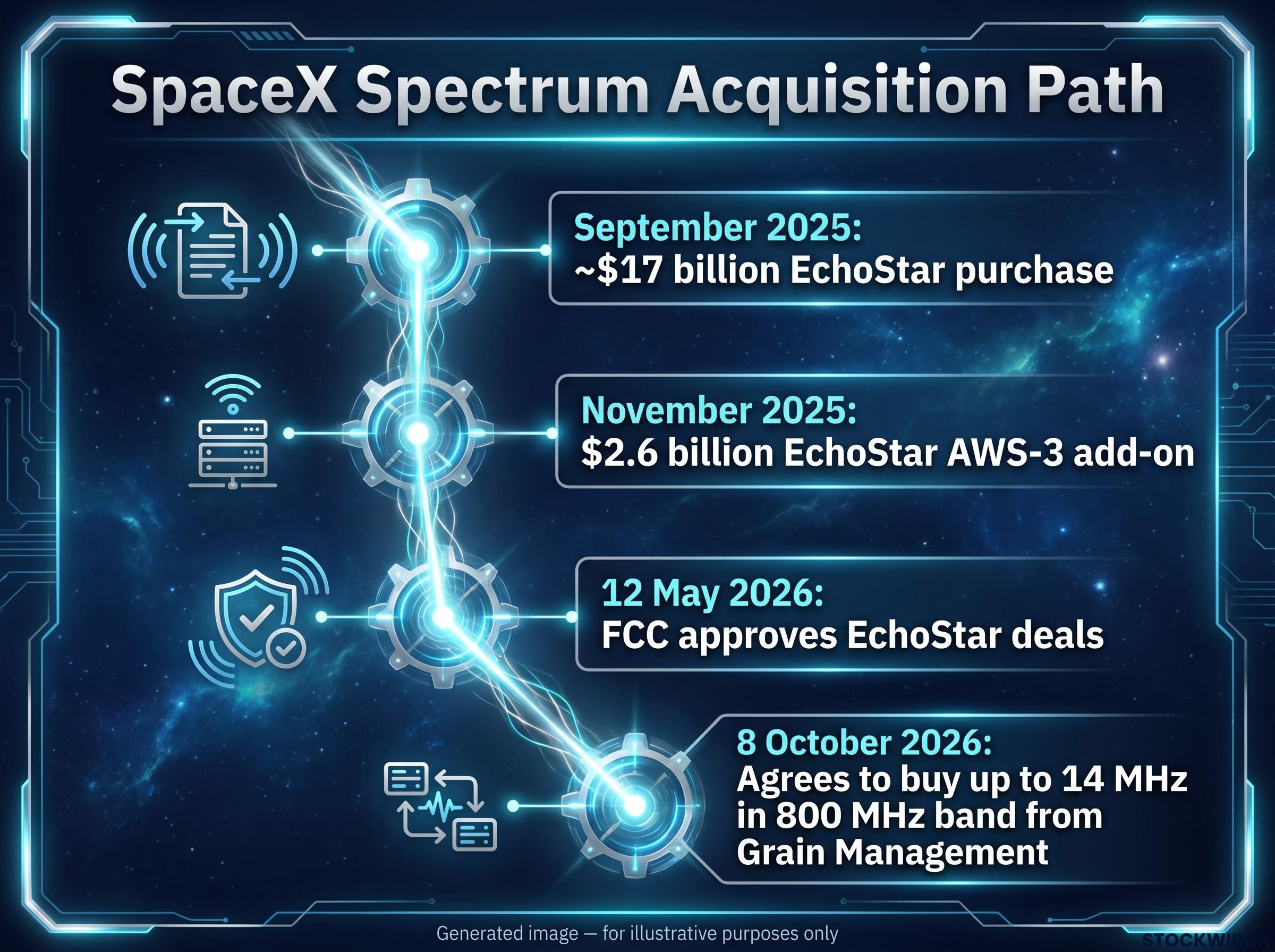
The deal follows the EchoStar purchases: about $17 billion in September 2025 and a $2.6 billion AWS-3 add-on in November 2025. The FCC approved both on 12 May 2026. What changed perception was SpaceX President Gwynne Shotwell‘s comment in August 2026 that SpaceX plans to build terrestrial infrastructure and expects to win “quite a few” customers from the Big Three. That turned a niche coverage provider into a rival. Investors now also face open questions about how much extra capital spending incumbents will need to defend their share.
T-Mobile’s direct-to-cell partnership with SpaceX currently complements its own network. Its outsized drop tells you the market is pricing the chance that a current partner becomes a direct competitor, not just a rural coverage add-on.
T-Mobile’s current arrangement is one example of wholesale direct-to-cell infrastructure, where a carrier distributes satellite coverage to its own customers while Starlink earns revenue from the constellation it has already funded for broadband.
The tower question
The carrier sell-off has a clear explanation. The tower rally does not, and the third section below takes it up in detail.
When big ASX news breaks, our subscribers know first
What is creative destruction, and how does it apply to wireless?
Economist Joseph Schumpeter gave the market’s split reaction a name decades ago.
Creative destruction: The process by which new entrants displace the profits of established businesses while creating new activity and demand elsewhere.
Applied to SpaceX wireless, the idea is that licensed spectrum combined with a satellite network could reorganise the wireless value chain. Incumbents might lose rents, meaning profits they earn because competition is limited. Total connectivity could still expand at the same time.
Past disruptions show that the damage is rarely spread evenly:
- Streaming vs cable TV: Cable incumbents lost the bundle and were forced to cut prices and consolidate. Streaming distributors gained.
- Cloud vs legacy IT: Hardware vendors saw margins compress. Cloud providers gained as total computing use grew.
- Cable companies in wireless: Comcast and Charter used MVNO agreements and Wi-Fi offload to pressure incumbent margins. An MVNO, or mobile virtual network operator, is a provider that sells mobile service over another company’s network.
In each case, part of the supply chain lost while another part found new demand. A Yale School of Management paper on the FCC’s May 2026 approval reportedly argues that new licences suited to direct-to-cell service can change market structure by enabling competition. That reference has not been independently confirmed.
The lesson for your portfolio is that creative destruction works as a sorting mechanism. The useful question for any disruption headline is which of your holdings sit on the displaced side of the chain and which sit on the enabling side.
Why would tower companies benefit from a rival that might bypass towers?
The tension is built into the story. Reuters framed the spectrum as letting Starlink Mobile bypass conventional cell towers. SpaceX’s own plan includes standard equipment such as antennas on towers and rooftops. As Shotwell put it: “we definitely intend to build out terrestrial.”
The bull case follows from that plan. SpaceX could become a new tenant, and leasing space from American Tower, Crown Castle or SBA would be faster than building greenfield sites, meaning new towers on undeveloped land. GuruFocus suggested a larger satellite-mobile ecosystem might need more terrestrial infrastructure rather than less, though that view is unverified. Low-band and mid-band networks also often require urban densification, which means adding more sites to carry heavy city traffic.
A second explanation is less about fundamentals. CNBC described the towers as once “obsolete” tech stocks. An out-of-favour group given a fresh narrative can rally on value rotation and short covering, where investors who bet against a stock buy it back to close their positions.
The bear case
Towers stay exposed to carrier capital spending cycles. If incumbents cut back or shift to small cells and fiber, tower upside could be capped. A satellite-centric Starlink would make SpaceX a competitor to tower landlords, not a tenant. Neutral-host indoor systems or satellite-to-device links without terrestrial repeaters could also flatten growth.
| Scenario | What it means for towers | Evidence so far |
|---|---|---|
| Complementary tenant | New leasing demand | SpaceX’s stated terrestrial plans |
| Rotation or short covering | Temporary rerating | CNBC’s “obsolete” framing |
| Bypass | New competitor to landlords | Reuters’ framing of the deal |
No American Tower or Crown Castle filings or commentary on SpaceX direct-to-cell service had been found as of 9 October 2026. A one-day rally is a hypothesis, not evidence. Treat it as the market’s first guess about demand, not as confirmation of a new tenant.
What does one disruptor touching many sectors mean for investors?
The telecom trade is the narrow story. The wider one is a private company moving prices across several sectors. In the original source discussion, one host argued SpaceX is more diversified than other private names, with real revenue and growth across space-related businesses.
SpaceX is privately held, so you can only get exposure indirectly or through secondary markets. No valuation or IPO timetable tied to the announcement has been reported.
Because SpaceX has no reported valuation tied to this announcement, analysts lean on sum-of-the-parts valuation, assigning each segment its own methodology so early-stage ambitions are not priced like recurring revenue already operating at scale.
The spillover reached even further. In that same discussion, the hosts said tokenized markets showed OpenAI taking a sizable hit on the news. No independent sourcing was found for that claim. Tokenized markets, which trade blockchain-based tokens linked to private company value, are the only live price signal for names such as OpenAI and Anthropic, but liquidity may be thin. The reported move suggests traders already treat SpaceX as a cross-sector force. Unverified, thinly traded pricing is still not a reliable valuation signal.
Risks that could change the thesis
Gwynne Shotwell, President, SpaceX: SpaceX expects to win “quite a few” customers from the Big Three carriers.
Shotwell’s ambition is a stated goal, not a result. The four risks below are ranked by how soon each could matter:
- Regulatory: The Grain Management deal needs FCC approval. The EchoStar deals cleared on 12 May 2026, but each review brings scrutiny on interference and competition.
- Execution and capital spending: A true mobile service requires heavy investment and carrier-grade operations.
- Competitive response: Incumbents may answer with pricing, network upgrades and partnerships that compress margins. Cooperative models are already emerging, including the carrier joint venture on rural dead zones that Reuters reported on 14 May 2026.
- Business-model uncertainty: It is unclear whether the T-Mobile relationship stays a partnership or turns into a rivalry.
These statements are speculative and subject to change based on market developments and company performance.
What the sell-off settles, and what it leaves open
The carrier reaction is the clearer signal: investors now treat SpaceX as a credible rival with the spectrum to compete indoors. The tower reaction remains an open question. Creative destruction explains why both moves can be true at once.
Three developments will show which reading holds:
- FCC action on the Grain Management spectrum
- Any tower-leasing disclosures from American Tower, Crown Castle or SBA
- Pricing or capital spending responses from AT&T, Verizon and T-Mobile
Until those arrive, keep the headline move separate from verified fundamentals in your own analysis.
This article is for informational purposes only and should not be considered financial advice. Investors should conduct their own research and consult with financial professionals before making investment decisions. Past performance does not guarantee future results.