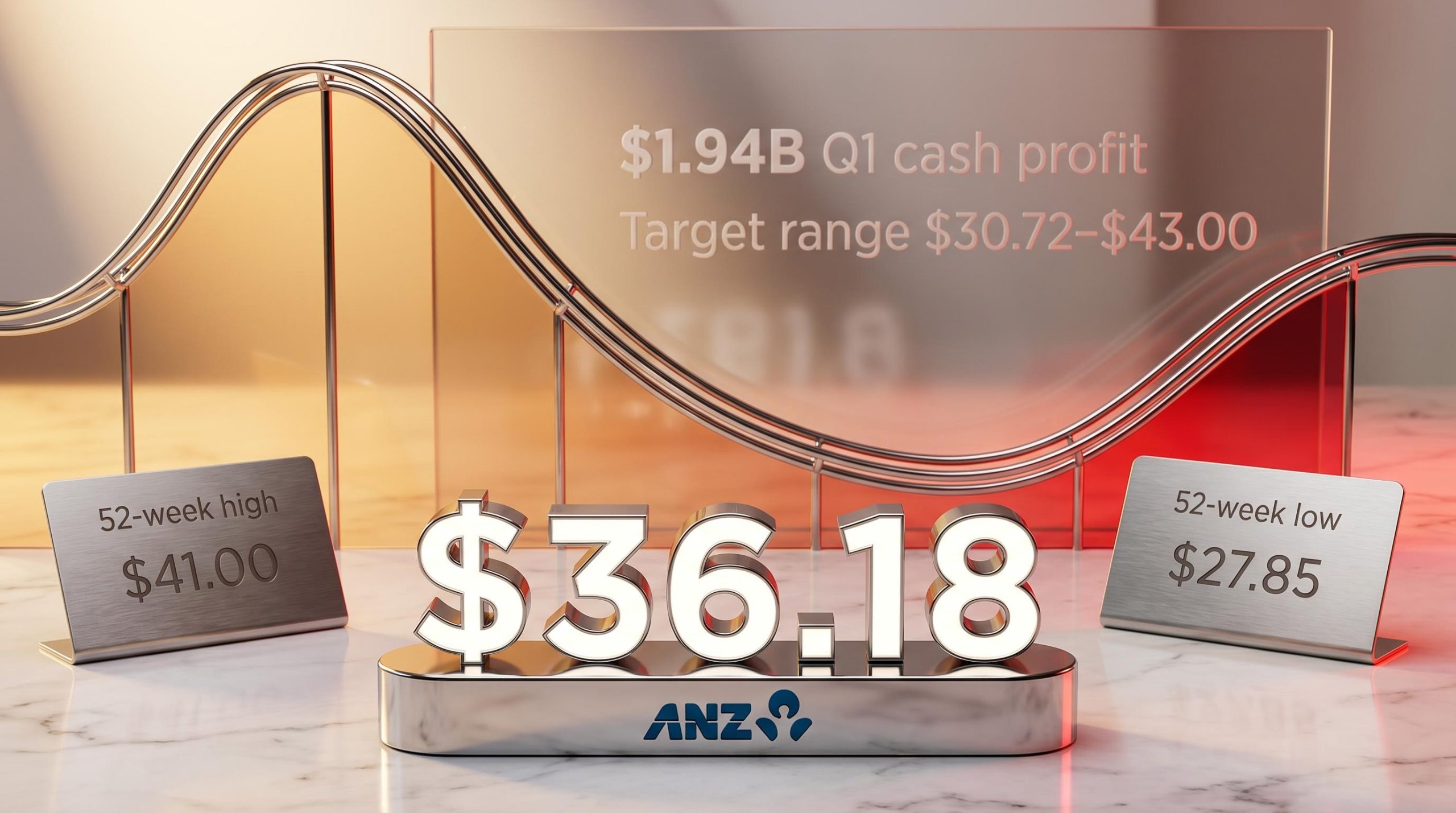
ANZ Group Holdings delivered one of the more instructive share price stories on the ASX through the first four months of 2026. The stock went from flat, to up more than 11%, to down more than 10%, to partially recovered, all within a single quarter. As of 30 April 2026, ANZ shares closed at $36.18, still well above their 12-month low of $27.85 but meaningfully off their 52-week high of $41.00. That kind of volatility in a Big Four bank stock does not happen without reason. What follows traces each phase of ANZ’s 2026 price movement, explains the forces behind each shift, and offers a framework for understanding how company-specific catalysts and macro headwinds interact to drive bank stock volatility on the ASX.
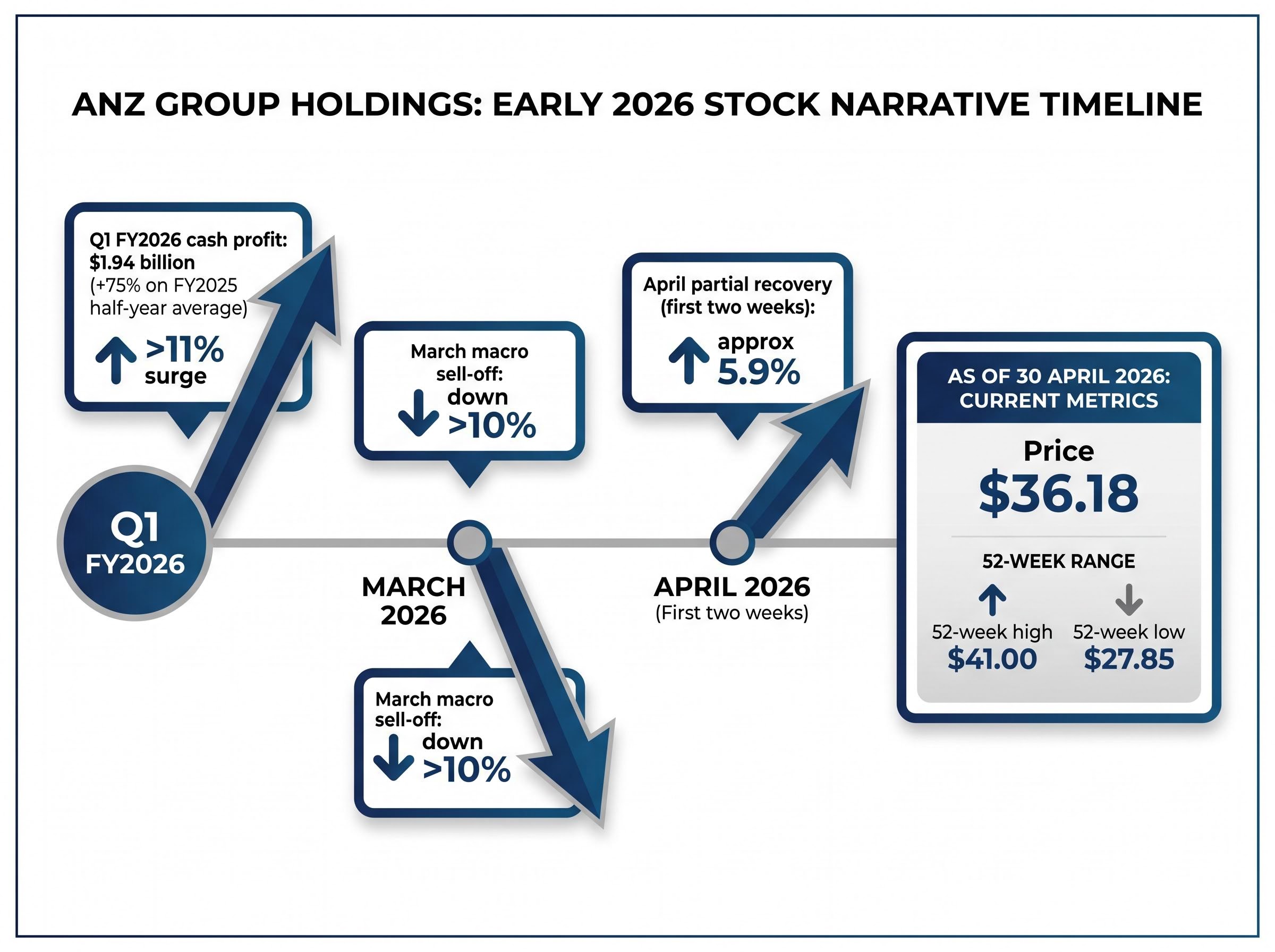
From flat to flying: What the Q1 earnings result did to ANZ’s share price
ANZ’s share price spent late 2025 and early January 2026 in a period of relative stasis. The stock drifted without a clear directional catalyst, and trading volumes reflected a market waiting for new information.
Then the Q1 earnings landed.
- Q1 FY2026 cash profit: $1.94 billion
- Increase on FY2025 half-year average: 75%
- Post-earnings share price surge: more than 11%
- February month-end gain: approximately 9%
$1.94 billion in quarterly cash profit, a 75% increase on the average of ANZ’s two FY2025 halves, was the single data point that reset the stock’s trajectory.
The result was stronger than anticipated. That distinction matters. A result that meets expectations tends to confirm the prevailing price. A result that exceeds them reprices the stock to reflect earnings power the market had not yet accounted for. ANZ’s 11% surge was not speculative enthusiasm; it was the market absorbing a genuine earnings surprise and adjusting valuations accordingly.
By the end of February, the stock had locked in approximately 9% in gains for the month, its strongest run since the post-pandemic recovery rally.
When big ASX news breaks, our subscribers know first
How bank stocks actually work: Net interest margins and earnings sensitivity explained
A net interest margin (NIM) is the difference between what a bank earns on loans and what it pays on deposits, expressed as a percentage of its interest-earning assets. It is the single most important earnings lever for Australian banks. When NIMs widen, bank profits rise; when they compress, profits fall.
The Reserve Bank of Australia (RBA) cash rate is the primary external force acting on NIMs. When the RBA raises rates, banks typically reprice their loan books faster than their deposit costs adjust, widening margins in the near term. ANZ economists have indicated they anticipate an RBA rate increase in May 2026, a signal that could support NIM-driven earnings in the coming quarter.
The RBA cash rate is the single most consequential external variable for Australian bank earnings, transmitting through the economy via mortgage repayments, deposit pricing, and business loan costs before ultimately registering in a bank’s net interest margin.
The RBA Monetary Policy Board decision released in March 2026 cited persistent inflation and sustained economic momentum as the primary justifications for adjusting the cash rate, providing the official context for why ANZ economists are anticipating a further move in May.
The relationship is not one-directional, however.
| Rate direction | NIM impact | Credit risk | Net price tendency |
|---|---|---|---|
| Rising | Widens (positive) | Increases over time | Positive near term, uncertain longer term |
| Falling | Compresses (negative) | Eases over time | Negative near term, supportive longer term |
Higher rates support NIMs in the short term but simultaneously raise the risk that borrowers default, which increases provisioning costs and erodes the earnings uplift over time.
Why housing market conditions amplify ANZ’s share price swings
Australian banks derive a substantial share of their revenue from mortgage lending. ANZ carries high exposure to residential property, which means housing price trends directly influence both credit quality and provisioning risk.
As of early 2026, Australian housing prices were declining back toward 2024 rates after a period of stabilisation. Supply remained tight, but affordability pressure and rising mortgage repayment costs were weighing on the credit outlook. For ANZ, this housing exposure adds a second layer of earnings sensitivity on top of the interest rate mechanism, making the stock responsive to property market data in a way that most non-financial companies are not.
The ABS total value of dwellings data for the December 2025 quarter recorded a decline in mean dwelling prices across most capital cities, providing the statistical foundation for assessing how softening property values translate into heightened provisioning risk for mortgage-exposed lenders like ANZ.
The March meltdown: Geopolitics, trade fears, and a 10% sector-wide sell-off
ANZ did not issue a profit warning in March 2026. It did not announce a capital raising, a management departure, or a regulatory action. The stock fell more than 10% anyway.
The decline was driven entirely by external forces:
- Middle East tensions elevated geopolitical risk premiums across global equities, with energy-exposed economies bearing the heaviest repricing.
- Elevated fuel costs fed through to inflation expectations, complicating the outlook for central bank policy and borrower serviceability.
- Trade-related uncertainties added a layer of concern about global growth, compressing valuations across rate-sensitive sectors.
The sell-off was not ANZ-specific. ASX banking peers experienced similar declines simultaneously, confirming the macro-driven nature of the move.
No price-sensitive company announcement from ANZ coincided with either the March sell-off or the mid-April softness that followed, reinforcing the conclusion that these moves were driven by sector-wide sentiment rather than company fundamentals.
The transmission mechanism is straightforward: geopolitical uncertainty triggers risk-off positioning, capital rotates out of rate-sensitive sectors, and bank valuations compress regardless of the underlying earnings trajectory. For investors, the distinction between a company-specific decline and a sector-wide repricing is the difference between a deteriorating investment thesis and a temporary sentiment event.
ANZ’s five-year return story makes a similar point: the bulk of the 27% capital gain over that period was attributable to multiple expansion rather than underlying profit growth, with the market re-rating the stock to approximately 14x forward earnings even as FY25 statutory profit declined roughly 10%.
April’s partial recovery and what a US-Iran peace signal meant for bank valuations
The same mechanism that drove ANZ’s March decline operated in reverse during April. A potential US-Iran peace agreement reduced geopolitical risk premiums across global markets, easing the pressure on energy prices and trade sentiment that had compressed bank valuations weeks earlier.
- 52-week high: $41.00
- 52-week low: $27.85
- Current price (30 April 2026): $36.18
- Year-to-date gain: approximately 4.5%
- 12-month gain: approximately 37.8%
- April recovery (first two weeks): approximately 5.9%
The recovery was real but partial. ANZ recouped roughly half of its March losses, not all of them. That gap reflects residual uncertainty about global trade conditions, domestic housing weakness, and the broader question of whether geopolitical risk premiums had been fully unwound or merely reduced.
Where ANZ’s price sits now relative to analyst targets
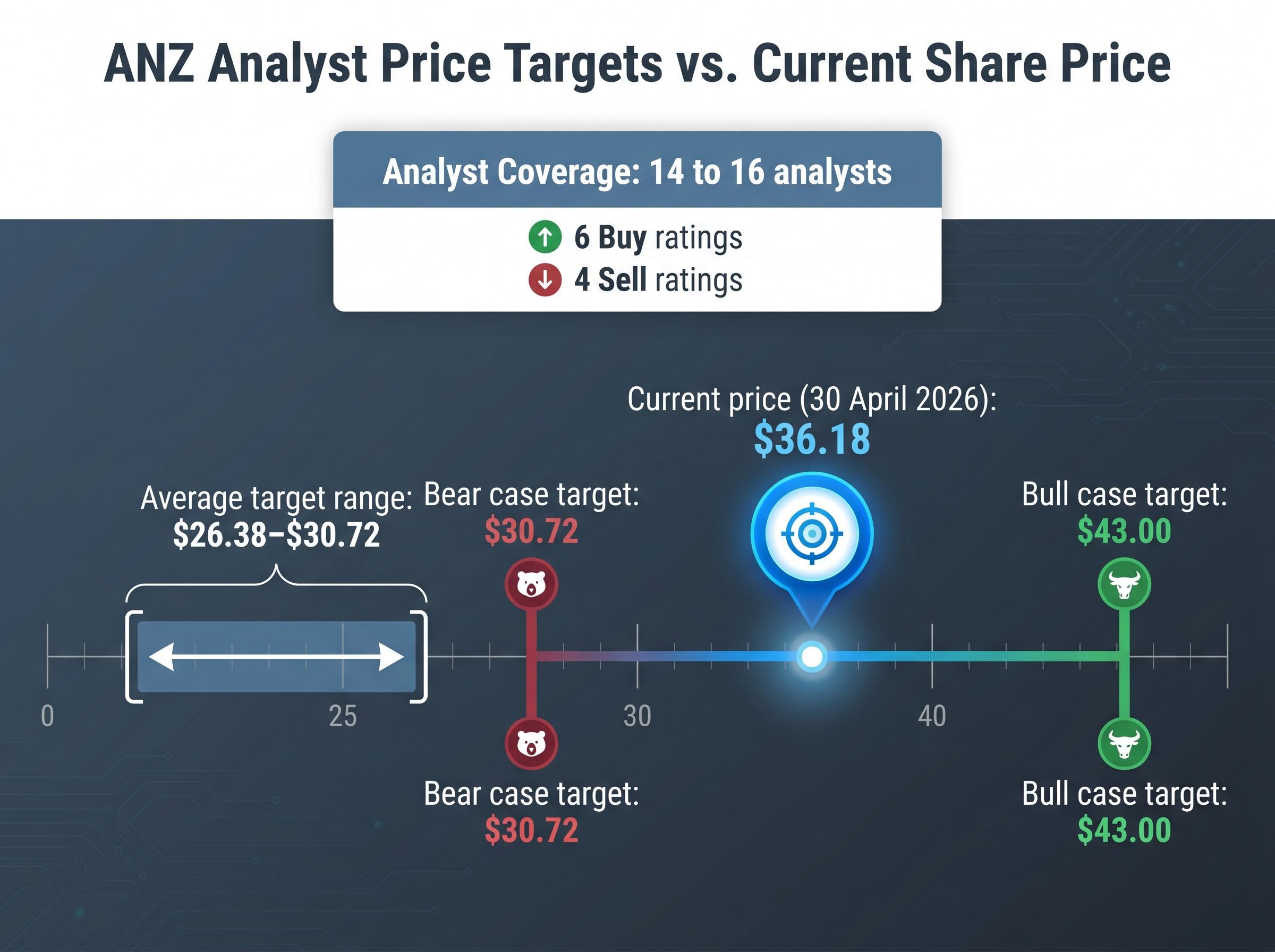
Approximately 14 to 16 analysts cover ANZ. Approximately six recommend Buy or Strong Buy, with the remainder split across Neutral, Hold, and Sell ratings.
The average analyst price target sits in the range of $26.38–$30.72, which places it meaningfully below the prevailing market price, suggesting analysts broadly view the stock as trading at a premium to fair value estimates. The highest individual target of $43.00 represents the bull case. At least one broker maintains a Sell rating with a target of $30.72.
That spread, from $30.72 to $43.00, captures the degree to which ANZ’s valuation remains contested among professional analysts.
The May 2026 earnings release and the rate decision that could move ANZ’s price next
Two catalysts arrive in quick succession during May 2026, and both have the capacity to move ANZ’s share price materially:
- Half-year results on 1 May 2026. Half-year results carry more weight than quarterly updates because they include a fuller picture of provisioning, dividend decisions (interim dividend payment scheduled for 1 July 2026), and management guidance. After the Q1 earnings surprise, the market will be calibrating whether that profit trajectory is sustainable or whether it reflected one-off factors.
- RBA May meeting. ANZ economists anticipate an RBA rate increase in May 2026. A confirmed hike would support NIM-driven earnings in the near term, though broader indications suggest persistently elevated rates are not the base case, meaning the earnings tailwind may be time-limited.
Whether the current rate cycle peaks at one more hike or extends further matters considerably for ANZ’s NIM outlook: oil futures backwardation and Oxford Economics modelling of potential back-to-back GDP contractions in Australia’s June and September 2026 quarters both point to the possibility that the earnings tailwind from rate settings reverses faster than consensus pricing currently implies.
ANZ economists have flagged a potential RBA rate increase in May 2026, a development that could provide near-term support for the bank’s net interest margins if confirmed.
Global bond yields rising on inflation concerns add complexity to the rate outlook. A rate hike that arrives alongside rising long-term yields could support NIMs while simultaneously increasing credit risk, creating a mixed signal for the share price.
What ANZ’s 2026 rollercoaster tells retail investors about ASX bank stocks
ANZ’s first four months of 2026 compress several years’ worth of bank stock dynamics into a single quarter. The principles are transferable:
- Distinguish company-specific from macro-driven moves. The Q1 earnings beat was an ANZ-specific catalyst; the March sell-off was not. Knowing which force is dominant at a given moment is the core analytical task when assessing bank stock volatility.
- Interpret analyst consensus as a range, not a number. ANZ’s price sits between the bear-case target of $30.72 and the bull-case target of $43.00. The outcome remains contested, and the spread itself is informative.
- Recognise the limits of sentiment-driven moves. The April recovery did not fully unwind the March decline. Markets do not mechanically reverse sentiment-driven repricing, and residual uncertainty tends to persist longer than the initial shock.
ANZ’s relatively balanced analyst split, with six Buy and four Sell ratings, compares favourably to the other three Big Four banks. According to an April 2026 Motley Fool analysis, three of the Big Four carry majority Sell or Strong Sell consensus ratings. That positioning gives ANZ a degree of relative value support even as the absolute price remains debated.
Leadership change and cultural reform as a longer-term variable
Nuno Matos commenced as ANZ’s Chief Executive Officer on 12 May 2025 and has since initiated a publicly stated cultural overhaul, including revising the bank’s corporate values. This is a variable institutional investors are likely to monitor over a multi-year horizon, distinct from the near-term earnings and macro catalysts that have dominated the 2026 price narrative. Whether the cultural reform translates into measurable operational improvement remains to be seen.
ANZ’s 2026 is still being written, and the next chapter starts May 1
ANZ’s 2026 share price story is not a simple trend. It is a case study in how earnings beats and macro forces layer on each other, producing moves that look volatile on a chart but follow identifiable causal logic when examined individually.
The next chapter begins on 1 May 2026 with the half-year results, followed closely by the RBA’s May meeting. Both events will test whether the Q1 earnings momentum holds and whether the macro headwinds that drove the March sell-off have genuinely eased or merely paused.
Retail investors who understand the NIM mechanism, the distinction between company-specific and sector-wide moves, and the contested nature of analyst consensus are better equipped to interpret whatever comes next.
Investors exploring how to act on the rate and inflation dynamics described above will find our comprehensive walkthrough of ASX portfolio positioning covers the specific instrument choices, including cash ETFs, quality equity tilts, and dollar cost averaging mechanics, that have historically performed through comparable tightening cycles.
This article is for informational purposes only and should not be considered financial advice. Investors should conduct their own research and consult with financial professionals before making investment decisions. Past performance does not guarantee future results, and forward-looking statements are subject to market conditions and various risk factors.