Why Starting With $100 a Month Beats Waiting to Invest More
1 hr ago

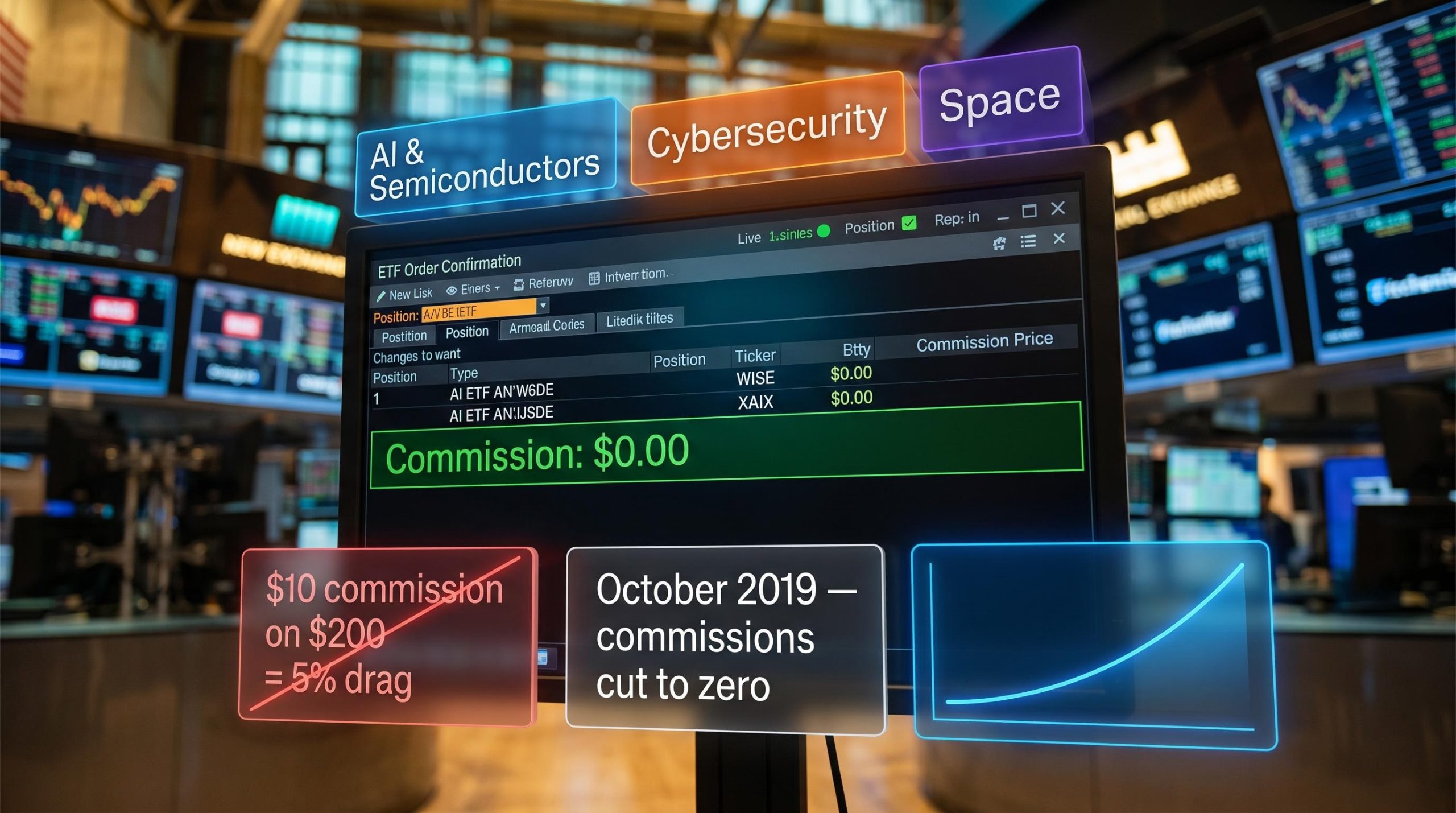
A $10 commission on a $200 position in an AI ETF used to consume 5% of your capital before a single share moved. That was the arithmetic, and it was enough to make most small, exploratory trades feel financially irrational. For years, it quietly kept retail investors from acting on the themes they followed most closely.
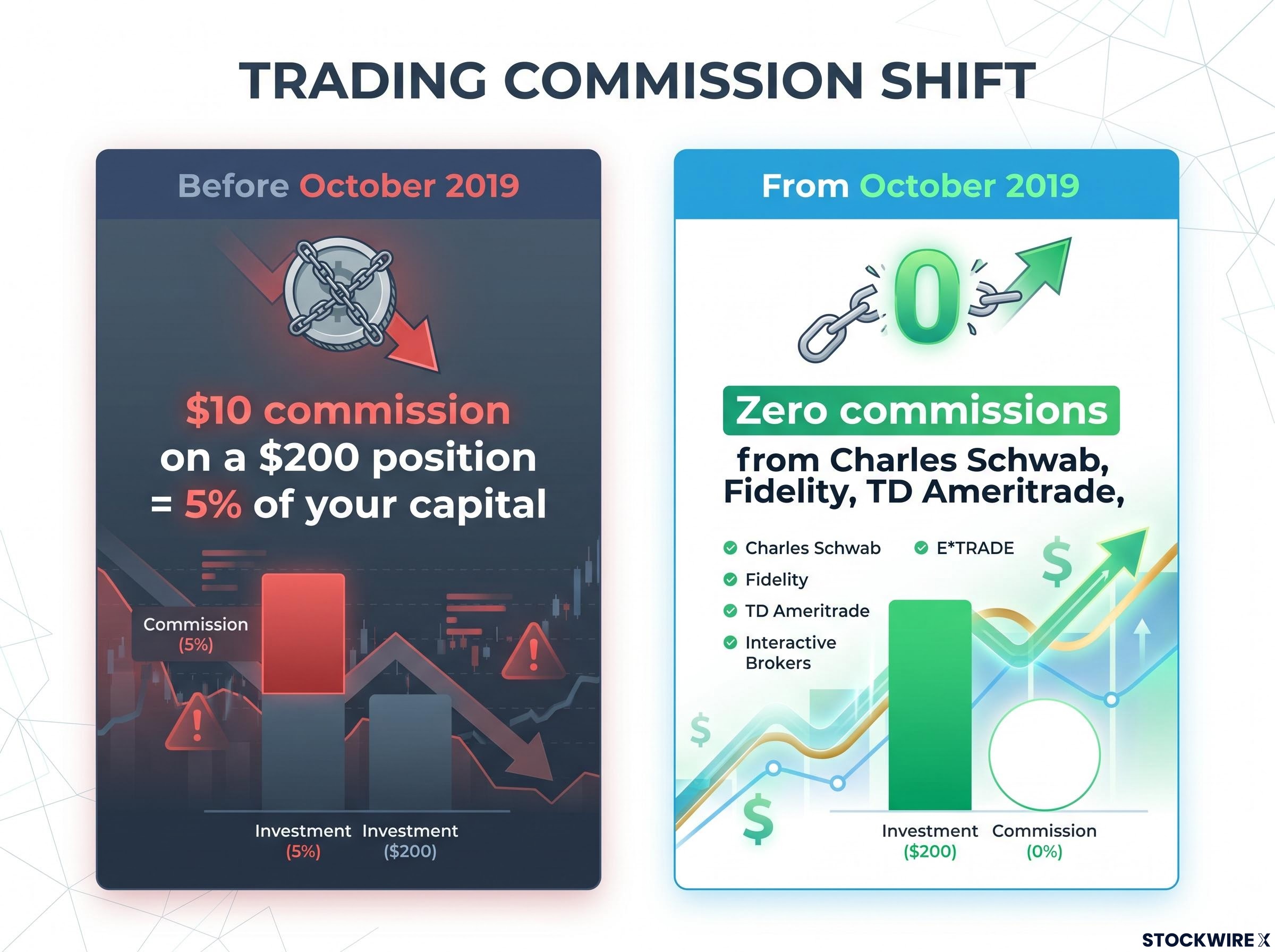
In October 2019, the barrier came down. Charles Schwab, Fidelity, TD Ameritrade, Interactive Brokers, and **E\*TRADE** cut equity and ETF commissions to zero, and the rest of the industry followed. The consequence has been structural rather than dramatic: investors who track artificial intelligence, cybersecurity, and space through daily reading can now convert that awareness into portfolio positions incrementally, at any size, without fee arithmetic deciding whether a trade is “worth it.”
Here is how the mechanics of that change work, which thematic ETF categories are drawing the most retail attention, and how to build exposure progressively without letting enthusiasm outrun discipline. If you have had opinions on these themes but have not yet acted on them, this is the framework for doing so.
Before October 2019, most brokerages charged a flat fee on every trade. The amount was the same whether you bought $200 or $20,000 worth of an ETF, which meant the fee hit small positions disproportionately hard.
A $10 commission on a $200 position consumed 5% of your capital immediately. The ETF had to gain 5% before you were even back to break-even, and that is before the fund’s own expense ratio.
That arithmetic shaped behaviour in two specific ways:
The result was an invisible minimum entry threshold. You did not need a rule telling you not to trade small. The fee arithmetic told you for you. Investors rationalised waiting until they had “enough” capital to justify the commission, and for many, that moment never arrived. The barrier was not a lack of interest or awareness. It was structural, and it made patient, incremental position-building feel like a losing proposition from the start.
The commission drag on small trades was not a minor inconvenience; a US$27.25 minimum fee consumed 54.5% of a US$50 purchase, making frequent, small contributions structurally uneconomical on traditional platforms and explaining why most retail investors waited until they had ‘enough’ to justify the entry.
If you already follow AI chip announcements, cybersecurity breach headlines, or satellite launch schedules, you are doing the awareness work that thematic investing builds on. The question is how to convert that awareness into a portfolio position without having to pick one company to bet on.
A thematic ETF is a fund organised around a forward-looking structural trend rather than a geography, traditional sector, or market-capitalisation segment. Instead of holding “Australian large caps” or “US technology,” it holds companies linked to a specific theme: artificial intelligence, cybersecurity, robotics, clean energy, or space commercialisation.
For you as a retail investor, the structure solves several problems at once:
Major providers now offer dedicated thematic ETF families. BlackRock, DWS (Xtrackers), and Global X cover AI, semiconductors, cybersecurity, digital assets, and multi-theme strategies. For an investor who has followed these themes through news and personal interest, a thematic ETF is the closest available instrument to expressing a view on the trend without concentrating risk on a single company.
Three structural themes are drawing the strongest interest from retail investors who follow technology and innovation. Each has a distinct investment thesis, a different maturity profile, and different risks. Understanding the differences matters, because “thematic ETF” is a category label, not a precise description.
| Theme | Structural driver | Typical holdings | Volatility profile | Representative fund |
|---|---|---|---|---|
| AI and semiconductors | Accelerating enterprise AI adoption and infrastructure buildout | Chip designers, semiconductor equipment, cloud and data-centre operators, AI software | Moderate to high | WISE (expense ratio 0.35%), XAIX (expense ratio 0.35%) |
| Cybersecurity | Expanding digital infrastructure, regulatory pressure, persistent cyber threats | Network and cloud security, identity management, endpoint protection, threat intelligence | Moderate | PSWD (Xtrackers Cybersecurity Select Equity ETF) |
| Space commercialisation | Launch cost reductions, satellite communications growth, earth observation demand | Launch services, satellite operators, in-orbit infrastructure, aerospace and defence firms | High | Various space-focused ETFs with differing pure-play vs. defence-weighted compositions |
AI and semiconductors is the most mature of the three in ETF terms. Funds like the Themes Generative Artificial Intelligence ETF (WISE) and the Xtrackers Artificial Intelligence and Big Data ETF (XAIX) both carry expense ratios of 0.35%, but their portfolios can look quite different. One may lean toward semiconductor hardware; another toward enterprise software platforms that incorporate AI. The label “AI ETF” tells you the theme. It does not tell you which part of the AI value chain you are buying.
Cybersecurity benefits from structural demand that is not cyclical in the traditional sense. Digital infrastructure keeps expanding, regulatory requirements keep tightening, and threats keep evolving. PSWD, the Xtrackers Cybersecurity Select Equity ETF, provides focused exposure across the major security segments.
Space commercialisation is the earliest-stage theme of the three and carries the highest uncertainty. The balance between pure-play space companies and diversified aerospace and defence names varies significantly across funds, which means two “space ETFs” can have very different risk profiles.
Morningstar research has found that thematic funds have historically shown low success rates in outperforming global equities over multi-year periods, with higher fees and poor entry timing among the contributing factors. The structural case for these themes is about long-run trends, not short-term outperformance.
The index methodology behind a thematic ETF determines what it actually holds. An investor who wants semiconductor exposure may inadvertently own a fund tilted toward enterprise software or broad tech if they rely only on the fund name. Before you buy, review the top holdings and index construction rules. That five-minute check is the difference between owning the exposure you intended and owning a broad tech fund with a thematic label.
Understanding what thematic ETFs are and which themes are available is one thing. What changed in October 2019, and has continued to spread since, is how you can act on that understanding. Removing the per-trade commission did not create new funds. It changed the economics of how you enter them.
Without a commission on each trade, the minimum economically sensible trade size effectively disappears. That shift has three practical implications:
The dollar-cost averaging evidence shows a more nuanced picture than the strategy’s reputation suggests: lump-sum investing outperforms in roughly 68-73% of historical periods because markets rise more often than they fall, yet DCA still provides meaningful behavioural protection by removing emotional timing decisions from the process, which matters when behavioural drag costs investors an estimated 1.5% annually.
This model has now spread beyond the major US brokerages. POEMS Cash Plus, operated by Phillip Securities Pte Ltd (PSPL), offers US$0 commission on US-listed stocks and ETFs as of June 2026, illustrating that zero-commission access is available to investors on international platforms as well.
The practical significance is straightforward. Dollar-cost averaging into a thematic ETF is now genuinely cost-free on the commission side, which means the compounding benefit of keeping all contributions invested, rather than partially consumed by fees, is available to you at any account size.
Zero commissions remove one cost. They do not remove the need to choose carefully. Before you commit capital to any thematic ETF, work through these five dimensions:
| Dimension | Thematic ETFs | Broad index ETFs |
|---|---|---|
| Fee range (annual) | 0.30-0.75% | 0.05-0.20% |
| Typical holdings count | 30-80 companies | 500-3,000+ companies |
| Theme specificity | Narrow, trend-focused | Broad market or sector |
| Volatility profile | Moderate to high | Moderate |
| Best use case | Targeted conviction exposure | Core portfolio foundation |
The Morningstar research finding is worth keeping front of mind here. Thematic funds have historically shown low success rates relative to global equities. Higher fees and poor entry timing are contributing factors. That does not mean thematic ETFs cannot add value, but it does mean you should evaluate each one rigorously rather than buying the label.
The behaviour gap in thematic investing is the mechanism that explains why Morningstar’s data looks so counterintuitive: when inflows spike near valuation peaks, the typical investor captures a much smaller slice of the fund’s reported time-weighted return than the headline figure suggests, and in ARK Innovation’s case, that gap ran to roughly 268 percentage points.
You have identified themes you believe in. You have evaluated individual funds. Now the question is how much of your portfolio these positions should represent, and how to structure the allocation so that enthusiasm does not override discipline.
The most practical framework is a core-satellite structure. Your core, 80-90% of the portfolio, sits in broad, low-cost index ETFs covering major equity and bond markets. Your thematic positions, 10-20%, sit as satellites around that core. The proportions matter: the core ensures that even if a thematic bet underperforms significantly, your overall portfolio absorbs the impact without serious damage.
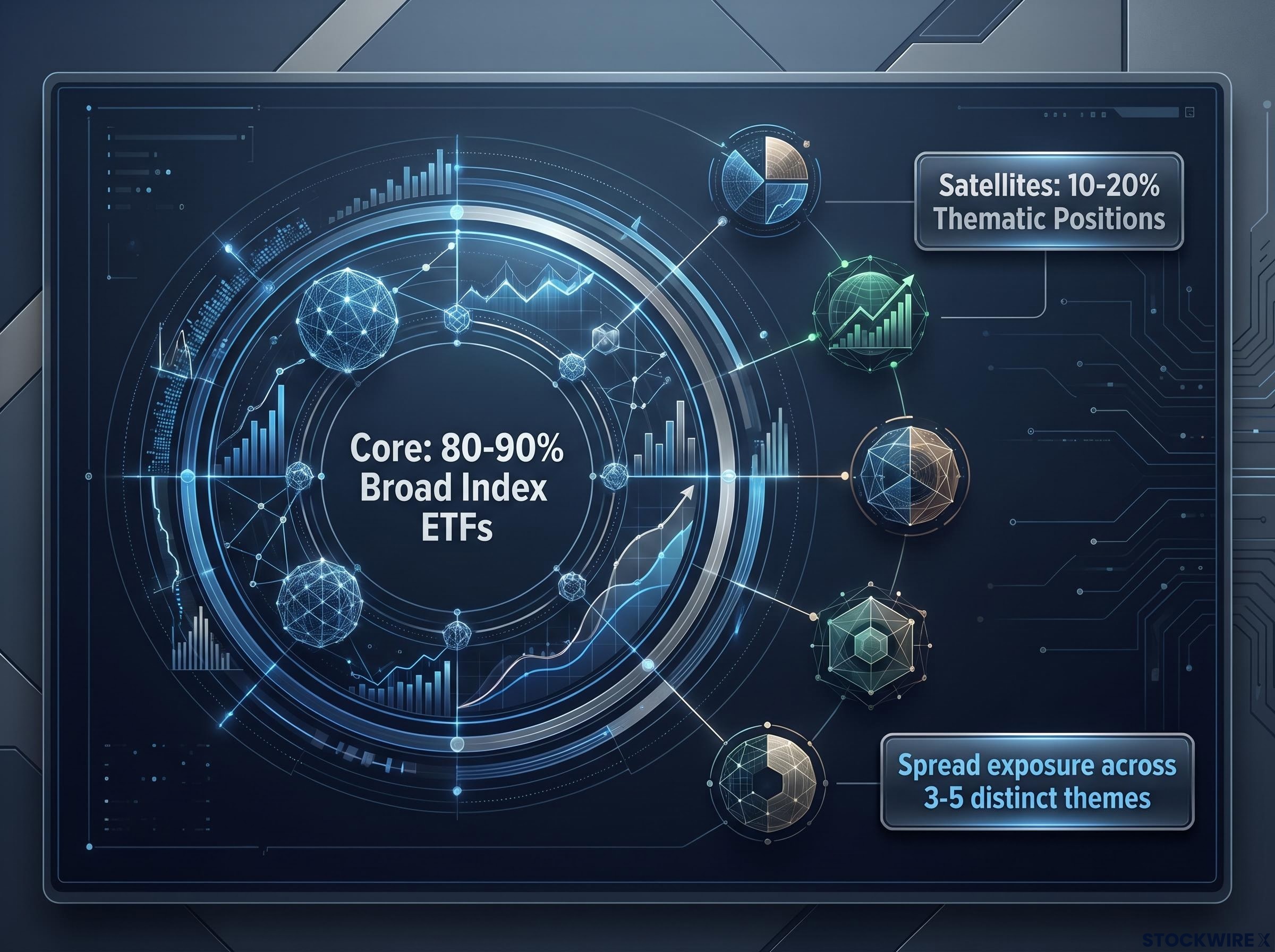
Within the thematic slice, three guidelines help manage risk:
To implement this using zero-commission trading, follow a four-step sequence:
This approach, what the research characterises as “conviction-weighted gradual accumulation,” mirrors how many institutions introduce new themes. The difference is that zero-commission trading now makes it operationally feasible for you at any account size, because incremental trades are no longer penalised by fees.
Zero-commission trading did not create thematic ETFs. What it removed was the structural barrier that made gradual, exploratory participation in those themes impractical for investors with modest account sizes. The arithmetic that used to make a $200 AI ETF position feel wasteful no longer applies, and that changes the range of investors who can act on their convictions.
The risk layer deserves equal weight. Thematic ETFs can be more volatile than broad-market funds, and Morningstar’s research confirms that historical performance has often disappointed relative to global equities. The case for thematic investing rests on long-run structural trends, not short-term outperformance. If you choose to allocate, do so with realistic expectations and a portfolio structure that contains the downside.
The active versus passive returns data provides the baseline against which thematic ETF performance should be judged: over a 20-year horizon, more than 90% of active large-cap fund managers underperformed the S&P 500, and the arithmetic reason is structural rather than a matter of skill, because managers collectively cannot outperform the market they constitute before fees.
If you follow AI, cybersecurity, and space through reading and personal interest, you are already doing the awareness work. The barrier that previously prevented you from converting that awareness into positions has been removed. What remains is the discipline to evaluate carefully, size appropriately, and build gradually.
This article is for informational purposes only and should not be considered financial advice. Investing involves risk, including the potential loss of principal. Investors should conduct their own research and consult with financial professionals before making investment decisions. Past performance does not guarantee future results.
A thematic ETF is a fund organised around a forward-looking structural trend, such as artificial intelligence, cybersecurity, or space commercialisation, rather than a geography or traditional sector. One trade gives you exposure to dozens of companies linked to that theme, removing the need to pick individual winners.
In October 2019, Charles Schwab, Fidelity, TD Ameritrade, Interactive Brokers, and E*TRADE all cut equity and ETF commissions to zero, and the rest of the industry followed. The change eliminated the flat per-trade fee that had previously made small, incremental positions financially impractical.
A core-satellite structure is the most practical framework: keep 80-90% of your portfolio in broad, low-cost index ETFs, and limit thematic positions to 10-20% as satellites. Spreading that thematic slice across 3-5 distinct themes reduces the risk of any single bet causing serious portfolio damage.
Thematic ETFs typically charge 0.30-0.75% per year, compared with 0.05-0.20% for broad index trackers. That gap of up to 0.55 percentage points compounds materially over a decade, particularly if the theme does not deliver the outperformance the investor expected.
Morningstar research has found that thematic funds show low success rates relative to global equities over multi-year periods, with higher fees and poor entry timing as the main contributing factors. When retail inflows spike near valuation peaks, the typical investor captures far less of the fund's reported return than the headline figure suggests.