Most retail investors are reading the same secondhand summaries, using the same broker reports, and arriving at the same stocks at roughly the same time. The problem is not a lack of information. It is that the information most people use has already done its work for someone else.
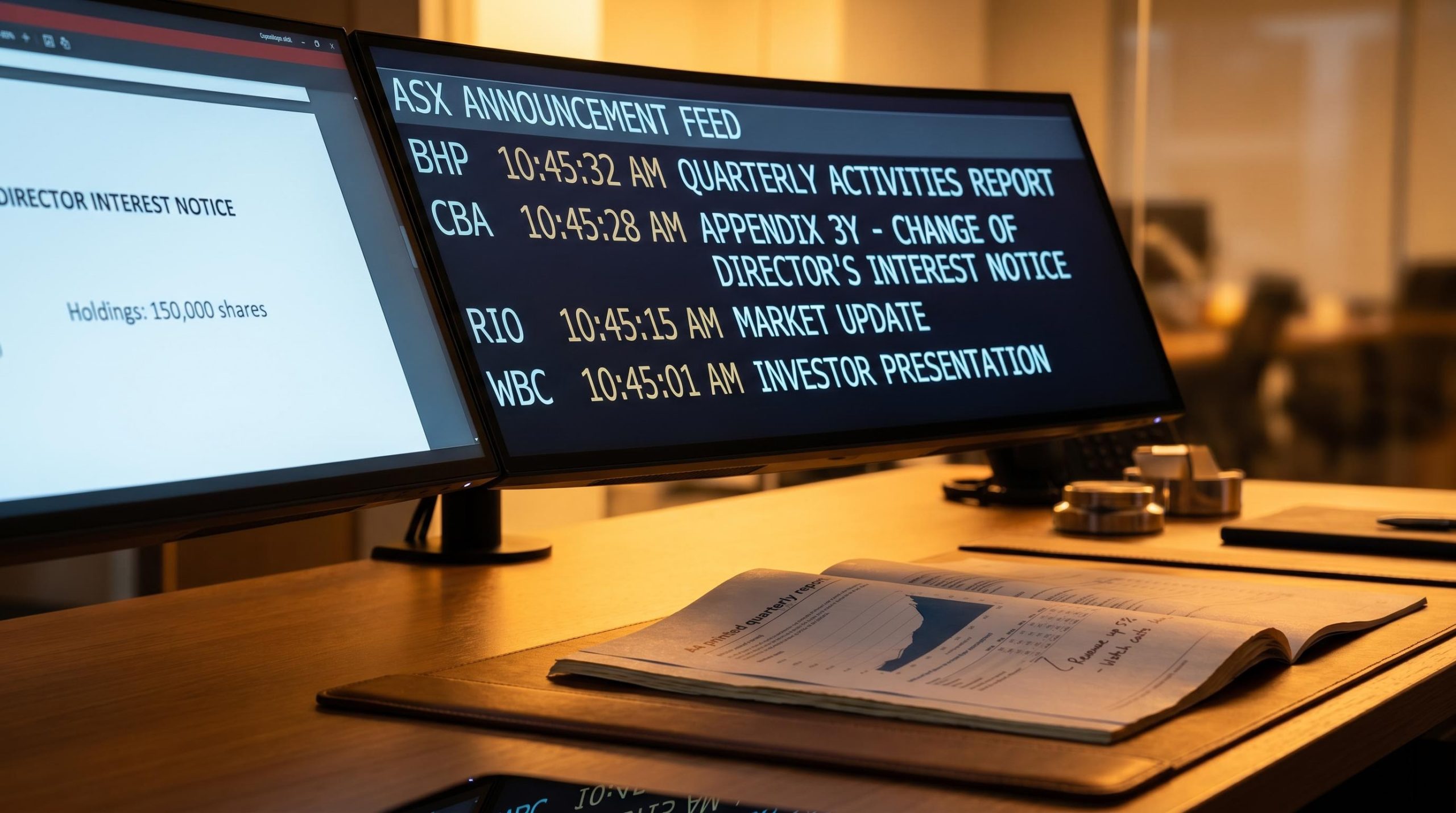
There is a concrete asymmetry available to you as an Australian retail investor: the ASX announcement feed delivers primary source material before any newsletter, podcast, or fund manager commentary adds their interpretation. The discipline to use that feed, combined with the ability to filter promotional noise, is a structural edge that requires no special access and no institutional resources.
This guide gives you two practical frameworks you can apply to your next research session. The first is a filter for assessing whether a source or management team deserves your trust. The second is a repeatable process for finding investment ideas before they become widely circulated. Together, they change how you approach small cap stock research from the ground up.
Why the ideas everyone is talking about are usually the wrong ones to act on
Think about how a small cap idea actually reaches you. A fund manager with a dedicated research team identifies an opportunity through primary analysis. They build a position at low prices over weeks or months while the stock is still obscure. The position matures, the thesis plays out, and at some point the manager discloses the holding, either for transparency, in a quarterly letter, or on a podcast.
That disclosure is the moment most retail investors first encounter the idea. But the return profile has already been captured. The edge existed during the research phase, not the disclosure phase.
This is not a criticism of any individual manager. It is a structural dynamic in small cap markets. The smaller the company, the more price-sensitive early information is, and the more the gap between idea origination and idea amplification determines who captures the returns.
The right response is not to ignore experienced voices. It is to use them differently.
What to borrow from fund managers:
- Analytical frameworks and how they evaluate businesses
- Sector knowledge and the questions they ask of management teams
- The discipline they apply to position sizing and risk assessment
What not to borrow:
- Their specific disclosed positions as fresh trade ideas
- Their timing, which reflects a position built at prices you can no longer access
- Their conviction level, which was earned through primary research you have not replicated
The implication for your own process is straightforward: fund manager commentary is most valuable as a framework-borrowing resource, not a stock-picking shortcut. Treating it as the latter is where retail returns diverge from institutional ones.
When big ASX news breaks, our subscribers know first
How to tell whether a source is giving you research or giving you a story
You have probably read commentary that felt promotional without being able to pinpoint exactly why. This section gives you a concrete filter to replace that instinct with a repeatable test.
The distinction comes down to verifiability. A credible, data-driven source cites primary documents, addresses risks alongside upside, and walks through the assumptions behind their conclusions. An enthusiasm-driven source leads with superlative language, references industry trends without connecting them to company-specific numbers, and minimises or omits the downside.
Watch for these specific phrases as warning signals: “world-class asset”, “transformational opportunity”, “highly experienced management team”. These phrases appear in promotional commentary regardless of the underlying quality of the company. They are marketing language, not analysis.
The foundational rule is simple. If a claim cannot be traced back to a filed document, a specific number, or a verifiable data point, treat it as narrative, not research. And pay attention to commercial relationships: paid promotion, capital raise support, or sponsorship arrangements create bias that does not need to be intentional to distort the analysis.
The line between commentary and licensed financial advice matters more than most retail investors realise: ASIC research found 63% of Gen Z Australians trust finfluencer content that carries no legal obligation to be accurate or suitable for any individual’s circumstances.
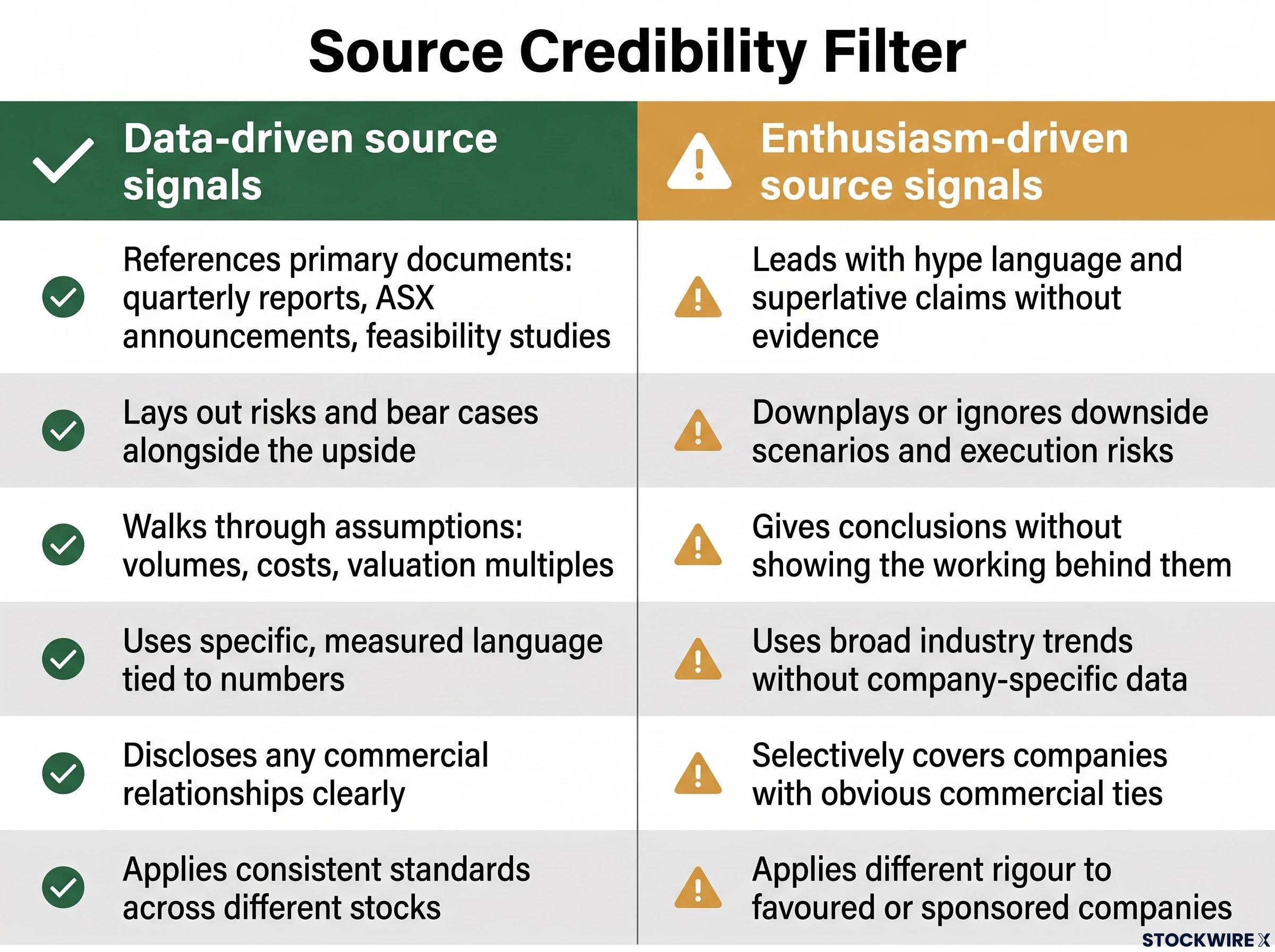
| Data-driven source signals | Enthusiasm-driven source signals |
|---|---|
| References primary documents: quarterly reports, ASX announcements, feasibility studies | Leads with hype language and superlative claims without evidence |
| Lays out risks and bear cases alongside the upside | Downplays or ignores downside scenarios and execution risks |
| Walks through assumptions: volumes, costs, valuation multiples | Gives conclusions without showing the working behind them |
| Uses specific, measured language tied to numbers | Uses broad industry trends without company-specific data |
| Discloses any commercial relationships clearly | Selectively covers companies with obvious commercial ties |
| Applies consistent standards across different stocks | Applies different rigour to favoured or sponsored companies |
Once you apply this filter consistently, the time you spend on promotional commentary drops dramatically. That time redirects toward primary documents, which changes the quality of every subsequent research decision you make.
What management behaviour actually tells you about alignment
“Management alignment matters” is advice you have probably heard many times. The harder question is how you actually assess it. The answer is not in the investor presentation. It is in observable behaviour over time.
Case study: Vulcan Energy Resources An early position in Vulcan Energy Resources was taken at a placement price of roughly 40 cents per share, at a time when direct lithium extraction (DLE) technology, which recovers lithium from underground brine rather than conventional hard-rock mining, had little recognition among most retail investors. The credibility signal that anchored conviction came not from the pitch deck but from watching how the CEO conducted himself day to day: riding his bike to the office and keeping personal expenditure minimal. That alignment between how he lived and what the company stood for established trust well before the broader market had assigned any meaningful value to the technology.
Contrast that with the red flag pattern visible elsewhere in junior mining: executives whose conspicuous personal spending sits awkwardly alongside active investor capital raises. When someone is seeking external funding while simultaneously signalling personal wealth, the inconsistency raises a reasonable question about whether the business or the lifestyle is the primary beneficiary.
You can apply this discipline to any company using four specific management credibility signals:
- Verifiability of communication. Are management’s public statements about projects, financing, and timelines backed by filed documents and later outcomes?
- Delivery record against milestones. Are commitments met broadly on time and budget? When they slip, are the explanations detailed and consistent, or vague and shifting?
- Personal behaviour and lifestyle. Does management’s visible conduct suggest they are focused on building long-term value, or does it suggest capital extraction?
- Remuneration and incentive structure. Are vesting conditions tied to genuine value creation, or to short-term share price metrics that can be gamed?
No single signal is decisive on its own. But when they align, either positively or negatively, they create a pattern you can use to calibrate your conviction. These behavioural reads are among the earliest credibility signals available, and they are widely ignored, which is precisely why they carry edge for investors willing to look.
The ASX announcement feed as a primary research tool
If you are an Australian retail investor, the ASX announcement feed is a structural advantage most people scroll past. Every material update from a listed company must pass through it. It reaches all investors simultaneously. And critically, it arrives before any newsletter, podcast, or social media commentary has added interpretation.
Continuous disclosure obligations require listed companies to announce material information the moment they become internally aware of it, not when the board has completed its review, which means the ASX announcement feed often captures the earliest public signal of a material development in a company’s operations.
That last point is where the real value sits. When you read an ASX announcement directly, you are forming your own view on primary source material. When you read a newsletter summary of that same announcement, you are absorbing someone else’s view, including whatever biases, omissions, or emphasis they have applied. The gap between those two experiences is where genuine informational edge exists.
Here are three practical steps to set up the announcement feed as a research tool:
- Set sector or theme-based alerts. Filter the feed toward sectors you care about (lithium, software, medtech, or whichever themes match your watchlist) so the volume is manageable and relevant.
- Read full documents, not just headlines or summaries. Quarterly reports, capital raising notices, and director interest notices contain detail that headlines never capture.
- Compare announcements over time. Track how a company’s language evolves across quarters. Are promises being fulfilled? Is the tone becoming more cautious, more promotional, or more concrete? Language shifts are a credibility signal in their own right.
Some of the richest insights live in sections most investors skip:
- Capital raising terms: discounts offered, attached options, broker fees, and the mix of institutional versus retail investors
- Director interest notices: insider buying, selling, or subtle shifts in holdings
- Related party transactions: who is being paid, for what, and on what terms
- Management incentive vesting schedules and how they relate to dividend timing or corporate announcements
Here is an example of the synthesis this enables. Cross-referencing dividend announcement timing against management vesting schedules and insider selling windows can surface a form of proprietary insight built entirely from public documents. There is no hidden data involved. The value comes from doing the connective work across filings that most investors never attempt.
A repeatable five-step process for building your own investment thesis
Having the right filters and the right primary source material only matters if you have a structured process to convert them into an investment decision. Here is a five-step workflow you can start using this week.
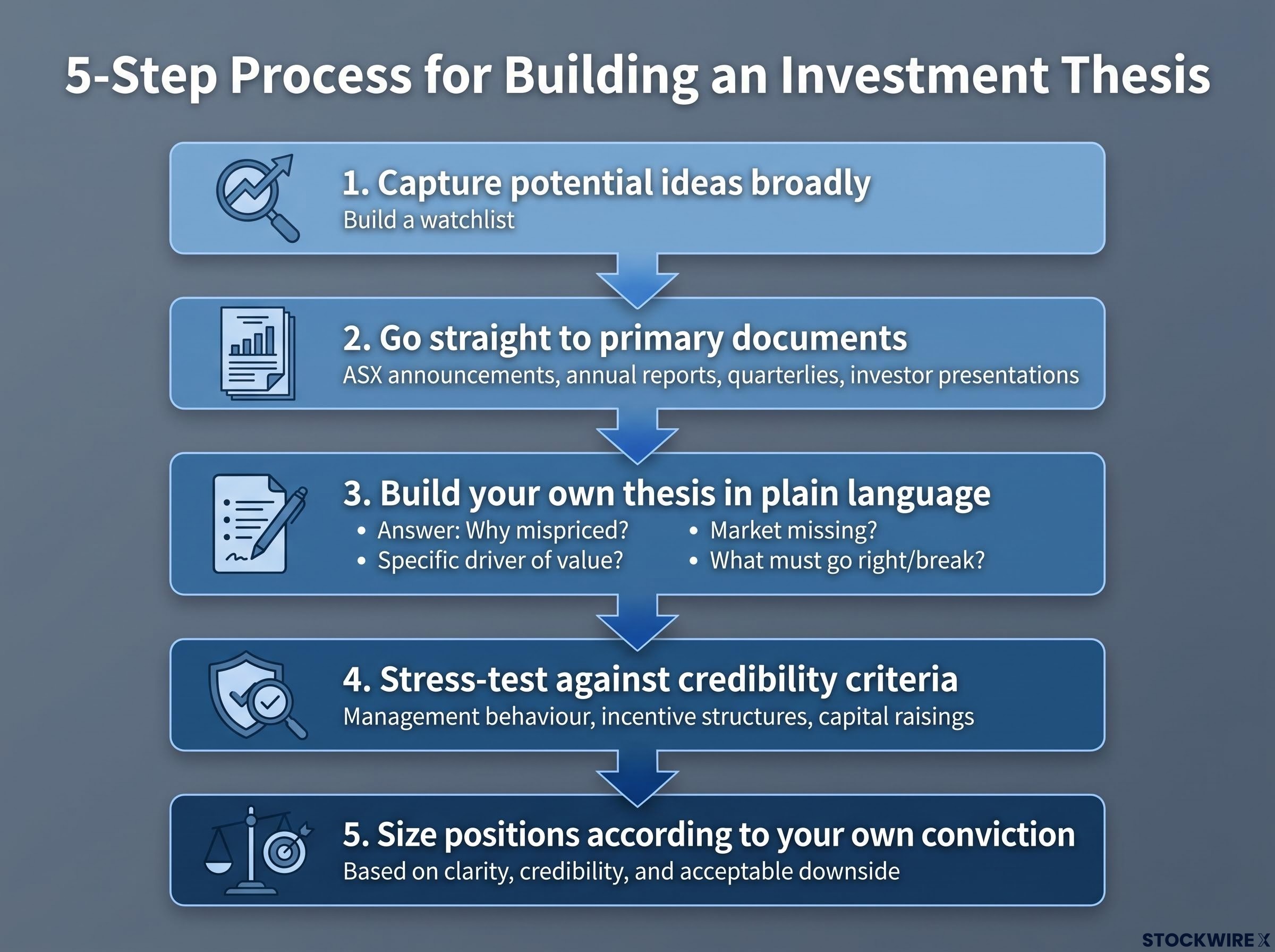
- Capture potential ideas broadly. Note tickers or sectors that appear repeatedly in credible sources, industry news, or your announcement feed alerts. Do not buy anything yet. Build a watchlist.
- Go straight to primary documents. For any stock on your watchlist, read the recent ASX announcements, the latest annual report and most recent quarterly, and investor presentations with an emphasis on numbers and commitments. Write down the specific claims and the evidence attached to them.
From information gathering to building conviction
- Build your own thesis in plain language. This is the most important step and the one most investors skip. Answer four questions clearly:
- Why might this business be mispriced?
- What is the specific driver of value (product, asset, contract, structural change)?
- What does the market appear to be missing?
- What must go right for the thesis to hold, and what would break it?
If you cannot answer these in plain language, your thesis is not ready. The discipline of writing it down forces clarity that mental notes never achieve.
- Stress-test against credibility criteria. This is where the work from earlier in this guide connects directly. Apply the management credibility checklist: is behaviour consistent with the thesis? Do incentive structures support long-term value creation? Are there red flags in capital raisings, related party transactions, or the gap between promises and delivery? Run the source credibility filter across the commentary you have consumed about this company. How much of your view is grounded in verified data, and how much in someone else’s narrative?
Applying a structured ASX stock evaluation framework at step four of this process, covering financial ratios, valuation multiples, and upgrade or downgrade cycle signals, gives your stress-test a consistent analytical baseline rather than an ad hoc checklist that varies with each new company.
- Size positions according to your own conviction. Higher conviction sizing is earned by three things: clarity of thesis, management credibility, and acceptable downside. Not by how compelling the story sounds. A stock with an attractive narrative but weak credibility signals, misaligned incentives, or unverifiable claims deserves a smaller position, or no position at all.
The position sizing step is where your credibility and research work actually converts into better portfolio outcomes, not just better-informed opinions. Discipline in sizing is the bridge between good analysis and good results.
This article is for informational purposes only and should not be considered financial advice. Investors should conduct their own research and consult with financial professionals before making investment decisions.
Developing the habits that compound over time in small cap investing
The two core disciplines in this guide, filtering source credibility and generating independent ideas, are not separate techniques. They reinforce each other. A better credibility filter means fewer low-quality inputs entering your research process. Fewer low-quality inputs mean the ideas you develop are grounded in stronger foundations. Over time, that cycle compounds.
Your durable edge in small cap investing comes from five sources:
- Filtering out promotional, enthusiasm-driven inputs before they distort your analysis
- Focusing on specific, verifiable claims and aligned management behaviour rather than narrative attractiveness
- Working directly from primary documents, particularly the ASX announcement feed, instead of secondhand summaries
- Doing the synthesis work others skip: connecting incentives, timing, capital flows, and behavioural patterns across documents
- Constructing and owning your own investment theses, and sizing positions based on your research quality rather than someone else’s confidence
None of these require special access, institutional resources, or secret information. They require the discipline to apply a higher-quality filter consistently, session after session, month after month. The payoff is that an increasing proportion of your decisions are grounded in reality rather than narrative, and that is the kind of edge that compounds.
Your next action is concrete. Open the ASX announcement feed for a company already on your watchlist. Apply the credibility checklist and the thesis framework to what you find there. That is where the practice starts.
Investors ready to commit capital to small cap positions will find our full explainer on small cap volatility clarifies how to distinguish illiquidity-driven price swings from genuine fundamental deterioration, a distinction that directly affects when you act on your thesis.