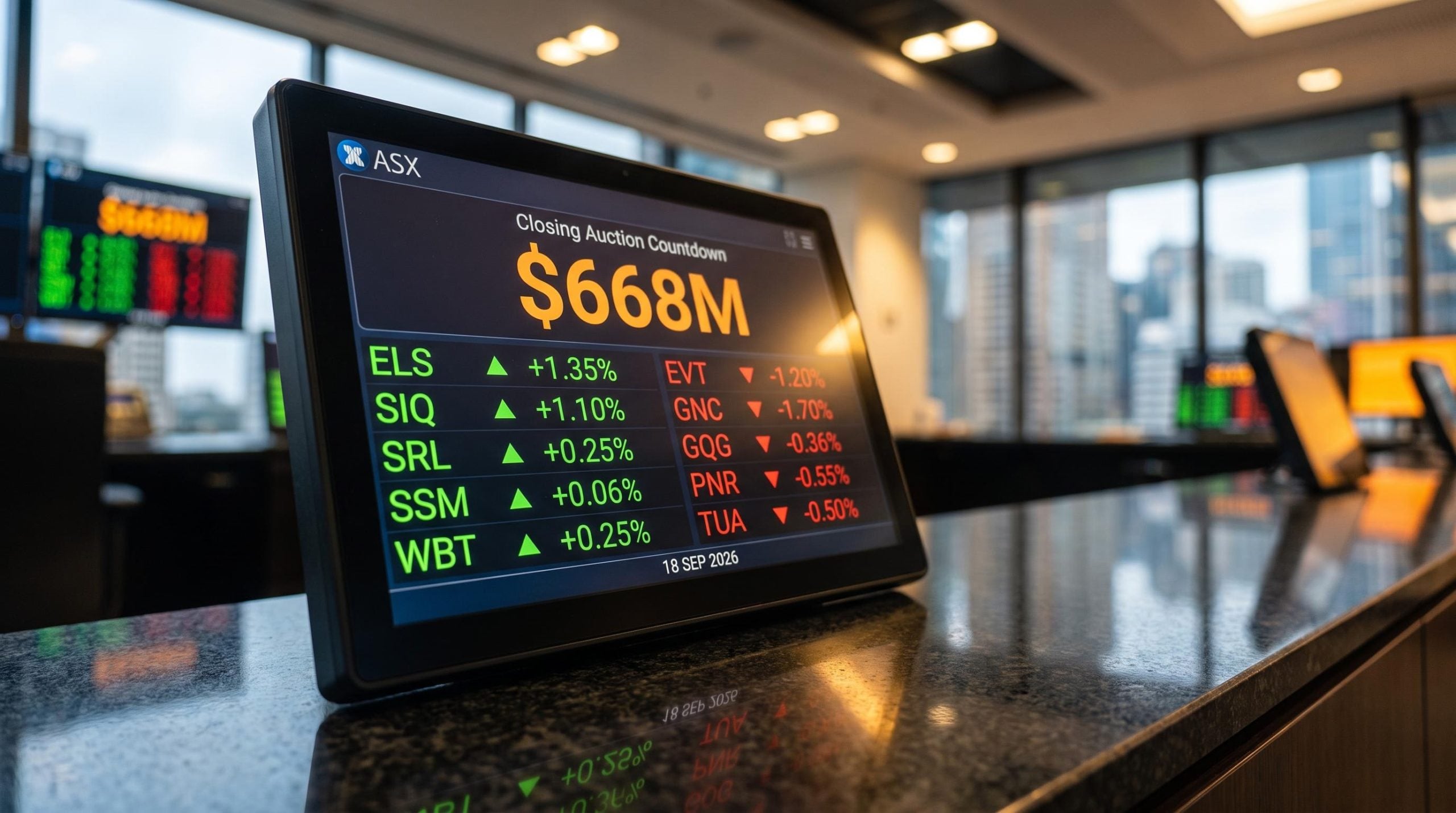
Roughly $668 million in forced trades, all expected to land in a single end-of-day auction on 18 September 2026, executed by funds that are legally unable to care about the price they pay. That is the shape of the event unfolding on the ASX right now.
This is not a normal trading day. On the effective session, passive funds tracking the ASX 200 must restructure their portfolios to reflect five new additions and five departures, confirmed by S&P Dow Jones Indices on 4 September 2026 and effective prior to the open on 21 September 2026.
The rebalance is scheduled, mechanically predictable, and known to every participant with an index mandate. Yet the price outcome for each affected stock at the close remains genuinely uncertain, which is exactly the tension worth understanding.
Here is what the mechanics actually look like: which companies are moving in and out, why passive funds have no pricing discretion, how arbitrageurs typically position around these dates, and where the risk sits for anyone watching the close on 18 September.
Five in, five out: what the September 2026 ASX 200 constituent list actually signals
The changes are confirmed. Five companies enter the benchmark and five leave, effective prior to the open on 21 September 2026, per the S&P Dow Jones Indices announcement of 4 September 2026.
| Ticker | Company | Direction | Sector |
|---|---|---|---|
| ELS | Elsight Limited | Addition | Defence technology |
| SIQ | Smartgroup Corporation Limited | Addition | Employee benefits administration |
| SRL | Sunrise Energy Metals Limited | Addition | Critical minerals |
| SSM | Service Stream Limited | Addition | Infrastructure services |
| WBT | Weebit Nano Limited | Addition | Semiconductor memory |
| EVT | EVT Limited | Removal | Entertainment and leisure |
| GNC | GrainCorp Limited | Removal | Agribusiness |
| GQG | GQG Partners Inc. | Removal | Funds management |
| PNR | Pantoro Gold Limited | Removal | Gold mining |
| TUA | Tuas Limited | Removal | Telecommunications |
What the inclusion criteria reveal about the additions
Read the additions together and a pattern emerges. Defence technology, benefits administration, critical minerals, infrastructure services, and semiconductor memory: the group skews toward smaller, thematic businesses, several of them resource-adjacent or growth-oriented, that have carried recent price momentum.
The gateway is mechanical, not qualitative. S&P Dow Jones Indices requires a company’s three-month average float-adjusted market capitalisation (its market value excluding shares that are not freely tradable) to clear the relevant selection buffer before it qualifies.
The gateway is float-adjusted market capitalisation, and ASX 200 inclusion criteria are set and enforced by S&P Dow Jones Indices rather than the ASX itself, a separation that explains why a company can list on the exchange for years before it qualifies for the benchmark.
The June 2026 rebalance shows the same filter at work, admitting Electro Optic Systems, Elevra Lithium, Kingsgate Consolidated, Minerals 260, and FireFly Metals, each after sustained gains in market cap and liquidity pushed it above the threshold.
The GQG Partners case makes the reversibility explicit. GQG was added to the ASX 200 in the September 2025 rebalance and is now being removed just twelve months later.
What this tells you is straightforward. Index membership is conditional and reversible, earned through market cap and liquidity, not a screen for business quality, so inclusion should be read as a signal of where mechanical buying will fall, not an endorsement of the underlying company.
When big ASX news breaks, our subscribers know first
Why passive funds have no choice about price on 18 September
The reason passive funds crowd into the close comes down to how they are measured. Index funds and ETFs calculate their net asset value (the per-unit value of the fund) using official closing prices, so any trade executed away from the close introduces tracking error, the very gap from the benchmark that their mandate is built to minimise.
Index funds and ETFs calculate their net asset value using official closing prices, so any trade executed away from the close introduces tracking error, a gap that compounds in economic cost well beyond the expense ratio and that fund managers are structurally incentivised to eliminate entirely.
That leaves one structurally logical venue: the ASX Closing Single Price Auction, or CSPA. It sets a single uncrossing price that becomes the official close, and it is where rebalance-driven execution concentrates.
Three conditions force passive execution into that window:
- Fund NAV is struck at closing prices, so trading elsewhere creates tracking error.
- The mandate requires holdings to mirror the benchmark, leaving no discretion over which stocks to trade.
- The effective-date deadline means the trade must happen by 21 September regardless of the clearing price.
The scale is meaningful. Morgan Stanley strategist Antony Conte estimated roughly $2.5 billion of gross trading across all affected S&P/ASX indices for this rebalance.
Estimated rebalance flow Approximately $2.5 billion in gross trading across all S&P/ASX indices, with around $668 million attributable specifically to ASX 200 additions and deletions. Antony Conte, Morgan Stanley, as cited in the Australian Financial Review, 23 July 2026.
One caveat matters. Conte built the $668 million figure on an assumption of six changes per side; the confirmed count is five per side, so the true ASX 200-specific volume may run modestly below that number.
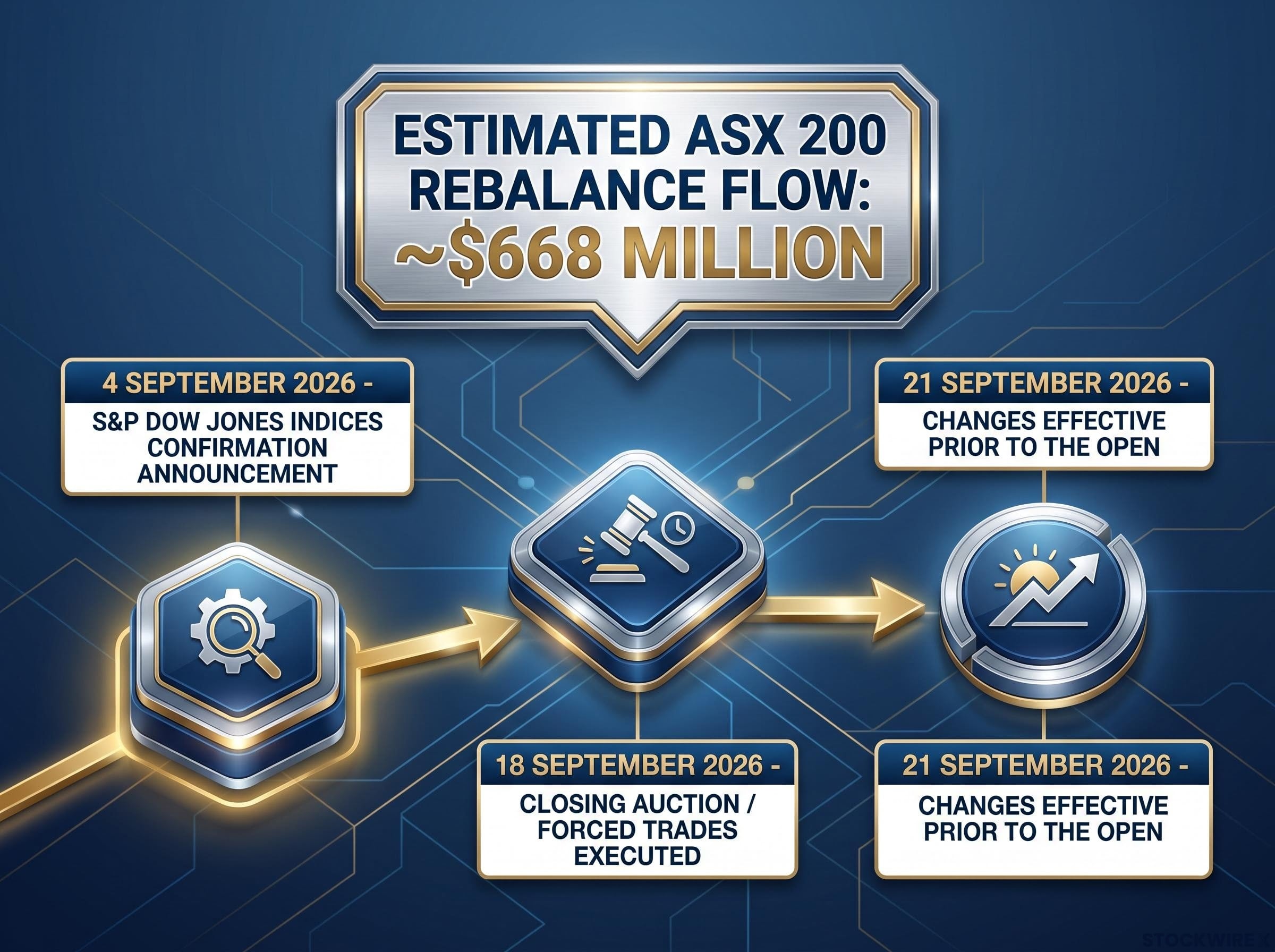
The bulk of that flow lands in a single session on 18 September 2026, even though the effective date is 21 September. On major rebalance days, the closing auction absorbs a disproportionate share of the day’s total liquidity, which is precisely why normal intraday price discovery breaks down in the final minutes.
The dollar figure tells you the scale. The more useful point is that passive funds are price-insensitive by design, and that design is what makes the 18 September auction structurally predictable in its direction even when the exact clearing price for any single stock is not. That predictability is the raw material the arbitrage layer works with.
How arbitrageurs position ahead of the forced flow
Specialist rebalance desks do not wait for the auction. They run a sequential playbook built around the fact that passive demand is coming and its direction is known:
- Predict the likely additions and deletions before the official announcement.
- Accumulate positions quietly in those names.
- Hedge the exposure index-relative to strip out broad market risk.
- Exit into the forced passive flow at the closing auction on the effective date.
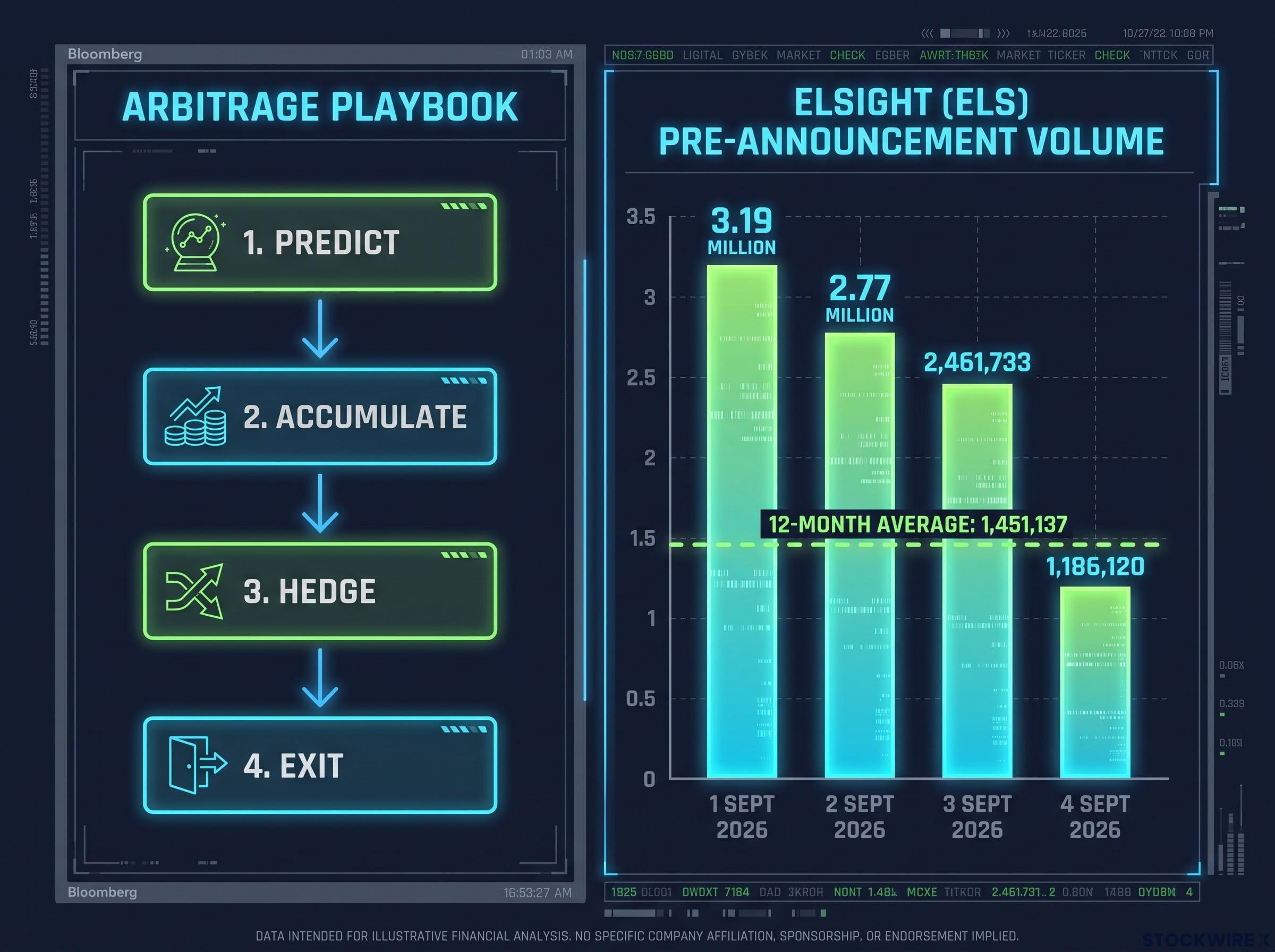
The volume data around Elsight shows this in motion. Against a twelve-month average daily volume of 1,451,137 shares, ELS traded well above that pace in the days bracketing the announcement.
| Date | Shares traded | Closing price |
|---|---|---|
| 1 September 2026 | 3.19 million | $5.16 |
| 2 September 2026 | 2.77 million | $4.71 |
| 3 September 2026 | 2,461,733 | $4.76 |
| 4 September 2026 | 1,186,120 | $4.72 |
| 12-month average | 1,451,137 | Reference |
Weebit Nano shows the same routine liquidity, averaging roughly 1.77 million to 1.91 million shares a day through late August and early September 2026, ample depth for pre-positioning to occur without leaving obvious footprints.
Academic work quantifies the payoff. An SSRN study on S&P/ASX 200 rebalance effects documents cumulative abnormal returns in the front-running window (20 to 6 trading days before the effective date) of roughly +0.51% for additions and +1.70% for deletions.
The AUSIEX analysis of index reconstitution costs references a Dimensional Fund Advisors study documenting pre-inclusion price run-ups and post-event reversals across Australian indices, providing quantified backing for the front-running and mean-reversion patterns this rebalance cycle is again displaying.
The same study finds a negative correlation between an addition’s abnormal return and the length of the announcement-to-effective interval. A longer gap gives pre-positioning more time to absorb the move, which means that by 10 September 2026, with roughly ten trading days between the 4 September announcement and the 18 September execution session, a meaningful portion of the expected price impact may already be embedded.
Some desks also run the trade in reverse, unwinding after the effective-date close to harvest the mean-reversion that produces the documented give-back patterns.
The ELS volume spike, set against its twelve-month average, is the clearest tell here. Sophisticated participants were building positions before most investors had processed the news, which reframes what post-announcement price action actually represents. Elevated volume and rising prices in additions are not necessarily fresh investor enthusiasm; they may be arbitrageurs exiting into momentum rather than entering it, and the easy money in the announcement-day move may already be gone.
Where the risk actually sits for traders watching this event
The forced-flow story reads like an opportunity. The evidence on how these events actually resolve reads more like a warning, and three distinct risks stack on top of one another.
- Closing auction execution risk: Large order imbalances can push the uncrossing price materially above or below the intraday range, and State Street Global Advisors microstructure work notes that closing prices on rebalance days can deviate sharply from levels trading minutes earlier. Submitting at-market orders without sight of the indicative imbalance exposes a trader to significant slippage.
- Post-event mean-reversion: The SSRN study documents that once forced passive buying dissipates, inclusion rallies in additions frequently give back a portion of their gains, with abnormal returns that are significant but highly variable across cycles.
- Liquidity risk for smaller additions: Thin names can see outsized temporary flows that do not persist once index demand fades. ELS, SRL and WBT are all comparatively small by ASX 200 standards.
Post-event mean-reversion is not a theoretical possibility but a documented pattern across index inclusions; in the SpaceX case, shares fell approximately 45% from their peak above $201 to $118 by late July 2026 as mechanical index demand proved structurally insufficient to absorb the selling pressure that followed initial inclusion buying.
The last point is worth hearing directly.
On chasing smaller additions Smaller, less liquid additions can experience outsized temporary flows that may not be durable once index-driven buying fades, leaving meaningful post-event drift risk. TAMIM Asset Management, June 2026 note.
The variability in the SSRN data is the honest answer to anyone who sees the headline dollar figure and assumes a clean directional trade. The move is real, but its size and persistence are not reliably forecastable, and thin liquidity in smaller additions makes the downside asymmetric for anyone who arrives late.
One number to treat with caution
The $668 million estimate deserves a specific footnote. Conte derived it assuming six changes per side, and the confirmed outcome is five per side, so actual ASX 200-specific flow is likely lower than the headline.
As of 10 September 2026, no revised Morgan Stanley figure is publicly available. The point is not to discard the number: it remains the only quantified public estimate and stays directionally useful. But a smaller flow means a smaller price impact, which shrinks both the opportunity and the mechanical support underneath any addition, and a trader should size accordingly.
Each risk compounds the others. A trader who accounts for slippage, reversal, and the Conte caveat can size a position and choose an entry with eyes open; one who fixates only on the forced-flow opportunity is working from an incomplete picture.
What the pattern of this rebalance tells you heading into 18 September
Pull the four threads together as they stand on 10 September 2026, eight days out. The constituent list is fixed, the forced-flow mechanics are known, the arbitrage layer is visibly active, and the risk profile is documented.
Much of it is already in prices. The ELS volume data and the academic evidence on front-running abnormal returns both point to advanced pre-positioning in the most liquid additions, and the SSRN finding that longer announcement-to-effective windows compress subsequent moves reinforces the read. Across a roughly ten trading day gap, the announcement-day opportunity is largely behind the market.
What remains to play for is the auction itself. The close on 18 September 2026 will still concentrate a large volume of mechanical flow, and the actual uncrossing price for each of the five additions and five removals is unknown until the moment it clears, making execution-day price action genuinely unpredictable.
For anyone weighing participation, the honest read is that the crowded, predictable part of the trade has already closed, leaving an execution-day auction where both scale and uncertainty are large.
Three variables are worth watching into the session:
- Indicative imbalance and price data in the pre-auction window on 18 September.
- Post-announcement price action in the additions relative to their average daily volumes, as a gauge of how much move is already embedded.
- Price action in the days after 21 September for signs of the mean-reversion the historical record repeatedly shows.
That framework travels beyond this event. It applies to every ASX 200 rebalance, and it is the difference between reacting to a headline dollar figure and reading the mechanics that produce it.
Index inclusion mechanics follow the same forced-buying logic regardless of geography or index provider: a fixed announcement date, a known effective date, and a passive fund universe that must transact at whatever price the market clears, a dynamic that produced an estimated $7 billion to $27 billion in mandatory buying when SpaceX entered major US benchmarks in June 2026.
This article is for informational purposes only and should not be considered financial advice. Investors should conduct their own research and consult with financial professionals before making investment decisions.
Past performance does not guarantee future results. Financial projections are subject to market conditions and various risk factors.