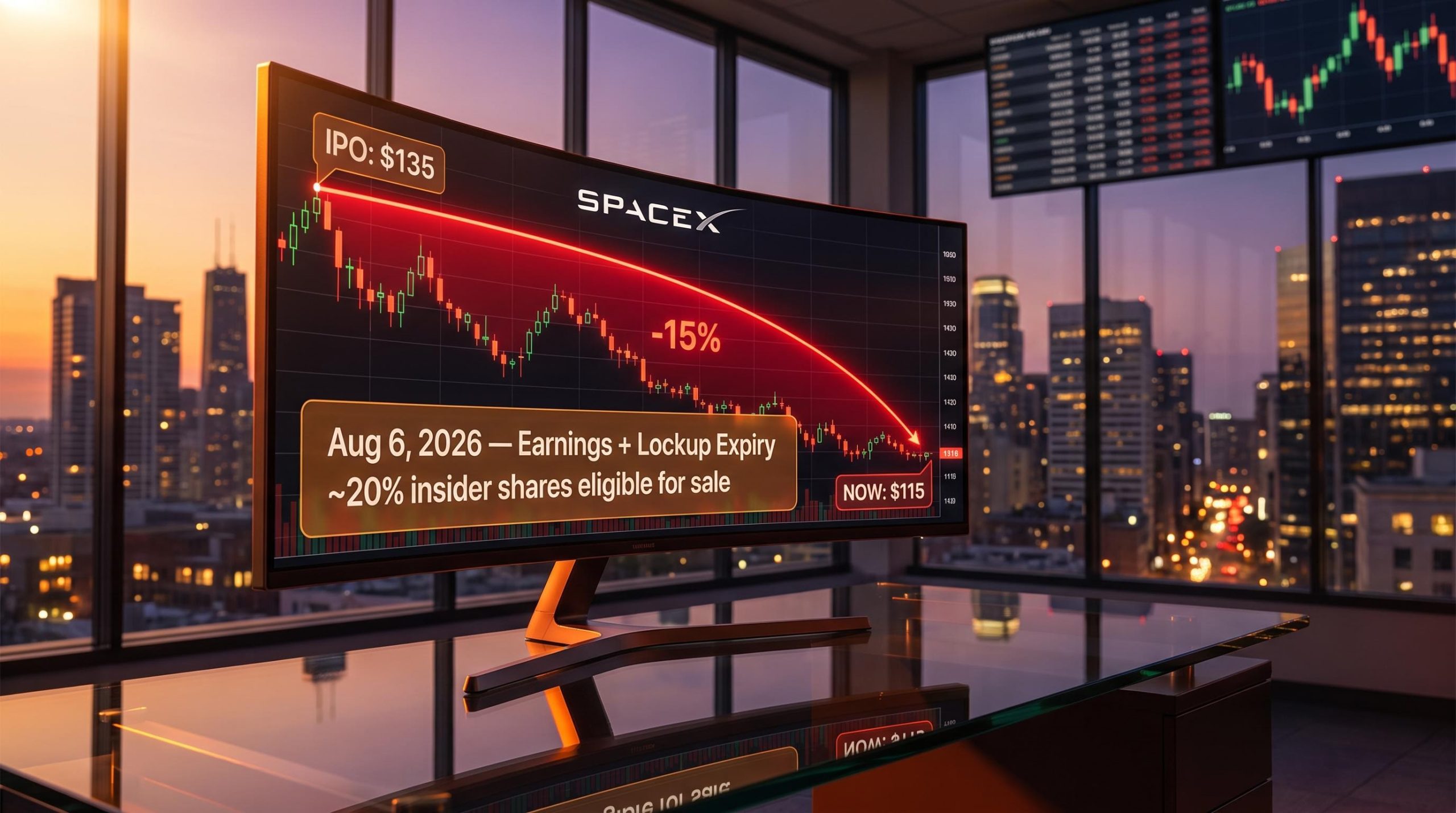
SpaceX went public at $135 per share in mid-June 2026, the largest IPO on record. Six weeks later, the stock is trading near $115. Buyers who got in on IPO day are sitting on losses of roughly 15%.
That decline is not unfolding in a vacuum. The next two weeks bring two events that most investors who bought on day-one excitement were not modelling for: SpaceX’s first-ever earnings release as a public company and the first major insider lockup expiry, both converging in the first week of August 2026. This is not ordinary post-IPO drift. It is a dual pressure point with structural consequences for the share price.
Here is what the mechanics of lockups, earnings catalysts, and IPO price discovery actually mean for how you should think about your position, or your entry timing, right now.
Why SpaceX shares are trading well below the IPO price six weeks in
The trajectory has followed a pattern that should look familiar to anyone who has watched a high-profile listing in its first months. SpaceX priced at $135 in mid-June, briefly surged to levels that placed the company among the world’s most valuable firms, then pulled back sharply. By the week of July 24, 2026, shares were trading near $115, a decline of roughly 15% from the offering price and roughly 20-40% below the early intraday peak, depending on which high you measure from.
Several forces are operating simultaneously:
- Profit-taking from investors who received allocations and sold into the initial pop
- Concerns about debt-funded capital spending, with SpaceX having tapped bond markets for tens of billions of dollars
- Broader tech-sector sensitivity to interest-rate expectations, which tends to hit long-duration growth names hardest
- A valuation reset as institutional analysts begin publishing coverage with more grounded earnings models
No single factor dominates. This is a cluster effect, and it is best understood through the concept of “price discovery,” the structural process where a stock travels from IPO-hype pricing toward a market consensus about what the business is actually worth.
Fisher Investments has noted this dynamic explicitly: IPO excitement does not reliably translate into immediate investment returns, and newly public companies frequently exhibit elevated volatility as initial enthusiasm subsides.
The 15% loss from the IPO price is not evidence of a broken company. It is what happens when a stock has to travel from peak-hype pricing to market-consensus pricing, and that journey is not over.
The structural pattern behind IPO underperformance runs deeper than post-hype normalisation: newly listed companies have trailed comparably sized established peers by an average of 3.3% annually across their first five years, a drag that compounds materially over any horizon longer than the initial momentum window.
When big ASX news breaks, our subscribers know first
How IPO lockup periods work, and why August 6 is the date to watch
When a company lists on public markets, it puts agreements in place that bar insiders, including employees, executives, and early backers, from offloading their shares for a defined period following the offering. These restrictions, called lockup agreements, typically last 90-180 days and exist for a specific reason: to prevent a flood of supply hitting the market in the weeks immediately after the IPO, when the ownership base is still thin and price is most fragile.
The mechanics matter more than the concept. Lockup expiry does not mean every insider will sell. It means the pool of shares that could be sold expands sharply, and the market has to price in that possibility. Even a minority of insiders choosing to reduce exposure can exert meaningful downward pressure.
NYU research on lockup expiry effects documents a 1-3% average stock price decline and a 40% surge in trading volume when lockup periods end, even when the expiry date is fully known to the market in advance, underscoring why the August 6 tranche represents genuine incremental risk rather than a fully priced-in event.
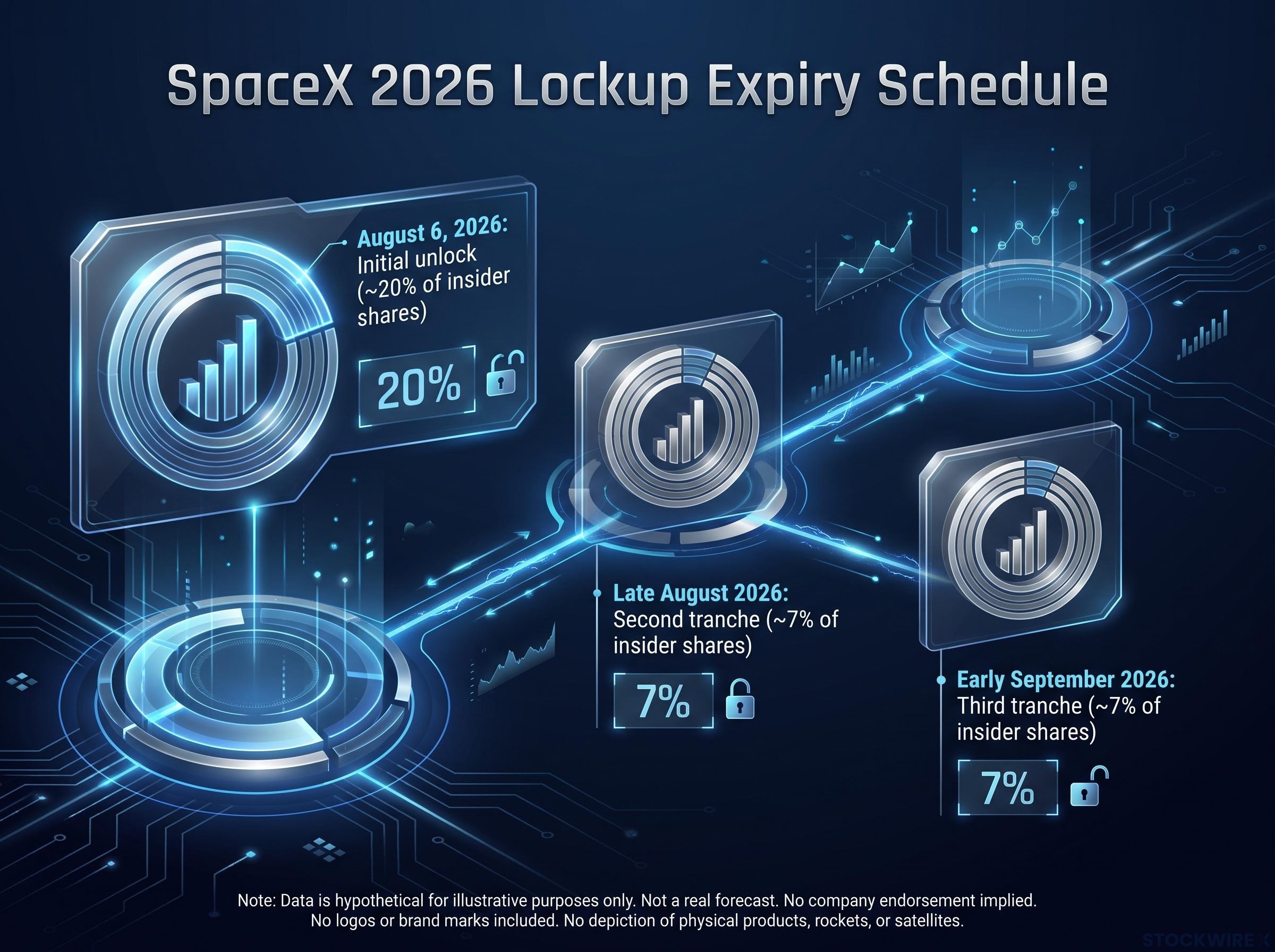
For SpaceX, the structure unfolds in rolling tranches:
- Lockup restrictions are in place at the IPO, preventing insider sales
- The first major tranche expires on August 6, 2026, tied to the first post-IPO earnings release
- Approximately 20% of insider shares become eligible for sale after that date
- Additional tranches of roughly 7% each unlock in late August and early September
- The market absorbs (or fails to absorb) the incremental supply, and price adjusts accordingly
| Tranche | Approximate timing | Estimated share percentage |
|---|---|---|
| Initial unlock | August 6, 2026 | ~20% of insider shares |
| Second tranche | Late August 2026 | ~7% of insider shares |
| Third tranche | Early September 2026 | ~7% of insider shares |
For an investor holding SpaceX shares, August 6 is not a single risk event to survive. It is the opening of a multi-month period of elevated supply pressure. The full effect will not be visible until well into September, and subsequent tranches are expected to continue through late 2026.
The first earnings release lands at the same moment as the lockup, and that timing is not accidental
SpaceX is scheduled to release its first-ever earnings report as a public company during the first week of August 2026, essentially simultaneous with the initial lockup expiry. Until now, public-market investors have had very limited visibility into the actual financials. Most analysis has relied on private-market data points, estimates, and narrative.
This first report is the moment when story-based IPO pricing meets real numbers. Revenue, margins, capital expenditure, and cash flow across distinct business segments, including launch, Starlink, and AI-related infrastructure, will be visible for the first time. If growth and profitability align with the expectations the $135 IPO price implied, that can support the stock. If growth is slower, margins thinner, or spending heavier than hoped, the market may reprice the equity lower.
The convergence creates what amounts to a concentrated risk window: elevated uncertainty from the first detailed financial disclosure, a sudden expansion in sellable share supply, and a still-developing institutional ownership base, all arriving in the same one-to-two week period.
What insiders will be weighing when the lockup lifts
Consider the decision facing an early employee or venture fund whose lockup lifts around earnings. If they sell before the report, they avoid the risk of a bad print but give up the upside if results beat expectations. If they hold through, they accept event risk for potential gain.
The market does not need most insiders to sell for price pressure to build. A meaningful minority acting on the “take some risk off” impulse is sufficient to shift the supply-demand balance, particularly into a market that is already reassessing the stock after a 15% post-IPO decline. The two biggest near-term price risks for SpaceX stockholders are concentrated into the same window, and investors need to size that risk deliberately rather than assume it is already priced in.
Why index inclusion did not rescue the stock, and what that tells you about catalyst-driven investing
Ahead of the IPO, a widely held expectation was that Nasdaq-100 inclusion and thematic ETF buying would provide durable price support. The logic was straightforward: passive funds tracking the index would be forced to buy shares, creating a structural bid underneath the stock.
Those flows likely did occur. SpaceX shares still declined approximately 20% from the point of Nasdaq-100 inclusion through the week of July 24, 2026.
A 20% decline from the time of Nasdaq-100 inclusion through late July, despite forced index buying, is one of the clearest recent illustrations of why a known catalyst often fails to produce the expected price response.
What happened follows a pattern seen across many stocks and many catalysts:
| Stage | What typically happens |
|---|---|
| 1. Anticipation | A positive event (index inclusion, contract win) is widely expected |
| 2. Pre-positioning | Early buyers bid the stock up in advance, pricing in the good news |
| 3. Event arrival | Actual incremental demand from forced buyers is smaller than pre-positioned supply |
| 4. Profit-taking | Early buyers sell into the forced buying, creating selling pressure |
| 5. Post-event sag | The stock drifts lower, disappointing investors who waited for the headline |
The lesson is directly applicable to the August earnings release. If the market is already positioned for a positive first report, even a genuinely good print may not produce the rally investors are expecting, because much of the optimism will already be in the price. By the time a catalyst is splashed across financial media, much of its impact on price is often already spent.
The expectations gap, the market’s tendency to price deviation from roadshow guidance rather than absolute performance numbers, is why a first earnings report showing genuine growth can still produce a disappointing stock reaction if institutional positioning already reflected that optimism.
What the post-IPO pattern means for different investors right now
The analytical picture above describes the mechanics. The question that matters is what you do with it. Three distinct situations call for different frameworks.
If you bought at or near the IPO price
You are sitting on losses of approximately 15% as of July 25, 2026, and the next few weeks combine earnings risk with supply risk. The decision is not “should I sell to avoid pain” but “does the August information change my view of long-term business quality.”
- The first earnings report will reveal whether revenue, margins, and capital intensity support the growth narrative that justified $135
- Selling purely to avoid near-term losses requires accurately predicting both the magnitude of any further decline and the re-entry point, which is difficult to execute consistently
- The more structured question is how much single-stock concentration risk your portfolio can bear while this uncertainty resolves
If you are waiting to initiate a position
From a purely mechanical standpoint, patience has a structural case behind it.
- The market will have meaningfully better financial data after the first (and possibly second) earnings report
- A large increase in float from staggered lockup expirations is still ahead, not behind
- Historical IPO data suggests many new listings offer better entry points months after the offering, once early overhangs and hype have been digested
Patience does not guarantee lower prices. It does provide a clearer fundamental picture and a market price less dominated by technical and sentiment swings.
If your thesis is genuinely long-term
A 5-10 year thesis built on Starlink’s potential as a global broadband platform, SpaceX’s position in launch, and optionality around AI infrastructure may treat August volatility as noise. That is a legitimate framework.
- Long-term conviction should rest on analysis of capital intensity, margin trajectory, and competitive dynamics, not on brand or founder reputation alone
- For a business that is capital-intensive, operates in highly regulated domains, and now carries material debt, the path from “visionary” to “shareholder-friendly” requires ongoing scrutiny
- The August data is relevant even for long-term holders because it provides the first real calibration of whether the business is tracking toward the outcomes the thesis depends on
What the August data will actually tell you about whether SpaceX is worth the price
Most of the discussion so far has been about mechanics: lockups, index flows, positioning, insider incentives. These matter to near-term pricing, but they are separate from the core valuation question.
At $135 per share in the largest IPO on record, the market priced in substantial growth and margin expansion across multiple business lines. The first earnings report will begin to test whether that pricing was broadly justified. Four categories of data deserve the closest attention:
The SpaceX IPO valuation rested on a $4.28 billion net loss against $4.69 billion in Q1 2026 revenue, meaning the first earnings release will test whether the capital intensity embedded in those numbers is a temporary growth-phase feature or a structural condition of the business.
| What to watch | Why it matters |
|---|---|
| Revenue growth by segment | Shows whether launch, Starlink, and newer verticals are scaling at the rate the IPO valuation implied |
| Operating margins | Reveals whether Starlink is approaching profitability and how heavy AI and data-centre capex is weighing on returns |
| Capital expenditure and funding reliance | Indicates whether the business can self-fund growth or remains dependent on bond markets and external capital |
| Contract durability | Government and commercial contract backlogs signal revenue visibility and competitive positioning |
Within Starlink specifically, three sub-metrics will shape the read:
- Subscriber growth trajectory and geographic expansion
- Unit economics (revenue per subscriber versus cost to serve)
- Churn rates, which indicate whether the service retains users after the initial signup period
The first earnings release will not resolve all uncertainty. A single quarter is not sufficient to draw firm conclusions on a business of this complexity and capital intensity. But it will move the conversation from narrative to numbers, and that is the shift that matters.
Until this data is available and digested, any strong claim that SpaceX is definitively cheap or expensive at current levels is speculation rather than evidence-based analysis.
This article is for informational purposes only and should not be considered financial advice. Investors should conduct their own research and consult with financial professionals before making investment decisions. Past performance does not guarantee future results, and forward-looking statements are subject to change based on market developments and company performance.
What changes after August, and what does not
Some of the headwinds pressuring SpaceX shares right now are temporary. The lockup supply overhang will gradually resolve as tranches unlock through late 2026. The first and second earnings reports will give institutions the data they need to build valuation frameworks. The float will expand, reducing the outsized impact of individual trades on price.
What resolves over the next three to six months:
- Initial lockup selling pressure (August 6 first tranche, late August and early September additional tranches)
- The information vacuum around financial performance
- The thin, still-developing institutional ownership base
What requires multiple earnings cycles to assess:
- Whether operating margins justify the IPO valuation as Starlink scales
- The true capital intensity of the business and its reliance on external funding
- Competitive dynamics in both launch and AI infrastructure over a multi-year horizon
Fisher Investments has framed it plainly: patient investors may find more attractive entry points after post-IPO dynamics have run their course.
The business may prove worth the IPO price or more over a multi-year horizon. The near-term mechanics make the weeks surrounding August 6 a structurally difficult window for new buyers. The quality of the first earnings release and guidance, relative to what the market has priced in, is the single most informative data point available right now. Treat it as the first real calibration signal, not a final verdict.
For investors wanting to stress-test the long-term thesis with specific numbers, our deep-dive into the CAGR mathematics behind SpaceX’s valuation models what sustained annual growth rates the current share price actually requires, and how those rates compare to the strongest decade-long growth records in market history.