The SpaceX IPO is shaping up to be the largest public offering in history by dollar value, and most U.S. retail investors will not be able to buy a single share at the offering price. SpaceX confidentially filed for an IPO on 1 April 2026, with Reuters reporting an early June roadshow target and an implied valuation of approximately $1.75 trillion. Retail distribution is expected to be concentrated through one or two brokerages, with accredited investors prioritised.
For those locked out, the IPO hype has largely overshadowed a more accessible opportunity: a group of publicly traded space stocks already available through every major brokerage, several of which have posted one-year gains well into the triple digits. What follows identifies the top-performing exchange-listed space companies available to any U.S. investor today, explains the structural access advantage they hold over the SpaceX IPO, and provides a risk-calibrated framework for evaluating each one before committing capital.
Why most investors will miss the SpaceX IPO at the opening price
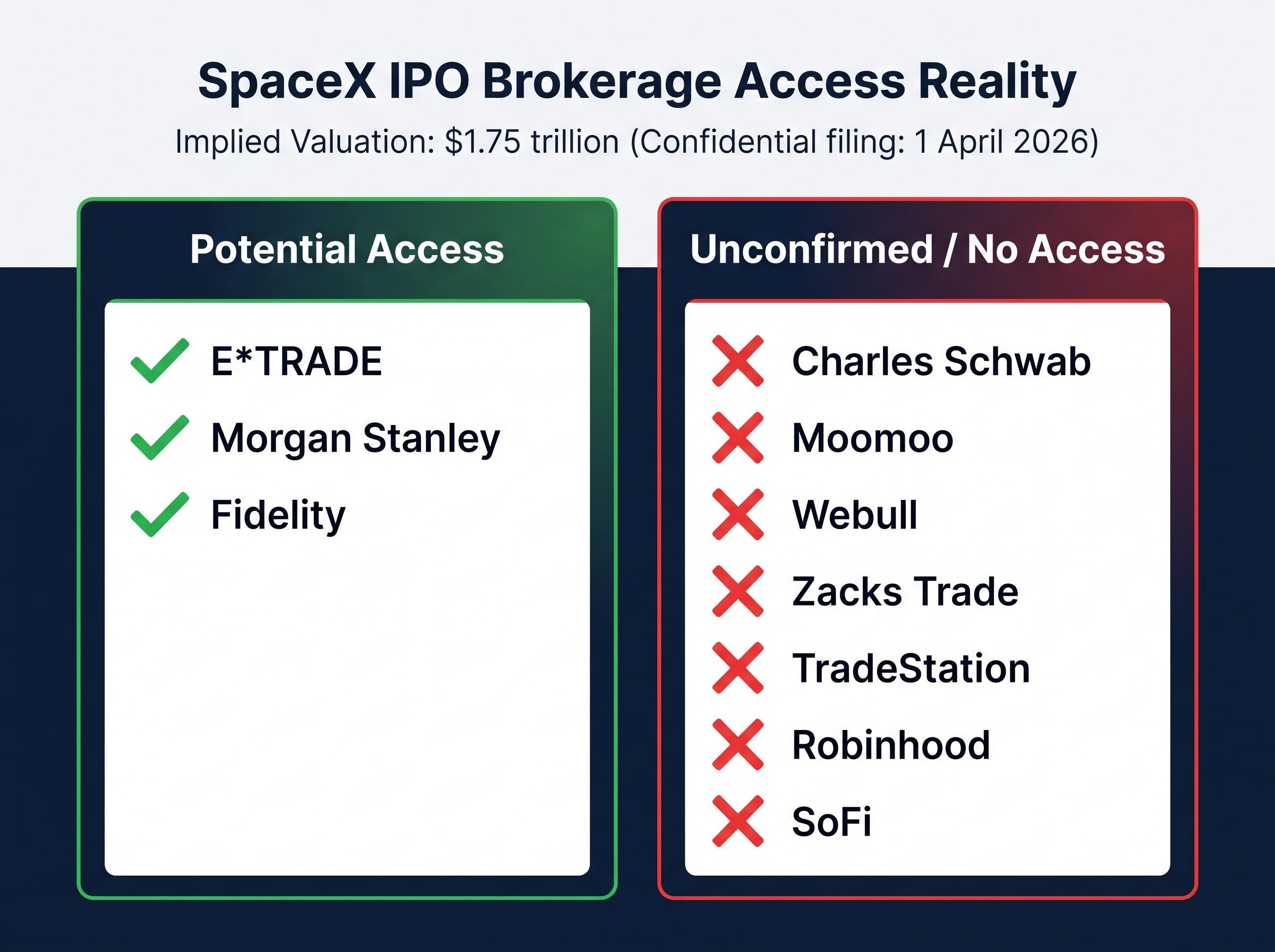
The access problem is not hypothetical. Reuters reporting from 14 April 2026 indicated that SpaceX’s retail IPO distribution would be concentrated through **E\*TRADE (whose parent Morgan Stanley is a lead underwriter) and potentially Fidelity. Reuters further reported that SpaceX was considering excluding Robinhood and SoFi entirely from the allocation, though Elon Musk** publicly disputed this claim. Neither platform has confirmed participation.
Key finding from Reuters (14 April 2026): SpaceX was reportedly considering excluding Robinhood and SoFi from IPO distribution. Musk disputed this publicly, but neither brokerage has confirmed participation as of early May 2026.
For the tens of millions of U.S. retail investors holding accounts at non-participating brokerages, IPO access is a practical non-starter. The following platforms have not been referenced as IPO participants in verified reporting:
- Charles Schwab
- Moomoo
- Webull
- Zacks Trade
- TradeStation
- Robinhood and SoFi (participation unconfirmed)
Even investors who do gain access face structural disadvantages. A 180-day post-IPO lockup is anticipated, preventing early participants from responding to post-listing volatility. IPO pricing typically reflects institutional demand rather than retail fair value, meaning the entry price is set by the buyers with the deepest pockets.
The SpaceX IPO valuation has drawn sharp scrutiny from analysts who put the implied EBITDA multiple at approximately 250x, a figure that prices in decades of future growth with no margin for execution risk, and no S-1 has been publicly filed to let retail investors verify the underlying financials.
Every space stock profiled in this article, by contrast, is freely tradeable today through Fidelity, **E\*TRADE, Charles Schwab, Robinhood, and TD Ameritrade**, with no lockup periods, no accreditation requirements, and no allocation lottery.
When big ASX news breaks, our subscribers know first
The IPO performance trap: what history says about buying at the bell
The structural barriers are only half the story. The historical record for IPO investing is considerably less favourable than the media cycle around high-profile offerings suggests.
Nasdaq analysis (published 15 April 2021): Approximately two-thirds of IPOs from 2010-2020 were trailing broader market benchmarks by their third year of trading.
That statistic deserves attention. A roughly 66% base rate of underperformance means the default outcome for buying an IPO and holding it for three years has been worse than buying an index fund.
IPO underperformance data compiled across the 2010-2020 decade shows that roughly two-thirds of newly listed companies trailed broad market benchmarks within three years of listing, a base rate that applies regardless of how much media attention surrounded the original offering.
The mechanics behind this are straightforward. Media coverage creates a short-term “IPO pop,” a surge in demand that drives the share price above the offering price within hours or days of listing. Retail investors typically access shares in the secondary market after institutional buyers have already driven the price higher, meaning they buy the excitement rather than the value.
For a SpaceX IPO specifically, the compounding risks are:
- Access barriers: Most retail investors cannot buy at the offering price, forcing secondary-market entry at inflated levels
- Lockup period: A 180-day lockup prevents early investors from exiting if the post-listing price declines
- Peak pricing: Retail entry typically occurs at the top of the IPO pop, not at the institutional offering price
Bear-case analyst commentary has flagged that high-multiple space names are vulnerable to 30-50% pullbacks if sector sentiment reverses. The publicly traded alternatives profiled below do not eliminate that risk, but they do eliminate the lockup and access barriers entirely.
Understanding the space sector: what these companies actually do
The eight companies covered in this article span four distinct sub-sectors, and the distinction matters for risk management. A single adverse event, whether a NASA budget cut, a launch failure, or a shift in defence spending, affects each sub-sector differently.
| Company | Ticker | Sub-sector | Primary Revenue Driver |
|---|---|---|---|
| Rocket Lab | RKLB | Launch services | Government and commercial launch contracts |
| AST SpaceMobile | ASTS | Direct-to-device satellite comms | Commercial mobile connectivity (pre-revenue) |
| Globalstar | GSAT | Direct-to-device satellite comms | Satellite SOS features (Amazon-owned) |
| Planet Labs | PL | Earth observation / geospatial intelligence | Commercial and government imaging contracts |
| BlackSky Technology | BKSY | Earth observation / geospatial intelligence | International defence contracts |
| Viasat | VSAT | Satellite broadband / infrastructure | Legacy satellite broadband services |
| EchoStar | SATS | Satellite broadband / infrastructure | Satellite comms and DISH merger synergies |
| Intuitive Machines | LUNR | Satellite broadband / infrastructure | NASA lunar surface contracts |
Companies like LUNR and BKSY are heavily reliant on government clients, while ASTS and RKLB are building commercial pipelines alongside their government contract books. That distinction shapes how each stock responds to different catalysts. Owning both a launch company and an Earth observation name provides more meaningful diversification than holding two stocks in the same sub-sector.
The ETF alternative for diversified space exposure
For investors who prefer a single-ticker approach, the ARK Space Exploration & Innovation ETF (ARKX) provides basket exposure to the sector. As of May 2026, ARKX has delivered approximately 32% YTD gains with an expense ratio of 0.75%. Its top holdings include RKLB and LUNR, which creates overlap for investors who also hold those individual names. The ETF serves as a useful baseline allocation before layering in higher-conviction single-stock positions.
The top-performing publicly traded space stocks available today
| Company | Ticker | Share Price (May 2026) | YTD Performance | Key Catalyst |
|---|---|---|---|---|
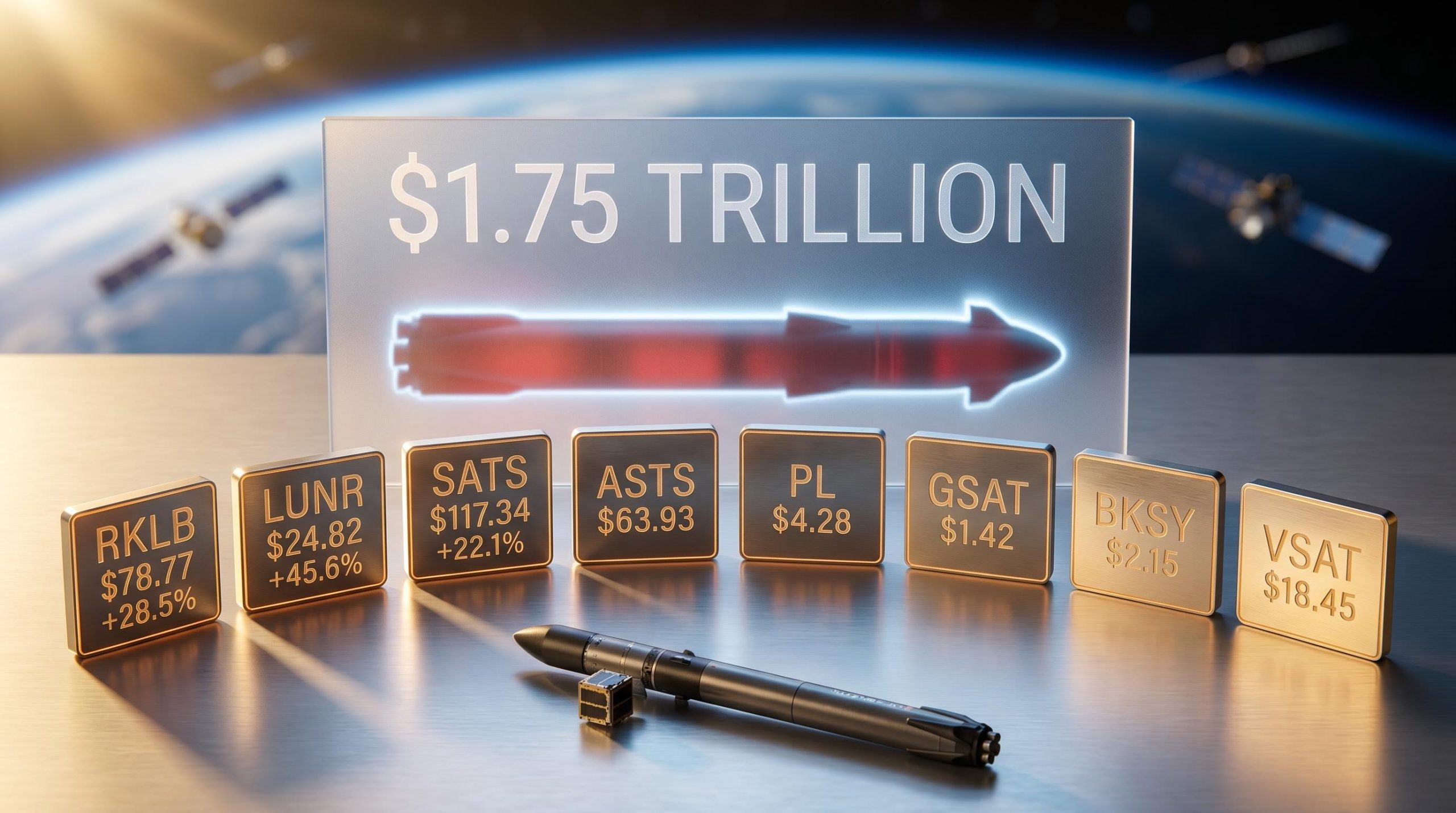
| Rocket Lab | RKLB | $78.77 | +28.5% | $200M USAF contract; Neutron rocket (late 2026) |
| AST SpaceMobile | ASTS | $63.93 | -12.06% | BlueBird Block 1 launch (Q3 2026) |
| EchoStar | SATS | $117.34 | +22.1% | DISH merger synergies; EBITDA growth |
| Intuitive Machines | LUNR | $24.82 | +45.6% | $180.4M NASA CLPS contract |
| Planet Labs | PL | $4.28 | +15.2% | FY2026 Q4 revenue $86.8M |
| Globalstar | GSAT | $1.42 | +12.4% | $11.6B Amazon acquisition (April 2026) |
| BlackSky Technology | BKSY | $2.15 | +18.7% | ~$55M in international defence contracts |
| Viasat | VSAT | $18.45 | -8.4% | Legacy business restructuring |
Data integrity note: Several trailing-twelve-month (TTM) performance figures circulating in media coverage, including claims as high as +1,062% for BKSY, could not be independently verified. Investors should confirm all performance data via Yahoo Finance or MarketWatch before making allocation decisions.
Rocket Lab (RKLB): the launch infrastructure play
Rocket Lab trades at $78.77 with a market cap of approximately $45-46 billion, making it the largest pure-play space company on public markets. YTD gains of +28.5% have been driven by a $200 million USAF contract win in May 2026, which partially offset near-term sentiment pressure from the Neutron rocket delay (pushed to late 2026 following a propellant tank failure announced 27 February 2026).
The stock trades at approximately 15x estimated 2027 sales. Successful Neutron execution would open a materially larger addressable market in medium-lift launch, a segment currently dominated by SpaceX’s Falcon 9. That re-rating opportunity is the bull case; the Neutron delay timeline is the bear case.
AST SpaceMobile (ASTS): the direct-to-smartphone bet
AST SpaceMobile is building a satellite network that connects directly to standard smartphones without specialised hardware. The stock sits at $63.93 with a $12.4 billion market cap, down -12.06% YTD but up +152.25% over the trailing twelve months (verified via live data).
That divergence between YTD loss and TTM gain illustrates the volatility profile. The binary event for the thesis is the BlueBird Block 1 satellite launch, targeted for Q3 2026. A successful deployment could validate the commercial model; a delay or failure would pressure a stock already trading at approximately 20x EV/Revenue.
EchoStar (SATS): the satellite infrastructure consolidator
EchoStar trades at $117.34 with a $5.05 billion market cap, up +22.1% YTD. Q1 2026 earnings showed strong DISH merger synergies with reported EBITDA growth. Post-merger integration remains the primary risk, alongside regulatory scrutiny on the combined entity.
The remaining five names in brief:
- LUNR (Intuitive Machines): Trading at $24.82 with a $3.53 billion market cap, up +45.6% YTD. NASA awarded a $180.4 million CLPS contract on 24 March 2026 for lunar surface operations (not the frequently misquoted $4.8 billion figure). Revenue base remains nascent, and the stock’s near-term trajectory is tied to mission execution. Analyst consensus price targets range from $22-$29.
- PL (Planet Labs): Share price $4.28, market cap $1.28 billion, up +15.2% YTD. FY2026 Q4 revenue of $86.8 million (reported March 2026) showed continued growth, but the profitability timeline remains uncertain at approximately 4x forward sales.
- GSAT (Globalstar): Trading at $1.42 with a $2.78 billion market cap. Amazon completed its acquisition of Globalstar for approximately $11.6 billion in April 2026. The primary risk is transition: strategic direction shifts under new ownership.
- BKSY (BlackSky Technology): Share price $2.15, market cap $342 million. Two international defence contracts totalling approximately $55 million were announced in April 2026. The sub-$1 billion market cap introduces additional volatility and liquidity risk that larger names do not carry.
- VSAT (Viasat): Trading at $18.45, market cap $2.41 billion, down -8.4% YTD. The legacy satellite business faces structural pressure, and debt from prior acquisitions remains the primary bear case.
How to size a space stock position: a risk-calibrated framework
Identifying the right names is only half the decision. Position sizing is where most retail investors lose money in high-growth sectors: over-concentration at the peak of enthusiasm, followed by forced selling during the inevitable drawdown.
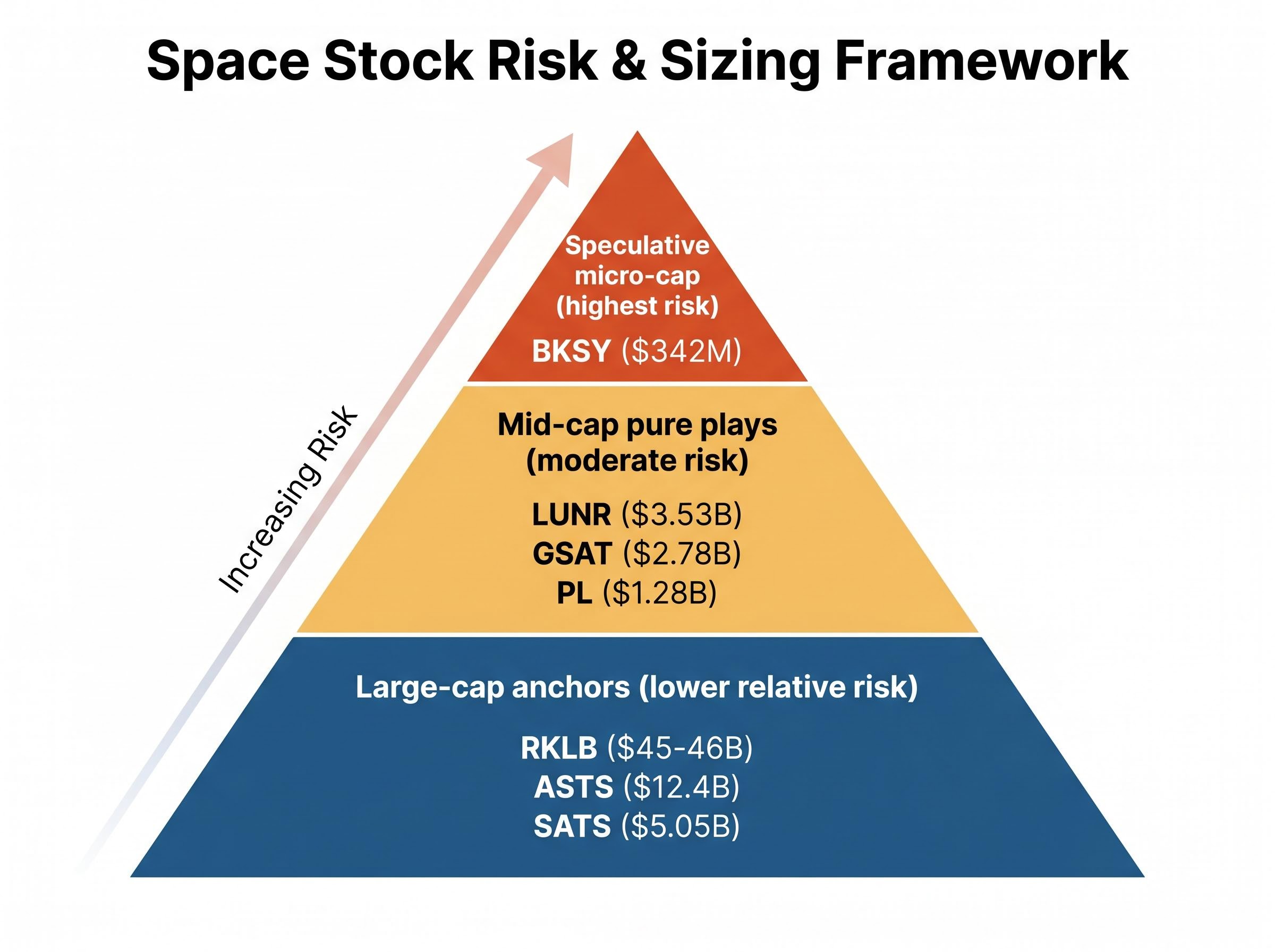
The eight stocks profiled above fall into three distinct risk tiers:
- Large-cap anchors (lower relative risk): RKLB ($45-46B), ASTS ($12.4B), SATS ($5.05B), with diversified revenue streams or government contract backing
- Mid-cap pure plays (moderate risk): LUNR ($3.53B), GSAT ($2.78B), PL ($1.28B), with narrower revenue bases and single-mission or single-client dependency
- Speculative micro-cap (highest risk): BKSY ($342M), where sub-$1B market cap amplifies volatility and limits institutional ownership
Bear-case analyst commentary has flagged that high-multiple names in this sector are historically vulnerable to 30-50% drawdowns during broader market risk-off episodes. Some analysts have also floated a scenario where a post-SpaceX IPO reallocation could temporarily pressure RKLB and LUNR as institutional capital rotates toward SpaceX shares.
SPAC-listed space companies that reached public markets between 2020 and 2022 provide the clearest historical precedent for what happens when space sector valuations are built on narrative rather than revenue: Virgin Galactic fell more than 99% from its peak, and several peers followed a similar trajectory, making the current generation of exchange-listed names look considerably more grounded by comparison.
A practical four-step approach to sizing:
- Determine total portfolio allocation to the space sector (a percentage of total investable assets, not a dollar figure chosen by excitement)
- Set a baseline position via ARKX or RKLB as the sector anchor
- Layer in higher-risk names at proportionally smaller sizes, scaling down as market cap decreases
- Set pre-defined drawdown thresholds for each position before buying, not after the decline begins
SpaceX may still be worth watching, but the opportunity is already in your brokerage account
The SpaceX IPO will generate extraordinary media attention through June 2026 and beyond. For investors who secure access at the offering price and can tolerate a 180-day lockup, SpaceX may prove to be a compelling long-term holding, though that is a 2027-and-beyond consideration once shares trade freely.
For the majority of U.S. retail investors, the access barriers, lockup structure, and historical IPO underperformance data create a strong case for prioritising the publicly traded alternatives available today. Eight exchange-listed space companies are accessible through every major brokerage, with no allocation lottery, no accreditation requirements, and no mandatory holding periods.
The space sector’s strongest publicly accessible returns may already be visible in any standard brokerage account, no IPO invite required.
The logical next step is reviewing the ARKX ETF as a low-friction entry point, or independently confirming the stock data via Yahoo Finance or MarketWatch before acting on any individual name.
This article is for informational purposes only and should not be considered financial advice. Investors should conduct their own research and consult with financial professionals before making investment decisions. Past performance does not guarantee future results. Financial projections are subject to market conditions and various risk factors.